
Walking Perdido Key
Sand, Terrain, Wildlife & Routes
A walker’s honest account of what your feet actually find on a 17-mile barrier island, from the soft workout of the upper beach to the firm packed waterline of one of Florida’s most undisturbed shorelines.
This beach is where it all started. My daughter and I walked across the Alabama border onto Perdido Key at the beginning of Covid, neither of us knowing what was coming, just knowing we needed to be outside, moving, together. That was the day I decided I was going to walk a mile on every beach in Florida. She started the journey with me, right here at the western edge of the state.
I’ve been back since. The island holds up. It still has that quality that’s hard to explain until you’ve felt it underfoot. The quiet that settles into you the further east you go, the way the condos and beach chairs and noise drop away until it’s just you and the Gulf and miles of white sand backed by dunes doing exactly what dunes are supposed to do. This is the beach that started everything for me. That matters.
The vibe here is not the polished resort version of Florida beach. It’s local. It’s a little wild. The Flora-Bama anchors the west end with live music and cold drinks and that legendary bar-that-refused-to-die energy. Walk east past the State Park gate and the whole character of the island shifts. By the time you reach Johnson Beach you’re in Gulf Islands National Seashore territory. Federally protected, undeveloped, genuinely beautiful in that unselfconscious way that protected land always is.
This is my walking guide to Perdido Key. The sand conditions, the routes I’ve walked, what I saw, what surprised me, and everything you need to plan a walk worth the drive.
The Sand & Terrain: What Your Feet Will Find
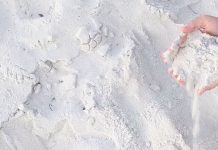
Understanding the sand underfoot is the difference between a walk that exhausts you and one that flows. Perdido Key gives you three distinct walking surfaces within about 30 feet of each other and knowing which zone you’re in changes everything about the experience.
Sand Hardness & Resistance
Slope & Camber
Surface Changes Along the Route
Sand & Terrain Ratings
Footwear Recommendation
Barefoot: Yes, from October through May at the waterline. The quartz grain is fine and shell content low enough that the main beach areas are comfortable barefoot. The cool sand temperature is a genuine luxury, you can walk barefoot at noon in September here in a way you simply can’t on shell-heavier beaches.
Summer mid-day: The dry upper beach heats up by 10am in July and August. Sandals or water shoes for the crossing from boardwalk to waterline. Once at the wet zone, barefoot is fine all day.
Wilderness section (east of turnaround): Water shoes or lightweight trail runners recommended. Shell hash, seaweed deposits, and variable terrain ask more of your feet after mile 2.
Long-distance fitness walkers: Minimalist beach shoes or trail runners. The waterline packing is excellent but 4+ miles on any sand surface asks something of your ankles and stabilizers.
Dogs & Pet Accessibility
Where Dogs Are Allowed
- ✓County Access 4 on the Sound (bay) side, the designated dog-friendly beach on Perdido Key. Calm water, leashed dogs welcome on sand and in the water.
- ✓The North Trail at Perdido Key State Park permits leashed dogs, though the Gulf beach side does not.
- ✓Big Lagoon State Park on the nearby mainland, excellent leashed-dog option with calm bay access and trail walking.
Where Dogs Are NOT Allowed
- ✗Gulf-side beach at Perdido Key State Park, no dogs permitted.
- ✗Johnson Beach / Gulf Islands National Seashore, no dogs on the Gulf beach. Active nesting habitat for shorebirds, sea turtles, and the endangered beach mouse.
Paws on the Ground Reality
County Access 4 on the Sound side is genuinely pleasant for dogs. The water is calm and shallow, ideal for dogs who love to wade without dealing with surf. Sand temperature on the Sound side is cooler because it doesn’t receive the same direct midday sun exposure as the open Gulf face. Crowds are consistently lighter. The walking is flat and easy on paws. Bring your own fresh water, there are no freshwater sources at Access 4. Early morning or late afternoon walks keep paws and people comfortable in any season.
Recommended Walking Routes
Perdido Key walks range from a flat, easy 20-minute stroll to a full-day expedition into Florida wilderness. Here are four routes matched to different goals and fitness levels, all starting from Johnson Beach Road.
⏱ 30–50 min
💚 Easy
Start: West Access parking lot at Perdido Key State Park (15301 Perdido Key Dr). Pay the $3 fee, follow the boardwalk over the dunes to the Gulf. Turn east and walk toward the East Access parking area.
This is the essential Perdido Key introduction. The dune backdrop is intact and sea oat-covered. The sand is consistently wide, clean, and quartz-white with low foot traffic. At low tide the firm zone is broad enough to walk four people side by side. By the time you reach the midpoint heading east, the beach typically opens up entirely.
⏱ 1–1.5 hrs
🔵 Easy–Moderate
Start: Main Johnson Beach pavilion parking area. Walk east along the Gulf beach from the pavilion, then return and pick up the Perdido Key Discovery Trail boardwalk.
This is my favorite route for combining terrain types. The Johnson Beach shoreline is wide and backed by undisturbed dunes, no resort towers in view. The Discovery Trail is a 0.6-mile accessible boardwalk loop crossing dune habitat, coastal scrub, and wetland edges bordering Big Lagoon. The scrub habitat along the boardwalk is where the Perdido Key beach mouse lives, keep eyes on the dune faces at dawn or dusk.
⏱ 1.5–2.5 hrs
🟠 Moderate
Start: Main Johnson Beach pavilion. Walk east along the Gulf beach all the way to the road’s end turnaround cul-de-sac, approximately 1.5 miles. Return along the beach or walk the roadside path back.
The full fitness walk, covers every terrain type Johnson Beach offers. The first mile from the pavilion is wide, clean, and well-packed at low tide. By the turnaround you’re at the edge of true wilderness. The roadside path return gives you the dune interior and scrub edge, where osprey nest platforms and black skimmers use the corridor that beach-face walkers never see.
⏱ Half day to full day
🟣 Challenging
Start: Cul-de-sac at the end of Johnson Beach Road, park in a designated lot further back and walk to the start. Past the road’s end, the barrier island continues 5.5 miles southeast accessible only on foot or by boat.
This is the version of Perdido Key most visitors never see. The beach narrows, dune systems rise higher, shell content increases, and wildlife density is exceptional. The Perdido Key beach mouse lives in the dune ridges out here. The loggerheads nest on this stretch undisturbed. At the far end, the island tapers to a narrow spit and Pensacola Pass opens to the east with Fort Pickens visible across the water.
The Walk Experience: What You’ll See
Walking Perdido Key in the fall is one of those experiences that reminds you why you started doing this in the first place.
Birds I Saw and What You Might See
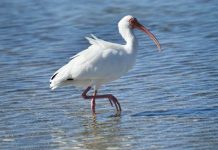
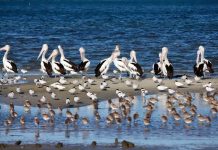
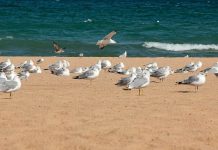
The bird life here is active and visible in a way that rewards even casual walkers. On my fall walks I had consistent company from laughing gulls working the wrack line, sanderlings sprinting the waterline in their characteristic stop-start way, and a few great blue herons standing in the shallows with that patient, prehistoric stillness they have. The herons here don’t spook easily, if you walk slowly and give them space, you can get close enough to really see them.
What surprised me most was a monarch butterfly resting directly on the sand near the dune toe, wings open flat, completely still. I’ve walked hundreds of beaches and never seen that. It turned out to be a fall migration day, and monarchs use the Gulf Coast as a corridor. Keep your eyes open for things that have no business being on a beach. That’s part of what makes walking more interesting than just walking.
Perdido Key is on the Great Florida Birding Trail for good reason, over 300 species have been recorded on this island. Year-round you can expect brown pelicans, willets, royal terns, osprey, and American oystercatchers. Spring and summer bring least terns, snowy plovers, Wilson’s plovers, and black skimmers, all of which nest on the upper beach, so give the dune zone a wide berth. Fall migration pushes dunlin, ruddy turnstones, red knots, and painted buntings through the scrub. Winter brings piping plovers to the upper beach, common loons offshore, and northern gannets diving dramatically beyond the surf zone. Bring binoculars. You will use them.
Sea Turtles & Wildlife
Four sea turtle species nest on Perdido Key, loggerhead, green, Kemp’s ridley, and occasionally hawksbill, with loggerheads being by far the most common. Nesting runs from late March through August, with hatchling emergence peaking in late summer through early fall. Nest markers on the upper beach are real protections, not decorations. Stay seaward of them. If you’re walking at night during nesting season, no lights on the upper beach, and if a turtle is emerging, freeze and give her a wide berth. She may abort the nest if she senses a threat.
The endangered Perdido Key beach mouse lives in the dune system east of the Johnson Beach turnaround. You won’t see one unless you’re out at dusk or dawn, it’s nocturnal and nearly invisible against the white sand. But in the early morning you may find its delicate tracks pressed near the dune toe. Bottlenose dolphins work the offshore waters year-round, most visible from the beach in calm early mornings. In late summer and fall, schools of cownose rays move through the surf zone, if you see people stopping at the waterline and pointing, it’s almost certainly rays.
Shelling, What to Look For
Shelling on Perdido Key is honest work, light in the main beach areas, more rewarding after storms and as you move east. It won’t compete with Sanibel or Captiva, but there’s a consistent cast of species along the wrack line that make for good walking and good squatting. And here’s a tip I give every beach walker: working the shell line means you’re constantly stopping, bending, and squatting to pick things up, which turns a flat beach walk into a full lower-body workout. Your legs will know you went shelling.
Most commonly found here. Fan-shaped with mottled brown and white coloring. Usually in fragments but occasionally whole after a good storm.
Ribbed, heart-shaped bivalves in cream to tan. Common along the wrack line, often still paired.
Tiny wedge-shaped bivalves in a rainbow of colors, found in clusters in the wet sand zone. Watch them burrow back into the sand as the wave recedes.
Florida’s state shell, left-handed spiral. Rare here but possible after a big storm pushes material in from offshore beds.
Round, smooth, tan to gray. Look for the neat round hole they drill in other shells.
Most common in fragments. Whole ones appear after calm periods on the east end at low tide.
Scenery & What Changes as You Walk
Walking east from the State Park, the sequence goes like this: sea oat dunes, boardwalk access points, a brief gap through the county condo corridor (unavoidable but short), then the Gulf Islands National Seashore gate, and then the beach opens into Johnson Beach’s wide, uninterrupted corridor. The pavilion and picnic area anchor the west end. Past the third parking lot, the road turnaround marks the end of vehicle access. Beyond it, the dune line rises, development disappears from view, and you’re walking a barrier island that looks the way barrier islands are supposed to look.
The light on this beach in fall is extraordinary. The lower sun angle catches the white quartz at a rake that makes the sand almost luminous. Early morning is the best photography window, the water shifts from gray-blue to turquoise to emerald as the sun climbs. The Discovery Trail boardwalk creates strong compositional lines through the coastal scrub at any time of day. If you have a camera, bring it. If you don’t, your phone will do fine, this beach photographs well because the elements are simple and strong.
Solitude vs. Crowds on Foot
In the fall, this beach is nearly empty. I walked the full Johnson Beach corridor on a Tuesday in October and passed fewer than a dozen people in three miles. That kind of solitude on a Florida Gulf beach is genuinely rare and worth planning around. The State Park is slightly busier even in shoulder season, but by the time you reach the second Johnson Beach parking lot heading east, the crowd density drops to almost nothing. Past the turnaround, on most days, you will be alone.
Summer weekends are a different story. Johnson Beach fills by mid-morning and the State Park by 10am. If you’re visiting in summer, walk before 8:30am or accept that you’ll share the shore. The good news: even on busy days, the beach is wide enough that it never feels truly crowded the way Clearwater or Destin does. There’s always room to find your own stretch of waterline.
Before You Go
Best Starting Points for Walkers
For the best walking experience, skip the main pavilion lot and head to Johnson Beach Lot 2 or 3 further east along Johnson Beach Road. You’ll find lighter crowds, immediate access to undeveloped shoreline in both directions, and you’re within easy range of the turnaround heading east. For a shorter walk in a completely park-protected environment, the State Park West Access is your best entry point, better dune backdrop than any county access and noticeably less foot traffic on the beach.
Best Times to Walk
First light to 9am is the gold window on any day, best photography light, lowest crowds, coolest sand, most wildlife activity. Second-best is 5pm onward as heat drops and late light comes in golden from the west. For tide timing: walk out within two hours of low tide. The beach firms up and widens significantly as water retreats, you’ll have noticeably better footing for the full length of your route. October is the ideal month overall: summer crowds gone, water still 78–80°F, fall migration birds moving through, the light at its most beautiful.
Recommended Essentials
These are the things I personally bring every time I walk this island, not a generic packing list, but what I’ve learned actually matters here. Click any item for my specific recommendations.
Reef-safe sunscreen
Tide chart app
Binoculars
eBird app
Water shoes
Mesh bag for shelling
Sun hat
Red flashlight (turtle season)
Credit card (both parks are cash-free)
What Makes This Walk Unique
On virtually every other developed Florida beach, there’s an endpoint, a parking lot, a pier, a resort, a jetty. The walk has a frame. On Perdido Key, past the end of Johnson Beach Road, the frame disappears. The island keeps going and the only thing stopping you is your water supply and your watch.
There’s a specific moment, about a quarter mile past the turnaround cul-de-sac, when you look back west and the last visible structure drops below the dune line. The beach ahead is white and empty and continuous. The Gulf runs to your right and Big Lagoon Sound shows to your left across the narrow island interior. You are, for all practical purposes, on an uninhabited barrier island on the Gulf of Mexico and this is still Florida, still about 17 miles from downtown Pensacola. That transition from trailhead parking lot to genuine wilderness in under half a mile is what makes a walk on Perdido Key different from any other walk in this series.
Thoughts & Reflections
The first time I walked this beach was with my daughter, at the start of Covid. We drove to the Alabama border and just started walking east into Florida. No plan, no agenda, the world was shutting down and the beach was open and we needed to move. That walk became the start of my mission to walk a mile on every beach in Florida. I didn’t know it yet. I just knew that the sand felt right and the island kept going and I didn’t want to stop.
Coming back alone in October, I started at Johnson Beach Lot 2 at 6:50am, still dark enough that the water and the sky were the same gray-blue. By the time the sun cleared the horizon I was half a mile east of the pavilion and the beach was mine in a different way than it was that first time, not shared with someone I love, but fully mine. There’s something about returning to a place that changed you. The sand underfoot was firm at the waterline, cool even at that hour. I found myself walking faster than I intended just because the ground invited it. I stopped twice to pick up cockle shells, did a proper squat each time, kept moving. You come here because the beach keeps going when every other beach would have turned into a parking lot.
The butterfly stopped me completely. I was walking the dune toe east of the second parking lot when a monarch landed on the sand about six feet in front of me, wings spread flat, completely still. I stood there for probably two minutes. It eventually lifted, caught the onshore breeze, and disappeared south. I looked it up later: fall monarch migration uses the Gulf Coast as a corridor. It was passing through on the same route its ancestors have used for thousands of years, and it chose to rest on a Perdido Key beach for a moment.
✦ Read my full reflection on the monarch butterfly and what it said to me about midlife, migration, and finding your own route, in The Monarch on the Sand.
“My daughter and I crossed into Florida on foot at the start of Covid, not knowing it would become the first step of a thousand-mile mission. I was a single mom, an entrepreneur, a woman who had spent years making sure everyone else had what they needed. That day on Perdido Key, walking east with nowhere we had to be, that was the first time in a long time I remembered I was also just a person. The island keeps going long after most people turn back. Turns out, so do I.”

