


My earliest memory of the ocean might not even be the ocean. It’s my mother’s arms. I was small enough to be picked straight up off my feet, and she scooped me out of the surf because there was a Portuguese man o’ war drifting in on the same wave I was standing in. I don’t remember being scared. I remember being airborne, and I remember the blue balloon-shaped thing bobbing past below me like it owned the place. It kind of did.
I grew up in Miami and lived all over this state since, and I have walked or waded into just about every beach Florida has, plenty of them more than once. This isn’t a research trip or a bucket list item for me. It’s the water I grew up in. So instead of writing this one as a guide, I’m writing it as what it actually is: every thing in Florida’s water that I’ve swam with, boated past, gotten scooped away from, or spent a summer afternoon crouched in the sand watching.
Birds on the Coast: Learning to Actually See Them
I always loved the birds on the beach without ever really seeing them. Gulls, pelicans, whatever was standing at the waterline, all of it registered as one general category of “birds” until my partner started pointing out the things actual birders notice, and once you know to look for it, you can’t stop. The color of the legs. The shape and length of the bill. The way one bird runs the swash line in short frantic bursts while another wades through the shallows in slow motion. A stretch of sand that used to read as one blur of birds turns out to be six or seven completely different species, each one built and behaving in its own specific way.
That’s the whole foundation the Seaside Birding series is built on, habitat by habitat, species by species, the details that turn “some birds on the beach” into an actual identification. The full series is over at walkinthesand.com/birding.
Sea Turtles: The Ones With Their Own Story
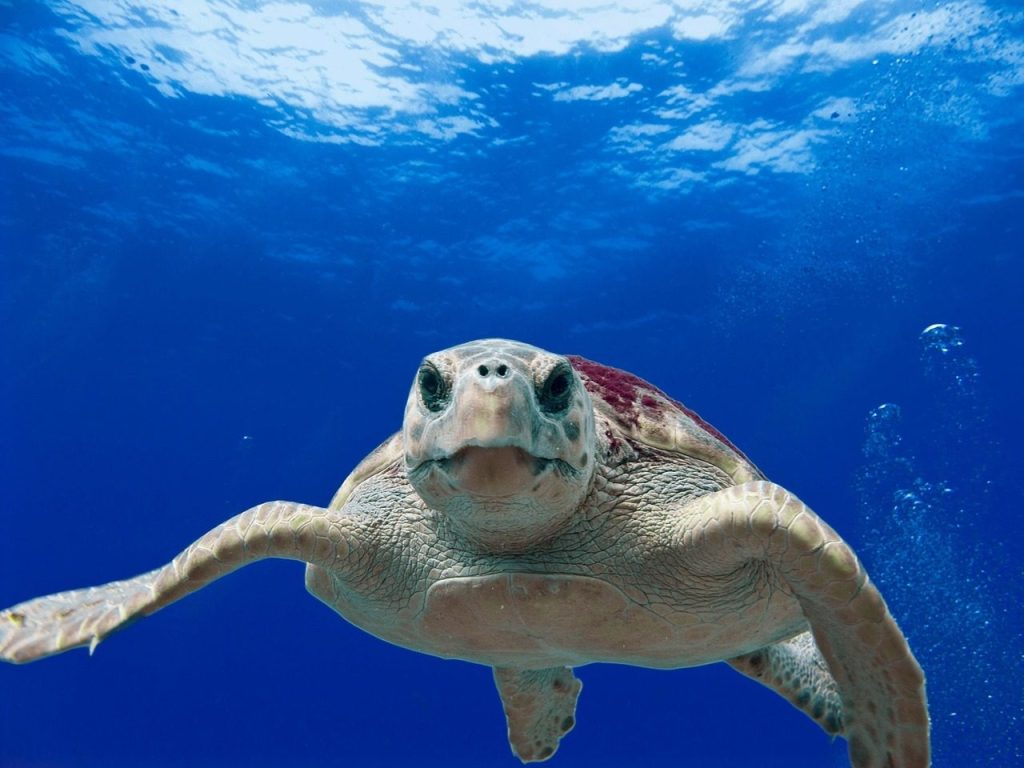
Sea turtles nesting season runs May through October, and if you’ve ever walked a Florida beach at sunrise during those months, you already know the drill without needing it explained, stretches of taped-off sand, a wooden stake with a laminated tag, sometimes a scatter of tiny flipper tracks leading straight back to the surf like a getaway that actually worked. Loggerheads do most of the nesting here, Florida holds one of the largest loggerhead nesting populations anywhere in the world, with green turtles and the occasional leatherback showing up too.
I’ve walked past more marked nests than I could ever count, at every stage of that quiet countdown, but I’ve never once timed a trip around an actual hatching. If you find a nest or a disoriented hatchling yourself, the ask is simple: leave it alone, keep lights off the beach at night since artificial light disorients hatchlings away from the water, and call it in rather than intervening. Sea Turtle Conservancy and the FWC sea turtle program both have more on nesting season and what to do if you come across one.
Dolphins: The One I’ve Always Known
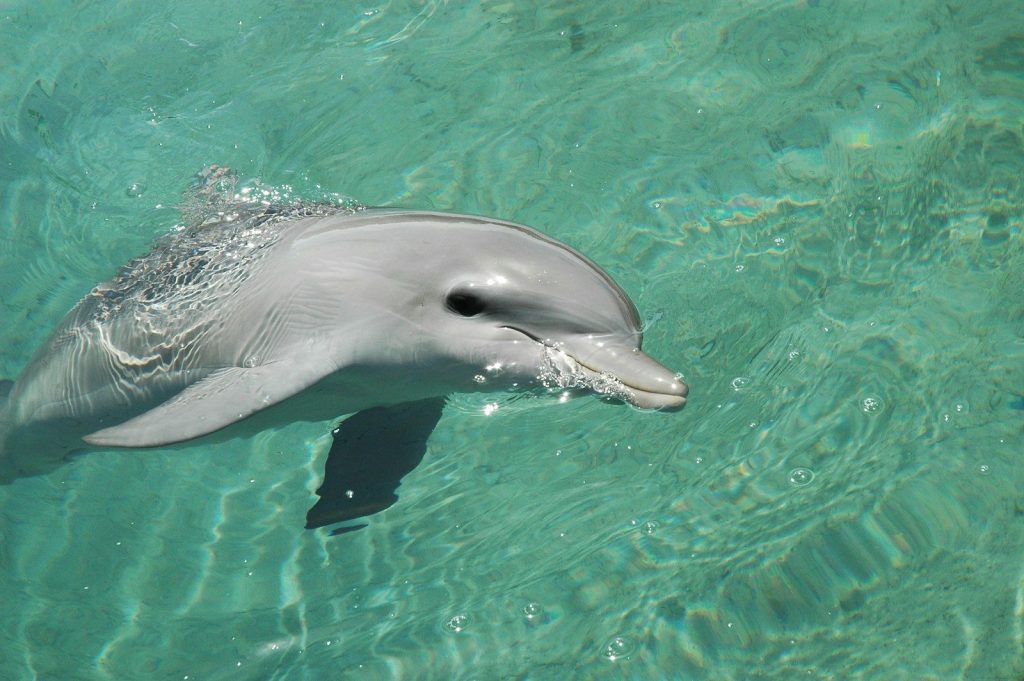
Dolphins are the animal I associate with Florida water more than any other, because they’re the one I’ve seen the longest. I don’t have a first dolphin memory the way I have a first man o’ war memory, because there wasn’t a first time. They were just always there, cutting along beside the boat, showing up while we snorkeled like they were as curious about us as we were about them. That casual, matter-of-fact familiarity is very much a Florida thing. Ask almost anyone who grew up boating here and you’ll get some version of the same shrug: dolphins are just part of the water.
It turns out that familiarity is backed up by real science. Sarasota Bay is home to one of the most studied dolphin populations on the planet. The Sarasota Dolphin Research Program, run through the Chicago Zoological Society and based at Mote Marine Laboratory, has followed the same resident community of roughly 170 bottlenose dolphins since 1970, which makes it the longest-running study of a wild dolphin population anywhere in the world. Researchers there can recognize individual dolphins by the nicks and notches in their dorsal fins, some of which they’ve been tracking for over fifty years, and they’ve confirmed that each dolphin develops its own signature whistle as a calf, essentially a name it uses for itself and recognizes in others.
These days I hold myself to a stricter standard than I did as a kid on a boat with no idea there were rules at all. NOAA Fisheries asks people to stay at least 50 yards back from wild dolphins, never feed them, and let them choose the encounter instead of chasing one down. Dolphins that get used to people and boats lose the wariness that keeps them safe, and that almost always ends badly for the dolphin, not the person. I still get the same little jolt every time one surfaces near me. That part hasn’t worn off, and I hope it never does.
Manatees: Swimming With Giants
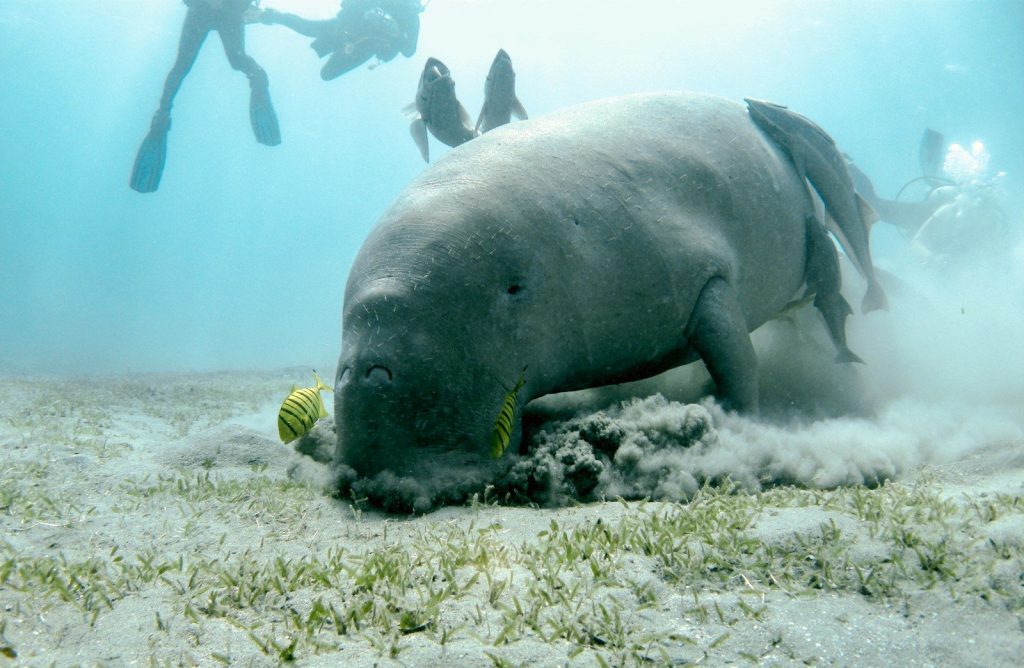
I have swam with manatees more than once in central west Florida, the springs there are cold enough to make you gasp and clear enough that you can watch a two thousand pound animal drift toward you in total silence, moving slower than seems physically possible. There’s a stillness to being in the water with something that large and that unbothered by your presence. It rearranges your sense of scale for the rest of the day.
I’ve also seen manatees offshore on the Gulf side in loose, energetic groups, more commotion than a manatee usually bothers to make, splashing and circling in a way that didn’t look like their usual slow drift at all. I suspected at the time it might be a mating gathering, and it turns out that instinct was right. Florida manatees form what researchers actually call a mating herd, one female in estrus pursued by anywhere from a handful to a dozen males over several weeks, and Save the Manatee Club describes the scene in shallow water as genuinely dramatic, all churn and flippers and flailing flukes. If you ever come across one, the request from biologists is simple: keep your distance and let it happen without an audience crowding in.
Florida’s manatee population has climbed a long way from the days when only a few hundred were left in the wild. Current estimates from Save the Manatee Club put the number between 8,000 and 12,000, which is why the Florida Fish and Wildlife Conservation Commission downgraded them from endangered to threatened in 2017. Threatened still means fragile. Boat strikes remain one of the leading causes of manatee death, which is worth remembering every time you’re the one driving.
Sharks Around the Islands
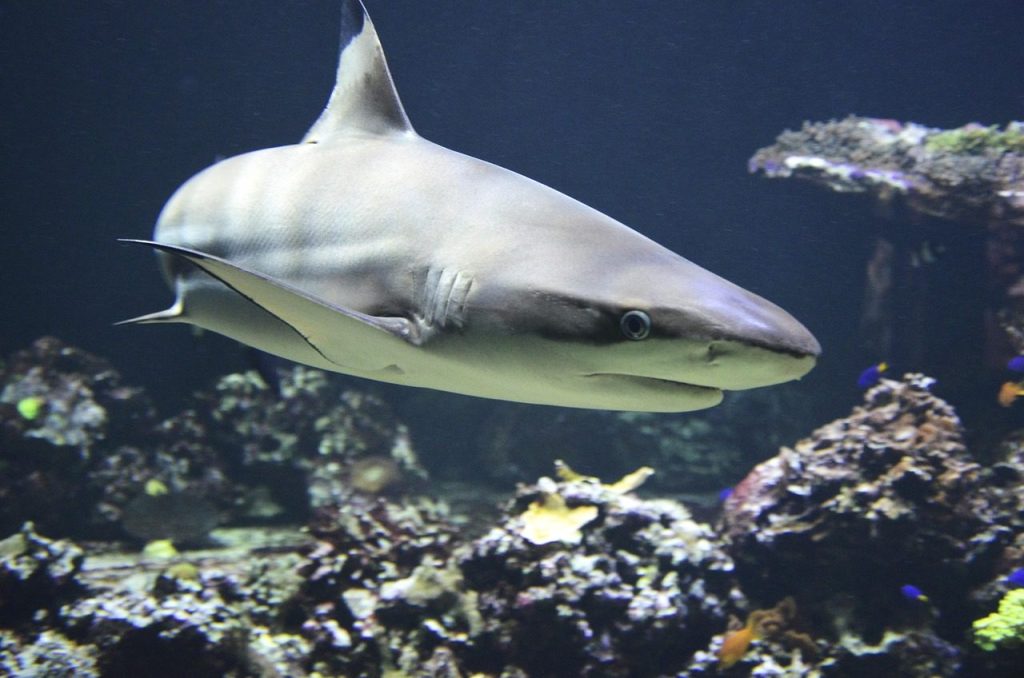
There is a saying in Florida, if you are in the water, chances are you are within 10 feet of a shark.
While that is an exaggeration, growing up boating, skiing, and generally living on the water around the islands off Miami, sharks were just part of the scenery. My memory says nurse sharks resting on the bottom near the flats, and hammerheads cutting through open water further out, though I’ll be honest, memory is a slippery narrator, and I couldn’t swear to the hammerheads under oath forty years later. What I can swear to is that seeing a shark shape under the boat never once stopped anyone from jumping in. That’s just how it was.
Years later, flying into the Dry Tortugas with my kids, we looked down through water so clear it barely counted as water and watched sharks moving below the plane like they were swimming through glass. That’s the kind of visibility you only get that far from the mainland, and it’s the closest I’ve come to seeing exactly how much is actually down there at any given time on any given day, everywhere else too, just usually hidden from view.
Florida does have a real shark event worth knowing about, even if I’ve never timed a visit to catch it. Every winter, tens of thousands of blacktip sharks migrate into the shallow water off Palm Beach County, forming one of the largest coastal shark aggregations documented anywhere in the world, peaking from January through March. They’re there for the baitfish, not for people, and most beachgoers never know how much company they had in the water that day.
Rays Playing in the Waves
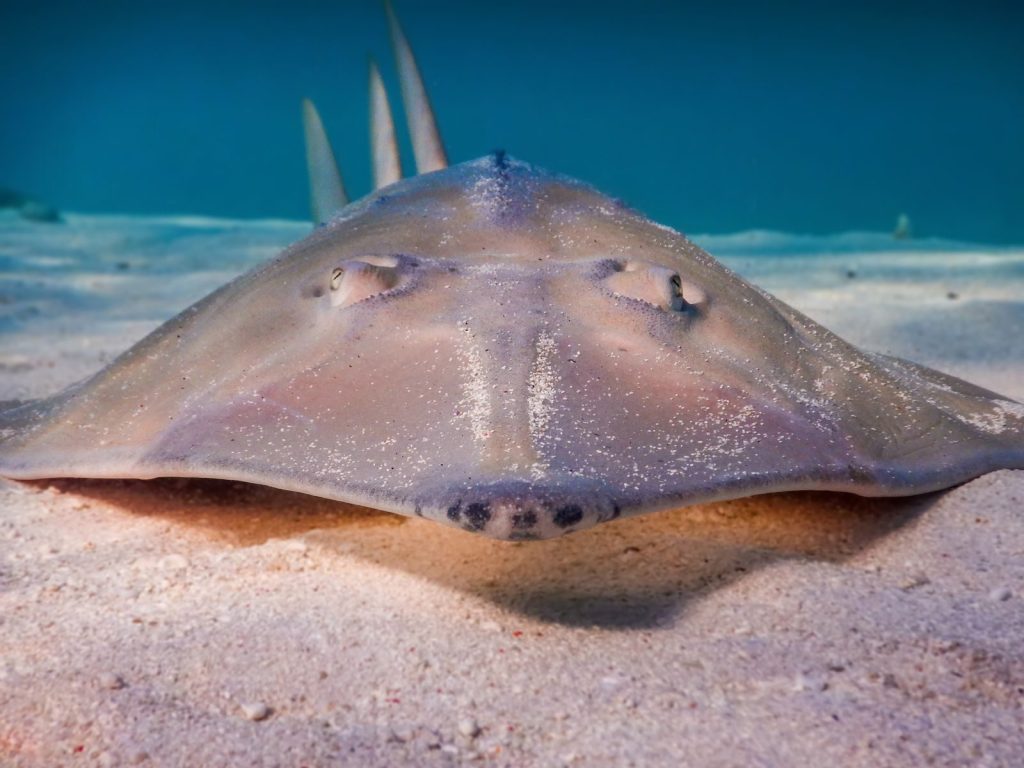
I’ve watched rays right off the shoreline more times than I can count, gliding along just past the break or, my daughter’s favorite version, riding the waves themselves, that flat glide and sudden bank turn that looks almost joyful if you let yourself read it that way. There’s something about a ray in the shallows that always makes me stop walking.
Stingrays are the most common ray you’ll come across, and they’re the reason for the “stingray shuffle,” sliding your feet through the sand instead of stepping, which gives a buried ray time to feel you coming and move off before there’s ever a problem. Nearly every ray injury happens from someone stepping directly on top of one that had nowhere to go. Florida is also home to spotted eagle rays, studied off the west coast by Mote Marine Laboratory since 2009, cownose rays that move through in dense migratory schools each spring and fall, and even the occasional giant manta ray along the southeast Atlantic coast, a genuinely protected, threatened species if you’re ever lucky enough to see one.
Jellyfish and the Man O’ War
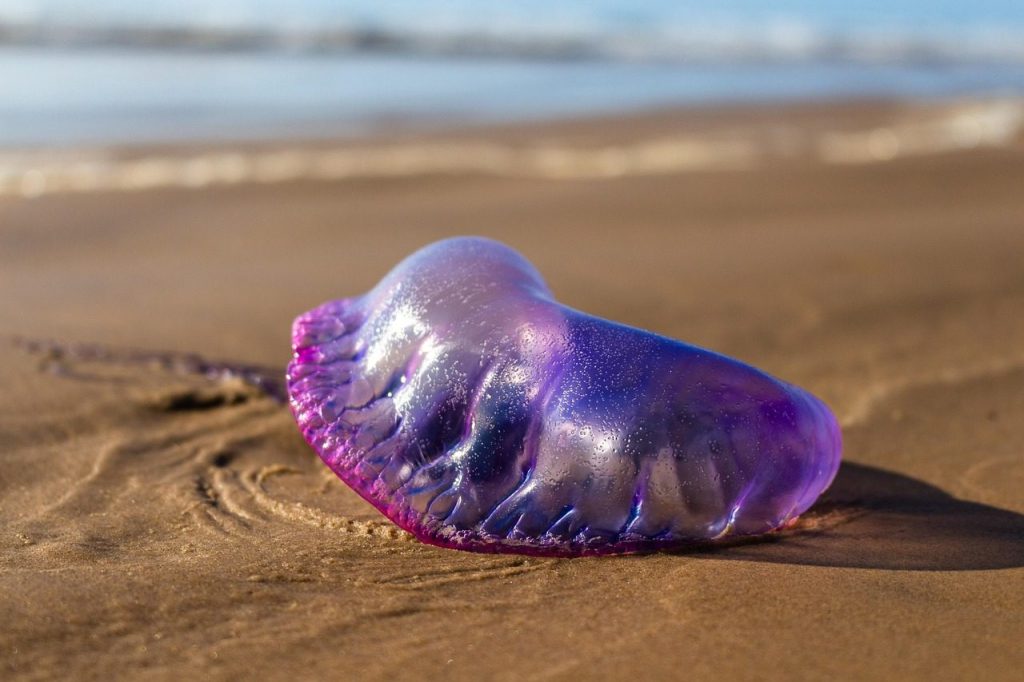
That opening memory of being swept up out of the surf wasn’t an isolated incident, it just happened to be the first one. Jellyfish washing up on the sand is about as common a Florida beach sight as shells, and after a few days of steady onshore wind you’ll find them scattered along the wrack line almost everywhere in the state. Moon jellies and cannonball jellies are the ones you’ll see most, and their sting, if you happen to brush one still in the water, is usually mild.
The Portuguese man o’ war is the one that earns real respect, and my mother clearly knew that decades before I understood why. It isn’t technically a jellyfish at all, it’s a colony of specialized organisms working together under that one blue sail, and its sting is treated differently than a true jellyfish sting, hot water instead of the vinegar rinse that helps with the others. Worth knowing the difference before you need it, and worth teaching a kid, the way my mother taught me without a single word, just a very fast pair of arms.
Horseshoe Crabs: A Purely Posthumous Relationship
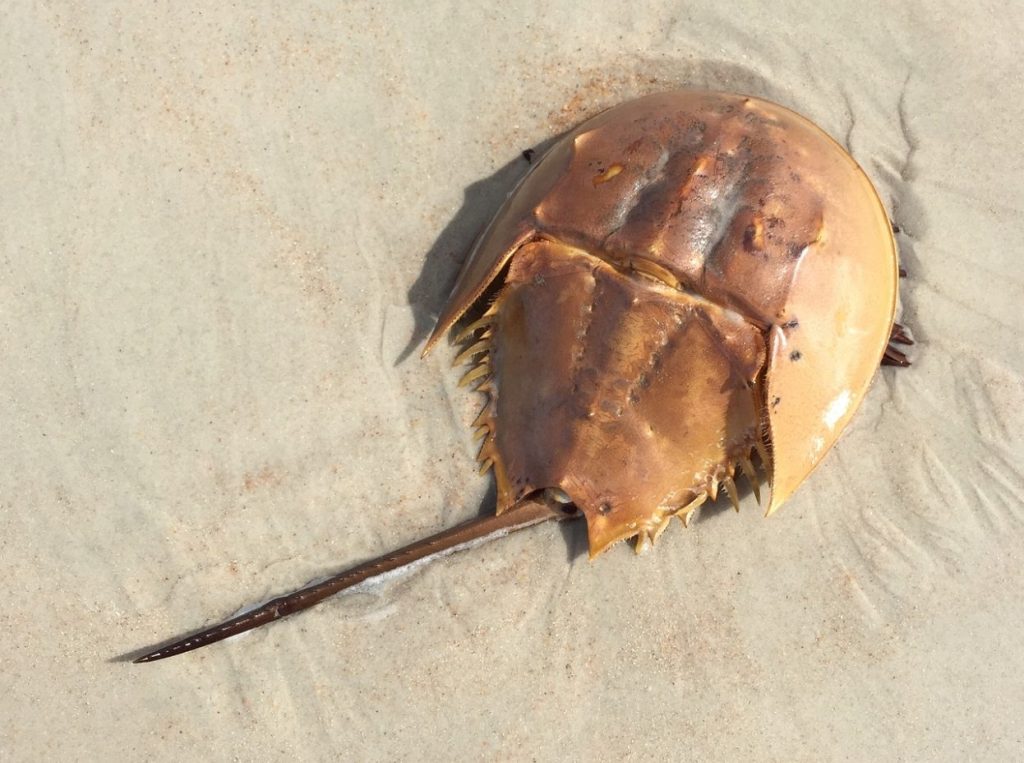
Here’s an honest confession. Every horseshoe crab I have ever encountered on a Florida beach was already gone, just the smooth brown shell washed up on the sand, or the strange discarded molt that looks like the animal but isn’t. I find them genuinely cool, that helmet shape and the long spiked tail, but I have never once seen a live one on the beach.
Every spring and fall, around the full and new moon high tides, horseshoe crabs come ashore in mating pairs to spawn right at the waterline. Florida Horseshoe Crab Watch, a citizen science program through FWC and the University of Florida, trains volunteers to count and tag them during those exact windows. It’s officially on my list now. A living relationship with a creature older than the dinosaurs feels like it’s worth upgrading from the shell collection.
Coquinas: The Best Trick on the Whole Beach
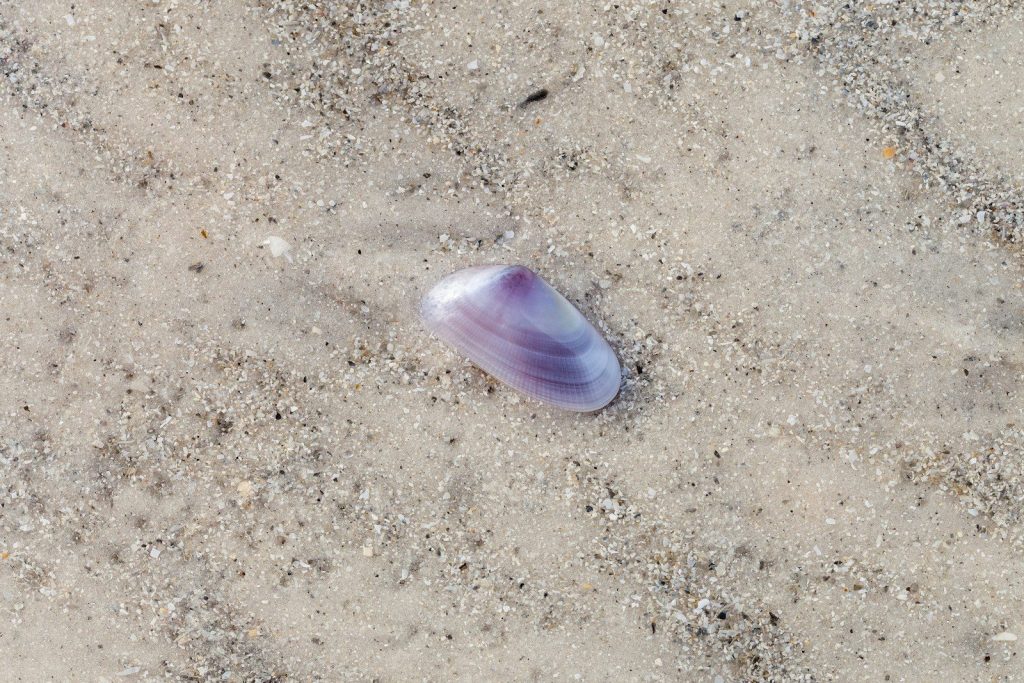
If you asked me to name one single favorite beach memory from childhood straight through my teenage years, it might genuinely be coquinas. You crouch down where the last wave just pulled back, and there they are, tiny wedge-shaped shells in every pastel color you can imagine, rising straight up out of the wet sand as the water arrives and then digging themselves back down before the next wave even finishes retreating. It looks like the beach itself is breathing.
They’re called Donax variabilis, and that rising and burrowing isn’t random, it’s exactly how they feed and how they migrate up and down the beach with the tide, using a muscular little foot to reposition themselves faster than seems fair for something the size of a fingernail. They’re also, appropriately, fugacious, a word that means fleeting, quick to fade, gone almost as soon as you notice them, which describes both the wave-by-wave show and the coquina’s own short lifespan, usually just a year or two. I could sit at that exact spot in the sand for an embarrassingly long time. I still can.
Crabs Everywhere, Including the Hotel Lawn
Crabs have been part of this whole journey in every form Florida offers them. Ghost crabs skittering sideways into their burrows at the first footstep. Whatever small scuttling thing turns up under a rock at the tide line. And then there was Key West, where my kids and I got a genuine kick out of finding land crabs wandering around the pool deck and grounds of the hotel like they’d been invited.
Those are almost certainly blue land crabs, Cardisoma guanhumi, a chunky, blue-shelled crab that lives in burrows well back from the water and only heads to the ocean when females need to release their eggs. They forage mostly at dawn and dusk, which lines up exactly with when you’re most likely to spot one crossing a walkway at a resort, looking enormous and a little prehistoric and, honestly, completely unbothered by the humans stepping around it.
The One That Challenges to be Seen: Whales
For everything I’ve listed here, there’s one Florida sea animal I have only ever seen once in Florida: a whale. It’s not for lack of a coastline. North Atlantic right whales, among the rarest large whales left on Earth, travel down to calve in the shallow water off northeast Florida every winter, roughly mid-November through mid-April, in the stretch between Fernandina Beach and Cape Canaveral. There are no whale watching tours here, on purpose, they’re too rare and too easily stressed to be treated as a tourist activity, so sightings happen the old-fashioned way, someone on the beach noticing something enormous surface just past the breakers and calling it in.
How to Watch Without Getting in the Way
Whatever era you grew up boating in, the current rules are worth knowing and worth following now, for the animals’ sake more than anyone’s. Fifty yards is the standard minimum distance for dolphins and manatees. Five hundred yards for right whales specifically. Feeding any wild marine mammal is illegal in Florida, not just discouraged, and it’s the single fastest way to turn a wild animal into one that gets hurt around boats and hooks. If you ever find a sick, injured, or dead manatee, dolphin, or whale, call the FWC Wildlife Alert Hotline at 1-888-404-3922, or the Marine Mammal Stranding Network at 1-877-942-5343 for dolphins and whales specifically, and stay out of the water while you wait for trained help.
Thoughts & Reflections
I’ve spent my whole life in this state’s water without ever once thinking of it as research. It was just Tuesday. A dolphin off the bow, a ray in the shallows, my mother’s arms yanking me skyward away from something blue and dangerous and beautiful at the same time. It’s only now, writing it down, that I can see how much of who I am got built in that water, one ordinary encounter at a time, long before I had any language for perspective or curiosity or any of the other words I use for it now. Sometimes the biggest lessons don’t announce themselves. They just show up quietly beside the boat, look at you sideways, and swim on.
“I didn’t grow up learning about Florida’s sea life. I grew up inside it, and I’m still not done.”