


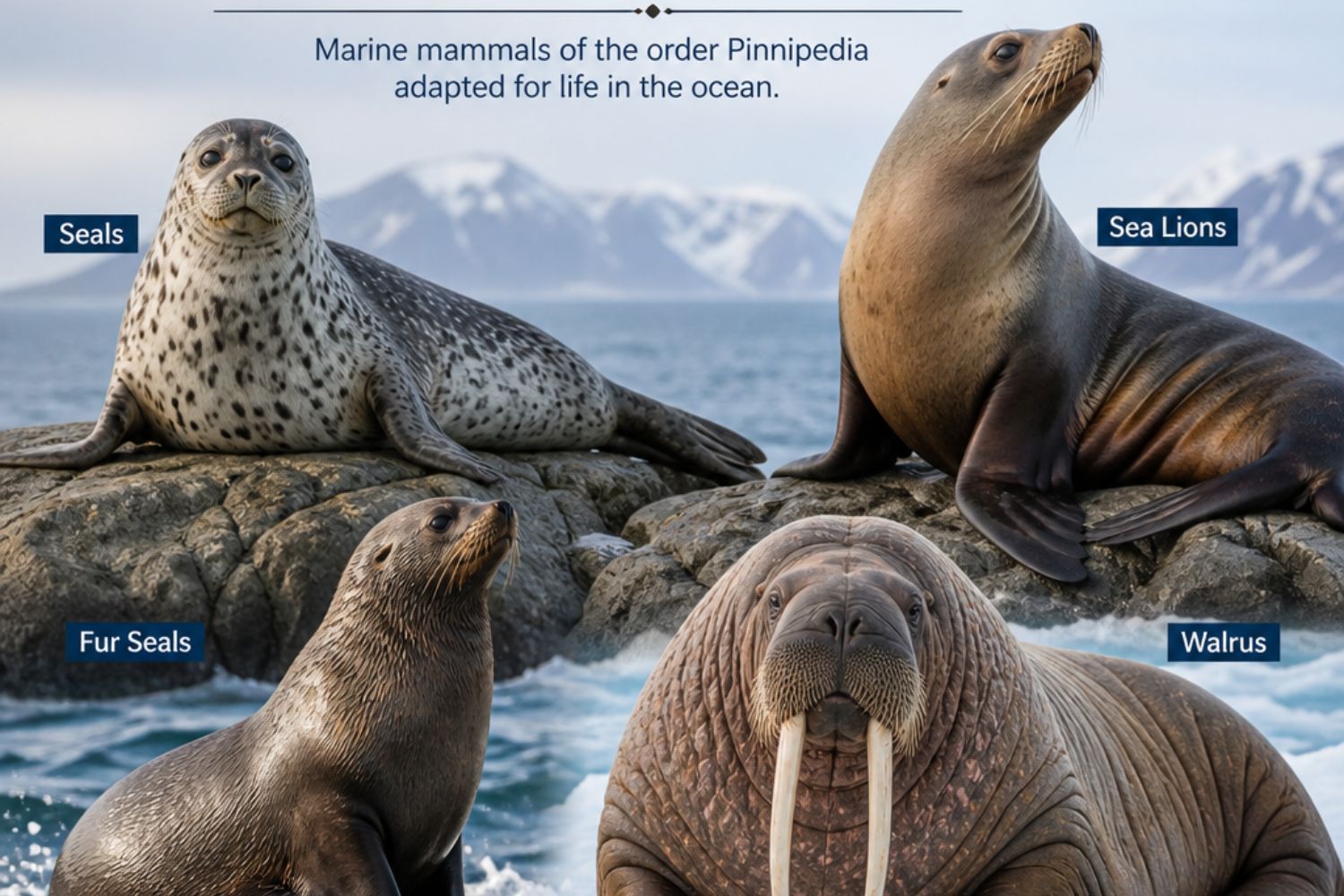
Pinnipeds are some of the ocean’s most fascinating mammals. They look like creatures built for two worlds, and that is exactly what they are. Spending much of their lives in the water but depending on land or ice for rest, birth, and nursing, pinnipeds include seals, sea lions, fur seals, and the walrus.
I used to think “seal” was just a word for one animal. A gray, whiskered thing that barks and eats fish. Then I petsat on an island with an elephant seal for a neighbor, and I started paying attention, and it turns out I had been lumping together four genuinely different families of animal my whole life. Some of them have ears you can see. Some of them can’t turn their hind flippers around to walk. One of them has tusks. They all show up on a beach eventually, but the beaches they choose, and what they’re doing there, turns out to be one of the more interesting rabbit holes I’ve fallen into on this walking mission.
What Are Pinnipeds?
Pinnipeds are a group of semi-aquatic marine mammals in the order Carnivora. That means they are related to other meat-eating mammals, even though their appearance may suggest otherwise.
The word pinniped means “fin-footed,” which is a fitting name for animals with flippers instead of paws. Their streamlined bodies, thick blubber, and strong swimming ability make them well adapted to marine life. Yet despite their shared lifestyle, these animals are not all the same.
There are three main families of pinnipeds:
- True seals
- Sea lions and fur seals
- Walruses
Each group has its own traits, habits, and preferred habitats. Still, they all share a few key features:
- Flipper-shaped limbs
- Thick layers of fat for insulation
- Ability to dive and hunt underwater
- Dependence on land or ice for resting and breeding
The fastest way to sort them out at a glance is to look at the ears and watch how they move.
True seals, the Phocidae family, have no visible ear flaps, just small holes, and their hind flippers point permanently backward, so on land they can only hitch themselves along on their bellies like a caterpillar. Elsie Mae, the elephant seal I wrote about from my Anacortes petsit, is a true seal. Sea lions and fur seals both belong to the Otariidae family, the eared seals, and you can spot the visible ear flaps immediately. More importantly, they can rotate their hind flippers forward underneath themselves, which means they can actually walk, and even climb, rather than flop. Walrus get their own family entirely, Odobenidae, and there’s only one living species left in it. No ears you’d notice, tusks nobody else has, and a face only a walrus mother could love.
Shared Adaptations of Pinnipeds
Although pinnipeds vary in size and appearance, their survival depends on similar adaptations.
Key Adaptations
- Blubber: This thick fat layer keeps them warm in cold water.
- Flippers: Their limbs are modified for swimming.
- Strong lungs: Many pinnipeds can hold their breath for long dives.
- Streamlined bodies: These reduce drag in the water.
- Sensitive whiskers: Helpful for detecting prey.
The True Seals
This is the largest and oldest group, and it includes some of the most dramatic animals on any coastline. Northern elephant seals haul out by the thousands at Point Reyes National Seashore and on San Miguel Island in California’s Channel Islands, where Channel Islands National Park hosts roughly 50,000 elephant seals breeding each year at Point Bennett alone. Their southern cousins do something even bigger at South Georgia Island in the sub-Antarctic, which holds the largest southern elephant seal breeding population on Earth. That population took a serious hit when avian flu reached the island in 2023, with researchers reporting a drop of roughly a third in breeding females by 2024, a sober reminder that even the biggest colonies aren’t invincible.
Gray seals have their own superlative up in Canada. Sable Island, a 42 kilometer sandbar off Nova Scotia managed by Parks Canada, holds the largest breeding colony of gray seals in the world, with hundreds of thousands gathering on its beaches every winter to pup. Harp seals do something almost no other pinniped does, they skip the beach entirely and give birth out on the pack ice of the Gulf of St. Lawrence near the Magdalen Islands, their pups born white as snow for camouflage against the ice rather than sand. And the Hawaiian monk seal, one of the most endangered seals on the planet, is found nowhere else in the world except the Hawaiian archipelago, with the bulk of the population in the remote Northwestern Hawaiian Islands and a smaller, closely watched population basking on the main island beaches most visitors actually get to see.
The Sea Lions
Sea lions are the ones you’ve probably watched bark and jostle for space on a dock somewhere, and San Miguel Island does double duty here too, its Point Bennett rookery holding one of the largest aggregations of California sea lions anywhere, alongside those elephant seals. On the Oregon coast, the Sea Lion Caves near Florence hold the only known mainland rookery for Steller sea lions, the largest of all the eared seals, in a sea cave you can actually walk down into and view from an observation platform. And down in the Pacific, the Galápagos sea lion has made itself famous for having essentially no fear of people at all, sea lions haul out directly on the docks, benches, and even boat ramps of towns like Puerto Baquerizo Moreno, a species found nowhere else in the world, protected within Galápagos National Park.
The Fur Seals
Fur seals are technically eared seals too, closer cousins to sea lions than to Elsie Mae’s family, but they earned their own name from the dense underfur that once made them a target for the fur trade and nearly wiped several species out. The Pribilof Islands in Alaska’s Bering Sea, St. Paul and St. George, are the largest northern fur seal breeding grounds on the planet, a history so central to the islands that they were once simply called the Fur Seal Islands. On the other side of the world, South Georgia shows up again, this time hosting roughly 97 percent of the entire global population of Antarctic fur seals, a comeback story after the species was hunted to near extinction by the 1900s and rebounded from what may have been as few as a dozen breeding pairs. And on Namibia’s Skeleton Coast, Cape Cross holds one of the largest Cape fur seal colonies in the world, more than 100,000 animals crowding a stretch of desert coastline named for a stone cross a Portuguese explorer planted there in 1486.
The Walrus
There’s only one walrus species left, split into a Pacific and an Atlantic population, and they’re unmistakable once you’ve seen those tusks. In Alaska’s Bristol Bay, Round Island, part of the Walrus Islands State Game Sanctuary, hosts as many as 15,000 male Pacific walrus hauling out on its beaches every summer, packed so tightly together that from a distance the shoreline itself looks like it’s breathing. Atlantic walrus gather on the beaches and ice of Svalbard, the Norwegian archipelago deep in the Arctic, where protection efforts have allowed a once nearly eliminated population to slowly recover. In recent years, shrinking Arctic sea ice has pushed Pacific walrus to haul out earlier and in larger numbers on beaches near Point Lay, Alaska, sometimes tens of thousands at once, which researchers watch closely since so many walrus crowded onto one beach can trigger deadly stampedes if anything startles them.
Rules Wherever You Go
Every one of these animals is protected, in the United States under the federal Marine Mammal Protection Act, and under equivalent laws almost everywhere else they haul out. Keep your distance, most agencies recommend at least 50 to 150 feet depending on the species and situation, more if a ranger or guide tells you more. Keep dogs leashed and well back. Never get between an animal and the water, since that’s its escape route and blocking it can provoke a defensive charge from an animal that outweighs you by a lot. And if a pup is alone on the beach, leave it alone. Mothers regularly leave pups to forage and come back, and a “rescued” pup is very often a healthy one that just lost its ride.
Curiosity Corner
What’s the actual difference between a seal and a sea lion?
Ears and mobility. Sea lions have visible ear flaps and can rotate their hind flippers forward to walk and climb. True seals have no visible ears, just small holes, and can only wiggle along on their bellies on land. If you can watch it walk, it’s a sea lion or fur seal. If it’s flopping, it’s a true seal.
Why do walruses get lumped in with seals and sea lions at all?
They’re all pinnipeds, carnivorous marine mammals with flippers instead of legs, and they share a common ancestor that returned to the ocean tens of millions of years ago. But genetically, the walrus split off on its own branch, making it roughly as different from a true seal as a bear is from a dog, related, but its own thing entirely.
Can seals actually sleep in the water?
Yes, and it’s one of the stranger things about them. Some species can sleep with half their brain at a time while drifting at the surface, a trick called unihemispheric sleep that lets them keep one eye open for predators even while resting.
Do a seal’s whiskers actually do anything special?
They’re remarkably sensitive sensors called vibrissae, capable of detecting the faint wake left behind by a fish that swam past seconds earlier, well after the fish itself is gone. A seal can essentially follow an invisible trail through open water using nothing but its whiskers.
Thoughts & Reflections
I keep coming back to how wrong I had it for so long, thinking “seal” was just one animal instead of four entirely different families living four entirely different lives. A true seal hitching itself along a beach on its belly and a sea lion climbing a sea cave wall are not doing a slightly different version of the same thing. They’re doing completely different things that happen to look similar from a distance, if you never bother to look closer. I think about how often I’ve done that with people too, assumed I understood someone because they fit a category I already had a label for, when the truth was I just hadn’t looked closely enough yet to notice how different they actually were underneath the label.