



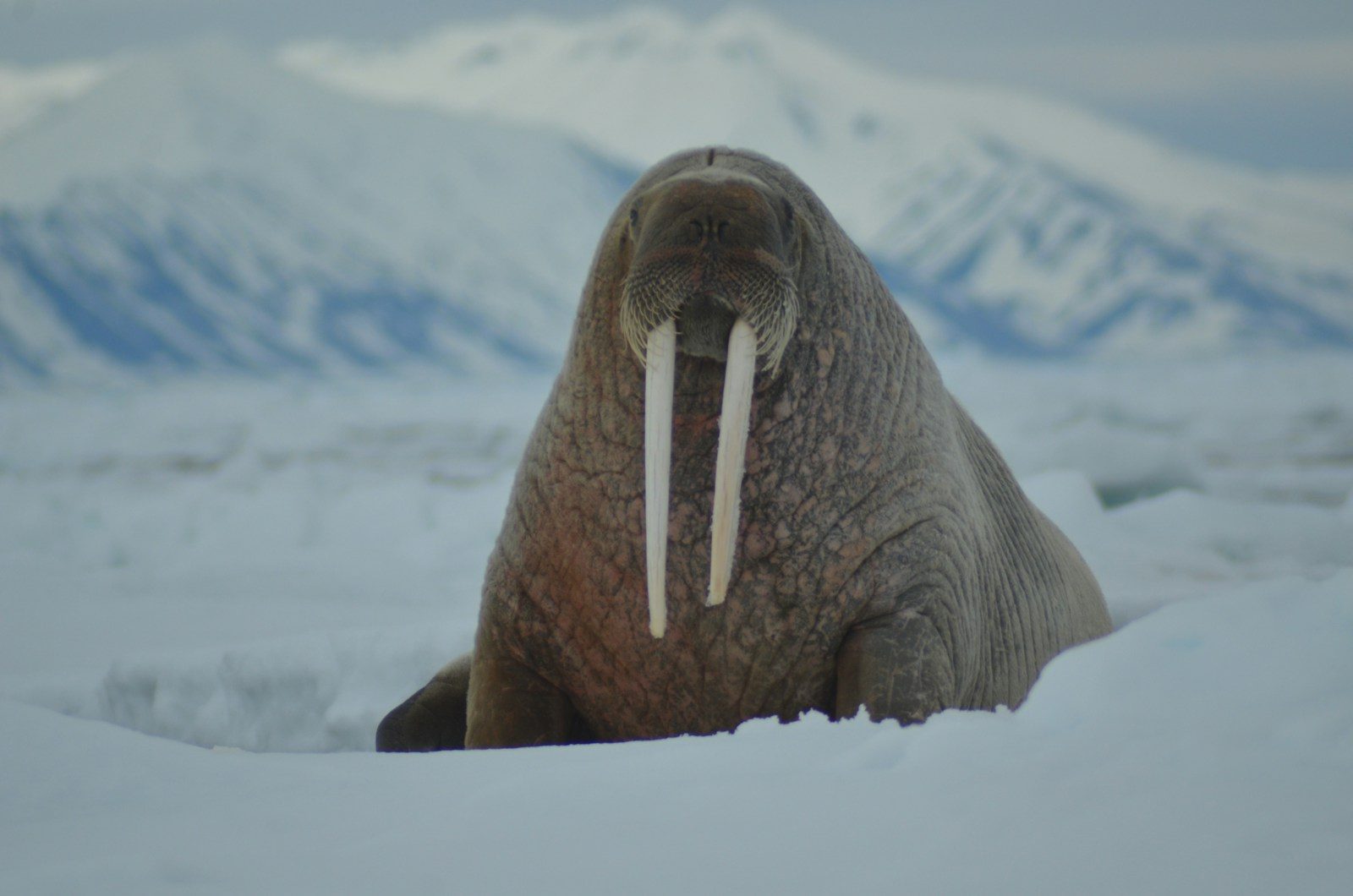
Every other family in this series gave me multiple species to sort through, true seals with eighteen, sea lions with six, fur seals with nine. The walrus gives me exactly one. Odobenidae was once a whole branch of the pinniped family tree with a real spread of species across millions of years, and every single one of them is gone except this last, tusked, unmistakable survivor. There’s something almost lonely about that, one animal carrying an entire family’s worth of identity on its own, and I didn’t expect that to be the detail that stuck with me most by the end of this whole series.
Jump to a population:
- Pacific walrus — Round Island and Point Lay, Alaska, and Wrangel Island, Russia
- Atlantic walrus — Svalbard, Norway, and Foxe Basin, Canada
- Laptev walrus — the Laptev and East Siberian Seas, Russia
Walrus: The Giant of the Group
There’s no mistaking a walrus for anything else in the pinniped world. Both males and females grow those elongated canine tusks, and the genus name Odobenus literally translates to “tooth walker,” a reference to how a walrus uses its tusks to haul its own enormous body up onto ice, hooking them into the surface and pulling. Beneath those iconic whiskers are hundreds of extremely sensitive vibrissae, which a walrus uses to feel its way across the pitch black seafloor and locate clams buried in sediment purely by touch, since eyesight is close to useless down there. Males can weigh close to 4,000 pounds, dwarfing females, and the entire species is intensely social, hauling out shoulder to shoulder in crowds that can run into the tens of thousands.
Walrus Features
Walruses are easy to identify because of their:
- Long tusks
- Thick whiskers, called vibrissae
- Very large size
- Blubbery body
- Strong social behavior
Tusks are used for many purposes, including hauling out onto ice, defending territory, and possibly showing strength during social interactions.
Walrus Diet
Walruses mainly feed on bottom-dwelling animals such as clams and other shellfish. They use their sensitive whiskers to locate food in murky water and then suck out the meat from the shells.
The Pacific Walrus
The Pacific walrus ranges across the Bering, Chukchi, and East Siberian Seas, and the single largest population on the planet lives on Wrangel Island, a Russian nature reserve so biodiverse that biologists have nicknamed it the Galapagos of the Far North. In Alaska’s Bristol Bay, Round Island, part of the Walrus Islands State Game Sanctuary, hosts as many as 15,000 male Pacific walrus hauling out on its beaches every summer, packed so tightly together that from a distance the shoreline itself looks like it’s breathing. In recent years, shrinking Arctic sea ice has pushed walrus to haul out earlier and in far larger numbers on beaches near Point Lay, Alaska, with a single 2014 aerial survey documenting an estimated 35,000 animals crowded onto one stretch of shore, a phenomenon researchers first began tracking in Russia back in 2006 and now watch closely every autumn.
Nearly all of the Pacific walrus’s world is ice rather than beach, but when the ice retreats too far to reach, they crowd onto whatever solid coastline is left. Round Island is rocky and boulder strewn. Wrangel Island offers a rugged gravel coast at the edge of the Chukchi Sea. And Point Lay, the site of those unprecedented mass haulouts, is a flat barrier island beach of sand and gravel that was never built to hold tens of thousands of two-ton animals at once, which is exactly the problem.
The Atlantic Walrus
The Atlantic walrus ranges from the central Canadian Arctic east to Russia’s Kara Sea and north to Svalbard, a population that was hunted hard enough in earlier centuries that recovery is still ongoing in places. Svalbard, the Norwegian archipelago deep in the Arctic, has seen its once nearly eliminated walrus population slowly rebuild under decades of protection. In the Canadian Arctic, Foxe Basin holds one of four recognized extant Atlantic walrus populations, remote enough that most of Canada will never see one of its own walrus in person.
Svalbard gives them rocky, glacier backed beaches at the edge of the Barents Sea. Foxe Basin offers similarly remote gravel coastline hundreds of miles from the nearest town. And in a detail that ties this whole series together, walrus once hauled out on Sable Island too, the very same Nova Scotia sandbar covered earlier in this series for its enormous gray seal colony, before that Northwest Atlantic walrus population was hunted to extirpation entirely by the late 1700s.
The Laptev Walrus
Some researchers recognize a third walrus population, isolated in Russia’s Laptev and East Siberian Seas, distinct enough in range from both the Pacific and Atlantic populations that it’s sometimes treated as its own subspecies rather than folded into either. It remains one of the least studied walrus populations anywhere on Earth.
Almost nothing is documented about where this population actually comes ashore, and that itself is the point. It exists in one of the least visited, least studied stretches of Arctic coastline on the planet, and that obscurity may be the closest thing to protection it currently has.
Rules Wherever You Go
Walrus haulouts carry a specific danger no other pinniped colony quite matches, the stampede. When tens of thousands of animals are packed shoulder to shoulder on a single beach, a sudden noise, a low flying aircraft, an approaching boat, or a startled predator can trigger a panicked rush toward the water that crushes smaller and younger walrus caught underfoot. This is exactly why access to sites like Round Island requires a permit and why aircraft are barred from flying low over known haulouts. If you’re ever near one, stay back, stay quiet, and never do anything that could startle the crowd, for their sake far more than yours.
Curiosity Corner
What are those tusks actually for?
Mostly for hauling their own body weight out of the water and up onto ice or rock, which is where the genus name Odobenus, “tooth walker,” comes from. They’re also used in dominance displays and occasional fights between males, but hunting isn’t really part of the job, walrus find their food by touch, not by tusk.
How do the whiskers work?
A walrus has hundreds of vibrissae packed with nerve endings, sensitive enough to detect the shape and texture of a clam buried in seafloor sediment in total darkness. It’s essentially reading the ocean floor with its face, since eyesight is nearly useless at typical foraging depth.
Why is a walrus stampede so dangerous?
The sheer density of a haulout is the problem. Tens of thousands of two-ton animals packed onto one beach have almost no room to move carefully, so a panicked rush toward the water can crush calves and smaller animals caught in the crowd, a real and documented risk at large haulouts like Point Lay.
Why is the walrus the only species left in its family?
The fossil record shows Odobenidae was once a genuinely diverse family with a real spread of species over millions of years. For reasons still debated among paleontologists, every other branch died out, leaving the modern walrus as the sole survivor of an entire evolutionary lineage rather than one member of a large living family.
Thoughts & Reflections
Every other animal in this whole series had cousins to be compared to. A Weddell seal makes more sense once you’ve met a crabeater seal. A Galapagos sea lion makes more sense next to a Steller. The walrus doesn’t get that. It’s the last of its entire branch, and it has been for a very long time, which means everything about it, the tusks, the whiskers, the sheer scale of a Round Island haulout, had to be figured out with no living relative to compare it to. I think there’s something worth sitting with in that. Being one of a kind isn’t the same as being incomplete. Sometimes the whole family tree narrows down to a single, fully formed answer, and that answer turns out to be more than enough.