


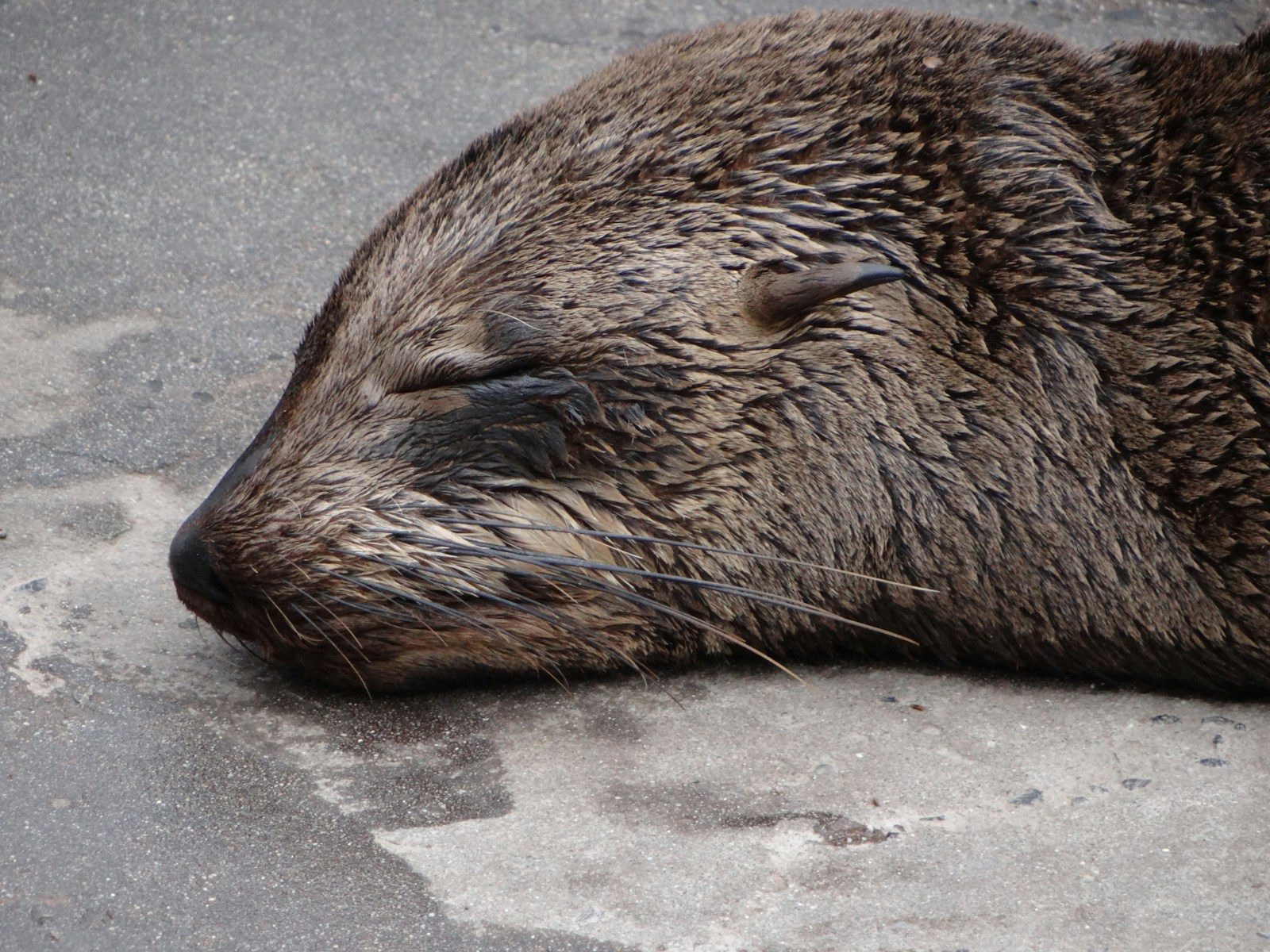
Fur seals are the closest relatives sea lions have, both eared seals, both able to rotate those hind flippers forward and walk instead of flop. What sets a fur seal apart is underneath the surface, a dense double coat with a thick layer of underfur that traps air and keeps cold water from ever touching skin. That same coat is the reason this family has one of the roughest histories of any pinniped group. Fur seals were hunted commercially for their pelts more intensively than almost any other marine mammal on Earth, and several of the nine living species alive today exist only because a tiny remnant population managed to disappear from view long enough to rebuild.
Jump to a species:
- Guadalupe fur seal — Guadalupe Island, Mexico
- Juan Fernandez fur seal — Juan Fernandez Islands, Chile
- Antarctic fur seal — South Georgia Island
- Northern fur seal — Pribilof Islands, Alaska
- Cape fur seal — Cape Cross, Namibia
- South American fur seal — Guafo Island, southern Chile
- Galapagos fur seal — the Galapagos Islands
- Subantarctic fur seal — Gough Island and Tristan da Cunha
- New Zealand fur seal — Kaikoura Peninsula, New Zealand
Fur Seals: A Close Relative of Sea Lions
Fur seals belong to the same Otariidae family as sea lions, the eared seals, and share the same forward rotating hind flippers that let them walk and climb. The real difference is the coat. A fur seal’s dense underfur was worth a fortune on the nineteenth century fur market, and several species were hunted down to a few dozen individuals, or fewer, before protections finally caught up. Most fur seals are also noticeably smaller and more compact than sea lions, with shorter, more pointed muzzles and a visibly thicker mane on breeding males.
Why Are They Called Fur Seals?
Fur seals have a particularly thick and valuable coat of fur, which historically made them targets for hunting. Their dense underfur helps protect them in colder waters, though it is not their only defense against the cold. Like other pinnipeds, they also rely on blubber for insulation.
Fur Seal Traits
Fur seals are generally smaller than sea lions and often have a more pointed snout. They are strong swimmers and can spend long periods feeding at sea before returning to breeding colonies.
The Comeback Stories
Three species in this family came back from the edge of nothing, and all three are worth knowing by name. The Guadalupe fur seal was hunted so hard that only seven individuals were counted in 1892, and the species was believed extinct for decades until a small breeding group was discovered hiding in a sea cave on Mexico’s Guadalupe Island in 1954. It has since recovered to tens of thousands. The Juan Fernandez fur seal has an even stranger story, it was also believed extinct until a surviving population was rediscovered on the remote Juan Fernandez Islands off Chile, the same island group associated with the real castaway behind the Robinson Crusoe legend. And the Antarctic fur seal, concentrated almost entirely on South Georgia Island, rebounded from what may have been as few as a dozen breeding pairs after commercial sealing ended in 1908 to a population now estimated in the millions, roughly 97 percent of the entire species living on that one island group.
These recoveries all trace back to the same kind of shoreline: hard to reach, hard to land on, exactly the terrain that let a handful of survivors disappear from view long enough to rebuild. The last Guadalupe fur seals held out in a sea cave on the island’s volcanic coast, discovered almost by accident. Juan Fernandez fur seals cling to sheer, boulder strewn cliffs so rugged that landing a boat there is its own small feat of navigation. South Georgia’s beaches are dark shingle and glacial outwash backed by tussock grass, the same cold, difficult coastline the Antarctic fur seal shares with the elephant seals that also call the island home.
The Biggest Colonies
Three species anchor the largest fur seal populations on Earth. The Pribilof Islands in Alaska’s Bering Sea, St. Paul and St. George, are the largest northern fur seal breeding grounds on the planet, a history so central to the islands that they were once simply called the Fur Seal Islands. On Namibia’s Skeleton Coast, Cape Cross holds one of the largest Cape fur seal colonies anywhere, more than 100,000 animals crowding a stretch of desert coastline named for a stone cross a Portuguese explorer planted there in 1486. And off the coast of southern Chile, Guafo Island holds the largest breeding colony of South American fur seals, a species that ranges the entire South American coastline from Peru and Chile in the west to Uruguay and Brazil in the east.
The sheer scale of these colonies comes with equally rugged shorelines to match. St. Paul and St. George are boulder strewn volcanic beaches wrapped in near constant Bering Sea fog. Cape Cross sits on a coastline that earned its Skeleton Coast name honestly, sand and rock backed by open desert with almost no fresh water anywhere nearby. And Guafo Island is a remote, rain-soaked, densely forested coastline that most people, Chilean or otherwise, will never set foot on.
The Rare and the Small
Two species stand apart for their size and their isolation. The Galapagos fur seal is the smallest of all the eared seals anywhere in the world, adapted to equatorial heat in a way no other fur seal has had to manage, with oversized eyes that help it hunt at night when the tropical sun isn’t a problem. The subantarctic fur seal breeds almost entirely on a handful of remote South Atlantic islands, chiefly Gough Island and Tristan da Cunha, some of the most isolated inhabited and uninhabited islands on the planet, occasionally joined by wandering Antarctic fur seals that show up hundreds of miles north of where they’re supposed to be.
Both species keep to rock rather than open sand. Galapagos fur seals wedge themselves into shaded lava crevices and boulder piles along the islands’ volcanic coastline, seeking out shade the way no other fur seal needs to given how close they live to the equator. Gough Island and Tristan da Cunha offer the subantarctic fur seal steep, boulder strewn volcanic shorelines with barely a patch of level ground in sight.
The One You Can Actually Walk To
New Zealand fur seals range along the coasts of New Zealand and southern Australia, and the single most accessible colony anywhere in this entire family sits at Kaikoura Peninsula on New Zealand’s South Island, a colony you reach by an easy public walking track rather than a boat, permit, or multi-day expedition.
Unlike almost everything else in this article, this is a colony you can genuinely walk to. Kaikoura gives New Zealand fur seals a flat rock platform shoreline right at the edge of a public walking track, close enough that the 2016 earthquake, which physically lifted sections of this coastline several feet, changed how visitors experience the colony, pushing the seals further from the old car park and onto the open rock terraces they use today.
Rules Wherever You Go
Fur seals share the same mobility and unpredictability as sea lions, so treat any colony with the same caution. Stay at least 50 to 150 feet back depending on local guidance, and remember the specific New Zealand advice given at Kaikoura applies everywhere in this family, they will attack if they feel cornered and can move surprisingly fast for an animal that looks like it’s dozing. Keep dogs leashed at all times, since fur seals and dogs read each other as threats. And never approach a mother and pup pair, since fur seal mothers alternate long ocean foraging trips with short nursing visits, and a disturbed reunion can separate them for good.
Curiosity Corner
What’s the actual difference between a fur seal and a sea lion?
Coat density and size. Fur seals carry a dense double coat with thick underfur, while sea lions have a single coarser layer. Fur seals also run smaller overall, with shorter, more pointed muzzles and visibly bigger eyes relative to head size.
Why were fur seals hunted so much harder than sea lions?
That dense underfur was extremely valuable on the nineteenth and early twentieth century fur market in a way sea lion pelts simply weren’t, which is why entire fur seal populations were pushed to a handful of survivors while sea lions, hunted mostly for oil and meat, generally fared somewhat better.
How did the Guadalupe fur seal recover from just a handful of survivors?
Total protection and a lot of time. Once hunting stopped and the species gained legal protection in both Mexico and the United States, the small surviving population on Guadalupe Island was left completely alone to breed, and fur seals turned out to be resilient enough to rebuild from a very small genetic base.
Do fur seals in warm places like the Galapagos still need all that fur?
Yes, but they manage the heat with behavior instead of biology, seeking out shade in lava crevices during the hottest parts of the day and staying more active at night, rather than evolving away the dense coat that every other fur seal relies on for insulation in colder water.