



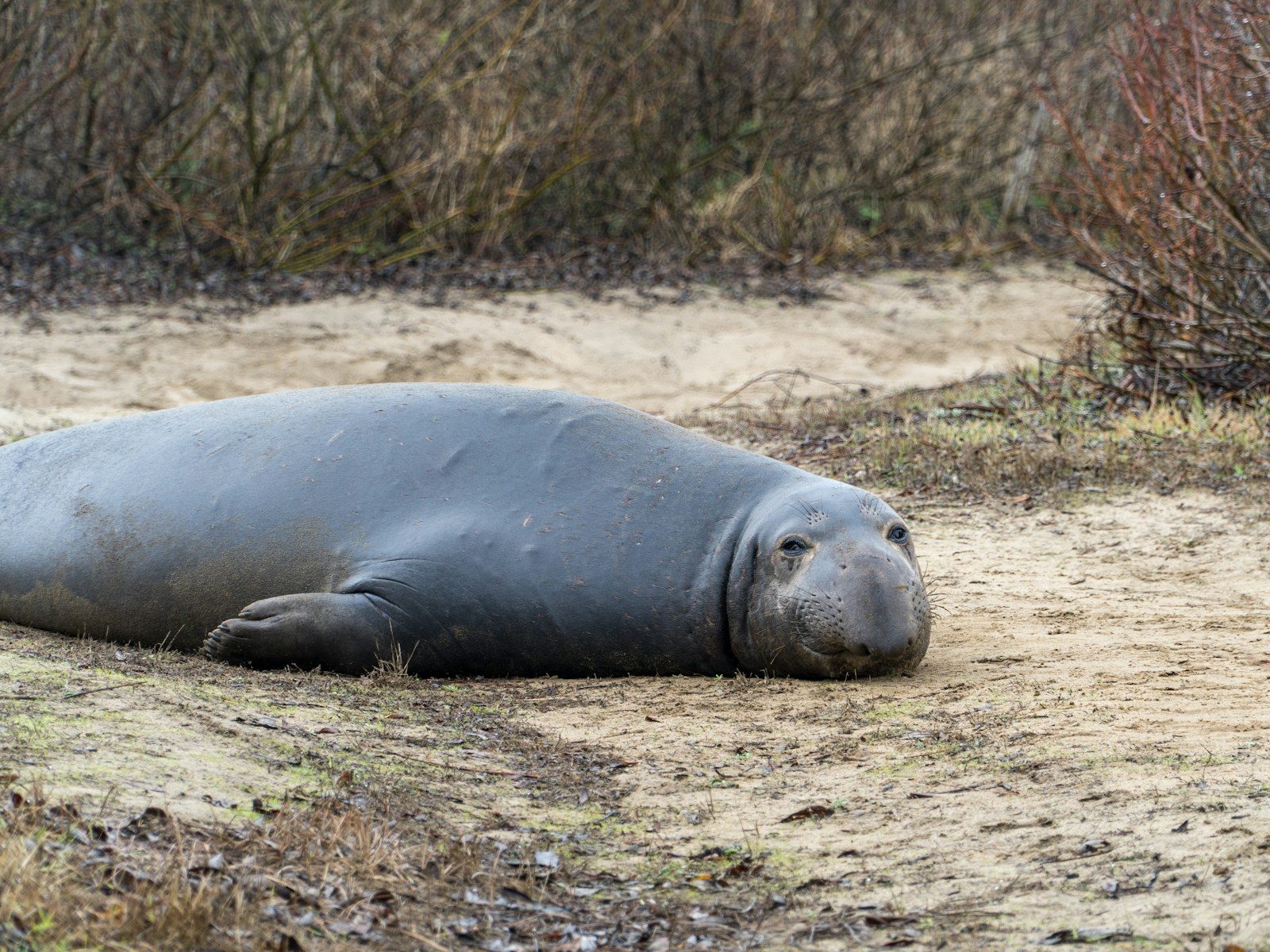
Elsie Mae, the elephant seal I got to know a little during a petsit on Fidalgo Island, belongs to the biggest and oldest branch of the pinniped family tree.
True seals, the Phocidae, have been doing their own thing since long before sea lions and fur seals split off onto their own evolutionary path. No visible ears. No ability to turn their hind flippers forward. On land they hitch themselves along on their bellies like giant, blubbery inchworms, which looks undignified right up until you watch the same animal in the water, where it becomes one of the most graceful things in the ocean. There are eighteen living species in this family, plus one we lost within living memory, and they’ve ended up in some of the strangest, most extreme places on the planet.
Jump to a species:
- Northern elephant seal — California’s Point Reyes and Channel Islands
- Southern elephant seal — South Georgia Island
- Harbor seal — coastlines across the Northern Hemisphere
- Gray seal — Sable Island, Nova Scotia
- Ringed seal — Arctic sea ice
- Bearded seal — Arctic sea ice
- Spotted seal — Bering Sea pack ice
- Ribbon seal — Bering Sea and Sea of Okhotsk
- Hooded seal — Davis Strait and Jan Mayen pack ice
- Harp seal — Gulf of St. Lawrence pack ice
- Weddell seal — McMurdo Sound, Antarctica
- Crabeater seal — circumpolar Antarctic pack ice
- Leopard seal — Antarctic pack ice
- Ross seal — deep Antarctic pack ice
- Hawaiian monk seal — Northwestern Hawaiian Islands
- Mediterranean monk seal — Greece, Turkey, and Cape Blanc, Mauritania
- Caribbean monk seal — extinct, once the Caribbean Sea
- Baikal seal — Lake Baikal, Siberia
- Caspian seal — the Caspian Sea
Seals: Quiet Masters of the Water
Seals are often the first animals people think of when they hear the word pinniped. True seals, also called earless seals, are known for their smooth, streamlined bodies and lack of visible external ear flaps.
How Seals Move
On land, seals move in a different way from sea lions. They often wriggle or “inch” along using their bellies and flippers. In the water, however, they are graceful and powerful swimmers. Their rear flippers help propel them, making them excellent divers.
Where Seals Live
Seals can be found in many parts of the world, from icy Arctic waters to temperate coastlines. Some species spend most of their lives close to shore, while others travel long distances across the ocean.
What Seals Eat
Most seals eat fish, squid, and crustaceans. Some species also eat larger prey such as penguins or small sharks, depending on where they live.
The Giants
Elephant seals are the obvious place to start, since they’re the reason I started paying attention to this family in the first place. Northern elephant seals like Elsie Mae haul out along the California coast, with Point Reyes National Seashore and the Channel Islands hosting some of the largest breeding populations anywhere. Their southern cousins do something even more staggering at South Georgia Island in the sub-Antarctic, home to the largest southern elephant seal breeding population on Earth. That population has had a rough few years. Highly pathogenic avian influenza reached the island in 2023, and researchers with the British Antarctic Survey documented a decline of roughly a third in breeding females by 2024, a reminder that even the biggest colony in the world isn’t immune to a bad outbreak.
The beaches match the animals in scale. California’s elephant seal haul-outs are wide, coarse sand stretches backed by low bluffs and dune grass, sand compacted by thousands of multi-ton bodies until it holds a shape no ordinary beach sand would. At South Georgia, the sand turns dark and glacial, a mix of volcanic grit and outwash gravel backed by tussock instead of palm trees, cold enough that the seals themselves send up visible steam on a clear morning.
The Ones You’ve Actually Seen
Harbor seals are probably the true seal you already know, even if you didn’t know the family name. They’re the ones resting on rocks and docks along coastlines all over the Northern Hemisphere, generally solitary, generally unbothered by anything short of a direct approach. Gray seals are their bigger, more dramatic relative, and Sable Island, a windswept sandbar off Nova Scotia managed by Parks Canada, holds the largest breeding colony of gray seals on the planet, hundreds of thousands of them gathering on its beaches every winter.
Harbor seals aren’t picky about their shoreline, they’ll haul out on almost anything solid and slightly raised, rocky ledges, gravel bars, sandbars exposed only at low tide, whatever keeps them a few inches above the next wave. Sable Island gives gray seals something far more dramatic to work with, a 42 kilometer crescent of pale, wind sculpted sand dunes rising straight out of the open Atlantic, among the largest and least disturbed dune systems left in eastern North America.
The Ice Seals of the Arctic
Several true seal species have built their entire life cycle around sea ice rather than sand, which means climate change is hitting this group especially hard. The ringed seal is the smallest and most common seal in the Arctic, small enough and stealthy enough to dig its own breathing holes through the ice and raise pups in snow caves above them, and it remains the primary prey of polar bears. It was listed as a threatened species in the United States specifically because of projected sea ice loss. The bearded seal, the largest of the Arctic ice seals, was listed alongside it for the same reason. The spotted seal and the ribbon seal, both centered on the Bering Sea and the Sea of Okhotsk, round out the group, the ribbon seal in particular easy to identify by the pale bands wrapped around its otherwise dark body, though it’s rarely seen since it spends so little time hauled out.
Two more ice specialists breed even farther out on open pack ice rather than anywhere near shore. Hooded seals, named for the inflatable balloon of skin the males can puff out of one nostril as a display, breed on drifting ice in the Davis Strait, off Newfoundland and Labrador, and around Jan Mayen in the Northeast Atlantic. And harp seals give birth right out on the pack ice of the Gulf of St. Lawrence near Quebec’s Magdalen Islands, their pups born pure white for camouflage. Warming winters have made that ice increasingly unreliable, and several recent seasons have seen the ice too thin to safely support the researchers and visitors who once traveled out to see the pups.
This is the one section in this whole series where I have to admit there isn’t really a beach at all. Every one of these six species builds its entire year around sea ice instead of sand, flat pans and pressure ridges that shift and drift with the current, offering a surface to pup and molt on but nothing permanent to ever return to twice. It’s about as far from my usual obsession with grain size and slope as coastal wildlife gets, and there’s something clarifying about an animal that never once needs solid ground under it.
The Antarctic Specialists
The Southern Ocean has its own dedicated cast. The Weddell seal holds the record for the most southerly breeding distribution of any mammal on Earth, denning in McMurdo Sound and the Ross Sea, close enough to Antarctica’s interior that researchers have studied the same breeding population there since the 1960s. The crabeater seal, despite the name, barely eats crabs at all and instead specializes almost entirely in krill, and it’s actually the most numerous seal species on the planet, with global estimates running into the millions, all of them scattered across the circumpolar pack ice most people will never sail through. The leopard seal is the one with a reputation, a genuine apex predator that hunts penguins and other seals and is built with a reptilian looking head to match. And the Ross seal is the family’s ghost, the smallest and least understood of the Antarctic seals, living so deep in the pack ice that even researchers rarely encounter one.
Weddell seals are the exception in this group, since they den on fast ice, ice still attached to the actual Antarctic coastline, which means there’s real shoreline underneath it all, dark volcanic rock at McMurdo Sound that the ice simply sits on top of. The other three species spend their entire lives out on drifting pack ice far from any coastline whatsoever, which means for a genuine leopard seal or Ross seal, there’s no shore in the picture at all, just ice, and beneath it, thousands of feet of open Southern Ocean.
The Odd Ones Out
Three species break the mold entirely. The monk seals are the only true seals built for warm water instead of cold. The Hawaiian monk seal is endemic to the Hawaiian archipelago and found nowhere else on Earth, with the largest share of the population in the remote Northwestern Hawaiian Islands. Its Mediterranean cousin has had a much harder road, reduced to a few hundred individuals scattered between Greece, Turkey, Albania, and a larger colony at Cape Blanc on the Mauritania and Western Sahara coast, and pushed almost entirely into hidden sea caves for pupping since open beaches no longer feel safe to them. A third monk seal, the Caribbean monk seal, was declared extinct in 2008, the first seal species lost to extinction in the modern era, and it’s the clearest reminder in this whole family of what happens when a species runs out of road.
Then there are the two seals that never made it back to the ocean at all. The Baikal seal lives exclusively in Lake Baikal in Siberia, the only pinniped species on Earth that is entirely freshwater, having likely swum up an ancient waterway from the Arctic and simply stayed. And the Caspian seal is the only marine mammal in the landlocked Caspian Sea, a population that has collapsed by more than 90 percent since 1900 due to pollution, hunting, fisheries bycatch, and the oil and gas development that now surrounds much of its remaining ice breeding habitat.
Hawaii’s monk seals still get the classic beach experience, resting on white coral sand backed by nothing but more ocean in every direction. The Mediterranean monk seal lost that option, centuries of human pressure pushed it off open sand entirely and into hidden sea caves with narrow entrances, some reachable only by swimming in from below, cobble and bare rock instead of sand underfoot. Baikal and Caspian seals split the difference between a shoreline and something else entirely, hauling out on rocky lake outcrops or drifting lake and sea ice depending on the season, since neither animal has touched an ocean coastline in its entire evolutionary history.
Rules Wherever You Go
A true seal on land is not a fast animal. That’s exactly why it needs more space from you, not less. Give any hauled out seal a minimum of 50 to 150 feet depending on the species and local guidance, keep dogs leashed, and never position yourself between a seal and the water. A seal that feels cornered on land is a seal that may thrash, bite, or attempt to bulldoze straight through whatever is in its path back to the ocean, and an animal that outweighs you by hundreds of pounds does not need to move fast to hurt you. If you find a pup alone, leave it exactly where it is. Mothers of most species leave pups on the beach or ice for stretches while they forage, and a pup that looks abandoned is usually just waiting.
Curiosity Corner
Why can’t true seals walk the way sea lions do?
Their hind flippers are fixed pointing backward and can’t rotate forward under the body, so on land they’re limited to a caterpillar-like hitch across the sand or ice, using their front flippers and belly muscles to pull themselves along. In the water that same hind flipper design becomes an advantage, giving them a powerful side to side propulsion that’s more efficient than a sea lion’s front flipper paddle.
How deep can true seals actually dive?
Elephant seals are the record holders in this family, regularly diving past 1,500 feet and capable of pushing to 3,000 feet or more to avoid predators, staying under for well over an hour at a time. Weddell seals aren’t far behind, diving under the Antarctic ice for up to 45 minutes at a stretch while hunting fish beneath a solid ice ceiling.
Why do some seals live in freshwater lakes?
The Baikal seal’s ancestors are believed to have swum up rivers connecting the Arctic Ocean to Lake Baikal during an earlier geological period and simply never left, adapting over time to a permanent freshwater life a very long way from any ocean.
Is it true a seal pup can be white as snow?
Several ice breeding species, including harp seals and hooded seals, are born with white natal fur called a lanugo coat, which camouflages them against snow and ice during the vulnerable first weeks of life before it’s shed for the darker, waterproof adult coat.
Thoughts & Reflections
Eighteen species, and they’ve ended up on volcanic beaches in California, drifting pack ice in the Gulf of St. Lawrence, the bottom of the world in McMurdo Sound, a landlocked sea surrounded by oil rigs, and a freshwater lake in the middle of Siberia. They share a body plan and not much else. I think about that every time I catch myself assuming a family, a group of people, a whole category of anything, is going to behave the way the one example I know behaves. Elsie Mae taught me what one elephant seal is like. She didn’t teach me a thing about a Weddell seal denning under Antarctic ice, and it would have been a mistake to assume she had.