









My earliest ocean memory might not even be a memory of the ocean. It’s a dolphin, surfacing beside our boat off Miami when I was small enough that everything about the water still felt enormous. It exhaled through its blowhole, that quick chuffing sound, looked at me sideways with one eye, and was gone again like nothing happened. I have been chasing that same small jolt of recognition every time a dorsal fin breaks the surface near me ever since, and after a lifetime on Florida’s water, it still hasn’t worn off once.
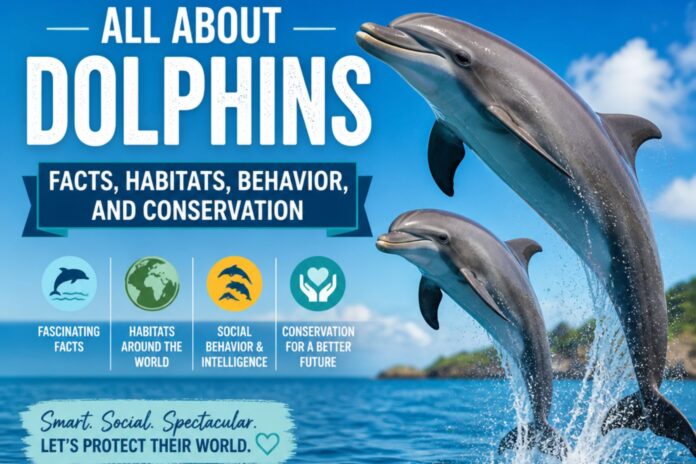
Dolphins are among the most fascinating animals in the ocean. Intelligent, playful, and highly social, they have captured human attention for centuries. Whether seen leaping from the water or moving in graceful pods, dolphins seem almost magical. But there is much more to them than their charm. Learning all about dolphins reveals just how complex and remarkable these marine mammals really are.
All About Dolphins
Dolphins are marine mammals, which means they breathe air, are warm-blooded, and nurse their young with milk. Although they live in water, they are not fish. Instead, they belong to the same group of animals as whales and porpoises.
There are more than 40 species of dolphins found in oceans and rivers around the world. Some live in coastal waters, while others prefer deep seas or freshwater rivers. The bottlenose dolphin is probably the most well-known species, but others, like the spinner dolphin and river dolphin, are equally interesting.
Where Dolphins Live
Dolphins live in many different environments across the globe. You can find them in:
- Warm tropical oceans
- Cooler coastal waters
- Deep offshore seas
- Major river systems in South America and Asia
Most dolphins prefer areas with plenty of food, such as fish and squid. Some species migrate with the seasons, while others stay in the same region year-round. Their ability to adapt to different habitats is one reason they are so successful.
What Dolphins Eat
Dolphins are carnivores, which means they eat other animals. Their diet usually includes:
- Fish
- Squid
- Crustaceans
- Small marine animals
Different species hunt in different ways. Some dolphins chase schools of fish together, while others use clever strategies to trap prey. Bottlenose dolphins, for example, may work as a group to corner fish or stir up sand to uncover hidden meals.
This teamwork shows how intelligent dolphins are. They don’t just hunt—they plan, communicate, and cooperate.
How Dolphins Communicate
One of the most amazing things about dolphins is how they communicate. They use a variety of sounds, body movements, and behaviors to interact with one another.
Common dolphin sounds include:
- Clicking noises
- Whistles
- Burst-pulse sounds
These sounds help dolphins locate food, recognize one another, and stay connected within their pod. Scientists believe that some dolphins may even develop unique signature whistles, almost like names.
Dolphins also communicate through physical gestures. They may leap, slap their tails, or swim in synchrony to send signals to the group.
Dolphin Intelligence
Dolphins are widely known for their intelligence. They have large brains relative to their body size and can solve problems, learn new skills, and remember complex tasks. In some studies, dolphins have shown the ability to recognize themselves in mirrors, which suggests a level of self-awareness.
They also display behaviors that point to emotional depth and social understanding. Dolphins help injured companions, protect young calves, and often stay close to members of their pod.
Their intelligence is one reason people are so drawn to them. Dolphins are not only beautiful animals—they are thoughtful, adaptable, and deeply social creatures.
Dolphin Social Life
Dolphins usually live in groups called pods. These pods may range in size from just a few individuals to dozens or even hundreds of dolphins.
Life in a pod offers many benefits:
- Protection from predators
- Easier hunting
- Support for young calves
- Social interaction and learning
Young dolphins stay close to their mothers for a long time, learning how to hunt, communicate, and navigate the ocean. The social bonds within a pod are often strong, and dolphins frequently cooperate to help one another.
Meet the Family
Dolphins and porpoises both belong to the toothed whale group, Odontoceti, and between them they make up nearly fifty species spread across six families. Oceanic dolphins, family Delphinidae, are the largest group by far, with roughly thirty eight species ranging from the five foot Maui’s dolphin to the orca, which is technically the largest dolphin on Earth even though almost nobody calls it one. A handful of species live only in fresh water: the river dolphins, spread across four separate families in the Amazon, the Orinoco, and historically the Ganges, Indus, and Yangtze river systems. And then there are the porpoises, family Phocoenidae, seven small, shy, blunt faced cousins that get mistaken for dolphins constantly but really shouldn’t be.
Here’s the fastest way to tell a dolphin from a porpoise, and I wish someone had told me this decades ago. Dolphins have a pronounced beaklike snout and cone shaped teeth built for grabbing fish, tend to be larger, and are the acrobatic, bow riding, leaping ones you picture when you hear the word. Porpoises have a blunt, beakless face, small spade shaped teeth, run smaller overall, and are noticeably shyer around boats and people. If it’s doing flips off your bow, it’s a dolphin. If it barely surfaces and vanishes the second it notices you, that’s a porpoise being exactly true to its nature.
Jump to a species:
- Bottlenose dolphin — coastal waters worldwide, including every Florida bay I’ve ever paddled
- Orca — every ocean on Earth, from the Arctic to Antarctica
- Spinner, spotted, and common dolphins — tropical and temperate seas worldwide
- River dolphins — the Amazon, the Orinoco, and Asia’s great rivers
- Porpoises — cooler coastal waters, and the Gulf of California’s vaquita
Bottlenose Dolphin
Tursiops truncatus is the dolphin most people have actually met, in the wild or otherwise, and the one I grew up around without ever thinking of it as anything special. It’s found in coastal and offshore waters practically worldwide, from temperate bays to tropical reefs, and it’s the species behind Florida’s most famous long term wildlife study, which gets its own full breakdown in my companion piece on Florida’s dolphins. Bottlenose dolphins live in fission fusion societies, meaning group membership shifts constantly rather than staying fixed, and individual animals recognize each other by signature whistles that function almost exactly like names.
Outside Florida, some of the most reliable, well managed wild encounters happen around Bimini in the Bahamas, where shallow, brilliantly clear sand flats host both bottlenose and Atlantic spotted dolphins that have been studied respectfully since the 1980s. New Zealand’s Bay of Islands and the Azores in the mid Atlantic both offer similarly good, ethically run boat based encounters.
Orca
The orca, Orcinus orca, is technically an oceanic dolphin, the largest one alive, reaching up to thirty feet and ten tons. It’s also one of the most widely distributed mammals on the planet, found from tropical waters to both polar ice caps. Scientists currently recognize around ten distinct ecotypes worldwide, populations that look similar but behave, hunt, and even vocalize so differently that they essentially function as separate cultures. In the Pacific Northwest alone, resident orcas hunt almost exclusively salmon and travel in tight, stable family pods, while transient or Bigg’s orcas hunt seals and other marine mammals in smaller, quieter groups, and rarely mix with residents at all.
The best documented orca population on Earth lives in the Salish Sea around Washington’s San Juan Islands and Canada’s Vancouver Island, where researchers have used photo identification since the 1970s to track individual whales across entire lifetimes. Norway’s fjords near Tromso draw huge winter gatherings of orcas following herring migrations, often with humpback whales feeding alongside them, and Iceland’s Snaefellsnes Peninsula offers a similar cold water spectacle.
Spinner, Spotted, and Common Dolphins
This trio covers some of the most acrobatic, easily recognized dolphins in the world. Spinner dolphins earn their name honestly, launching into the air and rotating multiple times before splashing back down, and they rest by day in sheltered bays after hunting offshore all night, which is exactly why Hawaii’s Kealakekua Bay, Egypt’s Sataya Reef, and Brazil’s Fernando de Noronha have become such reliable places to find them resting close to shore. Atlantic spotted dolphins, born plain gray and slowly developing their namesake spots with age, are the star attraction around Bimini, where they’re famously curious about swimmers and divers. Common dolphins travel in some of the largest pods of any cetacean, sometimes numbering in the thousands, and turn up reliably off the Azores and in New Zealand waters.
River Dolphins
Five living species never touch the ocean at all. The largest and best known is the Amazon river dolphin, or boto, found throughout the Amazon and Orinoco basins across seven South American countries. Botos are born gray and slowly turn pink with age, especially males, since the color comes largely from accumulated scar tissue built up over a lifetime of fighting other males, which means the pinkest dolphin in the river is very often also the toughest. They have unfused neck vertebrae, unlike ocean dolphins, giving them a flexibility of head movement that lets them maneuver through flooded forest branches most marine dolphins couldn’t dream of navigating.
The other river dolphins carry a heavier, more sobering story. The Ganges and Indus river dolphins of South Asia are both functionally blind, navigating entirely by echolocation in perpetually muddy water, and both are endangered by damming and pollution. The Chinese river dolphin, or baiji, once lived only in the Yangtze River and was declared functionally extinct in 2007 after a dedicated six week search failed to find a single individual, making it the first dolphin species driven extinct by human activity in modern history. I think about the baiji every time I read a hopeful headline about any endangered species, because it’s proof that the window for saving one can close for good.
Porpoises
Seven species make up this quieter, shyer branch of the family, found mostly in cooler coastal waters of the Northern Hemisphere, from the harbor porpoise common along the U.S. Atlantic and European coasts to Dall’s porpoise cutting fast, distinctive rooster tail splashes across the North Pacific. And then there’s the vaquita, Phocoena sinus, the smallest cetacean on Earth and, right now, the most endangered marine mammal on the entire planet. Found only in a small pocket of Mexico’s northern Gulf of California, the vaquita’s population crashed from an estimated 567 individuals in 1997 to as few as seven to ten today, almost entirely from accidental entanglement in illegal gillnets set for totoaba fish. A 2025 survey found reason for real, cautious hope, confirming at least one to two new calves born that year, evidence the tiny remaining population is still trying.
The Whole Social, Echolocating Life
Nearly every dolphin and porpoise navigates and hunts using echolocation, sending out rapid clicks and reading the returning echoes to build a sound picture of everything around them, prey, obstacles, even the internal structure of another animal’s body. Bottlenose dolphins layer individual signature whistles on top of that, essentially calling each other by name across open water, and orca pods maintain distinct dialects passed down through generations, different enough that researchers can often identify which pod is calling just from the recording. Social structure varies enormously across the family, from a bottlenose dolphin’s constantly shifting fission fusion groups to an orca’s stable, matriarchal, lifelong family pod, but nearly every species on this list is built around cooperation rather than solitude. Hunting together, raising calves together, and in more than one documented case, coming to the aid of an injured or distressed podmate.
Sand, Shallows, and the Nursery Effect
Dolphins don’t depend on sand the way a manatee depends on seagrass, but the connection is there if you know where to look for it. Shallow, sandy bays and flats, warm, calm, and full of small fish, function as nurseries for calves worldwide, which is exactly why Bimini’s white sand flats and Sarasota Bay’s protected, seagrass fringed shallows both became long term dolphin research sites rather than just pretty water. A soft sand bottom also means quieter, calmer conditions than an open, wave battered coastline, letting a mother dolphin teach a calf to hunt and echolocate somewhere the margin for error is a little more forgiving. Spotted dolphins around Bimini are even known to forage directly along the sand, nose down, tail up, digging small fish out of the bottom itself. The sand isn’t the whole story for a dolphin the way it is for a manatee, but it’s quietly shaping where the best dolphin nurseries on Earth happen to sit.
Rules Wherever You Go
The standard is the same in nearly every country that takes its marine mammals seriously: observe, don’t pursue. In U.S. waters, NOAA Fisheries recommends staying at least fifty yards from any wild dolphin or porpoise, cutting your engine to neutral if one approaches, and never feeding, touching, or attempting to swim with one uninvited. Feeding a wild dolphin is not a gray area anywhere responsible, it teaches the animal to associate boats and people with an easy meal, which reliably ends in that same dolphin getting struck by a propeller or hooked on fishing gear later. If you’re chartering a boat anywhere in the world, book with an operator that visibly limits time spent with any one group of animals and keeps a respectful, patient distance rather than one promising a guaranteed close encounter.
Threats to Dolphins
Even though dolphins are highly adaptable, many species face serious threats. Human activity has created problems in both ocean and freshwater environments.
Major threats include:
- Pollution
- Entanglement in fishing gear
- Habitat loss
- Noise from boats and ships
- Climate change
- Hunting in some parts of the world
Plastic waste and chemical pollution can harm dolphins directly or damage the fish they depend on. Loud underwater noise can interfere with their communication and navigation. Conservation efforts are essential to protect dolphin populations for the future.
Who’s Protecting Them
Whale and Dolphin Conservation works globally across nearly every species on this list, from stranding response to policy advocacy, and helped design the responsible viewing programs now used across multiple countries. The IUCN Cetacean Specialist Group coordinates the population science and Red List assessments behind every conservation status mentioned here. For the vaquita specifically, the International Committee for the Recovery of the Vaquita and Sea Shepherd Conservation Society run ongoing acoustic monitoring and anti gillnet patrols in the Gulf of California, the last, thinnest line standing between this species and extinction.
Curiosity Corner
What’s the actual difference between a dolphin and a porpoise?
Look at the face and the teeth. Dolphins have a pronounced beak and cone shaped teeth; porpoises have a blunt face and small, spade shaped teeth. Porpoises also tend to be smaller and considerably shier around boats.
Is an orca really a dolphin?
Yes, genuinely. The orca belongs to the oceanic dolphin family, Delphinidae, and is simply the largest member of it. The nickname killer whale predates modern taxonomy and just stuck.
Why is the Amazon river dolphin pink?
Mostly scar tissue. Botos are born gray and gradually turn pink as accumulated scars from fights, mostly among males, replace gray skin with pink tissue, which is why the oldest, most battle worn males tend to be the pinkest of all.
How do dolphins sleep if they have to keep breathing?
By resting one half of their brain at a time, a state called unihemispheric sleep. One eye stays open and one hemisphere stays alert enough to keep the animal breathing and aware of its surroundings while the other half genuinely rests.
Is it ever okay to swim with a wild dolphin that approaches me?
Stay still and let it choose, don’t chase or reach for it, and understand that in most countries, including the United States, deliberately initiating contact with a wild dolphin is illegal even when the dolphin seems interested in you.
Thoughts & Reflections
I have always loved seeing dolphins from as long as I can remember. Dolphins are extraordinary animals with complex behaviors, strong social bonds, and impressive intelligence. Their playful spirit makes them more intriguing and their family life is admirable. They live in oceans and rivers, hunt cooperatively, and communicate in sophisticated ways. At the same time, they face growing threats that make conservation more important than ever.
