



Jellyfish washing up on the sand is about as common a Florida beach sight as shells, and after a few days of steady onshore wind you’ll find them scattered along the wrack line almost everywhere in the state. I have a much older memory too, my mother pulling me out of the surf as a kid over a Portuguese man o’ war drifting toward me, faster than I’d ever seen her move. Florida hands you both experiences constantly, the harmless and the genuinely worth respecting, often within the same short walk.
Meet Florida’s Drifters
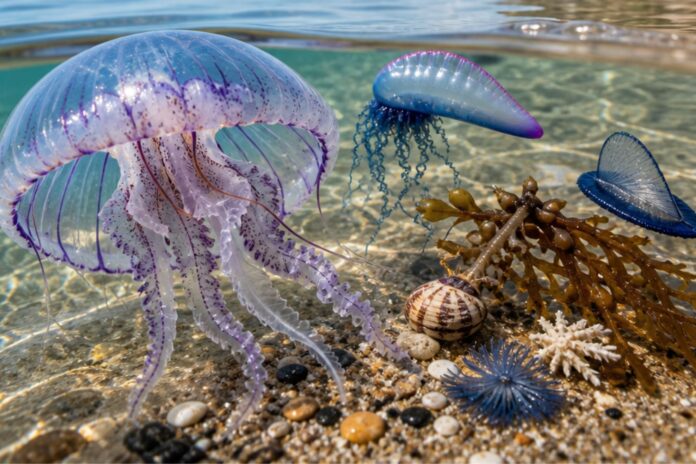
Florida’s coastal waters see a real mix throughout the warmer months: the common, mild stinging moon jellyfish, the equally common cannonball jellyfish, the more painful Atlantic sea nettle, the genuinely dangerous Portuguese man o’ war, an occasional true box jellyfish, and the seafloor dwelling upside-down jellyfish in the state’s mangrove lagoons and bays.
The Portuguese Man o’ War
This is the one that earns real respect, and my mother clearly knew that decades before I understood why. It isn’t technically a jellyfish at all, it’s a colony of specialized organisms working together under that one blue, wind catching sail, and its sting is treated differently than a true jellyfish sting: hot water instead of the vinegar rinse that helps with the others. Man o’ war sightings in Florida tend to arrive episodically rather than daily, often following sustained onshore winds that push them in from open water by the hundreds at once, and beach flags along the Panhandle and Gulf coast regularly go purple specifically because of this species. Even a stranded, deflated one on dry sand can still deliver a real sting, since the tentacles stay active for hours after the float itself has died, which is worth knowing before a curious kid reaches down to poke one.
The Cannonball Jellyfish
Stomolophus meleagris is Florida’s most harmless common jellyfish, a firm, round, cabbage shaped dome with no long trailing tentacles at all, and its sting is so mild that most people never notice being bumped by one in the water. It’s also, somewhat surprisingly, a genuine commercial fishery, harvested in bulk off Florida and Georgia and exported to Asian seafood markets, where jellyball, as the industry calls it, is a real and growing export product. Leatherback sea turtles rely on cannonball jellies as a major food source too, which makes this the rare jellyfish that’s simultaneously good news for beachgoers, valuable to a fishing industry, and quietly important to an endangered species all at once.
The Upside-Down Jellyfish at Lido Key
Genus Cassiopea is common throughout Florida’s mangrove lagoons and calm bay bottoms, especially around the Ten Thousand Islands and the Florida Keys, but one specific discovery deserves its own mention. In 2019, researchers with the Florida Fish and Wildlife Commission documented an extraordinarily dense population of upside-down jellyfish around Lido Key in Sarasota Bay, up to 121 individuals packed into a single square meter, a density rarely recorded this far north in the species’ range. If you’ve paddled or waded the bay side of Lido Key and noticed strange, cauliflower like shapes pulsing gently on the bottom, that’s exactly what you were looking at. They deliver only a mild sting through a cloud of stinging mucus rather than direct tentacle contact, but it’s still real enough that wading through a dense bed barefoot is worth avoiding.
The Sting You’re Actually Dealing With
The Atlantic sea nettle, brown striped and considerably more painful than a moon jelly or cannonball, is genuinely unusual among jellyfish for tolerating low salinity water, which lets it push well up into brackish rivers and estuaries most marine species avoid entirely. Florida also sees true box jellyfish, specifically Chiropsalmus quadrumanus, nearly transparent with thin, hard to see tentacles capable of a genuinely painful sting, though nowhere near as dangerous as Australia’s Chironex fleckeri. Florida beaches use a purple flag system to warn of dangerous marine life broadly, jellyfish, man o’ war, and stingrays alike, and it’s raised alongside the standard surf condition flag rather than replacing it, so checking both before you swim genuinely matters.
Why Blooms Happen When They Do
Florida’s jellyfish activity isn’t random, it tracks water temperature, wind, and current with real predictability. Warmer water through late spring and summer speeds up jellyfish reproduction and growth, which is exactly why bloom season runs heaviest from roughly May through October statewide. Wind direction matters just as much as temperature: the Gulf Stream and its associated currents ferry jellyfish and man o’ war colonies around the Gulf of Mexico and up the Atlantic coast, and a run of sustained onshore wind can push weeks’ worth of open water drifters onto the beach in a single afternoon. That’s also exactly why a stranded jellyfish on the sand is worth paying attention to even if you don’t see anything obvious in the water yet. Wind that pushed one ashore is very likely still pushing more in behind it.
A Note on Where They Actually Live
Most of what you’ll spot on this list spends its entire life drifting in open water and only ever touches sand at the very end, stranded after a storm or a shift in wind. The one real exception is the upside-down jellyfish, which needs exactly what a calm, shallow, sun warmed sandy or muddy bay bottom provides, a stable place to rest and enough sunlight reaching the seafloor to keep its symbiotic algae fed. Everything else on this list is really a visitor to the sand, not a resident of it, which is worth remembering the next time you find one stranded and assume it chose to be there.
The Panhandle
Perdido Key and the wider Emerald Coast, including Destin and the beaches of Walton County, see the state’s most frequent Portuguese man o’ war activity, arriving in episodic waves after sustained onshore winds rather than daily. Moon jellies and Atlantic sea nettles are the most commonly reported true jellyfish here, common enough that purple flags fly across all 26 miles of Walton County’s beaches during active bloom periods.
The Nature Coast & Big Bend
This quieter stretch of Gulf coast sees moon jellies and occasional cannonball jellyfish drifting through its clear, spring influenced water, generally in smaller numbers than the busier Panhandle beaches further west.
Tampa Bay
Cannonball jellyfish are common throughout Tampa Bay, largely harmless and often bumped into without much notice, and moon jellies drift through the same waters seasonally. The bay’s calm, sheltered bottom also supports upside-down jellyfish in select shallow, sunlit spots.
Southwest Florida
Behind Lido Key, Sarasota Bay hosts one of the densest documented upside-down jellyfish populations recorded anywhere this far north, discovered by FWC researchers packed at over a hundred individuals per square meter in 2019. Paddling or wading the bay side here, especially over calm, sun warmed flats, is your best chance in the entire state to see this genuinely strange, seafloor dwelling species up close. Further south, the mangrove backwaters of the Ten Thousand Islands near Naples and Everglades City hold their own resident Cassiopea populations, carpeting quiet basins on calm days.
The Space & Treasure Coasts
The Indian River Lagoon system, from Titusville down through Vero Beach, sees Atlantic sea nettles more often than the Gulf coast does, since this species tolerates the lagoon’s variable salinity better than most jellyfish. Man o’ war sightings occur here too, particularly on the barrier island beaches around Cocoa Beach and New Smyrna Beach after strong onshore wind events.
Southeast Florida & the Keys
Biscayne Bay and the beaches around Miami see the usual seasonal mix of moon jellies and cannonball jellyfish, and true box jellyfish, while uncommon, have been documented in South Florida waters. The Florida Keys hold some of the state’s most reliable upside-down jellyfish viewing, particularly in the calm, shallow seagrass and mangrove basins around Key West and the backcountry, where kayak tours regularly pass directly over resting “fields” of them on the bottom.
The Rules I Don’t Bend On
Never touch any jellyfish on the beach, stranded or not, since tentacles can sting for hours after the animal has died. For a true jellyfish sting, moon jelly, sea nettle, cannonball, or box jelly, rinse with vinegar to deactivate remaining stinging cells. For a Portuguese man o’ war sting specifically, use hot water instead, since vinegar can trigger a man o’ war’s cells to fire further rather than calm them. Always check the beach flags before entering the water, and treat a purple flag as a genuine heads up rather than background noise, especially on the Panhandle and Gulf coast during peak man o’ war season.
Who’s Researching Florida’s Jellyfish
The Florida Fish and Wildlife Conservation Commission conducts ongoing research into the state’s jellyfish populations, including the Lido Key upside-down jellyfish discovery, and Mote Marine Laboratory in Sarasota studies jellyfish blooms and their broader role in Gulf coast ecosystems. County beach safety programs statewide maintain the flag warning system and coordinate with lifeguards on real time jellyfish and man o’ war sightings throughout the summer season.
Questions I Get All the Time
Why do man o’ war sightings seem to come in waves rather than being constant?
They’re pure surface drifters with no ability to swim against wind or current, so sustained onshore winds can push large numbers ashore all at once, followed by stretches with none at all once the wind shifts.
Is it safe to touch a jellyfish that’s washed up and looks dead?
No. Stinging cells on tentacles, especially a man o’ war’s, can remain active for hours after the animal has died, so treat every stranded jellyfish as if it can still sting you.
What should I actually do if I get stung?
Rinse with vinegar for a true jellyfish sting, hot water for a man o’ war sting, and seek medical attention immediately if you experience difficulty breathing, chest pain, or a reaction covering a large area of skin.
Are the jellyfish sold as food the same ones stinging people at the beach?
Often the same species, yes. Cannonball jellyfish, Florida’s mildest common sting, is also the primary species harvested commercially and exported to Asian seafood markets.
Why did so many upside-down jellyfish show up at Lido Key specifically?
Researchers aren’t entirely certain, but the calm, shallow, sun warmed bay bottom on Lido Key’s bay side offers exactly the stable, sunlit habitat this species depends on for its photosynthetic algae to thrive.
Thoughts & Reflections
I keep coming back to how much of my own caution around the water was built long before I understood any of the biology behind it. My mother’s instinct that day wasn’t informed by a marine biology textbook, it was just a fast, protective read of something that looked wrong and needed distance immediately. Writing this piece finally gave me the words for what she already knew without them. I think that’s true of a lot of the wisdom passed down to us on beaches and everywhere else. The explanation often arrives decades after the lesson already did its job.
