



Meet the Loggerhead
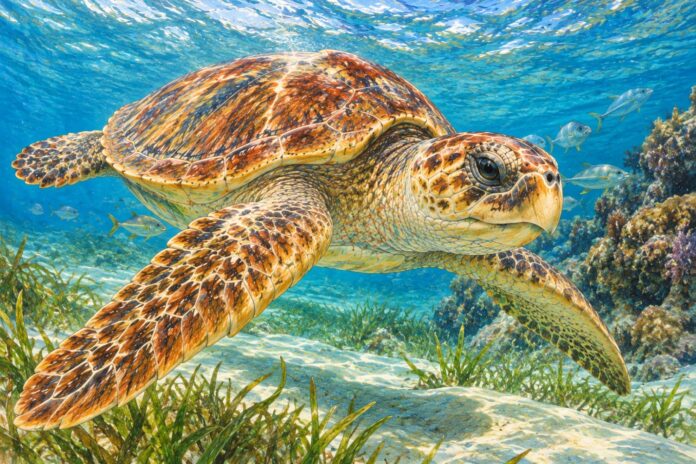
If sea turtles posed for a family portrait, the loggerhead would be the one in the front row with the biggest head, and that head is exactly where her name comes from. She is a heavy, powerful turtle, around 250 pounds as an adult, with jaws built to crack open whelks, conchs and crabs on the sea floor. She is not the largest, the rarest or the flashiest of the seven, but she may be the one most people will actually meet, because Florida hosts the largest loggerhead nesting aggregation on the planet. She is the dependable one, and she shows up on more shorelines than most people realize.
How to identify the Loggerhead Turtle
Look at her head first. It is wide and blocky, almost too large for her body, sitting on a thick neck, and it is the quickest way to tell her from a green turtle, who has a small, smooth, rounded head. Her shell is a long, heart-shaped reddish-brown, her belly is a yellowish cream, and if you count the big plates down each side of her shell you will find five pairs, where a green has four. You can find more of the details on NOAA’s loggerhead page. All that muscle is what she has to drag up the beach every time she nests, and that is where this story really starts.
The Sand for the Loggerhead
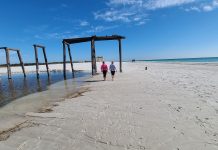
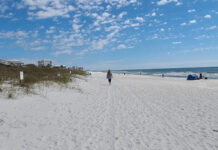
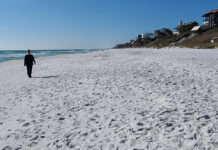
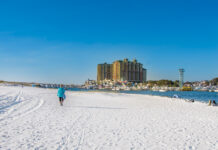
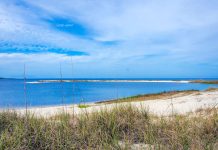
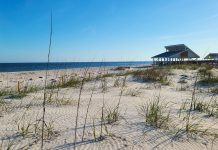
Every beach has its own personality in the sand itself, before you even look at the water. Some sand squeaks under your feet. Some holds a footprint like wet concrete. Some is so fine it blows sideways in a stiff wind and gets into everything you own. I used to think that was just a texture preference of mine, the sand nerd thing I do. Then I started paying attention to where loggerhead sea turtles actually choose to nest, and it turns out she’s just as particular about sand as I am. She’s not hauling herself up onto just any beach. She’s reading the ground the same way I do, just with better instincts and a much higher stake in getting it right.
A loggerhead needs sand that will hold a shape. Too fine and dry and the walls of her nest chamber collapse in on themselves before she’s done digging. Too coarse or rocky and she can’t dig efficiently at all. What she wants is somewhere in between, sand with enough structure to stay open while she works, well-drained enough that the eggs won’t sit in standing water after a summer storm, and set back far enough from the waterline that a normal high tide won’t reach the nest. She’s also choosing slope. Beaches with a gentle, gradual rise from the water tend to draw more nesting than beaches that go from flat sand to a steep dune wall with nothing in between. She needs room to work, and she needs to be able to get back down to the water again afterward without a fight.
Florida’s Quartz and the World’s Densest Nesting Ground
This is where I get to brag a little about my own coastline. The sand along Florida’s Atlantic coast is almost entirely quartz, tiny fragments worn down over thousands of years and carried south by longshore currents from as far away as the Appalachian Mountains. It’s fine, pale, and warm underfoot by midmorning, and it holds together just well enough to make a clean nest wall without turning to concrete. Peninsular Florida is the single largest loggerhead nesting aggregation on the planet, and once you’ve walked this sand at sunrise and found a fresh crawl in it, that stat stops being an abstract number and starts being something you can feel under your own feet.
The densest stretch of all runs from Brevard County down through the Treasure Coast into Palm Beach County, through the Archie Carr National Wildlife Refuge and past Juno Beach, one of the most nest-dense loggerhead beaches anywhere on Earth. This sand doesn’t look dramatic. It’s not black volcanic sand or pink coral sand. It’s just quiet, fine, pale gold sand that happens to be exactly what a loggerhead has been evolving to nest in for millions of years.
The Different Grain of the Mediterranean
Fly to Zakynthos, a Greek island in the Ionian Sea, and loggerheads are working an entirely different shoreline. Laganas Bay holds six separate nesting beaches, and researchers who study them describe each one as genuinely distinct, different slope, different sand color, different substrate composition, different level of human development pressing in from behind the dune line. Sekania, the most protected of the six, is closed to the public entirely and holds the highest nest density in the bay. The other five allow limited, carefully managed access. ARCHELON, the Sea Turtle Protection Society of Greece, has monitored this exact stretch of sand since 1984, and recorded roughly 2,155 nests across the bay in 2025 alone, a genuinely encouraging number for a nesting ground surrounded by one of the most visited tourist destinations in Greece.
What strikes me most about Zakynthos isn’t the nest count, it’s the contrast. The same species, the same nesting instinct, working a warm, pale Mediterranean sand instead of Florida quartz, with olive-covered hills behind the dunes instead of palm hammocks. Different sand, same ancient decision being made every summer night.
Oman’s Sand Against the Desert
Loggerheads also nest on Masirah Island, off Oman’s eastern coast, one of the largest loggerhead nesting concentrations anywhere outside Florida, though recent surveys suggest the numbers here have been sliding in a direction that worries the people who track it. What I find myself thinking about with Masirah is the sheer contrast in landscape, a nesting beach with open desert at its back instead of a resort strip or a state park boardwalk. Same sand-reading instinct in the turtle, an entirely different world surrounding it.
Australia’s Shoreline That Changes as You Walk It
Then there’s Mon Repos, fourteen kilometers outside Bundaberg on Queensland’s Woongarra coast, and it might be the strangest, most restless beach on this whole list. Visitors who walk its full length describe it changing character as they go, golden sand at one end giving way to shellgrit, then pebbles, then actual volcanic rock by the far end, all within the same six kilometers of protected shoreline. Mon Repos is the most significant loggerhead nesting site in the entire South Pacific, and it’s one of the only beaches on Earth where a loggerhead might be digging her nest a few hundred yards from a flatback or a green turtle doing the exact same thing, three species reading the same shifting, rock-strewn sand and each deciding it works.
The Crawl Itself
If you’ve ever tried to walk any real distance through soft, dry, ankle-deep sand, you already understand what a loggerhead is doing every single time she nests. She’s dragging roughly 250 pounds of herself up and out of the one environment where her body weight barely matters, into the one environment where every pound of it works against her. You can see the effort in the crawl itself, a wide, symmetrical track with deep flipper marks pressed into the softest part of the beach, sometimes a visible tail drag line down the center. The trip up is slower and messier than the trip back. Gravity and a lighter body do her a favor on the way home.
This is also, honestly, the whole reason I fell in love with reading beaches this way in the first place. A track tells you a true story about effort, in sand, the same way a trail tells you a story in dirt. You just have to know how to read it.
Country by Country: Everywhere She Nests and Feeds
I’ve walked you down a handful of famous beaches, but a loggerhead’s passport has a lot more stamps than that. So here is the wider map, sorted by ocean, with the countries where she nests first and the countries where she mostly feeds after. I’ve marked nesting as rare or sporadic wherever it is, because one nest on a beach and ten thousand nests on a beach are very different stories. The numbers shift every season, so treat them as a snapshot, and the regional assessments I leaned on are linked as we go, including the State of the World’s Sea Turtles loggerhead overview and NOAA’s loggerhead species page.
The Atlantic and the Gulf of Mexico: Where She Nests
- United States: Florida, Georgia, South Carolina and North Carolina on the Atlantic, plus Florida’s and Alabama’s Gulf beaches. NOAA counts more than 100,000 loggerhead nests a year across the country, most of them on Atlantic sand. Virginia sees the occasional nest at the northern edge.
- Mexico: the Yucatan Peninsula, where loggerheads nest on the Quintana Roo coast from spring into fall.
- Cabo Verde: the surprise on the list for most people. Boavista alone holds roughly 85 to 90 percent of the archipelago’s nesting, with more than 10,000 nests a year, and the southeastern Reserva Natural das Tartarugas packs about 60 percent of the nesting females onto roughly 15 kilometers of beach. It is described as the second-largest loggerhead population in the Atlantic and the third in the world, after Florida and Oman. Maio, Sal and Sao Nicolau add a few hundred nests each.
- Brazil: the Southwest Atlantic nesting population, centered on the beaches of Bahia, Espirito Santo, Sergipe and Rio de Janeiro.
- The Bahamas and Cuba: the northern edge of the Caribbean’s nesting clusters, according to the WIDECAST atlas of Caribbean nesting habitat. Elsewhere in the Caribbean, nesting is sparse.
- Mauritania and Guinea: a few nests, at the thin southern edge of the Northeast Atlantic population that is really Cabo Verde’s.
The Atlantic: Where She Feeds
Adults and juveniles forage in United States coastal waters from the Gulf of Mexico up the Atlantic seaboard, and loggerheads range as far north as Newfoundland in Canada. In the eastern Atlantic they feed off northwest Africa, around the Azores and as far south as the coast of Sierra Leone. In the southwest Atlantic, the feeding range runs from northern Brazil to southern Argentina.
The Mediterranean
The Mediterranean population is smaller than the giants above, but it is spread across more countries than any other basin. The country-by-country picture comes from the State of the World’s Sea Turtles Mediterranean review, and the figures below are from that 2018 snapshot.
- Greece: the biggest nesting country in the basin, with more than 6,000 nests in 2018. Kyparissia Bay and Laganas Bay on Zakynthos lead, with more beaches across the Peloponnese and Crete.
- Turkey: up to about 6,000 nests a year on 21 beaches, with Anamur, Belek and Dalyan holding roughly 65 percent of the national total.
- Cyprus: more than 2,200 loggerhead clutches islandwide in 2018.
- Libya: loggerheads nest here, though the number of females is unknown.
- Egypt: lower numbers, averaging about 67 loggerhead nests a year, mostly on a 22 kilometer beach on the North Sinai Peninsula.
- Israel and Lebanon: small numbers of nests, including the Tyre Coast Nature Reserve in southern Lebanon. Israel relocates nests to hatcheries.
- Syria: low-level nesting at several spots, with patchy data.
- Tunisia: regular nesting, especially on Kuriat Island, which gets about 25 nests a year.
- Italy: regular nesting on the southern Ionian coast and nearby islands, with a recent increase on western beaches.
- Spain, France and Malta: sporadic. Spain has logged roughly 42 loggerhead nests over about two decades, Malta has little sandy beach to offer, and a Languedoc nest in France is among the northernmost loggerhead nests in the world.
The feeding side is just as international. Tens of thousands of loggerheads, mostly Greek-born, spend the year in the waters off Montenegro, Croatia, Bosnia and Herzegovina and Slovenia, none of which have nesting beaches to speak of. Tunisia’s Gulf of Gabes is one of the basin’s most important feeding grounds, Albania’s Drini Bay is a possible overwintering spot, Greece’s Amvrakikos Bay is a notable feeding area, and Morocco and Algeria host loggerheads that nest elsewhere.
The Indian Ocean
- Oman: Masirah Island, the second-largest loggerhead nesting assemblage in the world, with more than 10,000 females a year in the earlier counts, though the trend is down. Yemen has a smaller amount of nesting.
- Sri Lanka: a tiny remnant, with fewer than 25 nests a year in the assessment.
- South Africa, Mozambique and Madagascar: the Southwest Indian population nests on the northeast coast of South Africa, southern Mozambique (Ponto d’Ouro supports most of that country’s loggerhead nesting) and southern Madagascar.
- Western Australia: loggerheads nest here too, with more than 2,500 females a year in the Southeast Indian population.
Feeding is widespread: the Gulf of Aden and the Arabian Gulf, around Sri Lanka and the Bay of Bengal, off Myanmar and Sumatra in Indonesia, north to Somalia, east to Seychelles, Mauritius and Reunion, and south around the Cape of Good Hope to coastal Namibia. Western and northern Australia, East Timor and Indonesia are part of the Southeast Indian feeding range.
The Pacific
- Japan: the only place in the entire North Pacific where loggerheads nest, on the east coast of Japan.
- Australia: Mon Repos and the Queensland coast, plus other beaches along eastern Australia.
- New Caledonia: smaller nesting, tied to the same South Pacific population as Australia. That population has dropped from about 3,500 nesting females a year in 1977 to about 500 today.
The Pacific is where feeding grounds get genuinely far from home. Hatchlings from Japan and Australia have been tracked feeding off Baja California Sur in Mexico, Peru and Chile, and loggerheads have been reported from Alaska to Chile. In the western Pacific they feed in the South China Sea off Vietnam, and Japan’s turtles also use the western United States coast.
Count them up and it’s dozens of countries and territories touched by this one species, from big-name nesting beaches to a quiet cove where a single juvenile is feeding on crabs. It is a good reminder that the beach is only the part of her life you can walk on.
Where You Can Go Stand on That Sand
If you want to see this in person, Juno Beach, through the Loggerhead Marinelife Center, runs guided nesting walks Tuesday through Saturday nights in June and July, on some of the densest loggerhead sand on the planet. In Greece, Zakynthos offers regulated, ARCHELON-supported access to several of the Laganas Bay beaches during nesting season, a completely different sand and light and landscape wrapped around the exact same behavior. And in Australia, Mon Repos, near Bundaberg, is the most significant loggerhead nesting site in the entire South Pacific and runs nightly ranger-led Turtle Encounter tours from November through March, worth the trip for the sand alone, let alone the turtles standing on it.
Thoughts & Reflections
I think what gets me most about loggerheads is how unglamorous their whole story is. They’re not the biggest, not the most colorful, not the rarest. They’re just the ones who show up, again and again, on beach after beach, year after year, and do the hard unseen work of dragging themselves somewhere difficult because it’s the right somewhere. I relate to that more than I probably should admit. Some of my best years didn’t look impressive from the outside either. They just required showing up on the right patch of ground and doing the digging.
And she doesn’t just do it once. A single female comes back to that same stretch of beach two, three, sometimes eight times in one season, a couple of weeks apart, no guarantee any given night will go better than the last one. That’s not a burst of motivation. That’s a habit, plain and unglamorous, repeated on faith. It’s the same thing I keep having to relearn about my own life, that the reinventions I’m proudest of never happened in one dramatic night on the sand. They happened because I kept crawling back up the same beach, again and again, on the nights I didn’t feel ready either, until eventually something took.
