



If sea stars are the slow, dignified grandparents of the echinoderm family, brittle stars are the fast, wiggly teenagers. They have thin, snaky arms, they scoot rather than crawl, and when you lift a rock at low tide, they are the ones that scatter. There are more species of brittle stars than of any other kind of echinoderm, and most people have walked right past hundreds of them without knowing.
Brittle Stars are among the most fascinating of the tiny wonders of the sea. They may not be as famous as sea stars, but brittle stars are every bit as captivating. If you’ve ever peered into a tide pool or lifted a rock at the right time, you may have seen one darting away in a graceful, spidery blur.
What Is a Brittle Star?
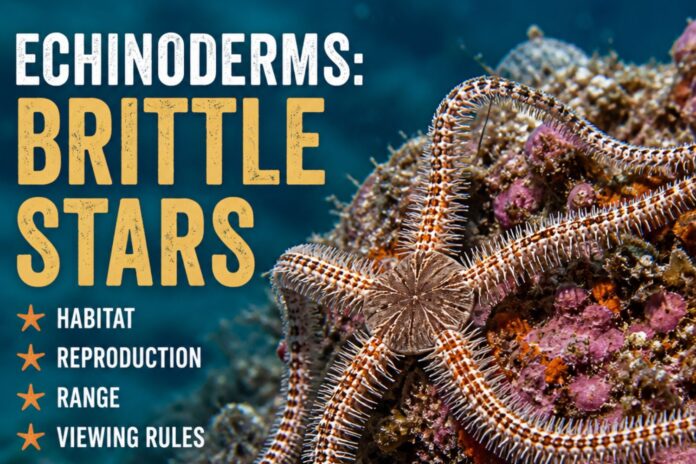
A brittle star is an echinoderm in the class Ophiuroidea. Like a sea star, it has a central disc and five arms, but the arms are slim, flexible, and clearly separate from the body, and they are covered in rows of small plates and spines.
Unlike sea stars, brittle stars do not move by using suction tube feet on their arms. Instead, they wiggle and snake their arms in a quick, elegant motion. It’s a little like watching a tiny underwater dancer.
Their arms are also more fragile than those of sea stars, which is where their name comes from. If an arm breaks, many species can regrow it later. That’s one of the many cool survival tricks in the ocean.
Brittle stars have no brain and no eyes, though their whole body works as a light sensor. Look at a brittle star’s mouth, on the underside, and you will see five jaws, which are used for scraping and crunching.
How Many Species of Brittle Stars Are There?
About 2,064 species, which makes brittle stars the largest class of echinoderms. They live in every ocean, in shallow sand and in the deep sea, and in some places they pack the seafloor in huge numbers. Here are the ones you are most likely to meet:
- Reticulated brittle star, Ophionereis reticulata: a pale, patterned brittle star of Florida and the Caribbean, with a net like pattern on its disc. It was first described from the Florida Keys.
- Spiny brittle star, Ophiocoma echinata: a dark Caribbean species that hides under rocks and rubble.
- Short-spined brittle star, Ophioderma brevispinum: a large, tough brittle star of the Atlantic coast of the United States.
- Sponge brittle star, Ophiothrix suensonii: a spiky, colorful brittle star that lives in sponges on Florida and Caribbean reefs.
- Giant basket star, Astrophyton muricatum: a Caribbean relative whose arms branch into a tangle, most active at night.
- Daisy brittle star, Ophiopholis aculeata: a strikingly patterned northern species of the Atlantic and Pacific.
- Burrowing brittle star, Amphiodia occidentalis: a sand burrower of the West Coast of the United States.
How Do Brittle Stars Move?
By rowing. A brittle star swings its arms in a coordinated pattern, with some arms reaching forward and some pushing back, and it scoots across the bottom in a series of quick, snaky motions. Their tube feet do not have suction cups the way a sea star’s do. They are used to sense the world and pass food to the mouth.
This arm rowing is quick enough to surprise you. Flip a rock and a brittle star may race for cover in a second or two, which is not something you expect from an echinoderm.
What Do Brittle Stars Eat?
Almost anything small. Some are scavengers that pick up dead animals and bits of debris. Some are deposit feeders that sweep particles off the sand with their arms and tube feet. Others hold their arms up into the current and catch drifting plankton in sticky mucus, passing the catch to the mouth. Basket stars, which are close cousins, climb onto coral at night and spread their branching arms out like fishing nets. A brittle star’s diet is flexible, and the animal changes its menu to match what is available. That adaptability helps explain why there are so many of them.
How Do Brittle Stars Reproduce?
Brittle stars reproduce in a few different ways, depending on the species. The most common method is sexual reproduction, where males and females release eggs and sperm into the water. Fertilization happens outside the body, and the young drift as tiny larvae before settling to the seafloor.
Their reproductive styles can include:
- Broadcast spawning: eggs and sperm are released into the water
- Larval development: babies float as plankton before becoming adults
- Asexual reproduction in some species: parts of the body can split and form new individuals
That last one is especially impressive. Nature loves a backup plan, and brittle stars have one built right in.
This ability helps them survive in tough environments and recover from damage. It’s one reason echinoderms are such successful marine animals.
Brittle Stars and Sand: The Periscope Trick
This is where brittle stars get really fun for a sand person. A lot of brittle stars live buried in the sand, and they look like nothing at all, until you notice a few thin arm tips poking up through the surface. Those arms are the periscope and the dinner net, waving in the current to catch what drifts by, while the rest of the animal stays hidden in the sand and safe from predators.
In some places, brittle stars bury themselves in such huge numbers that the seafloor is a living carpet of waving arms. On a sandy bottom, they are also part of the cleanup crew, and they are food for fish and crabs, which means they connect the tiny particles in the sand to the bigger animals above it.
On a beach, the sand behind the waterline holds an entire hidden world of burrowers you will never see, and brittle stars are among the best at the disappearing act. If you ever find a tiny star shaped imprint in wet sand, you may have found where one was resting.
How to See Brittle Stars
Brittle stars are true world travelers. They live in oceans across the globe, from shallow coastal waters to the deep sea. If there is a seafloor to cling to, chances are brittle stars may be nearby.
They are especially common around reefs in places like the Caribbean, Indo-Pacific islands, and other tropical marine zones. But don’t assume they belong only to warm waters. Brittle stars thrive from shallow tide pools to the darkest deep-sea plains. That wide distribution makes them one of the most successful groups of echinoderms on the planet.
Great places to look:
- Tide pools at low tide
- Under flat rocks near the shore
- Around coral reefs while snorkeling
- Kelp forests
- Aquariums and marine science centers
Many species hide during the day and come out at night to feed. Others live buried in sediment, with only their arms reaching out to catch food from the water. If you’re exploring at low tide, look carefully under stones or among seaweed. Brittle stars often tuck themselves into crevices, so move slowly and gently. A flashlight during a night reef walk can also reveal their hidden movement.
In beachy, warm-water places, you might spot brittle stars near reefs or in tide pools. In colder seas, they are often found under stones or in kelp forests. In the deep ocean, they can be incredibly abundant, carpeting the seafloor in numbers that are hard to imagine.
Popular Destinations to See Brittle Stars Around the World (and the Rules for Each)
Florida and the Florida Keys
Look for reticulated brittle stars and other species under rocks and in rubble on the reef flat at low tide, in sponges on the reef, and in the sandy seagrass beds along the coast. The Florida Keys National Marine Sanctuary protects living animals within its boundaries, and Florida’s marine life rules and park rules apply elsewhere. Check the FWC’s sea shell page before collecting anything. The best approach is to look, photograph, and replace.
The Caribbean
Brittle stars are everywhere on Caribbean reefs. Some hide under rocks, some live in sponges, and basket stars come out at night. A night snorkel or dive with a guide is the best way to see basket stars unfurl. Rules vary by island, and local guides know them best.
Panama
Bocas del Toro’s reefs, rubble, and grass flats are full of brittle stars, though you often have to look closely or go at night. A boat trip with a guide who knows the reefs is a good way to see them. Panama protects its marine life, and the simplest approach is to leave everything where you found it.
The Pacific Coast: Washington, Oregon, and California
Tide pools and sandy flats up and down the coast hold brittle stars, including the burrowing brittle stars of West Coast sand. In Washington and Oregon, intertidal animals are protected from most collecting. California requires a fishing license for most collecting, and marine protected areas generally ban it altogether. As elsewhere, replace every rock the way you found it.
The Atlantic Coast of the United States
From the Carolinas to New England, short-spined brittle stars and others live on rocky shores and sandy bottoms. Low tide on a rocky New England shore is a good time to look.
Northern Europe and the Deep Sea
Some of the largest brittle star beds on Earth are found on the seafloor off northern Europe, where dense populations of burrowing brittle stars carpet the bottom. Brittle stars are also among the most common animals of the deep sea. You will not see those on a beach walk, but it is nice to know they are there.
A Final Shoreline Thought
There’s something deeply satisfying about knowing that beneath the surf and sand, a whole hidden world is moving, feeding, and thriving. Brittle stars are one of the ocean’s most charming surprises: ancient, adaptable, and wonderfully strange in the best possible way.
So next time you’re walking the beach, stop for a moment. Look under a rock, peer into a tide pool, or watch a reef edge with fresh eyes. The sea is full of small marvels, and brittle stars are one of its most elegant little secrets.
Can You Touch Brittle Stars?
You can, but you shouldn’t. A brittle star is fragile, and picking it up can make it drop an arm, which costs it time and energy to regrow. That arm loss is a defense and not a harm, but it is a stress, and we are asking for it every time we handle one. The best way to meet a brittle star is to lift a rock gently, look, and put the rock back exactly the way you found it, with the same side down. A rock turned upside down can kill the animals that live under it and on it. Take your photo, put the rock back, and move on.
Here’s the simple beach-lovers’ rule: admire, don’t disturb.
If you’re visiting a protected area, follow local rules carefully. Some beaches and marine reserves have strict no-collecting policies to protect fragile ecosystems.
Respecting wildlife means future beachgoers can enjoy the same magic. And honestly, part of the wonder is watching a brittle star slip under a rock and disappear like a secret.
Who’s Protecting Brittle Stars
Brittle stars are not just pretty seafloor residents. They help keep marine ecosystems healthy by feeding on detritus, tiny particles, and small organisms. In doing so, they help recycle nutrients and clean up the ocean floor.
They are also food for other animals, making them an important link in the marine food web. In the great ocean story, brittle stars may be quiet characters, but they matter deeply.
Most brittle stars are not individually listed or fished, but they depend on healthy bottoms and reefs. The Florida Keys National Marine Sanctuary protects reef habitat, the Florida Fish and Wildlife Conservation Commission manages marine life collecting, and the World Register of Marine Species keeps the official list of species. Researchers at institutions like the Smithsonian study brittle star diversity, which is still being discovered.
Brittle Star Curiosity Corner
Are brittle stars and starfish the same thing?
They are cousins. Both are echinoderms, but brittle stars have thin, snake like arms that are clearly separate from a central disc, and they move much faster than sea stars.
What do brittle stars eat?
Small particles, plankton, and dead animals. Different species scavenge, sweep sand for food, or catch drifting plankton on their arms.
How do brittle stars move?
They row themselves along with their flexible arms, swinging some forward and pushing with others. They do not use their tube feet for crawling the way sea stars do.
How do brittle stars reproduce?
Most spawn into the water, some brood their young, and a few six armed species can split in two.
How many species of brittle stars are there?
About 2,000, and more than 2,060 by some counts, which makes them the largest group of echinoderms.
Can brittle stars regrow their arms?
Yes. They drop arms to escape predators and regrow them, which can take about two years in some species.
Can you touch a brittle star?
It’s best not to. Handling can make one drop an arm. If you lift a rock to look, put it back exactly as it was.
Do brittle stars live in sand?
Many do. They bury themselves with only the tips of their arms sticking out to catch food, and sometimes they live in huge numbers.
What is a basket star?
A close relative of the brittle star with arms that branch into a tangled mass. Basket stars climb up to feed at night and curl up during the day.
Where can I find brittle stars in Florida?
Under rocks and rubble on reef flats, in sponges, and in sandy seagrass beds, especially in the Keys. Look gently and replace anything you move.
