









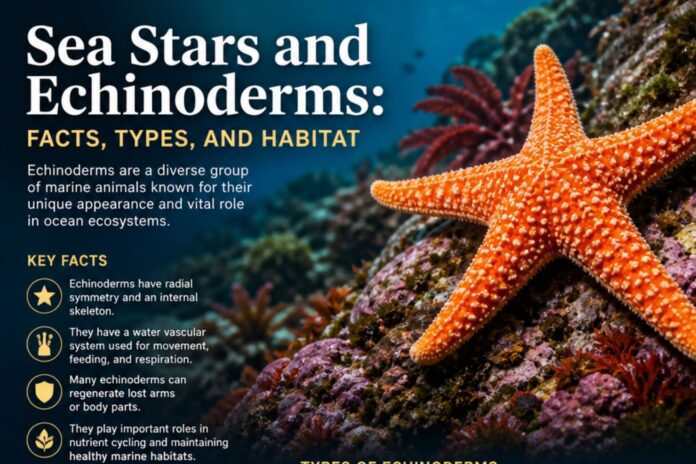
There’s a particular stillness to a sea star that nothing else on a beach quite has, that patient, five armed shape that looks like it’s waiting for something, even though it isn’t waiting for anything at all. This whole group, sea stars, urchins, sand dollars, cucumbers, and their stranger cousins, moves through the world so slowly and so quietly that most people walk right past the most genuinely bizarre biology in the entire ocean without ever realizing it.
A Closer Look at Nature’s Most Fascinating Invertebrates
Sea stars and other echinoderms are some of the most unusual animals in the ocean. They may look simple at first glance, but they have remarkable bodies, unique behaviors, and an ancient evolutionary history. From bright sea stars clinging to rocks in tidal pools to deep-sea creatures living thousands of feet below the surface, sea stars & echinoderms reveal just how diverse marine life can be.
What Are Echinoderms?
Echinoderms are a group of marine invertebrates that include:
- Sea stars
- Sea urchins
- Sand dollars
- Brittle stars
- Sea cucumbers
- Crinoids
The word echinoderm comes from Greek and means “spiny skin.” This name fits many members of the group, especially sea urchins and some sea stars, which have rough or spiny surfaces.
What makes echinoderms so special is that they all share a few key features:
- They live only in marine environments
- They have radial symmetry as adults, usually in five parts
- They possess a water vascular system
- They move using tube feet
- They can often regenerate lost body parts
These traits make them very different from most other animals, including fish, crustaceans, and mollusks.
Sea Stars: More Than Just Pretty Shapes
Sea stars are probably the most familiar echinoderms. Their star-shaped bodies and colorful arms make them a favorite of beachgoers and marine life enthusiasts alike. But sea stars are much more than decorative ocean creatures.
A sea star usually has a central disc and five arms, though some species have many more. Their bodies are built on a radial plan, which helps them interact with the environment from all directions. This is useful for animals that live on the seafloor and may encounter food or danger from any angle.
How Sea Stars Move
Sea stars do not have legs, fins, or even a conventional skeleton. Instead, they rely on hundreds of tiny tube feet on the underside of their bodies. These tube feet are controlled by a hydraulic system powered by seawater.
This allows sea stars to:
- Crawl slowly across rocks and sand
- Grip onto surfaces
- Open shellfish like clams and mussels
- Detect their surroundings
Their movement may seem slow to us, but it is highly effective for a bottom-dwelling predator or scavenger.
How They Eat
One of the most fascinating things about sea stars is their feeding method. Many species prey on bivalves such as clams and oysters. They use their arms and tube feet to pry open the shell just enough to push part of their stomach outside their body. This process is called external digestion.
The sea star’s stomach releases enzymes that begin breaking down the prey before the animal pulls the stomach back inside. It is one of the most unusual feeding strategies in the animal kingdom.
The Echinoderm Body Plan
Echinoderms have a body plan that is unlike most other animals. While many animals are bilaterally symmetrical, meaning the left and right sides mirror each other, adult echinoderms usually have pentaradial symmetry. This means their body parts are arranged in five sections around a central point.
Even though adult echinoderms are radially symmetrical, their larvae are often bilaterally symmetrical. This suggests that their development changes dramatically as they grow.
Another major feature is the water vascular system. This system is made up of fluid-filled canals and tube feet, and it helps with movement, feeding, and gas exchange. It is one of the defining characteristics of the group.
Meet the Family
Echinoderms take their name from the Greek for spiny skin, and the phylum includes roughly 7,000 species split across five living classes, every single one of them exclusively marine. Nearly all echinoderms share five-part radial symmetry, a body plan built around a central point in multiples of five rather than the left-right symmetry most animals use, and nearly all of them move using a genuinely strange internal plumbing system called the water vascular system, a network of fluid filled canals that hydraulically extends thousands of tiny tube feet to walk, grip, and feed. Perhaps the single most remarkable trait shared across this entire family is regeneration. Many species can regrow a lost arm, and a few can regenerate an entire new individual from nothing more than a single arm with a fragment of central disc still attached, essentially surviving being torn in half by becoming two.
Jump to a group:
- Sea star — every ocean on Earth
- Sand dollar — sandy shallows worldwide
- Sea urchin — reefs, rocky coasts, and kelp forests worldwide
- Sea cucumber — every seafloor on Earth, shallow to deep
- Brittle star — reefs, rubble, and sand worldwide
- Crinoid — reef structure and deep water worldwide
Sea Star
Class Asteroidea includes roughly 1,500 species, nearly all built around the familiar five arm shape, though several species carry ten, twenty, or even more. A sea star hunts using its cardiac stomach, an organ it can actually push out through its own mouth and insert directly into the gap between a clam or mussel’s shells, digesting the prey externally before drawing everything, stomach included, back inside. One species deserves a harder look than the rest: the crown-of-thorns starfish, a coral predator native to the Indo-Pacific whose populations periodically explode into genuine outbreaks, stripping a reef of up to ninety percent of its living coral tissue and remaining one of the leading documented causes of coral loss on Australia’s Great Barrier Reef over the past forty years.
Most of the sea stars people actually encounter live clinging to rock, reef, or piling rather than sand, but an entire group, the sand sifting sea stars in genus Astropecten, does the opposite, living completely buried just under the surface of sandy or muddy seafloor, only the very tips of their arms occasionally breaking the surface as they plow slowly through the sediment hunting buried mollusks and crustaceans. For this group, sand isn’t just habitat, it’s actively excavated real time hunting ground, reworked constantly as the animal moves.
Sand Dollar
A sand dollar is really a sea urchin that flattened itself into a disc, and living, it looks nothing like the bleached white find on a beach towel, it’s covered in a dense, velvety coat of short, purple-gray to brown spines that give it a fuzzy texture and, along with its tube feet, do all its moving, burrowing, and feeding. Sand dollars filter fine organic particles and algae straight out of the water and sediment using thousands of tiny spines dense enough to keep grains of sand from slipping through but fine enough to let food particles drop free onto threads of mucus that carry it to the mouth on the underside.
No animal in this entire article has a more literal, complete relationship with sand than the Sand Dollar. A resting sand dollar in calm water stands upright, angled into the current with roughly a third of its body buried, using that position to filter the maximum amount of passing water for food. In rougher water, it lies flat or burrows fully under to avoid being swept away, and here’s the detail that genuinely surprised me most in all my research for this piece: a young sand dollar, still too light to hold its ground against a strong current, will actually swallow heavy sand grains on purpose and keep them inside its body as ballast, weighting itself down the same way a sailor might load stones into a ship’s hold. It solves the problem of being too light for the world it lives in by eating rocks.
Sea Urchin
Sea urchins carry the family’s spines most literally, a dense forest of long, sharp, sometimes genuinely dangerous spikes covering a round, hard test, all mounted on ball and socket joints that let the animal aim them toward a threat from any direction. Underneath, a sea urchin’s mouth holds a remarkable five part chewing structure called Aristotle’s lantern, named for the philosopher’s own description of it, strong enough to scrape algae directly off solid rock.
Sea urchins are overwhelmingly reef and rock dwellers rather than sand dwellers, wedging into crevices and grazing rock and coral surfaces bare, and their relationship with a healthy kelp forest or reef is genuinely a balancing act. In normal numbers, urchins keep algae growth in check. Left unchecked by predators like sea otters, however, urchin populations can explode and graze an entire kelp forest down to bare rock, a devastated state scientists call an urchin barren that can persist for decades once established. A smaller group of burrowing and heart shaped urchins does live in soft sand and mud, excavating shallow depressions and processing sediment in bulk for the organic material trapped within it, but for most urchin species, sand is scenery rather than home.
Sea Cucumber
Sea cucumbers are the family’s soft bodied oddballs, elongated, sluggish, and built more like a squat, leathery worm than anything resembling a star or an urchin, though their five rows of tube feet and internal water vascular system give away the relation instantly under a microscope. Roughly 1,250 species exist worldwide, and their most reliable defense against a predator is genuinely bizarre: several species can eject part of their own internal organs, sometimes through the mouth, sometimes through the anus, as a sticky, tangling distraction, then simply regrow what they lost.
Of every animal in this entire article, the sea cucumber’s relationship with sand goes deepest, literally, since sand and sediment aren’t just where it lives, they’re what it eats. A sea cucumber crawls slowly across the seafloor ingesting enormous quantities of sand and mud, extracting the bacteria, algae, and organic material coating each grain, and expelling clean, processed sand behind it. On a single healthy reef, researchers have measured sea cucumber populations processing tens of thousands of tons of sediment a year, a scale of quiet, continuous seafloor cleaning that plays a genuine, measurable role in reef health, buffering acidity and recycling nutrients other reef animals depend on.
Brittle Star
Brittle stars look like a sea star’s more delicate cousin, five long, thin, whip like arms radiating from a small central disc, but the resemblance is mostly superficial. A brittle star’s arms contain no internal organs at all, unlike a true sea star’s, and they move with a genuinely fast, sinuous, snake like motion rather than the slow tube foot crawl most people associate with the whole family, which is exactly how the group earned its name, since those arms will detach in an instant, sacrificed to a predator, if grabbed.
Most brittle stars spend daylight hours hidden under rocks, coral rubble, or burrowed into sand and mud with only the tips of their arms extended into open water to feed, retreating fully out of sight at the first sign of a threat or bright light. Some sandy bottom species live in genuinely dense aggregations, hundreds of individuals per square yard, their arms creating a rippling, faintly unsettling carpet of movement across an otherwise still stretch of seafloor.
Crinoid
Crinoids, the sea lilies and feather stars, are the most ancient body plan in this entire phylum, and fossil evidence suggests the very first echinoderms looked something like a crinoid: an upside down, stalked animal filter feeding from a fixed position, tube feet originally evolved for capturing passing food rather than walking at all. Sea lilies still live exactly that way today, permanently anchored to the seafloor by a long stalk, while feather stars represent a later, more mobile branch of the same family, able to detach and swim in a slow, undulating motion when they need to relocate.
This is the true outlier of the entire article, an echinoderm with essentially no relationship to sand at all. Crinoids anchor to hard reef structure, rock, or deep coral rubble, holding their feathery arms up into open water current to filter feed, and a soft, shifting sand bottom offers this animal nothing to hold onto, no purchase for a stalk, no current worth filtering food from at ground level. Wherever you find a healthy crinoid population, you’re looking at structure, not sediment.
Regeneration and Survival
One of the most amazing abilities among sea stars and other echinoderms is regeneration. Some species can regrow lost arms, and in certain cases, an entire animal can regenerate from a single arm if part of the central disc remains attached.
This ability helps them survive attacks from predators. If a sea star loses an arm, it may still escape and later rebuild the missing part. Regeneration is not just useful for survival; it also makes echinoderms a major subject of scientific study.
Researchers are interested in how these animals repair tissue, regrow organs, and recover from injury. Their biology could offer clues for future medical advances in humans.
Rules Wherever You Go
Here’s the detail that trips up more people than almost anything else in this entire wildlife series: unlike a shell, most echinoderms have no empty version. A dried, motionless sea star washed up on the sand isn’t a discarded shell the animal has left behind, it’s very often the animal itself, alive, stressed, and in genuine trouble. If you find one stranded above the waterline, the kindest and simplest thing to do is gently return it to shallow water rather than assuming it’s already gone. Never harvest a live sea urchin, sea star, or sea cucumber without confirming local regulations first, since bag limits, size limits, and outright species prohibitions vary enormously by country and region, and reef managers around the world increasingly rely on public reporting of outbreak species like the crown-of-thorns starfish, so a genuine sighting is worth reporting to local marine authorities rather than simply photographing and moving on.
Threats Facing Sea Stars and Other Echinoderms
Despite their resilience, echinoderms face a number of threats. Ocean warming, pollution, habitat loss, and disease can all affect their populations. Sea stars in some regions have suffered severe die-offs caused by sea star wasting disease, which has had dramatic ecological effects.
Other challenges include:
- Rising sea temperatures
- Ocean acidification
- Coastal development
- Runoff and contamination
- Overharvesting in some regions
Protecting marine ecosystems helps protect echinoderms as well. Healthy oceans support healthy populations of these important animals.
Who’s Protecting Them
The Great Barrier Reef Marine Park Authority runs an active, ongoing crown-of-thorns starfish control program, training divers to manage outbreak populations directly on affected reefs. The IUCN Red List tracks conservation status across the phylum, and sea cucumber populations specifically have drawn growing international attention as global harvest for the seafood trade has pushed past a billion animals removed annually, a rate several marine researchers now consider unsustainable across much of the group’s range.
Curiosity Corner
Can a sea star really grow a whole new body from one arm?
In some species, yes, but only if a piece of the central disc stays attached to that arm. An arm alone, with no disc tissue, generally cannot regenerate a complete new animal.
Why do sand dollars look so different alive versus dead?
A living sand dollar is covered in a dense coat of short, moving spines that give it a fuzzy, often purple-brown appearance. The smooth white disc found on a beach is the bleached, spine-free skeleton, called a test, left behind after death.
Is it true sea urchins can go blind or lose their spines and recover?
Sea urchins can regenerate lost spines and tube feet throughout their lives, though the process takes time, and a heavily damaged individual is more vulnerable to predation in the meantime.
Do sea cucumbers actually eat sand on purpose?
Yes, genuinely, and it’s their primary feeding strategy. They ingest large volumes of sand and sediment specifically to extract the bacteria, algae, and organic material coating each grain, expelling clean sand behind them.
Why are crown-of-thorns starfish considered a problem if they’re native to the reef?
In normal numbers they’re a healthy part of the ecosystem, but periodic population explosions let them strip far more coral than a reef can regenerate between outbreaks, causing measurable long term decline.
A Lasting Fascination
Sea stars & echinoderms continue to capture human curiosity because they are so unlike us. They are simple in shape but complex in function, ancient in origin yet still essential to modern ocean life. Their strange bodies, unique feeding habits, and incredible regenerative powers make them one of the most captivating groups in the animal kingdom.
Whether you see them in a tide pool, an aquarium, or through a microscope, echinoderms offer a reminder that the ocean is full of extraordinary life forms waiting to be understood.
