







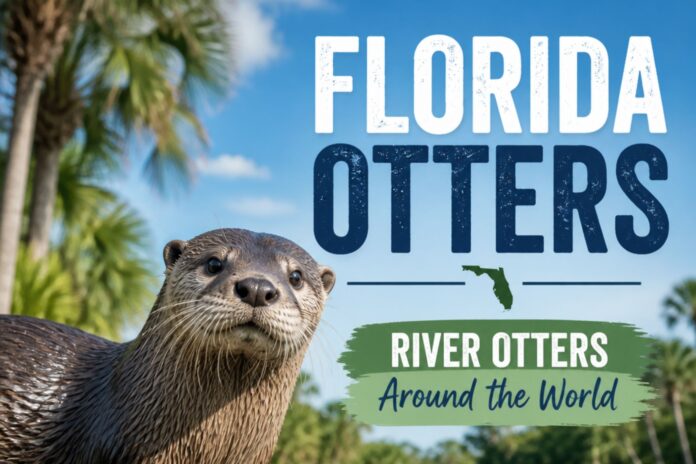
Florida’s waterways are home to one of North America’s most familiar mammals: the Florida river otter. These sleek, playful animals often show up in freshwater marshes, swamps, lakes, and rivers, where they hunt, swim, and slide through the landscape with ease.
River Otters are not on Florida beaches. Florida’s only otter species, live in fresh and brackish water, not the open surf, so think of this less as a “what you see on the beach” and more as a “what’s just inland of the sand” list, since so many of these spots sit only a short paddle or drive from the coast.
Meet Florida’s Actual Otter
The otter most people see in Florida is the North American river otter (Lontra canadensis). This is the same species found across much of the United States and Canada, though the animals in Florida are adapted to the state’s warm, wet environment.
Unlike its Pacific cousin, the river otter retains a normal layer of body fat alongside its dense, water repellent fur, moves comfortably on land as well as in water, and lives in freshwater, brackish, and even coastal marsh habitats rather than the open ocean. An adult runs three to four feet long including its thick, tapering tail, weighs between eleven and twenty five pounds, and can hold its breath underwater for eight minutes or more while hunting fish, crayfish, frogs, and the occasional small bird or turtle.
These otters are usually smaller and more streamlined than many people expect. They have:
- Long, flexible bodies
- Thick, water-resistant fur
- Webbed feet for swimming
- Strong whiskers for detecting prey underwater
River otters are found in every part of Florida except the Keys, living in family groups centered on a mother and her current litter, denning in burrows called holts dug into a stream or lake bank with an underwater entrance. They’re also, by most accounts, seriously understudied here. Despite being common enough that plenty of Floridians have watched one slide down a muddy bank purely for fun, there’s remarkably little active, ongoing research on the species anywhere in the state, which is its own quiet reminder that “common” and “well understood” aren’t always the same thing.
How Florida Otters Compare to Sea Otters
Because sea otters are often the best-known otters in the U.S., it helps to compare them with Florida’s river otters. Sea otters live in ocean waters along the Pacific coast and are built for a marine lifestyle. Florida’s otters, on the other hand, are freshwater and brackish-water animals.
Here are a few key differences:
- Habitat: Sea otters live in marine environments; Florida otters live in rivers, lakes, swamps, and estuaries.
- Body shape: Sea otters are bulkier and have denser fur to survive cold ocean water.
- Behavior: Sea otters often float on their backs while feeding; river otters are more likely to travel along shorelines and dive repeatedly.
- Range: Sea otters are limited to the Pacific; river otters have a much wider global distribution through freshwater systems.
Both kinds of otters are skilled swimmers and important predators in their ecosystems, but they have evolved for very different worlds.
Why Sea Otters Will Never Call Florida Home
Sea otters are built entirely around one specific kind of coastline: cold, nutrient rich water, thick with kelp forests and the shellfish that grow in them. Florida’s Gulf and Atlantic waters are warm nearly year round, hold no kelp at all, and never have, not in any fossil record, not in any historic range map. The sea otter’s entire body, its total reliance on fur instead of blubber, its metabolism, its diet, is a solution to a cold water problem Florida simply doesn’t have. This isn’t a case of an animal being rare here the way a right whale is rare here. It’s a case of an animal that has never belonged here at all, and that’s a perfectly fine thing for a place to be honest about.
Freshwater Cousin, Similar Spirit
River otters share a lot of the same personality that makes sea otters so beloved, minus the kelp and the tools. They’re highly social, playful animals that slide down muddy banks apparently for no reason other than fun, communicate through a range of chirps, whistles, and growls, and mark territory with communal latrine sites along the water’s edge that the whole family group uses repeatedly. Where a sea otter cracks a clam open with a rock balanced on its chest, a Florida river otter is more likely to surface with a wriggling crayfish and simply crunch through the shell directly, no tools required, since it never had to solve the no blubber problem that shaped its Pacific cousin’s entire biology.
Where to See Florida’s River Otters
The Panhandle
Behind Perdido Key, the freshwater and brackish creeks feeding Big Lagoon and Perdido Bay hold resident river otters, most active at dawn and dusk along undeveloped, vegetated banks. Further east, Wakulla Springs and the marshes of St. Marks National Wildlife Refuge, both a short drive from the Panhandle’s beaches, are dependable, well documented otter habitat with the kind of clear, slow water that makes a sighting from a canoe genuinely likely.
Central Florida Springs
Florida’s clearest, spring fed waters offer some of the best otter viewing in the state. Ichetucknee Springs State Park in north central Florida hosts a genuinely reliable population, easily spotted from a kayak or tube in the park’s crystal clear spring run. Wekiva Springs State Park and the broader Wekiva River system near Orlando are similarly dependable, and the headwaters and rivers around Silver Springs, Homosassa Springs, and the Chassahowitzka River on the Nature Coast, the same waterways that draw manatees and dolphins, hold otters too, often overlooked entirely by visitors focused on the bigger, more famous residents.
The same spring fed rivers that draw manatees and dolphins into Crystal River’s Kings Bay, the Homosassa River, and the Chassahowitzka River also hold river otters, easy to overlook if you’re focused on the bigger residents but genuinely common along the undeveloped, grassy banks further upstream from where the manatee tours operate.
Tampa Bay
River otters use the quieter, more vegetated creeks and canals feeding Tampa Bay, particularly around the bay’s less developed eastern and northern shorelines, though sightings here tend to be a pleasant surprise rather than a planned destination the way they are further south.
Southwest Florida
This region holds some of the best, most consistent otter habitat in the state. Myakka River State Park, feeding into Charlotte Harbor, and the Corkscrew Swamp Sanctuary near Naples both offer dependable sightings in classic Florida cypress and marsh habitat. The mangrove backcountry of the Ten Thousand Islands, where fresh water meets the Gulf in a maze of brackish creeks, gives otters here a genuinely coastal lifestyle most people don’t associate with the species at all.
The Space & Treasure Coasts
The freshwater marshes and impoundments feeding the Indian River Lagoon system, including areas around Merritt Island National Wildlife Refuge, hold river otters working the same waterways as the region’s more famous manatees and dolphins.
Southeast Florida & the Everglades
The freshwater sloughs and canals of the Everglades and Big Cypress National Preserve hold otters throughout their range, particularly in areas with more riparian vegetation along the water’s edge. Otters are absent from the Florida Keys entirely, since the open ocean crossing is more than the species can manage, making the Everglades’ mainland waterways the southernmost reliable otter habitat in the state.
In Palm Beach County, Green Cay Nature Center and the adjacent Peaceful Waters Preserve in Wellington have become genuinely well known local otter viewing spots, proof that this species doesn’t need remote wilderness to thrive, just clean water and some patience.
A Note on the Water Underneath
Every location on this list shares one thing: clean, healthy fresh or brackish water with enough fish, crayfish, and cover along the banks to support a family group. Unlike the manatees and dolphins that share several of these same waterways, otters aren’t drawn here by sand or seagrass at all, they’re drawn by water quality itself, which quietly makes a healthy local otter population one of the better everyday signs that a Florida waterway is doing just fine.
The Rules I Don’t Bend On
Never approach, feed, or attempt to touch a wild river otter, even one that seems curious about you, since a startled otter has a genuinely serious bite and a family group will defend itself if it feels cornered. Keep dogs leashed and away from the water’s edge in known otter habitat, since otters and dogs rarely end an encounter well for either animal. If you’re paddling a spring run or backcountry creek and spot a slide mark, a smooth, muddy chute worn into a bank, give it a wide, quiet berth rather than lingering to watch, since that’s frequently a spot a family group uses repeatedly and doesn’t need an audience.
Protecting Florida’s Otters
Florida’s otters are not considered endangered, but they still depend on healthy ecosystems. Wetland loss, water pollution, and road crossings can all affect their populations. Even though otters are flexible and resilient, they are also a sign of environmental quality.
The Florida Fish and Wildlife Conservation Commission manages the state’s river otter population as a furbearing species with regulated trapping seasons, and Florida’s extensive network of state parks and wildlife refuges, from Ichetucknee to the Everglades, provides the protected wetland habitat the species depends on statewide. Compared to the deep, decades long research programs built around Florida’s manatees, dolphins, and sea turtles, the river otter remains a genuinely under researched animal here, which honestly makes an ordinary sighting feel a little more special once you know how little formal attention the species actually gets.
Questions I Get All the Time
Has a sea otter ever actually been spotted in Florida?
No, never, not as a vagrant, not historically, not in any verified sighting. The species’ entire range has always been confined to the North Pacific.
Are river otters dangerous to people or pets?
They’re generally shy and avoid people, but a cornered otter or a mother protecting pups can and will bite seriously, and small dogs have been injured in otter encounters, so keep a respectful distance and keep pets leashed near known habitat.
Can you tell a river otter apart from a beaver or a muskrat?
Yes, fairly easily once you know what to look for. Otters have a long, thick, tapering tail and a sleek, low swimming profile, while beavers have a flat, paddle shaped tail and swim with more of their back visible, and muskrats are considerably smaller with a thin, ratlike tail.
Do Florida’s otters ever swim in saltwater?
Regularly, in brackish estuaries and coastal marshes, though they still need regular access to fresh water to drink and to rinse salt out of their fur, which is why they’re rarely found far from a freshwater source even in coastal habitat.
Why don’t more people know Florida has otters at all?
Partly because they’re shy and mostly active at dawn, dusk, and night, and partly because they simply don’t have the dedicated research programs, viewing centers, or marketing that manatees and dolphins do, despite being just as genuinely present statewide.
Thoughts & Reflections
There’s a particular kind of humility in finding out an animal I assumed didn’t exist here at all has actually been sliding down muddy banks in this state my entire life, mostly unnoticed, mostly unresearched, mostly just quietly going about its business without anyone writing it a dedicated conservation plan or a viewing center. I think about how much of my own life has probably looked like that too, ordinary and present and worth noticing, just never quite dramatic enough to earn the spotlight the way the bigger, more famous stories do. Florida didn’t need to borrow California’s otter to have an otter story worth telling. It just needed someone to actually go looking for the one it already had.
