


I have seen rays swimming off the shoreline my whole life, gliding along in the wash of the waves like something folded out of paper, and I never once thought of Florida as having a real, headline worthy ray story. It turns out this state is quietly home to one of only three documented manta ray nursery grounds on the entire planet, a genuine migratory spectacle involving thousands of rays at once, and the last real American stronghold of one of the most endangered fish species alive. None of it made the postcards. All of it deserves a closer look.
Meet Florida’s Rays
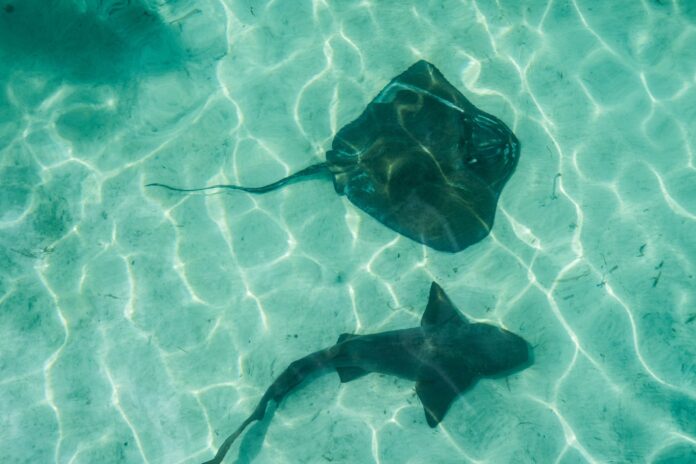
Florida’s waters host a genuine cross section of the ray family. The southern stingray and spotted eagle ray are both common sights gliding over sand and grass flats statewide. The cownose ray passes through in one of the more remarkable migratory spectacles in American waters. Two species of manta ray, the familiar Mobula birostris and a more recently recognized Atlantic species, Mobula yarae, both use Florida’s east coast, sometimes at the exact same location on the exact same day. And the smalltooth sawfish, once common throughout Florida’s coastal waters and now critically endangered, holds a genuinely unique distinction: it was the first marine fish ever protected under the U.S. Endangered Species Act, listed back in 2003.
The Everyday Rays: Stingrays and Eagle Rays
Long before you ever hear about manta nurseries or sawfish recovery efforts, the ray you’re most likely to actually meet in Florida is the southern stingray, gliding low over sand in water barely deep enough to cover it, or the spotted eagle ray, unmistakable with its dark, white spotted back and long, whip like tail, often seen leaping clear of the water for reasons researchers still debate. Both species are common statewide in grass flats, sandy bays, and just beyond the first sandbar off nearly every Gulf and Atlantic beach in Florida, which is exactly why the stingray shuffle has become such a deeply ingrained piece of Florida beach culture. It costs you nothing and it works.
The Cownose Ray Migration
Every spring and fall, Florida’s Gulf coast hosts one of the more startling wildlife sights a beachgoer can stumble into without any warning: a fever of cownose rays, sometimes numbering in the thousands, moving through nearshore water in a tight, coordinated mass. The Gulf population migrates clockwise between western Florida and Mexico’s Yucatan Peninsula, arriving on Florida’s coast in spring and departing south again each fall, and beachgoers from Clearwater to Anna Maria Island have filmed the migration passing directly beneath docks and piers close enough to touch. On the Atlantic side, a separate population makes an even longer journey, spending summers as far north as Chesapeake Bay before a multi year tracking study confirmed that virtually every tagged ray converges on the same wintering grounds near Cape Canaveral every single year, an extraordinary demonstration of site fidelity for an animal that spends half the year hundreds of miles away.
The Urban Mantas of Palm Beach
In 2020, a researcher named Jessica Pate, working out of a boat she borrowed from her grandfather, confirmed something nobody expected: a real manta ray nursery, only the third ever documented anywhere in the world, hiding in plain sight along one of the most developed, heavily boated stretches of coastline in the country. Her Florida Manta Project, part of the international Marine Megafauna Foundation, has since identified well over a hundred individual manta rays between Jupiter and Fort Lauderdale using the unique spot patterns on each animal’s belly, nicknaming the population “urban mantas” for their habit of feeding in the shadow of high rise condos and beachfront resorts most residents never think to look for them near.
The Boynton Beach Inlet has emerged as a genuine hot spot, especially in late summer and fall, when ten or more young mantas can sometimes be found feeding together in the outgoing tide. Researchers have also documented real courtship behavior in adult mantas further north along Florida’s coast, and the news isn’t entirely gentle: nearly half the young mantas studied show scarring from boat propellers or entanglement in fishing line, a sobering reminder of what it costs a slow moving filter feeder to share water with one of the busiest boating populations in the country.
The Smalltooth Sawfish: Florida’s Rarest Ray
This is the story I most wanted people to know. The smalltooth sawfish once ranged throughout Florida’s coastal waters, including a thriving population in the Indian River Lagoon, before decades of gillnet bycatch and habitat loss pushed it to the edge of extinction and out of that historic range almost entirely by the 1970s. Today its last reliable strongholds sit in the mangrove lined waters of Everglades National Park, the Ten Thousand Islands, and Charlotte Harbor, all federally designated critical habitat for the species’ most vulnerable early life stages.
The species faced a genuine crisis in the winters of 2024 and 2025, when a mysterious “spinning” phenomenon swept through the Florida Keys, causing more than eighty marine species, sawfish among the hardest hit, to swim in tight, disoriented circles before many died. The event is believed linked to algae driven neurotoxins, and it killed an estimated hundred or more sawfish, a devastating loss for a species already surviving in a fraction of its former range. In response, NOAA Fisheries launched an unprecedented emergency effort, the first ever attempt to rescue and rehabilitate a wild sawfish, a genuinely historic moment in American marine conservation regardless of outcome. There’s real reason for hope since: a 2026 study using acoustic tags found young sawfish once again using a stretch of the Indian River Lagoon as a nursery, the first evidence in decades that this historically important habitat may be recovering its old role.
The Rules I Don’t Bend On
Practice the stingray shuffle, sliding your feet along the sand rather than stepping down directly, at any Florida beach with warm, shallow water, which is to say nearly all of them. Never touch, ride, or feed a wild stingray or ray of any kind. Smalltooth sawfish are federally protected, and it is illegal to harm, harass, or possess one; if you’re lucky enough to see one alive, admire it from a distance and report the sighting to the U.S. Sawfish Recovery Hotline at 1-844-4SAWFISH, since every verified public sighting genuinely helps researchers track a species this close to the edge. If you’re boating anywhere in the manta nursery zone between Jupiter and Boynton Beach, slow down and keep a sharp eye on the water surface for a dark, diamond shaped shadow.
Who’s Protecting Florida’s Rays
The Florida Manta Project, part of the Marine Megafauna Foundation, leads the ongoing research into the state’s manta population and its nursery grounds. NOAA Fisheries manages the federal Smalltooth Sawfish Recovery Plan and coordinated the historic 2024 rescue effort. The Florida Museum of Natural History maintains sawfish research and public reporting programs alongside its shark work, and Florida Atlantic University’s Harbor Branch Oceanographic Institute, working with the Florida Fish and Wildlife Conservation Commission, produced the acoustic tagging research behind the recent, hopeful Indian River Lagoon nursery findings.
Questions I Get All the Time
When can I expect to see the cownose ray migration in Florida?
Gulf coast sightings cluster in spring as rays arrive from Mexico and again in fall as they head back south, while the Atlantic population is most reliably found wintering near Cape Canaveral.
Can I really see manta rays in Florida without a boat charter to somewhere exotic?
Yes, genuinely, and that’s the most surprising part of this whole story. The Jupiter to Boynton Beach stretch of Palm Beach County hosts a documented manta nursery, visible at times to snorkelers, divers, and even careful shoreline observers.
What should I do if I see a live sawfish?
Keep your distance, take a photo if you safely can, and report it to the U.S. Sawfish Recovery Hotline at 1-844-4SAWFISH. Do not attempt to touch, capture, or move the animal.
Is the sawfish spinning mystery solved?
Not entirely. Researchers strongly suspect a naturally occurring algal neurotoxin, but the exact mechanism is still under active study, and monitoring for a recurrence continues every winter.
Do I need to worry about stingrays every time I wade into the Gulf or ocean?
Not to the point of anxiety, just habit. The stingray shuffle takes no extra time and works because it gives a resting, buried ray a chance to feel you coming and move away before any contact happens at all.
Thoughts & Reflections
Of everything I researched across this entire wildlife series, the sawfish story is the one that stayed with me longest. A species that survived essentially unchanged for millions of years, nearly erased from an entire state in a few decades, and then, almost impossibly, showing the first real signs of coming back in the exact same river system it disappeared from first. I don’t think that’s a coincidence or a small thing. I think it’s proof that recovery is possible even after the kind of loss that looks, from the outside, like it should be permanent. That’s a lesson I keep learning from this whole walking mission in one form or another, wildlife, business, my own life. The ending you’re currently living in is very rarely the actual ending.
