









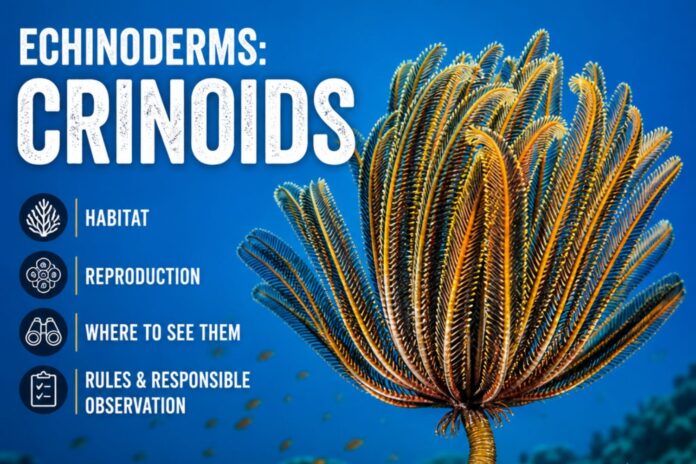
Crinoids are the echinoderm most people have never heard of, and the one that looks least like an echinoderm at all. Picture a feather boa with a mission. Feather stars cling to reefs with their arms spread wide, waving in the current, and sea lilies stand on slender stalks in the deep. They belong to one of the oldest animal groups still alive, and they were around for hundreds of millions of years before the first dinosaur took a step.
If you love beaches, tide pools, and the quiet magic of the sea, crinoids are one of those creatures that feel like a secret the ocean is happy to share. They belong to the echinoderms, the same amazing group as sea stars, sea urchins, and brittle stars. But crinoids have their own elegant style: feathery arms, delicate movement, and a look that seems almost too beautiful to be real.
They may be ancient, but they still thrive in oceans today. And once you know where to look, you may spot them swaying like underwater flowers.
What Is a Crinoid?
A crinoid is an echinoderm in the class Crinoidea, and it is the odd one in the family. Instead of a flat body with arms underneath, a crinoid has a small cup shaped body with a mouth on top and a crown of feathery arms around it, like a flower.
There are two kinds:
- Sea lilies: stalked crinoids that stay attached to the seafloor by a stalk for life.
- Feather stars: free-moving crinoids that crawl or swim using their arms.
Both have five part symmetry, which shows up as five arms, but most species split each arm into two or more, so a single crinoid can have ten, twenty, or even more than a hundred arms. Their fossils are everywhere in old limestone, and they are some of the oldest echinoderms in the fossil record, with relatives going back more than 450 million years.
How Many Species of Crinoids Are There?
About 600 living species are known. Only roughly 95 of them are stalked sea lilies, and the rest, around 540 or more, are feather stars. Here are the ones you are most likely to meet:
- Caribbean feather star (also called the Caribbean crinoid), Davidaster rubiginosus: a common feather star of Florida and Caribbean reefs, usually seen at night perched on coral and sponges.
- Orange feather star, Davidaster discoideus: a close relative with a similar range, found on reefs in the Caribbean.
- Giant feather star, Nemaster grandis: a larger Caribbean feather star with long, delicate arms.
- Caribbean sea lily, Neocrinus decorus: a stalked sea lily of the deeper Caribbean, one of the few sea lilies divers can reach.
- Rock-pool feather star, Antedon bifida: a feather star of the cold waters of northwestern Europe, sometimes seen in rock pools.
- Pacific Northwest feather star, Florometra serratissima: a deeper-water feather star of the cold North Pacific, from Alaska down to California.
- The colorful feather stars of the Indo-Pacific: reefs there hold the greatest variety of crinoids in the world.
How Do Crinoids Move?
Feather stars move more than you would expect. Underneath the body is a set of small clawlike limbs called cirri, which they use to grip coral, rock, and sponge. When it is time to move, a feather star lets go and crawls with its arms, or lifts its arms and swims in a graceful, fluttering pattern. They often climb to a high perch, such as the top of a coral head, because food rides the current, and a higher seat puts more of it within reach. Most come out at night and curl up during the day. Sea lilies stay put on their stalks, though a few can slowly drag themselves along the bottom when they need to. Most species are nocturnal, which is one reason a night snorkel or dive makes the difference.
What Do Crinoids Eat?
Whatever drifts by. Crinoids are suspension feeders, and the whole crown is a net. Each arm has tiny side branches lined with sticky tube feet, which catch plankton and bits of floating organic matter. The food is passed down a groove along each arm to the mouth at the center, which faces up. The crinoid’s mouth is on top and not underneath, the opposite of most of its relatives. Feeding is passive. The animal holds its arms in the current and waits, and the fan shape works best when it is turned into the flow.
How Do Crinoids Reproduce?
Crinoids reproduce in a few fascinating ways. Like many marine animals, they often release eggs and sperm into the water, where fertilization happens externally. The tiny larvae drift in the plankton before settling down and growing into adults.
Stalked species attach to the bottom and grow a stalk. Feather stars start with a stalk as juveniles, then break free as small adults and move on. Some feather stars brood their young on their arms. Crinoids also regenerate well. If a predator takes an arm, a new one grows back, and they have been called the ocean’s best at it. Because the arms branch and regrow, an injured crinoid still looks like a feather boa, only a messier one.
Crinoids and Sand: The Fossil Beach Connection
Crinoids are not sand dwellers, but they have a deep connection to the stuff I love. For a start, they live just above the sand, perched on coral heads and rocky outcrops at the edge of sandy bottoms where the current is strong, and their deep sea relatives, the sea lilies, stand on the seafloor in groves.
More surprising is what they leave behind.
A crinoid body is made of many small plates and stem pieces of calcium carbonate, and when the animal dies, these separate and sink, becoming part of the skeletal sediment on the sea floor. Over millions of years, those pieces helped build limestone, and some limestone is made largely of crinoid fragments. In parts of the American Midwest, round, hollow stem pieces called Indian beads turn up in creek gravel and on lakeshores, left over from ancient seas.
So a few of the grains and pebbles around you may have once been part of a sea lily. It is the longest sand story in this whole series.
Where Do Crinoids Live?
Crinoids live in the ocean, and many species prefer rocky reefs, coral reefs, ledges, and deeper seafloor habitats. Some are found in shallow tropical waters, while others live far below the surface in the dark, cold deep sea.
Common crinoid habitats include:
- Coral reefs
- Rocky shorelines and reef slopes
- Seagrass edges
- Deep-sea bottoms
- Caves and under ledges
- Lagoon reefs
Feather stars are often easier to find in shallow tropical waters, especially at night or in areas with strong currents. Sea lilies are more commonly found in deeper waters, though some can be seen on reefs in warmer regions.
Where Can You See Crinoids?
If you are a beach lover who also enjoys snorkeling, diving, or tidepool exploring, crinoids are a wonderful creature to add to your wish list.
Best ways to spot them:
- Snorkeling over coral reefs
- Scuba diving on reef slopes
- Night dives
- Guided marine tours
- Aquariums with living reef exhibits
Feather stars are often seen clinging to coral branches or waving their arms in the current. During the day, some species hide in cracks and shaded areas. At night, they may extend their arms more openly to feed.
Where in the World Can You Find Crinoids?
Crinoids are found in oceans all over the world. They are especially diverse in tropical and subtropical waters, where reefs are rich and colorful. But they are not limited to warm seas alone.
Regions where crinoids are commonly found:
- The Indo-Pacific
- The Caribbean
- The Red Sea
- The western Atlantic
- The Mediterranean
- Deep oceans worldwide
The Indo-Pacific region is especially famous for feather stars, with many species living around Indonesia, the Philippines, Australia, and nearby reef systems. The Caribbean also has beautiful crinoids, often tucked into coral heads or reef crevices.
Deep-sea crinoids are nearly global, found in ocean basins from one coast to another. The sea is vast, and crinoids have made themselves at home in many corners of it.
Popular Destinations to See Crinoids Around the World
Florida and the Florida Keys
Feather stars appear on the reefs of the Keys and southeast Florida, mostly at night when they climb up from their daytime hiding places. A guided night snorkel or dive is the best way to see them. The Florida Keys National Marine Sanctuary protects everything living within its boundaries, and reef touching is a no. Check the sanctuary’s visitor rules before you go.
The Caribbean
The Caribbean is a great place to see feather stars, and many islands have reef dives where they are common at night. Deeper dives may reach the Caribbean sea lily, one of the few stalked crinoids you can see on scuba. Ask your dive operator for current rules, and never touch the reef.
Panama
Bocas del Toro’s reefs hold feather stars, best seen on a night snorkel or dive with a guide. Rules are strict about touching and collecting marine life, and the simplest approach is to look and leave.
The Indo-Pacific
This is the center of crinoid diversity. From the Great Barrier Reef to Indonesia, the Philippines, and the Red Sea, colorful feather stars cling to reefs in a range of colors, and a single dive can show you several species. Many of these places are marine parks with strict no touch rules.
The Pacific Northwest
The cold water feather star of the North Pacific lives in deeper water than most tide pool walkers will reach, and divers sometimes meet it. Rules for collecting differ by state, and most intertidal and marine park areas are off limits for taking animals. Check with Washington Department of Fish and Wildlife and other state agencies.
Europe and the Mediterranean
Feather stars live in the cold waters of the northeast Atlantic and in the Mediterranean. In Britain, the rock-pool feather star is sometimes found in low tide pools, a rare chance to meet a crinoid on foot.
Can You Touch Crinoids?
No, and there is a very good reason. Crinoids are delicate. Their arms break easily, and a grabbed feather star can shed arms or lose its grip, which costs it feeding time and makes it vulnerable. They are also nocturnal and feed in the open, so they are often seen in the dark when there is a dive light on them.
Keep the light steady, keep your fins and hands away from the reef, and enjoy the show from a distance. A feather star in the open at night is one of the loveliest things on a reef. It does not need our help to look that way.
Who’s Protecting Crinoids
Crinoids are one of the ocean’s most graceful creatures. They connect us to ancient marine history, since their relatives have existed for hundreds of millions of years. Yet they still feel fresh and magical, like something painted by the sea itself.
They remind us that beaches and oceans are not just places to relax, but living worlds full of delicate beauty. A reef is not a souvenir shop. It is a home.
Crinoids are protected mostly through habitat. Healthy reefs mean healthy feather stars. The Florida Keys National Marine Sanctuary and marine parks around the world protect the reefs they live on, and the IUCN Red List tracks species status. The World Register of Marine Species keeps the official list of crinoid species. Gentle diving practices, like good buoyancy and a respect for the reef, are the best protection any of us can offer.
Crinoid Curiosity Corner
What is a crinoid?
An echinoderm with a cup shaped body and feathery arms, either a stalked sea lily or a free moving feather star.
Is a feather star an animal or a plant?
An animal. It is related to sea stars, sea urchins, and sand dollars, though it looks like a flower or a feather.
What do crinoids eat?
Plankton and tiny particles of food drifting in the water, caught on sticky tube feet along their arms and passed to the mouth on top.
How do crinoids move?
Feather stars crawl with their arms and clawlike cirri, and some can swim by waving their arms. Sea lilies stay on their stalks.
How do crinoids reproduce?
Most spawn into the water, and the larvae settle on the bottom. A few feather stars brood their young.
How many species of crinoids are there?
About 600 living species, of which roughly 95 are sea lilies and the rest are feather stars.
What is the difference between a sea lily and a feather star?
Sea lilies are attached to the bottom by a stalk. Feather stars have no stalk as adults and can crawl or swim.
Can you touch a feather star?
No. They are fragile and their arms can break. Look from a distance, especially on a night dive.
Where can I see crinoids?
Caribbean and Indo-Pacific reefs are the best places, especially at night. Florida Keys reefs have feather stars too.
What are Indian beads?
Fossilized stem pieces of ancient crinoids, round and hollow, found in creek gravel and on lakeshores in parts of the American Midwest.
