

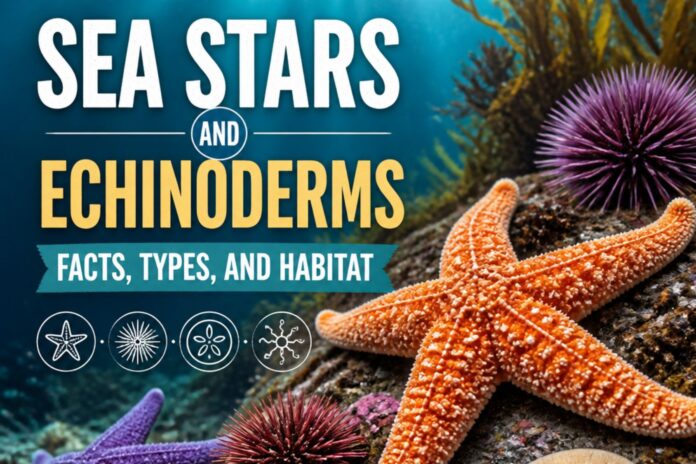
Florida’s beaches have handed me more sea stars and sand dollars over the years than I can count, and it took writing this whole wildlife series to finally learn something that genuinely changes how I look at every single one of them now. Unlike almost anything else you’ll ever pick up on a beach in Florida, most of these animals don’t have an empty version. What looks like a shell is usually the animal itself.
Meet Florida’s Echinoderms
Florida’s coastal waters host a genuinely rich cross section of this family: the keyhole sand dollar, the state’s signature flattened urchin, the large, strikingly patterned Bahama sea star, the spine covered long-spined urchin, the plumper sea biscuit, and a range of smaller sea stars, brittle stars, and sea cucumbers scattered across grass flats, reefs, and sandy shallows statewide.
The Keyhole Sand Dollar
Florida’s Gulf coast sand dollar is the keyhole sand dollar, Mellita quinquiesperforata, easily identified by five long, narrow slots, called lunules, cut clean through its disc. A living one is purple-brown and genuinely fuzzy, covered in short, constantly moving spines, and it burrows into shallow, sandy low tide flats, particularly around undisturbed, boat access only barrier islands where fewer feet have picked the population over. Those lunules aren’t decorative, they let water and sediment pass directly through the animal’s body rather than building up pressure against it, which is exactly what keeps a thin, flat disc from getting rolled and tumbled by every passing wave.
The Bahama Sea Star
Oreaster reticulatus, commonly called the Bahama or cushion sea star, is one of the largest sea stars in the entire family, reaching up to twenty inches across, with a thick, cushioned body and a bold, reticulated pattern that made it a favorite souvenir for decades before overharvesting nearly emptied entire stretches of the Florida Keys of visible adults. It’s now a commercially and recreationally prohibited species statewide, illegal to collect, possess, or sell under any circumstances, a direct response to just how badly the curio trade thinned this population out.
Young Bahama sea stars shelter in seagrass meadows for camouflage before adults move out onto open sandy or rubble bottom, where they spend their days doing genuinely useful, unglamorous work, stirring up sediment as they crawl, which benefits the filter feeding animals living around them. If you find one on a Florida beach, it is virtually always alive, since there’s no bleached, empty version of this animal the way there is with a shell.
The Long-Spined Urchin
Diadema antillarum carries some of the longest, sharpest spines of any urchin in Florida and Caribbean waters, dark, needle thin, and genuinely capable of breaking off painfully in skin, which is reason enough on its own to give a live one real distance. It’s also one of the most ecologically important grazers on any reef it inhabits, and its story carries real weight: a mass die-off across the wider Caribbean in the 1980s removed the vast majority of this species almost overnight, and the resulting explosion of algae growth on reefs that lost their primary grazer is still cited today as one of the clearest examples of how much a single, unglamorous echinoderm can hold an entire reef system together. It’s now a prohibited species in Florida waters, illegal to harvest, a rule as much about protecting an already fragile recovery as it is about protecting the individual animal.
The Law You Need to Know
Echinoderm collection in Florida follows the same basic principle running through nearly every wildlife law in this series: dead is generally fair game, live is heavily regulated, and a handful of species are off limits entirely regardless of condition. The Bahama sea star and long-spined urchin are both commercially and recreationally prohibited statewide under Florida Fish and Wildlife Conservation Commission marine life rules, meaning it’s illegal to collect, possess, or sell either one under any circumstances. For most other live echinoderms, state law requires a valid saltwater fishing license along with species specific bag limits and gear requirements. Locally, Collier and Lee Counties, the same counties covered in the companion piece on Florida’s living shells, extend that protection further, prohibiting the collection of any live sand dollar or sea star outright, no exceptions.
Here’s the detail that matters most: a sea star found on the beach, even one that looks completely dried out, stiff, and lifeless, is almost always still alive. There is no empty shell version of a sea star the way there is with a conch or a whelk. If you find one stranded above the waterline, gently return it to shallow water rather than assuming it’s a safe, harmless souvenir. A sand dollar does have a genuine empty stage, the bleached white test left behind after death, but the live animal is purple-brown, fuzzy, and moves, and collecting one in that state is illegal in Collier and Lee Counties specifically, and heavily regulated everywhere else in the state.
Where Sand Quality Shapes What You’ll Find
Florida’s best echinoderm beaches share the same basic sand recipe: shallow, gently sloping, current swept flats with enough fine sediment for a sand dollar or sand sifting sea star to burrow into but not so much soft mud that a heavier animal like the Bahama sea star can’t hold its footing. Boat only barrier islands, the kind reachable only by kayak or charter around Marco Island and Naples, consistently produce the richest finds precisely because that undisturbed sand hasn’t been picked over or compacted by daily foot traffic the way a busy mainland beach eventually is.
Region by Region List
Remember before you start this list: if it has arms or looks like a flat, fuzzy disc and it’s got any color to it at all, it’s almost certainly alive. Here’s the state, region by region, for sand dollars, sea stars, and their echinoderm cousins.
The Panhandle
Sand dollars turn up on the shallow, sandy flats around Perdido Key and throughout Gulf Islands National Seashore, particularly on the bay side where wave energy is gentler. Sea stars are less common here than further south but do appear on grass flats in Choctawhatchee Bay and St. Andrew Bay near Panama City.
The Nature Coast & Big Bend
The clear, spring influenced water and extensive grass flats of this region hold sand dollars and occasional Bahama sea stars, though this stretch of coast rewards patience over volume compared to the barrier islands further south.
Tampa Bay
Tampa Bay’s shallow grass flats and sandy edges hold sand dollars in good numbers, especially around the calmer waters behind the barrier beaches of St. Petersburg and Clearwater. Sea stars and the occasional sea biscuit turn up here too, most reliably after a period of calm weather that lets the sandy bottom stay undisturbed.
Southwest Florida
This is the richest echinoderm region in the entire state. Behind Lido Key and Siesta Key, sand dollars and sea stars are common on the calm, sandy flats of Sarasota Bay. Further south, the boat only barrier islands off Naples and Marco Island, including Keewaydin, Kice, and Shell Island, produce some of the most reliable keyhole sand dollar sightings in the state precisely because they see far less foot traffic than mainland beaches. Remember that Collier and Lee Counties prohibit collecting any live sand dollar or sea star outright. Charlotte Harbor and the passes around Boca Grande, Sanibel, and Captiva round out the region, with Bahama sea stars occasionally reported on quieter, undeveloped stretches.
The Space & Treasure Coasts
Sand dollars and sea stars both turn up along the Indian River Lagoon system from Titusville down through Vero Beach, particularly on shallow, sandy flats away from heavy boat traffic. The barrier island beaches around Cocoa Beach and New Smyrna Beach produce sand dollars reliably after calm periods, and the Lake Worth Lagoon near Riviera Beach and North Palm Beach has documented Bahama sea star sightings in its shallow, seagrass fringed waters.
Southeast Florida & the Keys
Biscayne Bay’s shallow flats behind Miami’s barrier beaches hold sand dollars and sea stars in the same sandy, grass edged habitat favored by the region’s other wildlife. The Florida Keys historically held some of the largest, most visible Bahama sea star populations in the state before decades of souvenir collecting thinned them out severely, a decline the species is still recovering from statewide. Long-spined urchins are present on reef structure throughout the Keys, an important, protected grazer for the health of the reef tract itself.
A Note on the Sand Underneath
The single best predictor of a good echinoderm beach in Florida is the same predictor that works for shelling: a gentle, undisturbed, current fed sandy flat, ideally one that sees light foot traffic. Sand dollars need exactly that kind of fine, stable sediment to burrow into and filter feed from, and Bahama sea stars favor the same calm, sandy or rubble strewn bottom just offshore. The boat only islands off Naples and Marco Island top this list for a reason that has nothing to do with luck, it’s simply sand that hasn’t been walked on nearly as much.
Who’s Protecting Florida’s Echinoderms
The Florida Fish and Wildlife Conservation Commission manages the statewide marine life regulations covering every species in this piece, including the outright prohibitions on Bahama sea stars and long-spined urchins. Mote Marine Laboratory in Sarasota conducts ongoing research into Florida’s reef and nearshore invertebrate populations, including long-spined urchin restoration efforts aimed at rebuilding a population that still hasn’t fully recovered from its 1980s collapse decades later.
Questions I Get All the Time
How can I tell if a sea star on the beach is alive?
Assume it is, even if it looks stiff, dry, or motionless. There’s no empty version of a sea star, so the safest and kindest move is always to gently place it back in shallow water.
Can I keep a white sand dollar I found on the beach?
A clean, bleached white test with no color or spines is empty and generally fine to keep outside Collier and Lee Counties, where all live and dead sand dollar collection is restricted. A purple-brown, fuzzy one is alive and should go back in the water immediately.
Why is it illegal to take a Bahama sea star even if I find it already looking worn or old?
The species is protected statewide regardless of the individual animal’s condition, a direct response to decades of overharvesting for the souvenir trade that seriously depleted visible populations, especially in the Florida Keys.
Are long-spined urchins dangerous to step on?
Yes, genuinely. Their spines are long, sharp, and prone to breaking off under the skin, so wear water shoes in known rocky or reef adjacent areas and give any urchin you spot real distance.
Where in Florida are echinoderms most reliably found?
Shallow, sandy, boat access flats around Southwest Florida’s barrier islands, particularly near Marco Island and Naples, tend to produce the richest and least disturbed finds statewide.
Thoughts & Reflections
I’ve walked enough beaches now to trust my own eye on this one. Every sea star I’ve ever picked up, I already knew was dead before my hand even closed around it, dried out, bleached, weightless in that particular way only something long finished ever gets. I didn’t learn that from a marine biology course. I learned it the same way I’ve learned to read almost everything else about a beach, by spending enough hours on enough sand that the difference eventually just announces itself without me having to think about it.
