





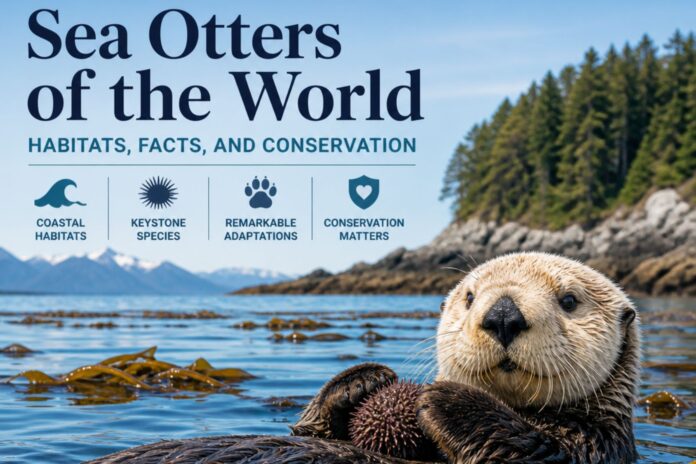
Sea otters are among the most charming animals in the ocean. With their thick fur, playful behavior, and remarkable intelligence, they capture attention wherever they live. But the sea otters of the world are more than just cute faces. They are vital to healthy coastal ecosystems, helping protect underwater forests and marine biodiversity.
Though they once ranged far more widely, sea otters today live in only a few regions of the North Pacific. Their story is one of survival, adaptation, and conservation.
Meet the Sea Otter
Enhydra lutris is the heaviest member of the weasel family, Mustelidae, and yet one of the smallest marine mammals alive, a genuinely odd combination that starts to make sense once you understand what it’s built around. Unlike every other marine mammal in this whole series, a sea otter has no blubber at all. Its entire insulation strategy is fur, the densest fur of any animal on Earth, with up to a million hairs packed into a single square inch. That fur has to be groomed constantly to trap the layer of air that actually keeps a sea otter warm in water cold enough to kill most mammals in minutes, which is why you’ll almost never see one sit still for long.
In most of its range, the sea otter functions as a keystone species. It eats sea urchins voraciously, and without that pressure, urchins graze kelp forests down to bare rock, an ecological collapse scientists call an urchin barren. Put the otters back, and the kelp comes back with them.
Unique Adaptations of Sea Otters
Sea otters are perfectly designed for life in chilly ocean environments.
The densest fur in the animal kingdom
Unlike seals and whales, sea otters do not rely on blubber for warmth. Instead, they have extraordinarily dense fur, which traps air and provides insulation.
This fur must be cleaned and groomed constantly to remain waterproof and effective. That is one reason otters spend so much time floating on their backs and tending to their coats.
Tool use and intelligence
Sea otters are one of the few animals known to use tools regularly. They often use rocks to crack open hard-shelled prey, resting the stone on their chest as they float.
This behavior shows problem-solving ability and makes them especially fascinating to observe.
Floating and foraging
Sea otters use their webbed feet and powerful tails to move through the water. They often carry food, tools, or even resting babies while floating on their backs.
Rafts and Family Life
Sea otters rest and socialize in groups called rafts, sometimes numbering from a handful of animals up to a hundred or more, usually separated loosely by sex. To keep from drifting apart while sleeping, otters wrap themselves in strands of kelp like an anchor line, and mothers keep newborn pups, who can’t yet dive or swim well, tucked onto their chest while they groom, forage, and rest. A pup’s fur is actually so buoyant at birth that it functions almost like a built in life vest, keeping the baby afloat even before it can swim on its own.
The Different Populations of Sea Otters
Sea otters are usually grouped by region. These populations are not all identical, and some are isolated from one another.
Southern Sea Otter
Enhydra lutris nereis clings to a single, narrow stretch of central California coastline, roughly Santa Cruz to Santa Barbara, after nearly vanishing entirely in the early 1900s. A tiny, undiscovered remnant colony near Big Sur turned out to be the entire genetic future of the subspecies, and today’s population, still listed as threatened, has slowly climbed back to around three thousand animals, every one of them descended from that one hidden colony.
Northern Sea Otter
Enhydra lutris kenyoni ranges from Alaska down through British Columbia and represents the largest, most genetically diverse population left in the world, though it’s far from uniformly healthy. Some stretches of the Aleutian Islands have rebounded strongly, while others have collapsed dramatically in recent decades for reasons that surprised even the scientists studying them, a story worth its own section further down.
Alaska holds the largest population of sea otters in the world. These animals are common in many coastal habitats and play a major role in maintaining balance in the region’s marine ecosystems.
Asian Sea Otter
Enhydra lutris lutris occupies the western edge of the species’ range, Russia’s Kuril and Commander Islands and the northern coast of Japan, the least studied and most geographically isolated of the three subspecies, separated from its American cousins by the entire width of the North Pacific.
Found along the Kamchatka Peninsula and the Commander Islands, Russian sea otters are often seen in remote and rugged coastal areas. Japan Sea Otters have been driven to extinction in the area showing how fragile these populations can be.
Nearly Hunted Out of Existence
Sea otter fur is the reason this species almost disappeared entirely. Once Russian explorers reached Alaska in 1741, a commercial fur trade began that lasted a century and a half and very nearly finished the species off completely, since a sea otter pelt, dense enough to keep a person warm through a Siberian winter, became one of the most valuable furs on Earth. By the time the International Fur Seal Treaty of 1911 finally banned the hunt, an estimated 300,000 sea otters had been reduced to as few as 2,000 individuals scattered across thirteen isolated remnant colonies. Two of those colonies vanished within a decade anyway.
Recovery since then has come through legal protection and, in several key locations, deliberate translocation, physically relocating otters from healthier populations into places where the species had disappeared entirely, including a successful reintroduction to British Columbia’s Vancouver Island in the early 1970s after the last confirmed Canadian sea otter had been shot in 1929. Today’s worldwide population sits somewhere between 100,000 and 150,000, a genuine conservation success story, though still nowhere close to historic numbers and still concentrated in a fraction of the coastline the species once called home.
The Orca Twist
Here’s a piece of sea otter history I did not expect to find, and it’s honestly one of the more fascinating ecological detective stories I came across in this entire wildlife series. Starting in the 1990s, sea otter numbers across large stretches of the central and western Aleutian Islands collapsed by as much as ninety percent in less than a decade, and for years scientists couldn’t explain why. Disease, pollution, and starvation were all ruled out. The answer turned out to be orcas, specifically a hypothesis that as commercial whaling decimated the great whale populations orcas traditionally hunted, some killer whales shifted down the food chain, first to Steller sea lions and harbor seals, and when those populations declined too, further still, to sea otters. It’s a genuinely sobering example of how removing one species from an ecosystem can ripple through the entire food web for decades before anyone even connects the dots.
Sand, Silt, and an Unexpected Estuary
Most of this species’ story belongs to rocky coastlines and kelp canopies, but one of the most compelling sea otter tales of the last twenty years actually unfolded in soft, muddy estuary sediment. California’s Elkhorn Slough, a tidal wetland near Monterey Bay, became an unplanned natural experiment when a small population of sea otters moved in and began preying heavily on crabs. Fewer crabs meant more of the small invertebrates crabs normally eat, and those invertebrates, in turn, graze algae off the blades of eelgrass, an underwater flowering plant not unlike the seagrass I’ve written about elsewhere in this series. The net result, confirmed by years of careful research, was healthier, cleaner eelgrass beds in a slough that otherwise suffers from serious agricultural runoff and pollution. An animal famous for kelp forests turned out to be quietly rescuing a seagrass meadow too, just by doing what it does best.
Where to Actually Go See Them
California’s Monterey Bay remains the single most reliable place on Earth to see wild sea otters, and Elkhorn Slough at Moss Landing specifically holds the largest concentration of southern sea otters anywhere, often visible just ten to fifteen feet offshore from a kayak or a guided pontoon tour. Morro Bay and Point Lobos State Natural Reserve further down the coast both offer excellent land based viewing. In Alaska, Kachemak Bay near Homer and Prince William Sound both host large, healthy northern sea otter populations, often visible from the shore or a short boat tour. Vancouver Island’s Checleset Bay, the site of Canada’s original reintroduction, remains one of the best places in British Columbia to see the species today.
Rules Wherever You Go
Keep a respectful distance from any raft of resting otters, since disturbing them repeatedly can cause them to abandon otherwise safe resting or nursing areas. Never approach a mother with a pup, and if you’re boating anywhere near a kelp bed or estuary known for otters, slow down well before any posted speed zone, since boat strikes remain a real and preventable cause of death in nearly every population.
Threats Facing Sea Otters
Despite their resilience, sea otters face many dangers.
Historical hunting
The fur trade nearly wiped out sea otters in the 18th and 19th centuries. Their luxurious fur was so valuable that populations collapsed across much of their range.
Oil spills
Because sea otters depend on fur rather than blubber, oil can be devastating. It damages the insulation of their coat and can lead to hypothermia or poisoning.
Habitat loss and pollution
Coastal development, water pollution, and ecosystem changes can reduce the quality of otter habitat. Harmful runoff and plastic waste also create risks.
Predation and food supply changes
In some areas, sea otters face growing predation from sharks or orcas, while warming oceans and changing prey populations may affect their ability to find food.
Who’s Protecting Them
The Monterey Bay Aquarium runs the world’s only sea otter surrogate mother program, pairing rescued, non releasable adult females with orphaned pups, and a landmark study found that surrogate raised otters and their offspring accounted for over half of Elkhorn Slough’s entire population growth over fifteen years. The U.S. Fish and Wildlife Service manages recovery efforts for the threatened southern sea otter, and Friends of the Sea Otter and the collaborative Sea Otter Savvy program both work directly with boaters, kayakers, and paddleboarders on responsible viewing practices along the California coast.
Important efforts include:
- legal protection from hunting
- habitat monitoring and restoration
- oil spill response planning
- rescue and rehabilitation programs
- research on population health and genetics
In some regions, these efforts have helped sea otters rebound. In others, populations remain vulnerable and need continued protection.
A Symbol of Ocean Health
The story of the sea otters of the world is really the story of how connected ocean ecosystems are. When otters thrive, kelp forests often thrive too. When otters disappear, the effects can ripple across the entire coastal environment.
Sea otters remind us that even small animals can have a powerful impact. Their survival depends on clean waters, healthy coastlines, and careful stewardship of the ocean. By protecting sea otters, we also protect the rich marine life that depends on them.
Curiosity Corner
Do sea otters really hold hands while they sleep?
Occasionally, yes, though wrapping in kelp is the more common anchor. Holding paws or kelp wrapping both serve the same basic purpose, keeping otters, especially mothers and pups, from drifting apart while resting.
Why don’t sea otters have blubber like other marine mammals?
Nobody knows for certain why the species evolved this way instead, but the tradeoff is real: sea otter fur is remarkably effective, but it requires several hours of grooming a day to keep functioning, and any oil spill or contamination that mats the fur can be fatal within hours.
Are sea otters and river otters closely related?
They’re both in the weasel family, Mustelidae, but they belong to different genera and evolved very different lifestyles. River otters retain some body fat and move easily on land; sea otters lost that fat entirely and rarely leave the water.
How much do sea otters actually eat?
Roughly a quarter of their body weight daily, an enormous amount driven by the sheer energy cost of staying warm without any blubber at all.
Could sea otters ever be reintroduced somewhere new?
It’s actively discussed for parts of their historic range, including Oregon and northern California, but any reintroduction requires the right combination of kelp, shellfish prey, and cold, nutrient rich water that the species has always depended on.
Thoughts & Reflections
Sea otters are more than playful animals drifting on their backs. They are ecosystem engineers, skilled hunters, and symbols of conservation success. From Alaska to California and across the North Pacific, the sea otters of the world continue to fascinate scientists and nature lovers alike.
Their future depends on our willingness to protect the fragile habitats they call home.
