


There is something magical about finding sea stars in the shallows. As a beach lover and lifelong admirer of the shorelines of the world, I’ve always felt a little thrill when I spot one tucked between rocks or resting on a reef ledge. I remember being younger and gently picking them up, turning them over in my hands, and then placing them back. It felt harmless back then. Now I know better. Even a short time out of the water, or rough handling, can stress or injure a sea star. These days, I don’t touch them at all, I just admire them where they belong.
What Is a Sea Star, and Is It the Same as a Starfish?
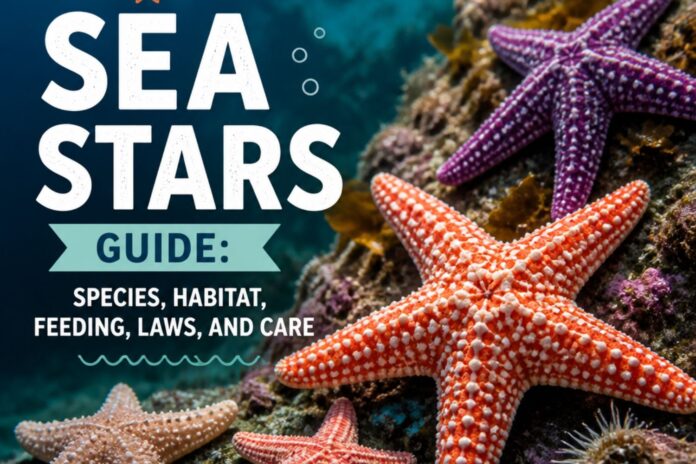
Same animal, two names. Scientists lean toward sea star because it isn’t a fish, and starfish is the name most of us picked up from a childhood beach bucket. Sea stars belong to the class Asteroidea, one of five living groups in the echinoderm family, alongside sand dollars, urchins, sea cucumbers, brittle stars, and crinoids. Their bodies are usually arranged in a star shape, most have five arms, though some carry ten, twenty, or more. They have no brain and no heart, and seawater and a clear body fluid do the circulating that blood does for us. At the tip of every arm sits a tiny eyespot that can tell light from dark, so a sea star is basically wearing five little night lights.
They are found in oceans all over the world, from tide pools and sandy beaches to coral reefs and deep seafloor habitats. They may look delicate, but they are perfectly adapted to life in the sea.
How Do Sea Stars Move?
On hundreds of tiny tube feet, and the plumbing is the best part. Seawater enters through a sieve plate on top of the body called the madreporite, flows down canals in each arm, and pumps up the tube feet, which grip, let go, and reach again in a slow ripple. No bones, no big muscles pushing off the sand, just water pressure and patience. Flip a sea star over and it twists one arm around and rolls itself upright in an unhurried cartwheel. Nobody would call a sea star fast, but the sunflower star is the sprinter of the group, which in sea star terms means you can actually watch it go.
How Do Sea Stars Eat?
Sea stars are amazing predators and scavengers. Many species feed on mussels, clams, oysters, snails, and other small marine animals. Their feeding method is wonderfully strange: they use tiny tube feet to pry open prey, then push part of their stomach outside their body and digest food externally.
That means they don’t “bite” like a fish or crab. They quite literally eat from the outside in. Some species also feed on dead organic material, algae, or tiny particles drifting in the water.
Ochre stars keep mussel populations in check, which gives other tide pool animals room to live, and sunflower stars eat sea urchins, which protects kelp forests. Cushion stars are gentler grazers, working over the algae and the thin edible film on sand and seagrass, and the sand dwelling stars swallow small clams and snails whole.
How Do Sea Stars Breed and Survive?
Sea stars reproduce in a few different ways. Mostly by spawning. Males and females release sperm and eggs into the water and let the sea handle the introductions, which is why sunflower stars, which breed in May and June, need neighbors close by for it to work. The fertilized eggs become tiny larvae that drift as plankton before settling to the bottom and turning into five armed miniatures.
Some species can also reproduce asexually by splitting or regenerating body parts. This regeneration is one of the most fascinating things about them. If a sea star loses an arm, it can often grow it back. In some species, a single arm with part of the central body can even regenerate into a whole new animal. The blue Linckia is famous for it, sometimes found as one lonely arm with a tiny new star sprouting from the broken end.
This remarkable ability helps them survive predators, accidents, and the tough conditions of the shore.
Sea Stars and Sand: Who Lives Where
Sea stars sort themselves by bottom type, and the sand is a fun place to watch it happen. The sand sifters (genus Astropecten and its cousins) have pointed tube feet with no suction cups. They traded grip for digging, and they plow just under the surface, hunting buried clams while the tips of their arms poke up like tiny periscopes. They are the beach’s hide and seek champions. The cushion stars prefer calm, shallow, sandy flats beside seagrass and mangroves, often in just a few inches of water, where they crawl slowly enough to stir the sediment as they go, like very patient gardeners. And the rock stars, the ochres and bats and giant pinks of the Pacific coast, cling to stone and pilings, and for them sand is the doormat, not the living room. If you see a sea star wedged on a rock at the tide line, it is not hoping for a beach day.
Can You Touch Starfish? The Honest Answer
Best not to, and here’s the why. A sea star takes in oxygen through its skin and tube feet, so every second out of the water is a second without air. Sunscreen, lotion, and the natural oils on our hands can irritate that skin, and prying one off a rock or squeezing it for a photo can injure it. Add a crowd and a camera and it gets worse. If you find one stranded above the waterline, slide your hand underneath, lift it as little as possible, and set it back in the water. Otherwise, look, take the photo with the star still in the sea, and move on.
Common Species and Where to Find Them
Nearly 1,900 species are known, grouped into about 36 families, and the World Asteroidea Database lists more than 1,800 accepted ones. They live in every ocean, from the tide pool you can step into to the deep sea thousands of feet down. These are the ones you’re most likely to meet:
- Ochre sea star (Pisaster ochraceus) – the purple or orange star common on the Pacific coast of North America, especially on rocky shores from California to Alaska.
- Sunflower sea star (Pycnopodia helianthoides) – the giant of the the northeastern Pacific coast, up to a meter across with 16 to 24 arms, often found in kelp forests and deeper coastal waters. It is now critically endangered.
- Chocolate chip sea star (Protoreaster nodosus) – Found in the Indo-Pacific, especially around sandy lagoons and reefs in places like the Philippines, Indonesia, and Fiji.
- Cushion star (Culcita novaeguineae) – Seen on tropical reefs in the Indian and Pacific Oceans, often around coral rubble and seagrass beds.
- Cushion sea star (also called the Bahama sea star), (Oreaster reticulatus) – the thick, orange to reddish star of Caribbean sand and seagrass flats, including the Florida Keys. It grows well over a foot across and is the star of Starfish Beach in Panama and Starfish Point in Grand Cayman.
- Bat star (Patiria miniata) – webbed arms that look like a bat’s wing, common in Pacific tide pools.
- Giant pink sea star (Pisaster giganteus) – pink with short white spines, the largest of its genus.
- Royal sea star (Astropecten articulatus) – a flat, pointy armed sand dweller found along Southeast US beaches.
- Blue sea star (Linckia laevigata) – Famous for its bright vivid blue color, found on coral reefs across the tropical Indo-Pacific, including Australia, Southeast Asia, and island nations.
- Mottled sea star (Echinaster spinulosus) – Common in the Caribbean, often seen on reefs, rocks, and seagrass areas.
If you walk along a rocky shoreline, especially at low tide, you may find sea stars clinging to wet stones or hidden in tide pools. On sandy beaches, they are less visible but may live just offshore in seagrass meadows or reef edges.
Sea Stars Around the World (and Where to Keep Your Hands to Yourself)
Bocas del Toro, Panama
Playa Estrella, better known as Starfish Beach, sits on the northwest coast of Isla Colón in the Bocas del Toro archipelago and was named for the cushion sea stars that once covered its shallow bottom. A researcher quoted in a HuffPost report on the beach said the seabed used to look orange, and that once tourism arrived the stars thinned out until only a couple dozen could be found. Snorkeling guides say a few cushion stars can still be spotted in inches of water, especially around the mangrove edge east of the beach and over the sand in front of it, just far fewer than before. Researchers with the Institute for Tropical Ecology and Conservation and students from the School for Field Studies have studied how the stars feed and move, and a researcher has been taking small educational signs to the beach restaurants and working to get the same message to boat drivers. The request is simple: look, do not touch, and do not lift them out of the water. It’s the lesson every starfish beach keeps teaching. A place can be loved a little too hard.
Grand Cayman
Starfish Point, on the north side of Grand Cayman near Cayman Kai, is a patch of shallow, sandy water bordered by seagrass where red cushion sea stars gather. Starfish are a protected species under the Cayman Islands National Conservation Law, and the Department of Environment has written handling guidelines and warned visitors after reports of people holding starfish out of the water for long stretches. You can reach it by road near Rum Point or on a boat tour out of the Seven Mile Beach side.
Phu Quoc, Vietnam
Starfish Beach near the Rach Vem fishing village on Phu Quoc’s northwest coast is a shallow stretch of seagrass where red cushion stars sit in a few feet of water. In April 2021, photos of dead, dried starfish lying on the sand after tourists carried them ashore for selfies set off public anger in Vietnam, and local guides have since pushed for better visitor habits. The advice there matches Panama and Cayman: enjoy them in the water and leave them there.
Florida
Cushion stars and a handful of smaller sea stars live on Florida’s grass flats, reef rubble, and sandy shallows, especially in the Keys and around Southwest Florida. Harvest of the Bahama starfish, the cushion star, is prohibited statewide. Other sea stars fall under the state’s marine life rules, which require a saltwater fishing license and cap you at five per species within a 20 organism daily bag, and state parks, local ordinances, and the Keys sanctuary can ban removal altogether. Even where it’s legal, a sea star in a bucket is a sea star in trouble. The FWC’s sea shell page has the current rules.
The Pacific Coast: Washington, Oregon, and California
This is ochre, bat, and giant pink star country, and it is also where sea star wasting disease has hit hardest. Since 2013 it has killed billions of sea stars, and sunflower stars have all but vanished from the Salish Sea. Rules vary by state. In Washington, most tide pool animals, sea stars included, are not allowed for harvest anywhere. Oregon’s tide pool protections prohibit collecting intertidal life with very few exceptions. California requires a fishing license for most collecting, bans taking sea stars off nearshore rocks in the intertidal zone, and marine protected areas generally allow no collecting at all. With a disease still in the water, the kindest rule is the simplest one: leave them alone.
Mexico’s Caribbean Coast
Dried starfish have long been a souvenir shop staple in Mexico’s beach towns. Local press in Isla Mujeres reported this October that dried starfish were still turning up in craft shops despite a permanent ban, which is a good reminder that a law and its enforcement are two different things. If it’s dried, pretty, and cheap, somebody paid for it with a living animal.
My Starfish Story
We called them starfish when I was a kid, and we picked them up every chance we got. Nobody told us not to, because nobody knew to tell us. We were just curious kids, then curious teenagers, then curious adults, turning one over to watch all those tiny feet wiggle.
So it’s a little funny that the starfish I think about most these days is one I didn’t find where I expected to. I went to Starfish Beach in Bocas del Toro, Panama, the one beach on the planet with the word starfish right there in the name, and I did not see a single one. It was out on a boat, on the middle island of the Bocas del Toro group, that I finally saw them. The beach with the name came up empty. The boat ride didn’t.
Why Sea Stars Matter on Beaches and Sandy Shores
Sea stars are more than pretty tide-pool treasures. They play an important role in coastal ecosystems. On rocky shores, they help keep populations of shellfish in balance. On sandy and reef environments, they are part of a larger web of life that supports healthy marine habitats.
When sea stars are removed from the water or taken as souvenirs, the damage is not just to one animal. It can disturb the balance of the entire shoreline ecosystem.
Laws and Local Protection Around the World
Rules vary widely from place to place. In many regions, taking marine life from protected beaches, marine reserves, or national parks is illegal. In the United States, for example, many state parks and marine protected areas prohibit collecting sea stars and other wildlife. In Australia, reef areas and marine parks often have strict “look, don’t touch” rules. In parts of Europe, the Caribbean, and Southeast Asia, local conservation laws may also restrict removing marine life from beaches or reefs.
During a recent trip to Panama, I didn’t come across specific laws about touching sea stars in the places I visited, at least not that I knew of. But the locals were incredibly protective and clear: don’t touch them. Their concern was heartfelt and real, because sea star numbers are dwindling in many places due to habitat stress, warming waters, and disease. That local wisdom stayed with me. It felt less like a rule and more like a gift of care.
Who’s Protecting Sea Stars
NOAA Fisheries has proposed listing the sunflower sea star as threatened under the Endangered Species Act, and The Nature Conservancy and Oregon State University scientists helped document a decline of more than ninety percent in the species. In Panama, the School for Field Studies and local researchers keep watching the cushion stars of Bocas del Toro, and in the Cayman Islands the Department of Environment enforces handling rules at Starfish Point. In Florida, the Florida Fish and Wildlife Conservation Commission protects the Bahama starfish, and the IUCN Red List tracks the species most at risk.
Sea Star Curiosity Corner
Are starfish and sea stars the same thing?
Yes. Starfish is the everyday name, sea star is the name scientists prefer because the animal isn’t a fish at all.
Can you touch a starfish?
It’s best not to. Sea stars breathe through their skin and tube feet, so even a short time out of the water stresses them, and lotions and oils on our hands can irritate them. Look, photograph them in the water, and let them be.
How can I tell if a starfish is alive?
A live one is wet, colorful, and firm, and its tube feet may be moving, though slowly. A dead one is usually dry, pale, and brittle, and may be falling apart. If you can’t tell, treat it as alive and put it in the water.
Do starfish have brains or eyes?
No brain, but they do have a ring of nerves and a simple eyespot at the tip of each arm that senses light and dark.
Why are sea stars dying on the West Coast?
Sea star wasting disease, which began in 2013, causes lesions and eventually makes the arms fall off. Studies have pointed to both bacteria and a virus, and warmer water seems to make it worse. Sunflower sea stars were hit hardest.
Can a starfish regrow an arm?
Yes. Many species regrow lost arms, and a few can regrow a whole body from one arm if a piece of the central disc is still attached.
Do starfish sting or bite?
Almost all are harmless to people. The exception is the crown-of-thorns starfish of the Indo-Pacific, which has venomous spines.
Is it illegal to take a starfish in Florida?
Taking a Bahama (cushion) starfish is prohibited statewide. Other sea stars are regulated as marine life, with a license and bag limits, and parks and local rules can be stricter. Check before you bag anything.
Where is Starfish Beach in Panama?
Playa Estrella is on the northwest coast of Isla Colón in the Bocas del Toro archipelago. You can reach it by road to Boca del Drago or by boat from Bocas Town.
