





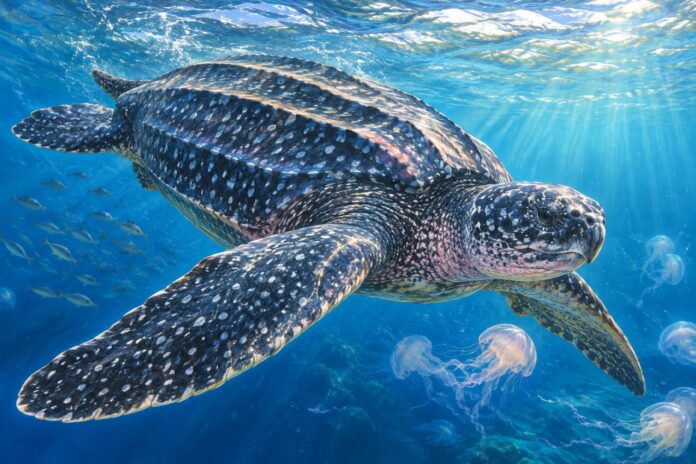
Meet the Leatherback
The leatherback is the odd one out in the family, and in the best way. She is the only sea turtle without a hard shell, and she is the only living member of her entire family, a lineage that stretches back more than 100 million years. She is also the largest sea turtle by a wide margin, reaching about six or seven feet from beak to tail and, in the biggest adults, topping 1,000 pounds. She dives well over a thousand feet deep in search of jellyfish, crosses entire oceans, and tolerates colder water than any other sea turtle, which is why she turns up off places like Nova Scotia and the coast of California.
You will not mistake her for anyone else. Instead of a shell she has dark, rubbery skin stretched over her back, scattered with pale spots and marked by seven long ridges running from her neck to her tail, giving her a teardrop shape. Her front flippers are enormous and have no claws, her upper jaw has two sharp cusps instead of a beak, and the top of her head often carries a pink patch whose pattern is different on every turtle, almost like a fingerprint. NOAA’s leatherback page covers the rest. A body that heavy and that soft has its own ideas about how to handle a beach, and the beach has its own ideas about her.
The Sand for the Leatherback
Every other sea turtle on this list is hauling a hard shell up the beach with her. The leatherback isn’t. She’s the largest turtle on Earth, sometimes topping 1,400 pounds, and everything holding her together back there is skin and cartilage and ridges instead of bone. That changes everything about how she reads a beach. She’s not just looking for good sand. She’s looking for a beach that will let her get in and out again with the least possible punishment to a body that was never built for dry land in the first place.
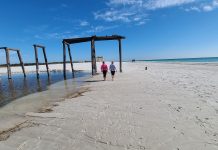
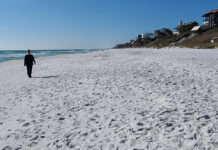
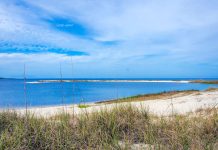
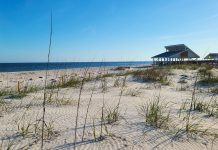
Researchers narrowed it down decades ago to a short, specific list, coarse-grained sand, a beach that slopes steeply and quickly toward the dunes, an approach free of rocks and debris, and close proximity to deep water just offshore. She’s not interested in a long, gentle walk across a flat beach the way a loggerhead will tolerate. Given the size of her, that walk would cost her dearly. What she wants is a beach where the drop into deep water happens fast, so she can get from open ocean to dry sand in the shortest possible distance, lay her eggs, and get back to a place her body is actually built for. Studies have also found she avoids the two extremes, sand low enough to flood and sand so high and firm it won’t hold a stable nest. She’s threading a narrow needle every single time.
Florida’s Steep Approach
Florida is the only state in the continental U.S. where leatherbacks nest regularly, concentrated most heavily on the southeast Atlantic coast in Palm Beach and Martin counties, and it’s not a coincidence that this is exactly where the Gulf Stream runs closest to shore anywhere in the country. That deep, fast-moving current sits practically against the beach here, giving her the short, steep approach she’s built for. The sand itself is the same fine Atlantic quartz shared with loggerheads and greens further inland on the same coast, but it’s the underwater geography just offshore, not the sand alone, that makes this particular stretch of Florida work so well for her.
Trinidad’s River-Fed Sand
Grande Riviere, on Trinidad’s wild, remote north coast, has the highest density of nesting leatherbacks anywhere in the world, packed onto a beach barely a kilometer long. The sand here is coarse and quartz-rich, a shade heavier and grittier underfoot than Florida’s, and the beach shelves steeply enough that researchers describe it as best tackled by strong swimmers. A river of the same name empties into the sea at the beach’s eastern end, constantly reshaping the shoreline, sometimes eroding it dramatically, sometimes rebuilding it within a season. Turtles here have adapted to the chaos with their own quiet logic, nesting the eastern end of the beach early in the season and working steadily westward as the season goes on, staying just ahead of the river’s mood. Access after dark requires a permit and a guide through the Grande Riviere Nature Tour Guides Association, a system built specifically to let people witness this without adding to the pressure on a beach that’s already negotiating with a river for its own shape.
Gabon’s Endless Sandspit
Nothing on this list prepared me for Mayumba. This stretch of Gabon’s southern coast, 60 kilometers of largely uninterrupted sand between the town of Mayumba and the Congo border, holds the largest nesting population of leatherbacks on the planet. On the best nights, upward of 550 females come ashore at once, a density that can exceed 20 turtles for every kilometer of beach. The sand itself is wild and largely untouched, wind-sculpted dunes backed by savanna and tidal lagoons, ghost crabs and monitor lizards working the same shoreline the turtles do. It’s not an easy place to get to, and that’s precisely the point. The remoteness that makes Mayumba a genuine expedition is the same remoteness that’s kept this beach functioning at a scale almost nowhere else on Earth still can.
Costa Rica’s Fading Pale Sand
Playa Grande, on Costa Rica’s Pacific coast, is a mile-long crescent of fine, pale sand backed by wind-shaped coastal scrub, and it protects the most important nesting site for the entire eastern Pacific leatherback population. I want to be honest about this one rather than just romantic about it. Playa Grande’s numbers have fallen hard over the decades, hit by egg poaching in earlier years and, more recently, by exactly the kind of coastal lighting and development pressure researchers have shown reduces nesting density on any leatherback beach. Las Baulas National Park exists specifically because that pale sand is worth fighting for, not because the fight is already won. It’s the one stop on this list I’d frame less as a guaranteed spectacle and more as a chance to witness a species holding on.
Her Track and Her Weight
A leatherback’s crawl is the widest of any sea turtle, sometimes six feet across, with a deep groove down the center where her long tail drags through the sand. Without a rigid shell to brace against, she’s genuinely clumsy on land, and the whole process, crawl, body pit, egg chamber, laying, covering, and the crawl back, can take close to two hours from start to finish. That’s a long time to be exposed, vulnerable, and completely out of her element, which is exactly why the beach she chooses matters so much. Every design choice in her nesting behavior is built around minimizing time spent somewhere her body was never meant to be.
Country by Country: Everywhere She Nests and Feeds
The leatherback’s map looks different from every other turtle in this series. Her nesting beaches are scattered and her feeding grounds are enormous, because she crosses entire oceans to chase jellyfish. I’ve sorted this by ocean, with the nesting countries first and the places she feeds after. NOAA calls Trinidad and Tobago and Gabon the largest remaining nesting aggregations, and several populations have fallen sharply, so I’ve flagged the ones that are down to a handful of nests. The numbers are snapshots, since leatherbacks swing a lot from year to year.
The Western Atlantic and the Caribbean
- Trinidad and Tobago: Grande Riviere and the island’s other north and east coast beaches, with hundreds of leatherbacks a night at peak season.
- Guyana, Suriname and French Guiana: the Guianas shoreline. French Guiana’s nesting fell from tens of thousands of nests a year in the 1990s to a few hundred by 2017, per the State of the World’s Sea Turtles leatherback review.
- Panama: Chiriqui Beach and Soropta in Bocas del Toro.
- Costa Rica: Gandoca-Manzanillo on the Caribbean coast.
- Colombia: Playon, Playona and Acandi on the Gulf of Darien.
- Venezuela: the Paria Peninsula and Gulf of Paria beaches.
- Brazil: Comboios Beach in Espirito Santo, the only part of Brazil where leatherbacks nest regularly.
- United States: Florida, Puerto Rico and the U.S. Virgin Islands (Sandy Point on St. Croix). Most U.S. nesting happens in those three places, and Florida’s nesting has recently declined at several sites.
The WIDECAST nesting atlas lists colonies of more than 1,000 crawls a year in Panama, Trinidad, Suriname and French Guiana, with 500 to 1,000 in Costa Rica, Guyana, Suriname and the U.S. Virgin Islands. On the feeding side, leatherbacks reach Nova Scotia in Canada.
The Atlantic Coast of Africa
This is the other half of the Atlantic story, and it is the biggest. The country list below comes from a review of leatherback nesting along the Atlantic coast of Africa. The counts are older, and several countries have too little survey effort to count at all.
- Gabon: the main event. Aerial surveys suggest at least 30,000 nests are laid along its coast in a season, with Mayumba, Pongara and Gamba the monitored sites.
- Equatorial Guinea: Bioko Island, with a mean of 3,896 nests across five beaches in the early 2000s, plus the Corisco islands.
- Republic of Congo, Democratic Republic of Congo and Angola: confirmed or suggested nesting, with smaller counts and limited survey data. Congo recorded at least 148 nests in 2005 to 2006.
- Sao Tome and Principe, Nigeria, Cameroon, Togo, Benin, Ghana and Cote d’Ivoire: low to moderate nesting along the Gulf of Guinea. Ghana logged 319 nests along a 14 kilometer stretch, Cote d’Ivoire 218 nests over 41 kilometers.
- Liberia, Sierra Leone and Guinea-Bissau: nesting confirmed or supported, in small numbers.
- Mauritania and Senegal: nesting has been reported, but whether it is regular is not confirmed.
The Eastern Pacific
- Mexico and Costa Rica: the core of the Eastern Pacific population, including Playa Grande in Costa Rica. NOAA reports that nesting has fallen by more than 90 percent over three generations.
- Panama, Nicaragua, Guatemala and El Salvador: smaller amounts, with Guatemala’s down to a handful of turtles per season.
The Western Pacific and Southeast Asia
- Indonesia: Papua Barat, which holds 50 to 75 percent of the Western Pacific population according to NOAA, and Jeen Womom Beach is its best-known stretch. Nesting there has dropped by more than 80 percent.
- Papua New Guinea and the Solomon Islands: the other two countries of the tri-national Western Pacific conservation plan.
- Thailand: the Andaman coast, from October to February.
- Vietnam: occasional leatherback nests.
- Malaysia: Terengganu once had about 10,000 nests a year in 1953, and the nesting there is now considered gone. Per the Southeast Asia review, leatherbacks are treated as extinct as a nesting species in Malaysia.
The Indian Ocean
- South Africa: the Maputaland coast of KwaZulu-Natal, where a monitoring program has run since 1963.
- Mozambique: Ponto d’Ouro supports most of the national nesting for both leatherbacks and loggerheads.
- Sri Lanka: leatherbacks are among the nesting species listed.
The Southwest Indian Ocean population is small and geographically restricted, and it is one of the least studied.
Where She Feeds
This is the part that makes leatherbacks different. Turtles from the Western Pacific nesting beaches feed off the U.S. West Coast, in California, Oregon and Washington, as well as the central North Pacific, Indonesian seas, the South China Sea, Malaysia, the Philippines, southeastern Australia and New Zealand. Eastern Pacific leatherbacks feed in the south-central and eastern tropical Pacific and in waters off South America. In the Atlantic, they work the waters off Nova Scotia and the Azores. Morocco and Tunisia see leatherbacks regularly, and about 30 percent of the strandings and bycatch reported in Algeria are leatherbacks. All of that adds up to some of the longest migrations of any animal on the planet.
If you ever want a sense of how big the ocean really is, look at where a single leatherback has been in a single year. She might nest in one country, feed off another continent, and still find her way back to the same stretch of sand.
Where You Can Go Stand on That Sand
In Florida, the same guided walk programs that cover loggerheads, Juno Beach and Boca Raton chief among them, will occasionally turn up a leatherback too, though she’s a bonus rather than the guarantee. Grande Riviere, Trinidad, is the most reliable place on Earth to see one specifically, through the permitted community guide system. Playa Grande, Costa Rica, runs ranger-led nesting tours through Las Baulas National Park during peak season, October through February, with sightings never guaranteed but genuinely likely given the density of nesting there. Mayumba, Gabon, is the real expedition option, remote, difficult to reach, and worth every bit of the effort if you want to see this species at the scale it was built for.
Thoughts & Reflections
But Playa Grande is the part of this story I can’t leave out of the reflection either. Knowing what you need isn’t enough if the world quietly stops offering it and nobody notices until the numbers are already falling. I don’t think that’s a reason for despair. I think it’s a reason to pay attention now, to the people and the places and the conditions that let you and the ones you love actually thrive, instead of waiting until they’re gone to admit how much they mattered.
