



Meet the Kemp’s Ridley
The Kemp’s ridley is the smallest sea turtle in the world and is often called the most endangered of the seven. She is named for Richard Kemp, a Key West fisherman who brought the turtle to the attention of scientists, and almost her entire world is the Gulf of Mexico, with nearly all of her nesting happening on a short stretch of coast in Tamaulipas, Mexico. She also breaks a rule that nearly every other sea turtle follows, because she nests mostly in broad daylight, and often in large groups called arribadas. That makes her one of the few turtles you can watch coming ashore while the sun is still up.
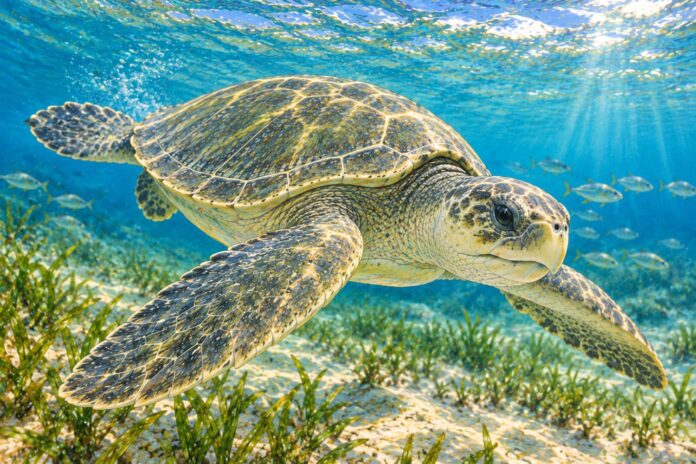
Look at the shape of her shell first. It is nearly round, almost as wide as it is long, on a turtle only about two feet long and under about 100 pounds. Adults are a gray to gray-olive on top and cream-yellow underneath, with a triangular head and a slightly hooked beak, and she has five pairs of plates down each side. The one turtle she gets confused with is the olive ridley, and the usual way to tell them apart is that the Kemp’s is rounder and grayer and has five pairs of plates, while the olive ridley usually has six or more. NOAA’s Kemp’s ridley page goes deeper. Small, round and daytime-bold, she picks a beach with a lot of open sky.
The Sand for the Kemp’s Ridley
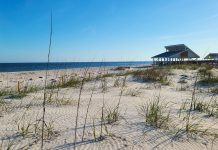
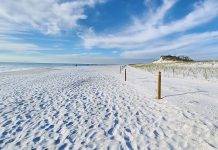
Of every sea turtle in this series, the Kemp’s ridley is the one whose entire story comes down to sand in the most literal way I’ve found yet. She’s the smallest sea turtle on Earth and the most endangered of all seven species, and for most of the last century, almost the entire population staked its future on one single beach. Not a region. Not a coastline. One beach. When I found out how close that bet came to failing completely, and what it actually took to give this species a second option, I understood why people who study sea turtles talk about this particular species differently than the rest.
Kemp’s ridleys nest in daylight, which no other sea turtle species does. They come ashore in a synchronized mass event called an arribada, sometimes triggered by strong northerly winds and shifting barometric pressure, though researchers admit they still don’t fully understand what sets it off. What they do know is that nearly the entire species has historically funneled itself onto one stretch of Gulf coast sand in Tamaulipas, Mexico, generation after generation, an almost unbelievable degree of commitment to a single piece of ground for a species with the whole ocean available to it.
Rancho Nuevo, the One Beach That Almost Wasn’t Enough
In 1947, a Mexican engineer named Andres Herrera filmed an arribada at Rancho Nuevo that stunned the scientific world when the footage surfaced years later, an estimated 40,000 turtles nesting on a single beach in a single day. It’s still one of the most staggering wildlife films ever shot. But that footage also marked something else, the last glimpse of the species at anything close to its historic scale. Egg poaching for human consumption drove the population into freefall over the following decades. By the 1980s, researchers were counting a few hundred nesting females left in the entire world. A joint U.S.-Mexico protection program launched in 1978 slowly turned that number around, and today Rancho Nuevo still hosts the vast majority of all Kemp’s ridley nesting anywhere on Earth, arribadas that once again reach into the hundreds of turtles on a good day, even if the beach has never come close to what that 1947 footage showed.
Texas Sand, Grown from Borrowed Sand
This is the part of the Kemp’s ridley story that genuinely stopped me. Starting in 1978, scientists on both sides of the border tried something that sounds almost too simple to work. They packed Rancho Nuevo eggs directly into sand carried from Padre Island, Texas, transported them north, incubated them, and released the hatchlings onto that Texas sand so they could imprint on it before swimming out into the Gulf. The idea was that sea turtles carry some memory of the beach they hatch on, and that a new generation raised on Padre Island sand might, decades later, choose to come home to it instead of Mexico. For eighteen years, nobody knew if it had worked. Then in 1996, the first tagged, imprinted female was found nesting on Padre Island. It had worked. Texas now hosts a genuine, self-sustaining second nesting population that exists because researchers were patient enough to wait almost two decades to find out if an idea built on nothing more than sand and hope would actually hold.
Veracruz, the Quiet Third Beach
South of Rancho Nuevo, a smaller, steadier nesting population continues at Veracruz, Mexico, a reminder that the species’ historic range once stretched much further along this coast than the single-beach story usually gets told. It’s not dramatic in the way Rancho Nuevo or Padre Island are, but every nest here is still part of the same slow rebuild.
Her Track and Her Daylight Nest
Being the smallest sea turtle species, her crawl is the smallest too, and it’s the only one you have a real chance of spotting in broad daylight instead of piecing together at dawn from the night before. A clutch runs somewhere around 100 eggs, and on nesting beaches like Padre Island, park staff now collect them almost as soon as they’re laid, moving them to protected incubation facilities to guard against the same predators and coastal traffic that make every nest here a genuine long shot. Watching for her isn’t a nighttime beach walk the way it is for loggerheads. It’s a daytime one, which changes the whole feel of looking for tracks.
Country by Country: Everywhere She Nests and Feeds
This one is the shortest list in the whole series, and that is the point. Most species on this list nest in dozens of countries. The Kemp’s ridley nests on just a few beaches in two, and almost all of that is in one. Where she feeds is a bigger story, and it runs well beyond North America. Sources are NOAA’s Kemp’s ridley species page and a paper on Kemp’s ridleys stranded in Spain and Portugal.
Where She Nests
- Mexico: Tamaulipas holds about 95 percent of worldwide nesting, mainly at Rancho Nuevo, Tepehuajes and Barra del Tordo. Veracruz has smaller-scale nesting.
- United States: Texas has the most, with Padre Island National Seashore the center. North Carolina, South Carolina, Georgia, Florida and Alabama see occasional nests, and Louisiana’s Chandeleur Islands logged nests in 2022 for the first time in about 75 years.
That’s it. Two countries, and nearly the whole species in one stretch of Mexican coast.
Where She Feeds in the Gulf of Mexico and the U.S. Atlantic
- United States: adults mainly use nearshore coastal habitat in the Gulf, and some females feed from the Yucatan Peninsula to southern Florida and the north-central Gulf. Juveniles are found along the Atlantic seaboard from Florida to New England, with the Chesapeake Bay, Long Island Sound and Cape Cod Bay as notable summer stops, and cold-stunned strandings on Cape Cod beaches each fall.
- Mexico: the Yucatan Peninsula and Gulf coast waters.
- Canada: juveniles have been recorded as far north as Nova Scotia.
Where She Turns Up Far from Home
Because young Kemp’s ridleys spend their first years drifting on ocean currents, they sometimes end up on the wrong side of the Atlantic. NOAA lists a few records near the Azores, in the United Kingdom, off Morocco and in the Mediterranean Sea. The Springer paper adds Madeira, Ireland, France and the Mediterranean waters of Italy, Malta and Spain, and four juveniles that stranded in Galicia and Portugal in 2014, with bycatch a likely cause. None of these countries has a Kemp’s ridley nest. They are strays, not residents.
So if you ever read about a Kemp’s ridley on a beach in Ireland or Portugal, remember where she was born. The beach was almost certainly in Tamaulipas.
Where You Can Go Stand on That Sand
Padre Island National Seashore is by far the most accessible place to witness this species in person. Trained volunteers patrol nearly 70 miles of protected beach each nesting season, a yellow flag flies at headquarters on any day a nest has been found, and the park periodically opens public hatchling releases that draw crowds from across Texas and beyond. If you’re on the beach and think you’ve spotted a nesting female or a nest, Texas has a dedicated report line, 1-866-887-8535. Rancho Nuevo itself remains a protected research sanctuary in Mexico rather than an open tourist destination, but its story is very much alive in every hatchling that crawls off Padre Island’s sand each summer.
Thoughts & Reflections
What actually moves me is the Padre Island story, though, not the collapse. Somebody looked at a species with everything riding on a single vulnerable place and decided the answer wasn’t to just protect that one place harder. It was to patiently, painstakingly build a second home, using nothing but borrowed sand and eighteen years of not knowing if any of it would work. That’s the part of my own life I recognize the most. Every time I’ve had to leave a place, a business, a marriage, a version of myself that couldn’t hold me anymore, I didn’t get proof in advance that the new ground would work either. I just packed what I had, carried it somewhere new, and waited to find out if it would take.
