



Meet the Green Sea Turtle
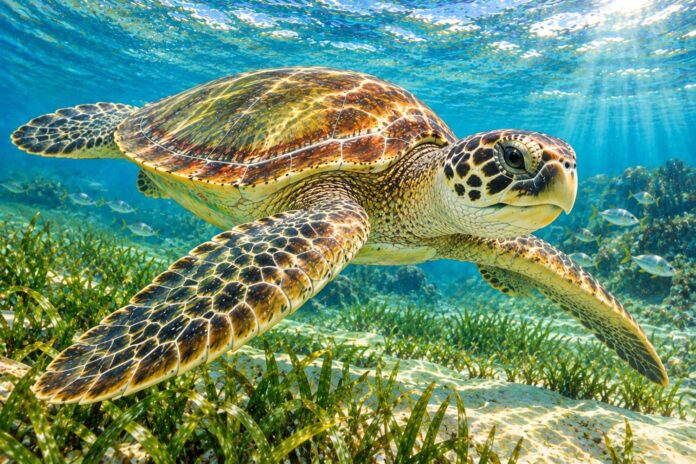
The green turtle is named for the color of her fat, not her shell. As an adult she is a grazer, spending her days over seagrass beds and algae-covered rock, and that plant diet tints her body fat green. She is also the most widespread turtle in this series, nesting in more than 80 countries and living in the coastal waters of more than 140, so if you have ever floated over seagrass in warm water, you may well have had a green turtle for a neighbor. Adults can top 300 pounds, and she moves through the water with a slow, unhurried grace that makes her easy to love.
The green’s face is the giveaway. Her head is small and rounded compared with the rest of her, her beak is blunt with a finely serrated edge for tearing plants, and she has a single pair of scales between her eyes where a loggerhead and a hawksbill have two. Her shell is smooth, wide and oval, usually olive to brown with a marbled or streaky pattern, and she has four pairs of plates down each side. In the eastern Pacific, greens are often so dark they are called black turtles. NOAA’s green turtle page has more. A turtle that spends her life gliding over seagrass makes the beach feel almost like an afterthought, which makes where she chooses to nest all the more interesting.
The Sand for the Green Sea Turtle
Green sea turtles get their name from the fat under their shell, tinted green from a lifetime of eating seagrass and algae, which makes them the vegetarians of the sea turtle world. But the longer I spent researching where they actually nest, the more I started thinking their name could just as easily come from the sand itself. This is a species that ends up on some of the strangest, most specific shorelines on Earth, jet black volcanic beaches, remote golden sand ringed by lava rock, a tiny coral cay so fragile that conservationists have had to physically move tens of thousands of cubic meters of sand just to keep it from drowning its own future. If loggerheads taught me that turtles are particular about texture, green turtles taught me that sometimes the sand itself is the whole story.
Green turtles turn out to be more tolerant of physical beach conditions than you’d expect. Researchers who’ve analyzed sand samples across an entire island’s worth of green turtle nesting beaches found the color, grain size, and moisture content varied wildly from one beach to the next, and none of it correlated strongly with how often turtles chose to nest there. What did matter was disturbance. Beaches near development and heavy human activity saw noticeably less nesting than quiet, undisturbed stretches, regardless of what the sand itself looked like underfoot. She’s less picky about texture than a loggerhead and far more particular about being left alone.
Florida’s Shared Sand
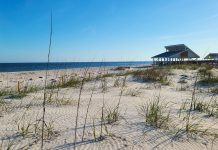
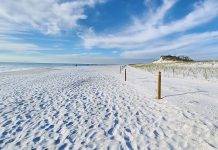
Green turtles nest on much of the same Atlantic Florida coastline as loggerheads, that same fine, pale quartz sand running from the Space Coast down through the Treasure Coast, with Hutchinson Island standing out as one of the state’s most significant green turtle nesting stretches. Florida’s green turtle population is the second largest in the Western Atlantic, and it follows a distinctive two-year rhythm, big nesting years followed by quieter ones, tied to how well the turtles fed the season before. Walk that same stretch of sand in an odd year versus an even one and you’ll notice the difference in nest markers before anyone tells you why.
Costa Rica’s Black Sand Miracle
Tortuguero, on Costa Rica’s roadless northern Caribbean coast, holds the largest green turtle rookery in the entire Western Hemisphere, and the beach itself looks nothing like Florida’s. Twenty-one miles of black volcanic sand, formed from sediment carried down from inland volcanoes over thousands of years, littered with driftwood tossed up by rough Caribbean surf, backed by dense rainforest instead of dune scrub. You can’t even reach it by road. It’s boat or small plane only, which is a large part of why it’s stayed wild enough for tens of thousands of females to keep returning every season. The Sea Turtle Conservancy has monitored this exact stretch of black sand continuously since the 1950s, work that started with Dr. Archie Carr himself.
Australia’s Sinking Sand
Raine Island, a tiny coral cay on the far outer edge of the northern Great Barrier Reef, is the largest green turtle rookery on the entire planet, up to 60,000 females in a single season on peak years. It’s also the most fragile nesting ground on this list, and the reason is entirely about sand. Rising seas and storm erosion have been stripping sand from the nesting beach for decades, and by the mid-1990s, high tides were flooding nests and drowning eggs before they ever had a chance to hatch. So conservationists did something I still can’t quite get over. They physically moved 40,000 cubic meters of sand, enough to fill sixteen Olympic swimming pools, to raise the nesting beach above the flood line. It worked. Hatchling numbers have climbed by hundreds of thousands since. Raine Island isn’t open to public visitors, access is tightly restricted to protect the research happening there, but it might be the single best example anywhere in the world of what it actually takes to save a piece of sand that a species depends on.
The Golden Sand at the End of the World
Ascension Island sits alone in the middle of the South Atlantic, a volcanic cinder cone rising straight out of deep ocean roughly a thousand miles from the nearest landmass, and its beaches are almost the visual opposite of Tortuguero’s. Long Beach, just outside the island’s only town, is a stretch of pale golden sand running up against a low ridge of sharp black volcanic rock spires, the kind of contrast that looks staged until you remember the whole island is just the exposed tip of an underwater volcano. Females travel nearly 1,400 miles from feeding grounds off Brazil to nest on this exact sand, the same beach many of them hatched on decades earlier. The island’s Conservation Department runs guided Long Beach turtle tours during nesting season, December through June, built specifically to let people watch without disturbing the process.
Her Track Looks Different Too
A green turtle’s crawl reads a little differently in the sand than a loggerhead’s. She’s larger, the biggest of all the hard-shelled species, and her track tends to be wider and more symmetrical, with a noticeably straighter path from water to nest site. Before she settles on a spot, she’ll often dig what researchers call a body pit, a broad, shallow depression scooped out with her front flippers, sometimes more than once in a night if the first spot doesn’t feel right, before digging the actual egg chamber underneath with her back flippers. It’s a slower, more deliberate process than it sounds, sometimes taking hours from first crawl to final cover, all of it happening in the dark, by feel alone.
Country by Country: Everywhere She Nests and Feeds
Of all the turtles in this series, the green has the biggest passport. NOAA says green turtles nest in more than 80 countries and live in coastal waters of more than 140, so I’m going to be honest and say this list is long. I’ve sorted it by ocean and by the regional populations that scientists use, as laid out in the State of the World’s Sea Turtles green turtle overview. Where I name a country for nesting, it means green turtles lay eggs there. Where I name a country for feeding, it means they live there on seagrass and algae without necessarily nesting. Counts change every season, so treat the numbers as a snapshot.
The Atlantic, the Caribbean and the Gulf of Mexico
- United States: Florida, Georgia, South Carolina and North Carolina on the mainland, plus Puerto Rico and the U.S. Virgin Islands.
- Mexico: Quintana Roo and the Yucatan coast.
- Costa Rica: Tortuguero, the largest green turtle nesting beach in the Western Hemisphere.
- Venezuela: Aves Island, a remote Caribbean rookery.
- Cuba: one of the high-density insular sites in the Caribbean, according to the WIDECAST nesting atlas. Greens nest in nearly every country and territory in the wider Caribbean, which is its own kind of astonishing.
- Suriname and French Guiana: high-density beaches on the Guiana Shield coast.
- Brazil: Trindade Island, Atol das Rocas and Fernando de Noronha.
- Ascension Island (United Kingdom): the mid-Atlantic island in the South Atlantic population.
- Equatorial Guinea, Guinea-Bissau, and Principe in Sao Tome and Principe: the West African nesting grounds in the South Atlantic population.
The feeding map goes much further. Greens graze inshore and nearshore waters from Texas to Maine, around Puerto Rico and the U.S. Virgin Islands, and down the South American coast to the Rio de la Plata, which means Argentina and Uruguay host greens that nest far away.
The Mediterranean
Greens are a smaller piece of the Mediterranean story than loggerheads, and they nest in the far eastern end. Details come from the State of the World’s Sea Turtles Mediterranean review.
- Turkey: up to about 4,000 green nests a year, mainly on Akyatan, Alata, Davultepe, Kazanli, Samandag and Sugozu, which together hold about 88 percent of the country’s green nesting.
- Cyprus: well over 1,300 green clutches islandwide in 2018.
- Syria: a 12.5 kilometer beach south of Latakia is among the top 10 Mediterranean green nesting areas.
- Egypt: about 7 green nests a year on average.
- Israel and Lebanon: small numbers of nests, including the Tyre Coast Nature Reserve in southern Lebanon.
Libya’s Gulfs of Bomba and Sirte are used by greens for feeding and overwintering, Tunisia’s Gulf of Gabes is a feeding area with rare green sightings, and juveniles are reported off Greece’s Peloponnese coast.
The Eastern Pacific
- Mexico: Colola Beach in Michoacan, where NOAA estimates about 28,000 females nest in a season, along with the Tres Marias and Revillagigedo archipelagos.
- Ecuador: the Galapagos, with Quinta Playa the biggest colony in the archipelago.
- Along the Pacific coasts of the Americas from Mexico to Peru, smaller nesting turns up in Guatemala, El Salvador and Costa Rica, among others.
For feeding, Peru’s Paracas and Sechura Bays, northern Chile and Colombia’s Pacific coast all hold greens, and the “black turtles” of San Diego Bay in California are part of the same population. Sightings reach as far north as southern Alaska.
The Central and Western Pacific
- Hawaii (United States): Lalo (French Frigate Shoals) holds about 96 percent of Hawaiian nesting, with a growing number on the main islands.
- Japan: the Ogasawara Islands, including Hahajima and Chichijima.
- Palau, Guam, the Northern Mariana Islands, the Federated States of Micronesia, the Marshall Islands and the Solomon Islands: the Central West Pacific rookeries.
- Indonesia: West Papua, where Piai Island in Raja Ampat logs roughly 1,500 to 3,200 nests a year.
- Papua New Guinea: part of both the Central West Pacific and Southwest Pacific populations.
- Fiji, American Samoa (Rose Atoll), Kiribati, Tokelau, the Cook Islands and French Polynesia (Scilly Atoll): the main nesting islands of the Central South Pacific. Samoa, Tonga, Tuvalu and Pitcairn host minor nesting.
- Australia: Raine Island and other Great Barrier Reef cays, plus Papua New Guinea and Vanuatu in the same Southwest Pacific population.
Southeast Asia
Details here come from the State of the World’s Sea Turtles Southeast Asia review.
- Malaysia: Sabah’s Turtle Islands (roughly 15,000 to 20,000 green clutches a year), Terengganu, and Sarawak’s Talang-Satang Islands. Nesting happens in 10 states.
- Indonesia: the Berau and Derawan Archipelago in East Kalimantan (an average of about 15,000 clutches a year) and Bangkaru Island off Sumatra.
- Philippines: the Turtle Islands in the Sulu Sea, where nesting has grown dramatically since the 1980s.
- Vietnam: Con Dao National Park, the country’s largest rookery, with around 700 green turtles nesting regularly nationwide.
- Thailand: both coasts, from the Andaman Sea in March to July to the Gulf of Thailand in May to September, including Koh Khram.
- Myanmar: nesting is reported, with Thameehla Island and Wa Ale Island among the sites named in the review.
- Cambodia: small amounts of nesting on islands including Koh Tang and Poulo Wai.
- Brunei and Timor-Leste: smaller amounts of nesting.
- Singapore: green turtles feed around the islands south of the city, but they don’t nest there.
The Indian Ocean and the Arabian Region
- Oman and Yemen: the North Indian population’s nesting beaches, with the Red Sea, the Persian Gulf and the Arabian Sea as its marine habitat.
- Pakistan, India, Bangladesh and Sri Lanka: green turtles nest in small numbers alongside olive ridleys (and, in Sri Lanka, other species).
- Madagascar, the Comoros (Mohéli), Mayotte, Europa and the Glorieuses in the Mozambique Channel, and Aldabra in the southern Seychelles: the Southwest Indian nesting islands.
- Tanzania and Mozambique: green nesting along the East African coast, including Quirimbas National Park in northern Mozambique.
- The Chagos Archipelago (United Kingdom): Diego Garcia has a monitored nesting population. The West Indian Ocean review covers the region in more detail.
That’s a lot of coastline, and it is the reason I keep saying the green turtle is the one most likely to be sharing your snorkel water without you knowing. If you’ve swum over seagrass anywhere warm, the odds are decent that she’s been your neighbor.
Where You Can Go Stand on That Sand
Tortuguero remains the single best place on Earth to witness green turtle nesting in real numbers, through guided village tours coordinated with the Sea Turtle Conservancy’s field station. Ascension Island offers something almost nobody else can, a genuinely remote, undisturbed nesting beach with an official, low-impact public tour program built right into the local conservation department. And if a trip to either one isn’t in the cards this year, Hutchinson Island and the rest of Florida’s Atlantic coast will still put you on real, working green turtle sand, no passport required.
Thoughts & Reflections
I think about that every time I catch myself waiting for circumstances to improve on their own before I make a move. Sometimes showing up again isn’t enough. Sometimes the ground you’re standing on needs to change too, and waiting for it to fix itself is really just another way of staying stuck. There’s no shame in that kind of rebuilding. Some of my own biggest years didn’t come from digging in and trying harder on the same old ground. They came from finally admitting the foundation needed to move, and then doing the unglamorous work of moving it.
