

30 historic lighthouses
About a dozen you can actually climb
Tallest: Ponce Inlet, 175 feet
Oldest standing: Amelia Island, 1838
A dozen more reachable only by boat
Two coasts, the Panhandle, and the Keys
Walking every beach in Florida means you spend a lot of time looking at the same handful of landmarks from a distance. You round a point, you see a tower, and eventually you start keeping a mental list. Somewhere around beach four hundred, my lighthouse list turned into its own obsession, separate from the sand but tangled up in it, because a working lighthouse tells you something a beach can’t: exactly how dangerous that stretch of water used to be, and who stood there keeping watch over it.
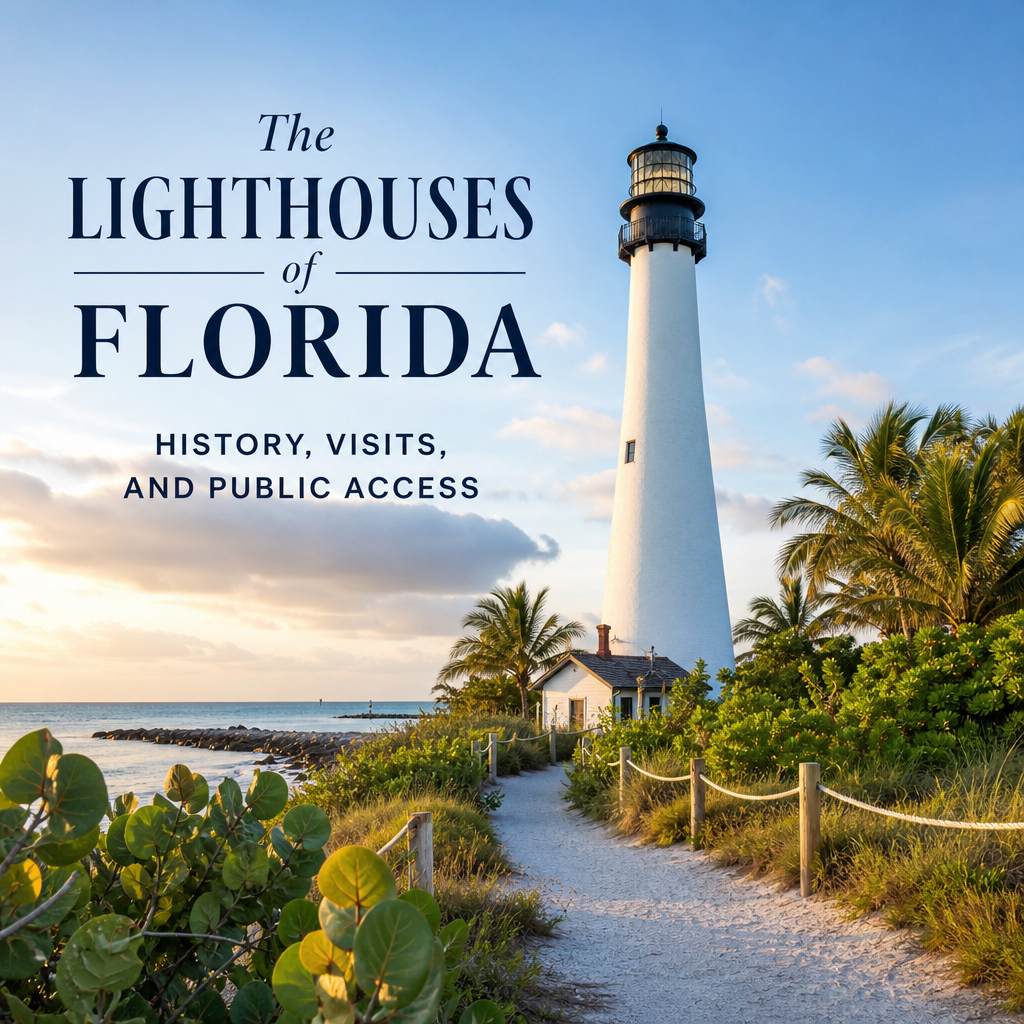
Florida’s coastline is lined with some of the most iconic lighthouses in the United States. Built to guide ships through dangerous waters, these towers now offer a mix of maritime history, scenic views, and memorable day trips. Some are fully open to the public, some allow climbing, and others can only be admired from the outside. Knowing what to expect can help you plan a better visit.
A Brief History of Florida’s Lighthouses
Florida’s long and treacherous shoreline made lighthouses essential from the early 1800s onward. Before modern navigation systems, sailors depended on these towers to avoid reefs, shoals, sandbars, and stormy passages.
Many of the state’s earliest lighthouses were built during the 19th century, a time when shipping traffic was growing quickly. Their purpose was practical, but their construction often reflected the style and materials of the era. Brick, coquina, and iron all appear in the state’s lighthouse history, depending on location and available resources.
Several of these towers survived hurricanes, wars, erosion, and even relocation. Today, they stand as reminders of Florida’s coastal heritage and the people who once kept the lights burning through the night.
Florida’s Lighthouses
Florida has 30 lighthouses that count as historic structures according to the Florida Lighthouse Association, and I have made it my business to find out the real answer to the question everyone actually wants to know before they drive out of their way: can I climb it? This guide walks the coast from the Panhandle down the Atlantic side, through the Gold Coast, out into the Keys and the Dry Tortugas, and back up the Gulf side, with the real story on every one still standing. I close with a quick-reference climb guide and what all of this taught me after enough towers to lose count of my own steps climbed.
The Panhandle Lights: Five Towers Between Pensacola and the Forgotten Coast
The Panhandle holds five lighthouses, and every one of them has a survival story. This stretch of coast takes hurricanes head on, and it shows in how many of these towers have been rebuilt, relocated, or rescued from a scrap auction by people who refused to let that happen.
Pensacola Lighthouse
Pensacola. Climbable. Naval Air Station access required.
Florida’s second lighthouse first shone in 1824, but the tower you climb today went up in 1859, a 150 foot brick column with a first order Fresnel lens still doing its job. What makes Pensacola different from every other lighthouse on this list is where it sits. The tower is inside Naval Air Station Pensacola, home of the Blue Angels, which means you’ll show a photo ID at a security gate before you ever see the tower.
You’ll notice the climb itself is no joke. There are 177 steps, and the tower narrows the higher you go, the same as most of the towers on this list built in that era. What you get at the top is a view most visitors to Pensacola never see: the whole naval base laid out below you, the Blue Angels’ hangars, and Pensacola Bay stretching toward the barrier islands I’ve walked more than once.
The security gate throws people off more than the climb does. Bring your ID, expect a short wait if a flight is training that day, and don’t schedule this for the same afternoon as anything else with a tight window. Once you’re through the gate, the museum in the restored keeper’s quarters is worth the extra thirty minutes, especially the exhibit on how many keepers here doubled as informal weather forecasters for the Navy long before radar existed.
Bring a photo ID and build in extra time for the base gate. The climb and the view are worth the hoop jumping.
Cape San Blas Lighthouse
Port St. Joe. Climbable. Relocated in 2014.
This is the lighthouse I point to when people ask me if a whole building can really be picked up and moved. In 2012, Hurricane Isaac left the tower and its two keeper’s dwellings with about fifty feet of buffer between them and the Gulf. Rather than lose it, the city of Port St. Joe spent over half a million dollars lifting the entire lighthouse, both keeper’s quarters, and the oil house onto trucks and hauling the whole complex twelve miles inland to George Core Park, where it stands today.
You’ll climb 131 steps up a narrow spiral staircase to reach the viewing platform, and the tower gets noticeably warmer as you go, especially in summer, so this is a morning climb if you can manage it. From the top you get 360 degrees of St. Joseph Bay on one side and the Gulf on the other, plus a clear look at just how much shoreline this stretch of the Forgotten Coast has lost and gained over the decades.
What gets me every time I visit is standing in the keeper’s quarters, now a small gift shop, and thinking about how this building has an entirely different backyard than the one its original keepers knew. The move saved a piece of real history instead of turning it into a plaque where a lighthouse used to be, and that matters more to me the more of these towers I visit that weren’t so lucky.
Go early. The 131 step climb heats up fast, and the 360 degree view over St. Joseph Bay is worth doing before the crowds arrive.
Cape St. George Lighthouse
St. George Island. Climbable. Rebuilt after collapse.
This lighthouse fell into the Gulf. Not metaphorically, literally: after decades of erosion undermining its foundation, the original 1852 tower collapsed into the water in October 2005. What you climb today is a faithful 2008 rebuild in Lighthouse Park at the center of the island, constructed using bricks salvaged from the original structure alongside new materials, following the same design down to the dimensions.
The climb is 92 wooden stairs followed by an eight rung ladder through a narrow scuttle hole to reach the lantern room, which is a different kind of climb than any other tower on this list. It’s tight, it’s a little bit of a workout for anyone uneasy in small spaces, and the payoff is a 360 degree view of the Gulf, Apalachicola Bay, and St. George Sound that makes the whole island make sense at once.
Time a visit for one of the monthly Full Moon Climbs if you can. Standing where the original tower collapsed, after dark, changes how the history lands.
Crooked River Lighthouse
Carrabelle. Climbable. Saved from auction.
Also known as the Carrabelle Light, this iron skeleton tower was built on the mainland in 1895 specifically because the three lighthouses that came before it, all on Dog Island, kept getting destroyed by storms. The Coast Guard decommissioned it in 1995 and had it slated for a surplus auction in 1999. A group of Carrabelle residents formed the Carrabelle Lighthouse Association, got the deed transferred to the city, and relit it with a replica Fresnel lens in 2007. It’s still shining every night because a small town decided it should.
You’ll climb about 130 spiral steps with no landings, which means once you start you’re committed, and the stairs narrow noticeably near the top. It’s the tallest lighthouse on the Forgotten Coast at 103 feet, and the watch room at the top gives you Carrabelle Beach, St. George Sound, and the dense green of Tate’s Hell State Forest all in one turn of your head.
This is one of the friendliest climbs in Florida, mostly because of who runs it. The volunteers here know every rivet in that iron skeleton and want to tell you about it, and the Keeper’s House Museum next door does a genuinely good job explaining how a bi-valve Fresnel lens works, which is not a sentence I expected to write about a gift shop.
This is a volunteer-run lighthouse that a whole town fought to save from the scrap heap. Ask the staff questions. They love answering them.
St. Marks Lighthouse
St. Marks National Wildlife Refuge. Not climbable. Grounds always open.
St. Marks is the second oldest lighthouse in Florida, first built in 1831 and rebuilt in 1842 after the original contractor was found to have cut corners on materials. It sits at the end of a 6.7 mile scenic drive through St. Marks National Wildlife Refuge, and it played a real role in the Civil War, when locals boiled seawater along this coast to make salt for Confederate troops while the light itself went dark for the duration of the war.
Here’s the thing to know before you drive out: you cannot climb this one. The interior stairs are closed to the public for safety, full stop, no exceptions. The refuge grounds are open every day at a small vehicle fee, and the keeper’s house museum inside opens for tours on select weekends and special events throughout the year, but the actual tower stays off limits.
I still think this is one worth the drive, and not despite the fact you can’t climb it. The refuge itself is one of the best birding stretches on this entire coast. I stopped to see the birds along Lighthouse Road more times than I can count. And even though there was no sandy beach to walk, standing at the base of a working lighthouse you’re not allowed to climb on a rocky shoreline, is its own kind of humbling.
You cannot climb this one, and that’s fine. Come for the refuge, the birding, and a working light you’re meant to admire from the ground.
The Atlantic Coast: From Florida’s Oldest Light to Its Tallest
This stretch covers the widest range of access I found anywhere in the state, from a lighthouse you cannot climb at all, to one that’s arguably the most complete light station left in the country.
Amelia Island Lighthouse
Fernandina Beach. Not climbable. Grounds open Saturdays.
This is the oldest standing lighthouse in Florida, first built in 1838 using materials salvaged from an even older light station near Cumberland Island, Georgia. What makes it unusual is where it ended up: smack in the middle of a quiet residential neighborhood, with houses close enough on either side that the city has to manage access carefully just to keep the peace with its neighbors.
You cannot climb this one under any circumstances the city currently allows. The grounds are open to the public every Saturday from 11am to 2pm for walking around and photos, and the city runs guided tours twice a month where you can step inside the base and hear the full history, but the stairs themselves stay closed. The lighthouse recently underwent a major, nearly two-year preservation project funded partly by state and Florida Lighthouse Association grants, reopening with a ceremony in 2025.
I’ve made the pilgrimage out to O’Hagan Lane, and I’ll tell you honestly, it takes some planning to catch it open. Go on a Saturday, park where you’re told to, and be respectful of the driveway you’re walking down, since it sits between two private homes. It’s a strange, quiet way to stand next to Florida’s oldest lighthouse, more like visiting a neighbor’s yard than a monument, and that’s part of what makes it memorable.
Plan around the Saturday 11am to 2pm window. This is Florida’s oldest lighthouse, and you’ll never get past the ground floor, but it’s worth the visit anyway.
St. Johns Light & St. Johns River Light
Naval Station Mayport. Not climbable, not really visitable. Two lighthouses, one restricted base.
Between Amelia Island and St. Augustine sits a naval base holding two lighthouses at once, and you won’t get inside the gate to see either one up close. The older of the pair, St. Johns River Light, first shone on August 1, 1859, an 81 foot brick tower that’s now the oldest surviving building in Mayport. It was retired in 1929 when a lightship took over the job seven miles offshore, and in the 1940s, runway fill for the growing naval air station buried much of its base under eight to ten feet of dirt, a detail that tells you everything about how this stretch of coast prioritized its military mission over its maritime history.
The newer tower, simply called St. Johns Light, went up in 1954 to replace that lightship once the Coast Guard decided a fixed structure was cheaper to run. It’s an odd looking thing for a lighthouse, a square art deco concrete tower with beveled corners and no lantern room at all, more airway beacon than classic tower, and it’s still an active aid to navigation today. Both lighthouses sit on active Naval Station Mayport property, and since 9/11 that means a military ID or an approved sponsor to get anywhere close.
I’ve caught glimpses of both from the water side more than once, since the St. Johns River Ferry, a real working car ferry that crosses between Mayport and Fort George Island, runs close enough to give you a look at the newer tower if you know where to watch. A local nonprofit, the Mayport Lighthouse Association, is now pushing to relocate the older river light to the Mayport Village waterfront so it can finally be restored and opened to the public.
You won’t get past the gate at either of these. Ride the St. Johns River Ferry between Mayport and Fort George Island instead, and watch for the newer tower off the port side as you cross.
St. Augustine Lighthouse
Anastasia Island. Climbable. 219 steps.
The current black and white spiral tower dates to 1874, but St. Augustine held the very first federally funded lighthouse site in Florida, dating back to 1824 on the same stretch of Anastasia Island. That original tower eventually lost its footing to beach erosion and toppled into the sea in 1880, five years after the current tower was already lit and doing the job.
You’ll climb 219 steps, more than any lighthouse on this list except Ponce Inlet, and the reward is a first order Fresnel lens still functioning at the top, a nine foot tall marvel of hand blown French glass from 1874 that still throws a single flash of light thirty miles out to sea. The St. Augustine Lighthouse and Maritime Museum around its base runs one of the most respected maritime archaeology programs in the state, actively locating and studying shipwrecks along this coast.
This is one of the most visited lighthouses in Florida for good reason, and I’ll admit part of me resists recommending the obvious pick. But I’ve climbed it at sunset during one of their evening events, and watching the light come on above you while the Old City goes gold below is worth fighting the crowds for at least once.
Do the sunset or moonrise climb if you can get tickets. Watching the working Fresnel lens activate above you is worth the extra planning.
Ponce de Leon Inlet Lighthouse
Ponce Inlet. Climbable. 203 steps. Florida’s tallest.
At 175 feet, this is the tallest lighthouse in Florida and one of the tallest brick towers in the country, completed in 1887 to mark one of the most dangerous inlets on the East Coast. What sets it apart isn’t just the height, it’s the completeness of the site. All three original keeper’s dwellings still stand here, which is rare enough that the site earned National Historic Landmark status, one of only eleven lighthouses in the country to hold that designation.
You’ll climb 203 steps, and I won’t pretend that isn’t a real workout, especially in Florida humidity. What you get for it is a view stretching from the Atlantic to the St. Johns River, and a separate exhibit building on the grounds that holds an actual collection of Fresnel lenses of every size, including the original first order lenses from both this station and Cape Canaveral.
I put this lighthouse and St. Augustine back to back on the same trip once. Do one, walk the beach, do the other the next day. The keeper’s houses here alone deserve unhurried time, and you’ll shortchange yourself trying to knock out both towers in one afternoon.
This is Florida’s tallest lighthouse and the most complete light station left in the state. Give the keeper’s houses real time, not just the climb.
Cape Canaveral Lighthouse
Cape Canaveral Space Force Station. Partially climbable. Booked tour required.
This is the lighthouse with the strangest neighbors in Florida. The current tower dates to 1868, moved inland from an original 1848 site as the shoreline shifted, and it now stands on active Space Force property surrounded by launch complexes and rocket history spanning from the earliest American satellite tests to today. It’s still an active Coast Guard aid to navigation, quietly doing its original job while the space program grew up around it.
You cannot simply drive out here. Access runs entirely through Canaveral Tours, which requires advance booking and, for most visitors, a security clearance submitted weeks ahead with photo ID. Once inside, you’re allowed to climb to the fifth interior level of the tower, not the very top, before the tour continues to Hangar C and the missile museum next door.
I’ll admit this is a lighthouse I haven’t made it to… yet. But it’s on my list. There’s something genuinely strange and moving about climbing a 19th century tower built to warn sailing ships off a shoal, standing inside a working military space installation, with rocket gantries visible out the same windows that once watched for shipwrecks.
Book weeks ahead and have your ID ready. This is the only lighthouse on the list where you’ll see shipwreck history and rocket history in the same afternoon.
Southeast Florida: Guided Climbs, a Boat Ride, and the Oldest Lens Still Working
Three lighthouses cover the Gold Coast down to Biscayne Bay, and every single one of them requires a guide. None of these are walk up and climb situations, which changes the pace of a visit in a good way.
Jupiter Inlet Lighthouse
Jupiter. Climbable by guided tour. Oldest working Fresnel lens in Florida.
This lighthouse was designed by a young Army lieutenant named George Gordon Meade, who would later command Union forces at Gettysburg. First lit in 1860, it was disabled for years during the Civil War after Confederate sympathizers dismantled and buried parts of the lens to keep it dark, a detail I think about every time I stand at the top. It holds the oldest Fresnel lens still actively working anywhere in Florida.
You can only climb with a guide, on a set daily schedule, and space fills fast in winter, so book ahead if you’re coming during peak season. The 105 step climb takes you up a tower built on top of a 48 foot ancient shell midden, meaning you’re already elevated before the tower even starts, which is part of why the view stretches as far as it does.
Book the guided climb ahead, especially in winter. The docents here turn a good view into a real history lesson.
Hillsboro Inlet Lighthouse
Hillsboro Beach. Climbable by boat tour only. Once a month.
You cannot drive to this lighthouse. It sits on gated private property along the Hillsboro Inlet, and the only way in is a boat tour run by the Hillsboro Lighthouse Preservation Society roughly once a month, departing from a dock in Pompano Beach. It’s one of the most powerful lights on the entire Atlantic coast, still an active aid to navigation since 1907, with its original second order Fresnel lens shining every night whether anyone visits or not.
The tour itself takes you along the Intracoastal Waterway before delivering you to the lighthouse dock, and once there you’re free to climb all 175 steps to the top. The area carries a piece of local legend too: the barefoot mailmen who once walked this coast delivering mail between Palm Beach and Miami predate the lighthouse, and one of them disappeared crossing this very inlet, presumed drowned or taken by an alligator.
This is the lighthouse that requires the most patience of anyone on this list, and I mean that as a compliment. Check tour dates months ahead, because there’s only one sailing day per month and it fills. The payoff is a lighthouse experience almost nobody else gets to have, since it simply isn’t accessible any other way.
Book the monthly boat tour as far ahead as you can. This is the hardest lighthouse in Florida to reach and one of the most rewarding once you do.
Cape Florida Lighthouse
Key Biscayne. Climbable by guided tour. Oldest structure in Miami-Dade County.
The original 1825 tower here didn’t survive peacefully. During the Second Seminole War in 1836, the lighthouse came under attack, and the story of the assistant keeper hiding through the assault while the wooden stairs burned beneath him is one of the more harrowing keeper stories in Florida lighthouse history. The tower was rebuilt in 1846 and still stands today inside Bill Baggs Cape Florida State Park, the oldest structure left in Miami-Dade County.
Climbing requires a guided tour, offered a couple of times a day, Thursday through Monday, included in the state park’s vehicle entrance fee. The climb itself is a little under a hundred steps, manageable for most visitors, and the top delivers a genuinely rare view: downtown Miami’s skyline on one horizon and open Atlantic water on the other, framed by the same palm covered park where you’ll find one of the better beaches in the county waiting below.
What I love most about this one is how easily it pairs with an actual beach day. Climb in the morning, spend the afternoon on the sand a few hundred feet away, and watch a Biscayne Bay sunset before you leave. Very few lighthouses in this state let you do all three in one visit without moving your car.
Pair the morning tour with a full beach day here. This is the rare lighthouse where the climb and the sand sit a few hundred feet apart.
The Keys and the Dry Tortugas: One You Can Walk To, and Six You Never Will
No stretch of this state has a more dramatic split between accessible and untouchable. Key West has the one lighthouse in the Keys you can casually walk up to on a sidewalk. Everything else out here needs a boat, and most of it needs a boat you’ll never be allowed to tie up next to.
Key West Lighthouse
Key West. Climbable. No boat required.
This is the only lighthouse in the entire Florida Keys you can reach on foot from a normal city sidewalk, which makes it an outlier on this whole list. The current 73 foot brick tower dates to 1848, replacing an original 1825 lighthouse whose keeper’s family drowned when a hurricane destroyed the original structure in 1846. It stayed active until 1969, when the growing skyline of Key West hotels started blocking its light from the sea, at which point it retired into museum life.
The climb is short by this list’s standards, and it’s open daily, run today by the Key West Art and Historical Society alongside the keeper’s quarters museum next door. One of the more interesting artifacts inside is the original first order Fresnel lens from Sombrero Key Light, one of the offshore reef towers you’ll never get to see up close, relocated here where visitors can actually study it.
After the boat-only lighthouses further out in the Keys, I’ll admit there’s something almost anticlimactic about strolling up to this one between breakfast and a walk down Duval Street. Don’t skip it for that reason. It’s a genuinely good museum, and it’s the easiest complete lighthouse experience in the entire island chain.
This is the one Keys lighthouse you can visit without a boat. Pair it with the Sombrero Key lens inside, since that’s the closest you’ll ever get to that offshore tower.
Garden Key Lighthouse, Fort Jefferson
Dry Tortugas National Park. Not climbable. Ferry or seaplane only.
Getting here is most of the story. Dry Tortugas National Park sits 70 miles west of Key West, reachable only by ferry or seaplane, and the lighthouse itself rises from the top of the fort’s own walls, an iron tower installed in 1876 after an earlier ground level light was destroyed by hurricanes. You cannot climb inside this lighthouse.
What you can do instead is walk the ramparts of Fort Jefferson itself, which puts you close enough to the tower to appreciate its scale, all while getting one of the more unusual vantage points in the entire National Park System: 45 foot brick walls, a 70 foot moat, and water so clear you can see the shipwrecks below it from certain angles.
I’ll be straight with you, this is a full day commitment, not a quick stop. The ferry ride alone runs two and a half hours each way. I took the seaplane (a beautiful way to view the fort and lighthouse before stepping foot on the island), which was also a full day commitment between dropoff and pickup. But it is an easy full day with plenty to do. Tour the grounds, look for birds, enjoy the water and the beach area, go snorkeling. The water around the fort is some of the clearest I’ve seen anywhere in the state.
Budget the full day. You can’t climb this lighthouse, but the fort ramparts beside it and the snorkeling around it make so worth it.
Loggerhead Key Lighthouse
Dry Tortugas National Park. Not climbable. Reachable only by private boat or kayak from Garden Key.
If Garden Key felt remote, Loggerhead Key is the version of the Dry Tortugas that most visitors never actually reach. The Yankee Freedom ferry that carries almost everyone out to Fort Jefferson only docks at Garden Key, three miles east of here, which means getting to this lighthouse takes a second, harder crossing: your own boat, a guided trip with a National Park Service permit, or a genuine six mile round trip paddle across open water if you brought a kayak or canoe on the ferry.
What you’re paddling toward is the tallest brick lighthouse in the Dry Tortugas, first lit in 1858 with a first order Fresnel lens, the largest size ever made, extended to 150 feet because the original light back on Garden Key simply wasn’t strong enough to warn ships off these reefs. It survived hurricanes in 1873 and 1875, got an electric lamp in 1931 that briefly made it one of the most powerful lights in the country, and kept working as an active aid to navigation until the Coast Guard formally decommissioned it in 2015. The pier here is closed to the public, so even once you arrive, you’re anchoring offshore and wading or dinghying the rest of the way in.
You cannot go inside, and neither can anyone else. Every structure on the island, the lighthouse, the 1922 keeper’s bungalow, the old boat house, stays closed, and you’re asked to keep to the designated trails once you’re ashore. What the island does let you do: snorkel Little Africa Reef just offshore, or the Windjammer wreck around the northwest point, while loggerhead and green sea turtles nest on the same beach by the thousands every summer.
Budget a second full day beyond Fort Jefferson if you want this one, and bring your own boat or kayak. Almost nobody makes the extra crossing, and the turtle nesting beach and the reef just offshore make it worth the effort anyway.
The 7 Reef Lights You’ll Never Climb
Offshore, Florida Keys National Marine Sanctuary. Boat or dive access only.
Strung along roughly 150 miles of reef from Key Biscayne to Key West sit seven towers marking the outer edge of the reef tract, six of them iron skeleton giants built between the 1850s and 1880s, each more than a hundred feet tall and engineered to let hurricane winds pass straight through the open ironwork instead of fighting it. A seventh, smaller light joined them in 1933. None of these are open to the public. The six historic giants were deactivated as official aids to navigation between 2014 and 2015, replaced by small solar powered lights and in several cases transferred to federal property agencies or local preservation groups. The seventh, Tennessee Reef Light, is a shorter, later automated tower that has largely been left alone, lantern, lens, and all.
-
- Alligator Reef Light. The most visible from land of the six, standing just off Islamorada and named for the USS Alligator, which wrecked here in 1822.
- Sombrero Key Light. The tallest reef light at 142 feet, off Marathon, its original first order lens now on display at the Key West Lighthouse museum.
- American Shoal Light. The last of the six completed, off Sugarloaf Key, and the least visited or photographed of the group.
- Carysfort Reef Light. Off Key Largo, one of the oldest of the six, dating in some form back to the 1850s and named for a British warship that wrecked nearby.
- Fowey Rocks Light. The northernmost of the group, about six miles off Key Biscayne, visible on a clear day from the top of Cape Florida Lighthouse.
- Sand Key Light. The southernmost, about six miles off Key West, marking a shifting sandbar that has claimed more ships than almost anywhere else on this list.
- Tennessee Reef Light. The shortest and youngest of the group at 49 feet, built in 1933 south of Long Key in water shallow enough that snorkelers and kayakers reach it, not just dive boats.
I grew up boating these waters and regularly saw them at a time where I thought it was cool, but never really understood the historical significance. You will not set foot on any of them, and honestly, that’s part of what makes them worth seeking out. These are the last Florida lighthouses doing exactly what they were built to do with no visitor center, no gift shop, and no one asking permission to stand where they stand.
You’ll never climb these seven, and that’s the point. Book a dive or snorkel charter out of the Upper or Middle Keys to see them the way they were meant to be seen, from the water.
The Gulf Coast: From Tarpon Country to a Tampa Bay Island With No Bridge
Every lighthouse on the Gulf side of the peninsula shares one thing in common: none of them are a simple drive up and climb. Some need a boat, some need a calendar, and one needs both.
Sanibel Island Lighthouse
Sanibel. Not climbable. Grounds open.
Officially the Point Ybel Light, this skeletal iron tower has marked the entrance to San Carlos Bay since 1884, and it survives today as the anchor of Sanibel’s public Lighthouse Beach Park. You cannot go inside or climb it, full stop, but the grounds around it are some of the most heavily used public beach access on the island, especially at sunset.
What draws people here isn’t really the tower itself, it’s everything around it. The fishing pier just past the lighthouse is a local institution, and the beach here consistently produces some of the better shelling on an island that’s already famous for it. I’ve done the squat more times than I can count working this stretch of sand, and the lighthouse makes a good landmark to orient yourself by while you’re hunting.
If you’re building a Sanibel day around this stop, come for golden hour. The lighthouse silhouettes beautifully against a Gulf sunset, and the pier fills with a mix of anglers and photographers who’ve clearly made this their regular spot, not just a tourist stop.
Skip the daytime rush and come for sunset. The lighthouse, the pier, and the shelling all work better in that last hour of light.
Port Boca Grande Lighthouse
Gasparilla Island. Climbable. Museum on site.
Boca Grande actually has two lighthouses, and it’s worth knowing the difference before you go. The one most people picture, and the one you can actually climb, is the Port Boca Grande Lighthouse at the island’s southern tip, a house style structure built in 1890 that now anchors Gasparilla Island State Park. Hurricane Ian caused serious damage here in 2022, and a restoration effort brought it back for climbing and museum tours in early 2024.
The museum inside covers the island’s phosphate shipping history and its long run as a tarpon fishing destination, with a hands on exhibit room where kids can touch actual fossils and shells pulled from nearby waters. A separate structure, the Gasparilla Island Rear Range Light, is a private skeleton tower that opens for tours only occasionally between October and April through the Barrier Island Parks Society, so don’t confuse the two if a tour date is what you’re after.
Boca Grande itself has no traffic lights and no chain restaurants, and that unhurried island pace carries over into how this lighthouse feels to visit. I’d build a whole slow day around it rather than treating it as a quick stop between beaches.
Confirm which of Boca Grande’s two lighthouses you’re after. The museum lighthouse at the south tip is the one open for regular climbing.
Gasparilla Island Lighthouse (Rear Range)
Gasparilla Island. Climbable. Docent-led tours, October through April.
This is the lighthouse most people miss on Boca Grande, and it has the strangest backstory of anything on this entire list. The iron skeleton tower standing today about a mile and a half north of the Port Boca Grande Lighthouse didn’t start its life in Florida at all. It was built in 1881 near Lewes, Delaware, as the Delaware Breakwater Rear Range Light, and after beach erosion made that spot untenable, the Lighthouse Service disassembled the whole tower piece by piece and shipped it south, reassembling it on Gasparilla Island in 1927. It didn’t actually shine here until 1932, five years later, once it was paired with a second range light a mile out in the Gulf that has since been removed.
The idea was simple and clever: when a ship’s navigator lined up this tower with the now-gone front range light offshore, they knew exactly when to turn into Boca Grande Pass. The Coast Guard kept it running until 2014, and it sat quietly falling apart until the Barrier Island Parks Society took over stewardship in 2016, raised over a million dollars, and reopened it for its first public climb on April 7, 2017. The light itself went back into service in 2018, this time as a standalone aid rather than half of a matched pair.
Don’t confuse this with the museum lighthouse down the road. This is Boca Grande’s other tower, the one that used to stand in Delaware, and it’s worth tracking down its October through April tour schedule.
Egmont Key Lighthouse
Mouth of Tampa Bay. Not climbable. Boat or ferry only.
Egmont Key sits right where Tampa Bay meets the Gulf, and getting there requires a boat or a ferry from Fort De Soto Park, since there’s no bridge and no cars allowed on the island. The current lighthouse dates to 1858, replacing an earlier tower knocked around by a string of 1840s hurricanes so severe that one keeper reportedly rowed away after a storm and never came back to the job.
The grounds are open and worth exploring well beyond the tower itself, since the island also holds the crumbling remains of a Spanish-American War era fort and an old quarantine station that once screened arriving ships. You cannot climb the lighthouse, but you can walk right up to its base, and the island’s population of gentle, unhurried gopher tortoises tends to steal the show anyway.
This feels like the wildest of the boat access lighthouses I’ve covered here, less maintained and more overgrown than Anclote Key or Cedar Key, in the best way. Bring water and sun protection, since there’s nothing to buy once you’re out there, and give yourself real time to explore the fort ruins alongside the lighthouse.
Catch the ferry from Fort De Soto Park and plan a half day. The fort ruins and the tortoises are as much the draw here as the lighthouse itself.
Cedar Key Lighthouse
Seahorse Key. Not climbable. Limited open house days.
The oldest lighthouse on Florida’s Gulf coast, built in 1854 and deactivated in 1915, sits on Seahorse Key, part of the Cedar Keys National Wildlife Refuge and shared with a University of Florida marine research station. Access is boat only from the town of Cedar Key, and the island closes to the public for large stretches of the year to protect one of the most significant brown pelican and wading bird rookeries on this entire coast.
On the open house days that do happen, you can walk up the hill to the light station and step inside the building, but the spiral stairs to the actual light are closed, so this is another grounds only visit. Given how much of the island’s calendar is dedicated to protecting nesting birds, I think that tradeoff is the right one, even as someone who loves getting to the top of these towers.
I’d plan a Cedar Key trip around the town itself first, with the lighthouse as a bonus if the timing lines up. The boat ride out is lovely regardless, and watching thousands of nesting birds work this island is its own kind of reward, arguably a better one than another set of stairs.
Build your trip around Cedar Key town and treat the lighthouse as a bonus. The bird rookery here matters more than the climb you won’t get anyway.
Anclote Key Lighthouse
Tarpon Springs. Climbable during open houses. Boat only.
Three miles offshore from the Tarpon Springs Sponge Docks, this 1887 skeletal tower spent five years closed to climbers after contaminated soil was discovered around its base in 2014, reopening in 2018 once the site was remediated, followed by an $800,000 full restoration completed in 2023. It’s owned and managed as part of Anclote Key Preserve State Park, and there’s still no dock, so you’re anchoring off the beach or arriving with a charter either way.
Climb days run the second weekend of every month, October through May, for a small requested donation, and the narrow interior staircase means only a handful of people are allowed up at a time, so expect a short wait if the open house is busy. From the top you get a clean view across to Honeymoon and Caladesi islands and Clearwater Beach, a genuinely different angle on shoreline I’ve walked plenty of times from the sand side.
The island itself is worth the trip even on a month you can’t climb. Shelling here is excellent, dogs are not allowed, and there are zero amenities once you’re on shore, so bring everything you’ll need for the day. I’ve made a habit of checking their open house calendar before I plan any trip to this part of the Gulf coast.
Check the open house calendar before you plan the trip. Even outside a climb day, the shelling and the isolation make this island worth the boat ride.
Quick Reference: Which Florida Lighthouses You Can Actually Climb
Here’s the honest cheat sheet, gathered from everything above, for anyone planning a trip around what you can actually walk to the top of.
- St. Augustine Lighthouse. 219 steps, open daily, no boat or tour booking required.
- Ponce de Leon Inlet Lighthouse. 203 steps, Florida’s tallest, open daily.
- Pensacola Lighthouse. 177 steps, requires a photo ID and a Naval Air Station security gate.
- Hillsboro Inlet Lighthouse. 175 steps, boat tour only, roughly once a month.
- Crooked River Lighthouse. About 130 steps, open Wednesday through Sunday, monthly Full Moon Climbs.
- Cape San Blas Lighthouse. 131 steps, relocated tower, open Wednesday through Saturday.
- Jupiter Inlet Lighthouse. 105 steps, guided tour required, book ahead in winter.
- Cape St. George Lighthouse. 92 steps plus a ladder, seasonal hours, monthly Full Moon Climbs.
- Cape Florida Lighthouse. Under 100 steps, guided tour required, Thursday through Monday.
- Anclote Key Lighthouse. Boat access only, climbable second weekends, October through May.
- Cape Canaveral Lighthouse. Partial climb to the fifth level, booked tour and security clearance required.
- Port Boca Grande Lighthouse. Small climb, regular museum hours, no boat needed.
- Gasparilla Island Lighthouse (Rear Range). 105 foot climb, docent-led tours only, October through April.
- Key West Lighthouse. Short climb, open daily, no boat needed, right in town.
Everything else on this list, from Amelia Island to St. Marks to the six offshore reef lights, is a grounds only or boat only visit. Wear closed toe shoes to any of the climbable towers, expect a height minimum around 40 to 48 inches at most of them, and know that the interiors get genuinely hot by midday from spring through fall. Morning climbs are the right call almost everywhere on this list.
Lighthouses You Can See But Never Climb
A handful of Florida’s original lighthouses are gone entirely, lost to storms, erosion, or demolition, and a couple more sit on active military land with no public access at all.
- The original St. Augustine Light (1824). Lost to beach erosion and collapse in 1880, five years after its replacement was already lit nearby.
- The original Cape Canaveral Light (1848). Demolished after the taller 1868 tower took over the job.
- Dog Island Light. Destroyed and rebuilt repeatedly before the Coast Guard gave up and built Crooked River Lighthouse on the mainland instead.
- Charlotte Harbor, Dames Point, Rebecca Shoal, and Northwest Passage Lights. All demolished or lost between the 1910s and 1970s, with little to nothing remaining today.
- St. Johns Light and St. Johns River Light, Mayport. Both sit on active Naval Station Mayport property with no public access, though the newer tower is visible from certain points across the river.
Florida Lighthouses: Frequently Asked Questions
How many lighthouses does Florida actually have?
Thirty structures count as historic lighthouses according to the Florida Lighthouse Association, spread across the Panhandle, the Atlantic coast, the Gulf coast, and the Florida Keys. A separate category of newer, privately built or decorative towers exist too, but those don’t count toward the historic total.
Which Florida lighthouse is the tallest?
Ponce de Leon Inlet Lighthouse in Ponce Inlet, at 175 feet, and one of the tallest brick towers in the entire country.
Which Florida lighthouse is the oldest?
Amelia Island Lighthouse is the oldest still standing, built in 1838. St. Augustine held the earliest federally authorized lighthouse site in the state, dating to 1824, though that original tower is long gone.
Can you actually climb most of Florida’s lighthouses?
No. Roughly a third of the state’s lighthouses allow public climbing, and several of those only on a limited schedule or through a booked, guided tour. The rest are grounds only visits, boat access only, or closed to the public entirely.
Which Florida lighthouses require a boat to see up close?
Anclote Key, Egmont Key, Cedar Key’s Seahorse Key light, Garden Key and Loggerhead Key in the Dry Tortugas, and all six of the offshore reef lights scattered through the Florida Keys National Marine Sanctuary.
Why is Pensacola Lighthouse harder to visit than the others?
It sits inside an active Naval Air Station. You’ll need a valid photo ID at the security gate, and the visit takes a bit more planning than a typical roadside lighthouse stop, but it’s fully open to the public once you’re through.
What should I wear to climb a lighthouse?
Closed toe shoes at every single one that allows climbing, no exceptions I’ve found. Most towers heat up significantly by midday, so a morning visit is more comfortable than an afternoon one, especially from late spring through early fall.
Are there height requirements to climb?
Yes, at nearly every climbable lighthouse, generally somewhere between 40 and 48 inches tall, and most require children to climb under their own power rather than being carried.
Is there a lighthouse road trip or passport program?
Yes. The Florida Lighthouse Association runs a lighthouse passport program where you can collect stamps at participating sites around the state, which turns this whole guide into an actual checklist if that’s the kind of trip you’re after.
Why Florida’s Lighthouses Are So Popular
Visitors are drawn to Florida’s lighthouses for different reasons. Some come for the history. Others come for the climb. Many simply enjoy the coastal scenery and the sense of stepping into another era. What makes the lighthouses of Florida especially appealing is their variety: Some are tall and dramatic, with sweeping staircases, some are smaller but surrounded by museum grounds and historic buildings, a few are still active navigational aids, many sit in beautiful parks, beaches, or waterfront settings.
Patti’s Perspective: What 30 Lighthouses Taught Me
I have always loved lighthouses but I didn’t set out to specifically visit them all. I set out to walk beaches, and the towers kept showing up in the corner of every photo until I finally admitted I needed to know their stories too. What surprised me most, working through this list, is how much the access itself tells you about a place. St. Augustine and Ponce Inlet want you there, staffed and welcoming and open daily. Amelia Island and St. Marks hold you at arm’s length, grounds only, stairs closed, look but don’t touch. Hillsboro Inlet and the six reef lights make you work for even a glimpse. None of that is an accident, and once you notice the pattern, every lighthouse visit becomes a small lesson in who a place trusts with its history.
The climbs themselves start to blur together after enough of them, another spiral staircase, another narrow landing, another view that makes your legs forget they’re tired. What doesn’t blur is the specific stuff: the shell midden under Jupiter’s tower, the buried lens at the same lighthouse during the Civil War, a whole building lifted onto trucks and driven twelve miles to save it at Cape San Blas, a tower that fell into the Gulf and got rebuilt brick by salvaged brick at Cape St. George. Every one of these has a keeper’s story buried somewhere in it, and most of those people never got a plaque of their own.
If you’re planning your own version of this trip, I’d tell you not to try to do it all in one pass. Pick a region, do it right, and let the rest wait for the next visit. I’ve spent years walking Florida’s coastline and I’m still finding lighthouses I haven’t climbed yet, and honestly, I hope that never runs out.
My take: if you only have time for two, make them St. Augustine and Jupiter Inlet, one for the completeness of the site, one for the story behind the lens. If you have a full week, add Hillsboro Inlet and the Dry Tortugas to the list, since both take real planning and both reward it more than almost anything else on this coast.
Want to Live Where the Lighthouses Are?
Every stretch of coast in this guide comes with its own waterfront real estate market, from quiet residential streets near Amelia Island’s lighthouse to the tarpon fishing culture around Boca Grande and the old Florida charm of the Forgotten Coast near Carrabelle and St. George Island.
These markets vary enormously in price and pace, from sleepy island towns with no traffic lights to full service beach communities with a lighthouse as the anchor landmark. If living near this kind of coastline is something you’re considering, whether full time, part time, or as an investment, it’s worth exploring what’s actually available in these areas.
Explore Waterfront Living at LiveByTheWater.com (Real estate referral partner)