
Hiking Perdido Key
Sand, Terrain, Wildlife & Routes
A local’s honest account of what your feet actually find on a 17-mile barrier island, from the soft give of the upper dune line to the hard-packed waterline of one of the last undeveloped shorelines in the Florida Panhandle.
My daughter and I started at the Florida-Alabama border on Perdido Key, toes in the sand, wind pulling my hair sideways, and a wide open shoreline in front of us with nowhere in particular we had to be.
There’s no marker on the beach itself showing exactly where the state line falls. We estimated it from the road sign, somewhere along the path that runs next to Flora-Bama’s outdoor eating area, and grabbed a bite there before we started walking. We didn’t know how far we’d go that day. It was 70 degrees and cloudless, the kind of day that makes it easy to keep going, so we did. Six miles later, under three hours, we still hadn’t run out of beach. The next day I came back alone and walked Johnson Beach for another six.
The western and eastern ends of this island are almost two different beaches wearing the same sand. Below I’ll walk you through everything I noticed: how the footing changes depending on which zone you’re standing in, the routes I’d actually send you on depending on your legs and your mood, and what’s living in these dunes and flying overhead. I’ll also point you to three companion pieces I’ve written that go deeper on the parts that deserve their own article: the full sand and shoreline breakdown, a seasonal birding guide, and a shelling and beach finds guide. If you haven’t already, my full Perdido Key beach guide covers the swimming, sunbathing, and family-day side of things this article doesn’t. Grab your shoes, or don’t (I rarely do), and let’s get into it.
Hiking Perdido Key: Quick Look
This beach is known for soft white sand and high dunes, and hiking it gives you a closer, slower look than a normal beach day ever will. Here’s the shorthand version before you get into the detail below.
Routes & Access Points
Here are the routes I’d actually recommend on Perdido Key, from a twenty minute stroll to a full day into real wilderness, plus one bay-side trail worth knowing if you’re traveling with a dog. All of them start somewhere along State Road 292 or Johnson Beach Road.
Flora-Bama · West End of the Island
🟢 Easy · 30–50 min
🐾 Dogs: No
About a mile of expansive beachfront with a genuine hiking trail on the bay side, useful if you’ve got a dog with you. I’d recommend walking both, or combining them into one loop out on the bay side and back on the beach.
Perdido Key State Park · Middle of the Island
🟢 Easy · 30–50 min
🐾 Dogs: No
Perdido Key State Park · Bay Side (off-beach bonus route)
🟢 Easy · 40–60 min
🐾 Dogs: Yes, leashed
If the west side of the island is wide and welcoming, Johnson Beach is nature quietly asking you not to tell too many people about it. No condos, no roads, just dunes, sea oats, and shoreline as far as you can see. Walk east past the state park gate and the whole mood shifts, the condos thin out, the dune line rises, and by the time you’re deep into national seashore territory, it’s just you, the Gulf, and miles of undisturbed sand.
Johnson Beach · Pavilion Area
🔵 Easy–Moderate · 1–1.5 hrs
🐾 Dogs: Leashed, trail only
Johnson Beach Rd · Full Corridor
🟠 Moderate · 1.5–2.5 hrs
🐾 Dogs: No
Johnson Beach Road End · Foot Access Only
🟣 Challenging · Half day+
🐾 Dogs: No
Sand & Terrain
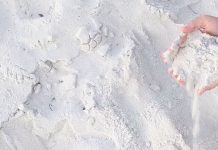
The sand here is soft, white, and warm, the kind that makes you want to stop walking altogether and just sit down with a good book. I mostly resisted. Every step near the dune line feels like walking through powdered sugar, no rocks, no shells sharp enough to protest, just fine quartz that pulls gently at your calves. I kicked my shoes off almost immediately, not out of obligation, out of respect.
Sand Softness & Resistance
The waterline here is about as good as beach walking gets. The wet sand packs hard under wave action, your foot barely sinks, and you can cover ground without working for it. Walk fifteen feet toward the dunes and the whole feel changes. That upper sand is fine, dry, and deep enough that it pulls at your calves with every step, like an elliptical machine that never settles into a rhythm. Real workout if that’s what you’re after, exhausting if you just want to get somewhere.
Slope & Camber
One thing I genuinely love about this beach is how flat it is. The slope toward the water is gentle compared to a lot of Atlantic-side Florida beaches, where a steep berm angle wears on one ankle over a long walk. After a rough storm, the edge of the berm can drop several inches from dry sand to wet sand in a single step, so watch your footing on evening walks when the light gets tricky. On a normal day, this is one of the easiest beach profiles in the Panhandle to walk.
Surface & Seasonal Changes
The farther east you go, the more this beach acts like a real barrier island instead of a manicured one. Shell fragments show up more in the wrack line past the Johnson Beach turnaround, and seaweed becomes part of the scenery instead of the exception. Winter storms from November through March can reshape the whole profile, steeper berm, more shell material, sometimes a different beach entirely than the one you walked in October. If you’re planning a long barefoot walk in the off season, it’s worth checking recent conditions first.
Want the full geology, grain composition, why this sand is so white, and the complete sand condition ratings? I broke it all down separately in Sand & Shore: Perdido Key.
Footwear Recommendations
From October through May, I skip shoes entirely from the boardwalk to the waterline. The quartz is fine enough and the shell content low enough in the main areas that barefoot is genuinely comfortable, and the cool sand is one of the small luxuries of this beach. I wear Skechers for the drive and the parking lot walk, they’re what’s actually in my car every trip, and I switch to bare feet the moment I hit sand.
In summer, the dry upper beach heats up fast, usually by 10am in July and August. A pair of sandals or water shoes for the crossing from the boardwalk to the waterline saves your feet, and once you’re at the wet zone, barefoot is fine again for the rest of the day.
Headed into the wilderness section east of the Johnson Beach turnaround? Switch to water shoes or lightweight trail runners. Shell hash, seaweed deposits, and more variable terrain past mile two ask more of your feet than the main beach does. And if you’re logging real distance anywhere on this island, a minimalist beach shoe or trail runner protects your ankles better than you’d think over four-plus miles of sand.
Dogs & Pet Accessibility
Are Dogs Allowed on the Sand? RESTRICTED / STRONGLY NO.
To protect highly sensitive habitats and nesting shorebirds, dogs are strictly banned from the sand at all Gulf-side beaches on Perdido Key, including the State Park and Johnson Beach.
Where Dogs Are Allowed
- ✓County Access 4 on the Sound (bay) side, the designated dog-friendly beach on Perdido Key. Calm water, leashed dogs welcome on sand and in the water.
- ✓The North Trail at Perdido Key State Park permits leashed dogs, though the Gulf beach side does not.
- ✓Big Lagoon State Park on the nearby mainland, excellent leashed-dog option with calm bay access and trail walking.
Where Dogs Are NOT Allowed
- ✗Gulf-side beach at Perdido Key State Park, no dogs permitted.
- ✗Johnson Beach / Gulf Islands National Seashore, no dogs on the Gulf beach. Active nesting habitat for shorebirds, sea turtles, and the endangered beach mouse.
Paws on the Ground Reality
County Access 4 on the Sound side is genuinely pleasant for dogs. The water is calm and shallow, ideal for dogs who love to wade without dealing with surf. The walking is flat and easy on paws. Bring your own fresh water, there are no freshwater sources at Access 4. Early morning or late afternoon walks keep paws and people comfortable in any season.
However, this is not the best hiking in the area.
If you want to take a nice long hike with your dog in the area, look just inland. Nearby mainland properties like Big Lagoon State Park and Tarkiln Bayou Preserve State Park permit leashed dogs on miles of their shaded nature trails, though they cannot step onto the swimming beaches. On the key itself, be highly vigilant about hot midday sand and sharp sandburs if you are walking near the road or trail shoulders.
The Walk Experience
Scenery & Points of Interest
Walking east from the state park, the scenery shifts in stages: sea oat dunes first, then boardwalk access points, a brief stretch of county condos (short and easy to walk through), then the Gulf Islands National Seashore gate, and finally Johnson Beach’s wide, uninterrupted shoreline. The pavilion and picnic area anchor the west end of Johnson Beach. Past the third parking lot, the road ends, the dune line rises, and development disappears from view completely.
The light here in fall is something else. A lower sun angle catches the white quartz at a rake that makes the whole beach look lit from within, and the water shifts from gray-blue to turquoise to something close to emerald as the sun climbs. If you carry a camera, early morning is your best window. If you only have your phone, it’ll do fine too, the elements are simple and strong enough to photograph well on their own.
Wildlife, Sea Turtles & Birds
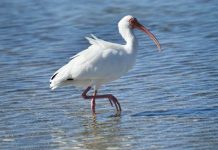
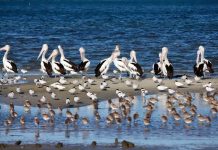
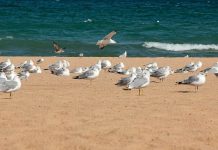
Because so few people venture past the main parking areas, birds are abundant here in a way that rewards even casual walkers. I’ve had terns darting over the surf, great blue herons stalking the shallows with monk-like patience, and egrets that looked dressed for a beachside wedding. Perdido Key sits on the Great Florida Birding Trail, and Gulf Islands National Seashore as a whole has recorded more than 300 species.
Four sea turtle species nest here, loggerhead, green, Kemp’s ridley, and occasionally hawksbill, with loggerheads by far the most common. Nesting runs roughly late March through August, hatchlings emerging through the fall. The endangered Perdido Key beach mouse lives in the dune system, especially east of the Johnson Beach turnaround, and bottlenose dolphins work the offshore waters year round.
I go a lot further on seasonal windows, habitat by habitat sightings, and what to expect month by month in Seaside Birding on Perdido Key.
Shelling & Beach Finds
Shelling on Perdido Key rewards patience more than luck. The everyday finds along the wrack line are steady enough to make a walk worth slowing down for, and every stop to pick one up is a chance for a proper squat instead of a bend, a mile of shelling adds up to more of a workout than you’d expect. Early morning after a hard rain is the best window I’ve found.
Full species list, seasonal frequency, and how this beach compares to other Panhandle shelling spots in Beach Finds on Perdido Key.
Solitude vs. Crowds
In the fall, this beach is close to empty. I’ve walked the full Johnson Beach corridor on a Tuesday in October and passed fewer than a dozen people in three miles. That kind of solitude on a Florida Gulf beach is genuinely rare and worth planning a trip around. The state park runs a little busier even in shoulder season, but by the time you reach the second Johnson Beach parking lot heading east, the crowd thins to almost nothing. Past the turnaround, most days, you’ll be alone.
Summer weekends tell a different story. Johnson Beach fills by mid-morning, and the state park by 10am. If you’re visiting in summer, walk before 8:30am or accept that you’ll share the shore. Even on the busiest days, this beach is wide enough that it never feels as packed as Clearwater or Destin can.
Community Vibe
Flora-Bama anchors the west end with live music and that legendary bar-that-refused-to-die energy, and the crowd here skews local and repeat-visitor rather than resort tourist. It’s a little rough around the edges in the best possible way. You’ll see the same faces at the same access points season after season, which tells you something about how people feel about this place once they find it.
Natural Features & Ecology
About sixty percent of Perdido Key sits under state or federal protection, which is a big part of why it still looks the way it does. The dune system does real work here: the endangered Perdido Key beach mouse forages sea oat seeds and stores them underground, which helps the dunes regenerate after storms. Hurricane Sally made landfall nearby in 2020 as a slow-moving Category 2 storm, and you can still read its fingerprints in a few of the steeper dune faces if you know where to look.
Essentials
These are the things I actually bring every time I walk this island, not a generic packing list, but what I’ve learned matters here specifically.
Reef-safe sunscreen
Tide chart app
Binoculars
eBird app
Water shoes
Mesh bag for shelling
Sun hat
Red flashlight (turtle season)
Credit card (both parks are cashless)
Amenities & Nearby Services
Along This Beach
Both main access points cover the basics well. Johnson Beach has two bathhouses with restrooms and changing rooms, outdoor rinse-off showers, and two picnic pavilions. Perdido Key State Park has a bathhouse and covered picnic tables near both parking areas. Once you’re past the Johnson Beach turnaround, there’s nothing at all, no restrooms, no shade, no water. Plan accordingly.
Off the Beach
Nothing sits directly on the sand, but you don’t have to go far. Grab a coffee before your walk at Bad Ass Coffee of Hawaii, the local spot that’s been fueling early risers on the Key for a few years now, or there’s a Starbucks a short drive up Perdido Key Drive if you’d rather have something familiar. A Publix covers groceries and supplies. Dining ranges from casual seafood shacks to Flora-Bama at the west end, and lodging runs from beachfront condos to vacation rentals throughout the key, with camping a few minutes away at Big Lagoon State Park.
What Makes This Walk Unique
On almost every other developed Florida beach, the walk has a frame, a parking lot, a pier, a resort, a jetty, some kind of endpoint. On Perdido Key, past the end of Johnson Beach Road, that frame disappears. The island keeps going, and the only thing stopping you is your water supply and your watch.
There’s a specific moment, about a quarter mile past the turnaround cul-de-sac, when you look back west and the last visible structure drops below the dune line. The beach ahead is open and continuous. The Gulf runs to your right, Big Lagoon shows to your left across the narrow island interior, and you’re standing on an uninhabited barrier island that’s still, technically, about 17 miles from downtown Pensacola. That shift from parking lot to real wilderness in under half a mile is what makes a walk on Perdido Key different from anywhere else in this series.
Hiker’s Tips
Tide Details
Walk out within about two hours of low tide if you can. The beach firms up and widens noticeably as the water retreats, which means better footing and more sand to work with, especially on the busier routes near Johnson Beach. A basic tide chart app is worth having open before you ever park the car.
Weather Considerations
Summers here run hot and humid, with the upper beach heating up fast by mid-morning in July and August. Hurricane season runs June through November, so it’s always worth a quick check of the forecast before a planned trip in those months. Winter brings cold fronts and can genuinely reshape the beach profile after a rough storm, but it also brings some of the clearest, quietest walking days of the year. Water temperatures stay swimmable well into October most years.
Best Times to Walk
First light to 9am is the gold window on any day, best photography light, lowest crowds, coolest sand, most wildlife activity. Second best is 5pm onward, once the heat drops and the light turns golden from the west. October is my pick for the best month overall, summer crowds gone, water still warm, migration in full swing, and the light at its most beautiful.
Thoughts & Reflections
The first time I walked this beach was with my daughter, at the start of Covid. We drove to the Alabama border and just started walking east into Florida. That walk started my mission to walk the complete coastline of Florida, a mile on every beach.
This walk changed my life more than I understood at the time. It came during a season of failure, Covid, a business I’d built collapsing, distance opening up between me and people I loved. But it was also the start of self-discovery, of learning to live in the moment and find something worth having in the smallest parts of a day. Like the monarch butterfly that stopped me completely on the sand near the dune toe, wings open flat, completely still. I didn’t know yet that fall monarch migration uses the Gulf Coast as a corridor. It was passing through on the same route its ancestors have used for thousands of years, and it chose to rest here, on this beach, at that exact moment.
Walking Johnson Beach felt like stepping into a version of Florida that exists before development, before tourism, before flip-flops became a state requirement. The shoreline is long and empty, the waves lapping in underneath the faint calls of seabirds overhead, and there’s a kind of peace in that which is hard to manufacture anywhere else. It reminded me that some of the most beautiful places ask for nothing back. No crowds, no cameras, just presence. And for a few miles, I was fully present. Fully, deeply, joyfully.
✦ Read my full reflection on the monarch butterfly and what it said to me about midlife, migration, and finding your own route, in The Monarch on the Sand.
“My daughter and I crossed into Florida on foot at the start of Covid, not knowing it would become the first step of a thousand-mile mission. I was a single mom, an entrepreneur, a woman who’d spent years making sure everyone else had what they needed. That day on Perdido Key, walking east with nowhere we had to be, was the first time in a long time I remembered I was also just a person. The island keeps going long after most people turn back. Turns out, so do I.”
