


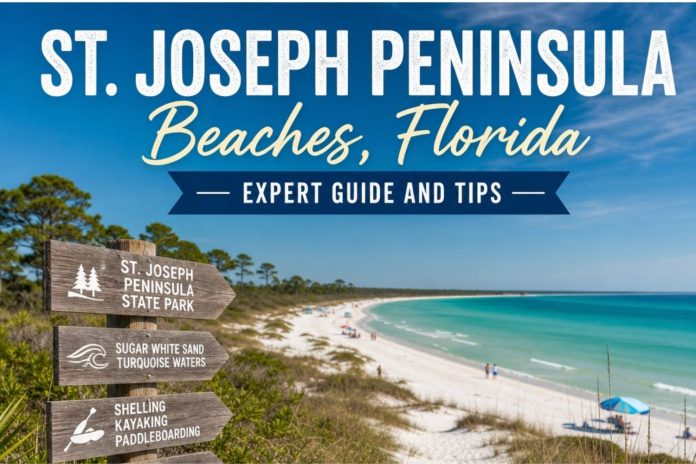
St. Joseph Peninsula State Park Beaches, Florida
St. Joseph Peninsula State Park is what a Florida Gulf beach looks like before the road arrives. Ten miles of white quartz sand, dunes that climb higher than anything else on this coastline, a 1,750-acre Wilderness Preserve at the northern tip where the only way in is on foot or by paddle, and a bay on the other side so clear you can count the scallops from the surface. If you want the Florida Gulf Coast at its most unguarded, this is the park.
T.H. Stone Memorial St. Joseph Peninsula State Park sits at the northern tip of the Cape San Blas peninsula in Gulf County, reached by SR-30A to SR-30E out of Port St. Joe. The park protects 2,516 acres of barrier peninsula between the Gulf of Mexico and St. Joseph Bay, with a full-facility campground, eight bay-view vacation cabins, 14 primitive campsites in the Wilderness Preserve, and three hiking trails ranging from a half-mile nature walk to a six-mile backcountry route into the most remote section of the park. It has been consistently rated among the top beaches in the nation. The $6 per vehicle entry fee, open 8am to sunset year-round, is one of the more honest bargains in the Florida state park system.
In this guide I’m walking you through every distinct area of the park, from the main Gulf beach access and Eagle Harbor bay side to the Bayview picnic area, the campground, and the Wilderness Preserve’s remote northern beaches. I’ll cover the sand and water quality that earned this park its national ranking, score it honestly across every category, and give you a clear read on who this park is built for. I close with my personal experience walking this park, including a visit in 2020 when Michael’s damage still had the roads closed and the dunes were the only thing standing as they always had. For the cape south of the park boundary, see the companion guide at Cape San Blas Area Beaches.
The Vibe and Culture at St. Joseph Peninsula State Park
Remote by Nature, Not by Accident
Everything you’d find at the county access points on the cape to the south, dialed further in every direction.
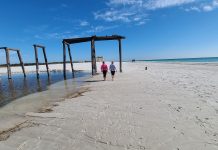
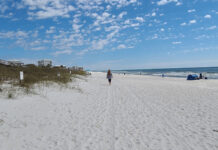
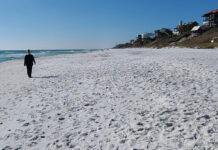
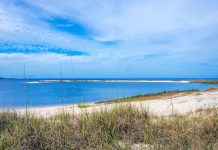
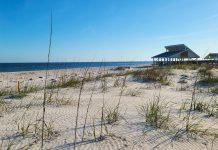
Walking into St. Joseph Peninsula State Park for the first time, the most immediate thing is the scale of the dunes. They are genuinely large, not the gentle humps you find at most Gulf beaches but real formations held in place by sea oat thickets and decades of protected growth. The beach in front of them spreads wide enough that even on a busy summer weekend, 10 miles of shoreline distributes the crowd at a density that feels generous. The nearest high-rise is wherever you came from.
The crowd that comes here self-selects sharply. Campers who reserved months in advance. Birders working the documented species list. Families returning to the same campsite every summer. Kayakers launching from Eagle Harbor into the seagrass flats. Backcountry hikers who collected their Wilderness Permit from the Ranger Station and are carrying everything they need for a night six miles from the gate. The common thread is intentionality: to get here, you drive 22 miles down a narrow peninsula, pay an entry fee, and then drive further into the park to reach the beach. That filter changes who you find on the sand.
Seasonally, summer is peak, scallop season from July through September brings serious bay traffic, and the campground books out early for summer weekends. Fall, when the water holds warm and the migrants are moving, is when the park’s birding reaches its best and the beach is at its most walkable with the summer crowds gone. The park runs 365 days a year, 8am to sunset.
St. Joseph Peninsula State Park Beach Areas: Six Distinct Zones
The park runs north to south down the peninsula with the bay on the east and Gulf on the west, and each area has a genuinely different character.
Gulf Breeze Beach Access Area
Main Gulf Beach · Two Large Picnic Shelters · Restrooms · Outdoor Showers
Gulf Breeze Beach Access is where most day visitors head after the entry gate, and it gives you the park’s full opening statement. The beach is wide, the parking is reasonable, and the two large picnic shelters nearby provide shaded gathering spots with direct Gulf access. The outdoor showers at the restroom facility are worth noting: after a day in the sand, that rinse before getting back in the car is one of those details that improves a park visit more than you’d expect.
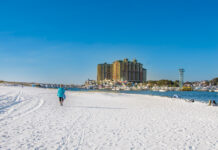
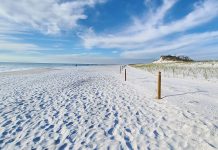
The sand in front of Gulf Breeze sets the standard that the rest of the park maintains. It’s very white and very fine, noticeably more uniform in color and grain than the county access points further south on the cape, and even at mid-morning on a summer weekend the beach spreads wide enough that people seem to disappear into it within 100 yards in either direction. The water runs emerald to turquoise on calm days with a gradual sandy entry, and the bottom is visible well past waist depth on clear mornings.
This is where I’d start any visit to the park, not because it’s the best area but because it gives you the scale of what you’re working with. Go north from here and the beach transitions into the Wilderness Preserve. Go south and you stay in the more developed park area near the campground and Eagle Harbor. Gulf Breeze is the orientation point that makes the rest of the park make sense.
Eagle Harbor and the Bay Side
Bay Access · Boat Ramp · Picnic Shelters · Kayak Launch · Scallop Cove Too Concession
Eagle Harbor sits on the bay side of the park and gives you access to St. Joseph Bay that the Gulf side can’t replicate. There’s a boat ramp, small picnic shelters, and a bay-edge beach with completely different water character from the Gulf just a short walk across the park road. At Eagle Harbor, the bay is shallow and calm, and the seagrass beds that make this part of the bay so productive for scalloping, snorkeling, and paddling are visible just below the surface on any clear morning.
Boaters launch here throughout the year, peaking during scallop season when the bay draws snorkelers from a wide radius. Outside of scallop season, Eagle Harbor has a much quieter quality: kayakers and paddleboarders, families wading the shallows, birders working the bay edge where ospreys, herons, and egrets are reliably active. The seagrass beds here hold seahorses, rays, juvenile redfish, and the bay scallops that define the summer crowd. The Scallop Cove Too concession near Eagle Harbor rents kayaks, canoes, paddleboards, pontoon boats, and dive flags, and carries basic camping and beach supplies.
If you came to the park for the bay and didn’t bring your own equipment, Eagle Harbor is where that gets sorted. If you came for both the Gulf and the bay in the same day, this is the second stop after the Gulf Breeze beach walk.
Bayview Day-Use Area
Bay Side · Large Pavilion · Playground · Bayview Trail Access
The Bayview area gives you the best fixed bay views in the park, with a large 70-seat pavilion overlooking the water that’s available for daily rental through the park office. The playground makes this a natural gathering spot for families, and the Bayview Trail, a 1.6-mile loop through coastal scrub and pine flatwoods along the bay edge, begins right here.
The Bayview Trail is the single best quick-access birding walk in the park. The route passes through several distinct habitat types and the bay views from the trail’s higher points show you the full width of St. Joseph Bay. I’ve seen great blue herons, white ibis, ospreys, and ground-nesting birds along this trail on a single morning walk. It’s not a long hike but it covers enough habitat variety to hold a birder’s attention for the full 90 minutes it takes at a careful pace.
The pavilion rental is worth knowing about for group visits. Water and electric are included, it overlooks the bay directly, and the park office handles reservations. For casual day visitors, the uncovered picnic tables around the pavilion are first-come and generally available outside of summer peak weekends.
Shady Pines Campground and the Beach Walk
Full-Facility Camping · Water and Electric · Short Walk to the Gulf
Shady Pines sits under a canopy of slash pines on the bay side with a short cross-road walk through the dune corridor to the Gulf beach. Sites have water and electric hookups, picnic tables, fire rings, and access to modern bathhouses nearby. The pine canopy provides real shade in summer. The walk to the Gulf from a Shady Pines campsite is five to ten minutes, and you emerge onto the beach with open water in both directions and very little evidence of the road you just crossed.
That walk is part of the campground experience in a way some state park campgrounds never achieve. The Gulf Breeze campground sections to the north are more open, better suited for larger RVs, and positioned closer to the Gulf Breeze beach area directly. Campers who want to hear the Gulf from their tent choose Gulf Breeze. Campers who want shade and pine forest sound choose Shady Pines.
The full campground has 119 sites between the two sections. Both can be reserved through the Florida State Parks system, and summer weekends book months in advance. Fall and winter dates have more availability but still reward advance planning. Pets are allowed in the family campground areas overnight on a leash, vaccinated per Florida state law, but not on the beach, along the natural shoreline, in picnic shelters, or in the Wilderness Preserve.
The Wilderness Preserve: Remote Gulf Beach
Northern Tip · Free Permit from Ranger Station · 6 Miles One Way · Pack-In/Pack-Out · No Pets
The Wilderness Preserve occupies the northern 1,750 acres of the park, and entering it requires a free permit picked up at the Ranger Station before you start. The main route is the Wilderness Preserve Trail, approximately six miles one way from the trailhead to the most remote primitive campsites near the peninsula tip. You can hike in on foot or paddle in from the bay side; most backpackers combine both approaches on multi-night trips, paddling gear in on the bay and hiking back along the Gulf beach.
The beach along the Wilderness Preserve is what the cape looks like with no road running parallel to it. On most days outside of summer peak, you will not see another set of footprints here. The dunes along the preserve are the tallest in the park, and the only sounds are the Gulf, the wind through the sea oats, and the birds that use this tip as a staging area during fall migration. The 14 primitive campsites are spaced over the full six miles from sites within the first mile of the trailhead to Site 14 at the far northern end. No water at any site; the park provides a water-fill station at the Wilderness Preserve entrance. Everything is pack-in, pack-out, including all trash. No pets permitted in the Wilderness Preserve under any circumstances.
Waking up at a primitive campsite on the Gulf at the tip of this peninsula, hearing the waves and nothing else, is the kind of experience that earns a place on a short list you keep returning to for years. The backcountry birding during fall migration along the dune spine is some of the most concentrated coastal raptor watching on the Florida Gulf Coast.
The Vacation Cabins on St. Joseph Bay
Eight Bay-View Cabins · Full Kitchen · Screened Porch · No Pets · Reserve 11 Months Ahead
The eight vacation cabins sit directly on the bay side with full bay views, equipped kitchens, screened porches, and a fireplace for the cooler months. Boaters moor in the nearby basin. The bay is visible from the porch of every unit, the boardwalk to the bayshore is just outside the door, and the nearest sound of a highway is more than 20 miles away.
These are not rustic cabins. They have everything a comfortable stay needs: beds, kitchen appliances, outdoor grills, and enough space for a family or a couple who wants to cook and sit outside and watch the bay rather than drive somewhere for dinner. They are also among the most sought-after overnight options on the entire Forgotten Coast, going 11 months in advance through the Florida State Parks reservation system. Fall and early winter dates open up more flexibility than summer. Only registered guide and companion animals are permitted; pets are not allowed in the cabin areas at all, only in the family campground sections.
What makes the planning effort worth it is the combination of full park access and bay-quiet that the cabins provide. You’re a short drive from the Gulf beach, a short walk from the bay, and removed from any sound that isn’t water, birds, or wind. On a clear morning from the screened porch, the bay is glass-flat and the herons are working the shallows, and the park is yours in a way that a nearby campsite can’t quite replicate.
St. Joseph Peninsula State Park Rankings: Expert Scores Across 11 Categories
These scores weigh the full park experience, from the main beach access and campground areas to the Wilderness Preserve’s remote northern tip and the bay side’s distinct character.
Sand Quality
10/10
Dr. Beach rated this the best beach in America in 2002, and the sand is the primary reason. Near-pure quartz, very fine, brilliantly white, and noticeably more uniform in color and grain than the county access points further south on the same peninsula. It is genuinely difficult to find a better-quality Gulf sand in the state of Florida.
Hiking & Beach Walking
10/10
Ten miles of unbroken Gulf beach, three separate trail systems totaling over eight miles, and a six-mile Wilderness Preserve route leading to some of the most remote beach walking accessible on foot in the Florida Panhandle.
Shelling
8/10
Gulf side and bay side together make this one of the stronger shelling destinations on the Panhandle. The Wilderness Preserve sections see so little foot traffic that shells sit undisturbed in the wrack line longer than at any accessible beach nearby. Try different times of year for different species, and always work the wrack line at low tide following storm activity. Never collect live shells.
Water Conditions
9/10
Exceptional on the Gulf side on calm days: emerald to turquoise, excellent visibility, gradual sandy entry, summer water averaging around 84 degrees. The bay side runs even clearer and shallower, with seagrass beds visible year-round. No lifeguards in the park. The bay side at Eagle Harbor and the Bayview area is the appropriate choice for young children and weaker swimmers.
Scenery & Natural Beauty
9.5/10
Towering white dunes, pine flatwoods, coastal scrub, two bodies of water, sea turtle nesting beach, and zero commercial development visible from any point in the park. The Wilderness Preserve’s dune formations are among the tallest on the entire Florida Gulf Coast. This is the Panhandle landscape before development found it, and the park has kept it exactly that way.
Birding & Wildlife
10/10
240-plus documented species, positioned on the Great Florida Birding Trail, and directly in the flight corridor for southbound fall migration. Sea turtle nesting May through October, primarily loggerhead with occasional green and Kemp’s Ridley. Manatees in the bay during warm months. Dolphins in both the Gulf and bay. Gopher tortoises in the dunes. Seahorses and rays in the bay seagrass. This park’s wildlife diversity is as strong as any state park beach in the state.
Family Friendliness
6/10
No lifeguards on any beach in the park, which is the main factor limiting this score for families with young children. The bay side at Eagle Harbor and the Bayview area provides flat, calm wading water that’s appropriate for small swimmers, but that requires knowing the park’s layout before you arrive. The campground and cabin experience is excellent for families with older children. Very young children need an attentive eye on the Gulf side at all times.
Dog Friendliness
4/10
Pets on a leash are welcome in the family campground areas. They are not allowed on any beach, along any natural shoreline, in picnic shelters, in restrooms, or in the Wilderness Preserve. Bay-side trails allow leashed dogs. This is a clearly stated and enforced park rule. If beach access with your dog is the priority, the county access points on Cape San Blas to the south are the right choice.
Solitude & Peace
10/10
The Wilderness Preserve’s primitive campsites sit miles from any road, accessed by trail or paddle, with no facilities and near-zero foot traffic outside of summer peak. Even the main Gulf beach, spread across 10 miles of unbroken shoreline, rarely feels crowded at either end of the park. This is as quiet as a driveable Florida beach destination gets.
Entertainment & Nightlife
1/10
There is none. The park closes at sunset. The nearest restaurants are in Port St. Joe, 22 miles back down the peninsula. The entertainment here is the Gulf, the bay, the birds, and the stars over the campsite. If that’s not enough, this isn’t the right park for the trip you have in mind.
Parking & Beach Access
6/10
The $6 per vehicle entry fee covers all park areas for the day, and parking at the main beach access areas is reasonable outside of summer peak weekends. Summer Saturdays and holiday weekends can fill the lot by mid-morning. Arrive before 9am in summer to be safe. The Wilderness Preserve is walk-in or paddle-in only by design, and that’s appropriate for what it is.
St. Joseph Peninsula State Park Sand & Water
The sand here is the reason this park keeps showing up on best-beach lists, and you’ll understand why the moment you step onto it. It’s wide, flat, and soft enough near the dune line at Gulf Breeze that you can sink your toes in and just stay a while. That upper beach sand is loose and a little tiring to walk across for long stretches, but it’s wonderful for lounging, digging, and building. Head down toward the water and everything firms up fast, a solid, packed surface that makes for easy, effortless walking across all ten miles of this beach. That same firm wet sand is your best bet if sandcastles are on the agenda, since it holds detail far better than the powdery sand up top.
The water here earns its reputation too. On a calm day, the Gulf runs emerald to turquoise with visibility that lets you see straight to the bottom well past your knees, and the entry is gentle and gradual, easy for swimmers of any confidence level to wade into. Across the park on the bay side at Eagle Harbor and Bayview, the water goes flat and even clearer, shallow enough to see seagrass beds from the surface on most calm mornings. There are no lifeguards anywhere in this park, so keep an eye on conditions yourself before swimming out, and know that the bay side is the gentler, more forgiving option if you’re swimming with kids or just want calm water.
-
Walkability. Ten miles of firm, flat waterline, some of the best long-distance walking sand anywhere on the Gulf Coast.
-
Softness & Playability. Deep, soft sand near the dune line at Gulf Breeze is ideal for lounging and building. The firm sand at the water’s edge holds a sandcastle shape beautifully.
-
Barefoot Comfort. Excellent nearly everywhere, cool quartz with very little shell underfoot. The one exception is the dry upper beach at Gulf Breeze on a hot summer midday.
-
Swimmability. Gentle, gradual entry on the Gulf side with no lifeguards, so check conditions yourself. The bay side at Eagle Harbor and Bayview is shallower and calmer, a great pick for kids or nervous swimmers.
Want the full geology, grain composition, and the complete sand and water condition ratings? I broke it all down separately in Sand & Shore: St. Joseph Peninsula State Park.
Dogs & Pet Accessibility
Are Dogs Allowed on the Sand? NO, not anywhere in this park.
Leashed pets are welcome in the family campground areas and on the Bayview and Maritime Hammock trails. They are not permitted on any beach, along any natural shoreline, in picnic shelters, or anywhere in the Wilderness Preserve, under any circumstance.
Where Dogs Are Allowed
- ✓The family campground areas at Shady Pines and Gulf Breeze, leashed, overnight.
- ✓The Bayview Trail, leashed.
- ✓The Maritime Hammock Nature Trail, leashed.
Where Dogs Are NOT Allowed
- ✗Any beach in the park, Gulf side or bay side.
- ✗Any natural shoreline, including Eagle Harbor’s bay edge.
- ✗Picnic shelters and restrooms.
- ✗The Wilderness Preserve, under any circumstance, with no exceptions made for permit holders.
- ✗The vacation cabins (only registered guide and companion animals permitted).
Paws on the Ground Reality
This is a firmly enforced rule, not a loose suggestion, and it’s the single biggest planning factor if your trip includes a dog. The good news is that the two trails where dogs are welcome, Bayview and Maritime Hammock, are genuinely pleasant walks in their own right, shaded and varied enough to make a decent outing even without beach access.
If beach time with your dog is the priority for this trip, the county access points on Cape San Blas just south of the park gate welcome leashed dogs on the sand at nearly every access point. See my Hiking Cape San Blas guide for that side of the peninsula.
Crowd Levels and the Overall Feel of St. Joseph Peninsula State Park
This park draws a specific kind of visitor, and the campground and cabin booking patterns reflect it. Campers who found this place once tend to come back on the same week every summer for years. The day visitors at the Gulf Breeze area on a summer weekend are a mix of families from Port St. Joe and Panama City, birders working the park’s list, and the scalloping crowd during July through September who park at Eagle Harbor and spend the day on the bay. Even at summer peak, the 10-mile beach distributes the crowd more generously than almost any comparable Panhandle beach. The Wilderness Preserve has its own separate crowd: backpackers, serious birders, and the occasional kayaker who paddles in from the bay side, none of whom are looking for company.
- Spring: excellent weather and manageable crowds; the campground has more availability than summer but advance planning is still needed for weekends; the bay begins to warm for snorkeling by late spring
- Summer: peak season with the campground at full capacity most weekends; scallop season from July through September brings the heaviest bay traffic; arrive at the park entrance by 9am on summer Saturdays to avoid capacity issues at the gate
- Fall: the best time to come for most visitors; water stays warm into October, summer crowds drop sharply after Labor Day, and the fall migration brings the park’s birding to its peak between September and November
- Winter: very quiet; lifeguard-free beach walking with the dunes to yourself, excellent for photography, and the bay-side cabin experience with the fireplace going is one of the Forgotten Coast’s better-kept seasonal secrets
Who Is St. Joseph Peninsula State Park Really For?
✓ Who Will Love This Park
-
Serious beach walkers who want an unbroken stretch of protected Gulf sand they can cover for miles without a condo or a beach bar interrupting the view
-
Birders and nature photographers with any interest in fall migration, sea turtle nesting, bay wildlife, or adding to a species list with real depth
-
Campers who want a full-facility campground within earshot of the Gulf, or a bay-view cabin with genuine quiet from sundown
-
Kayakers, paddleboarders, and snorkelers who want clear seagrass-bed water with marine life and a scalloping season that draws serious bay traffic for good reason
-
Backpackers who want a Wilderness Preserve permit and a primitive campsite on the Gulf tip of a protected peninsula miles from any road
-
Anyone who wants to see what the Florida Panhandle’s Gulf Coast looked like before development arrived, without any additional editing of the scenery
✗ Consider Another Option If…
-
You’re traveling with a dog and expect beach access; dogs are not allowed on any beach in the park, only on the bay-side trails on a leash, with no exceptions
-
You need lifeguards; there are none anywhere in the park, and this is a firm and consistent reality here regardless of the season
-
You want evening dining, boardwalk entertainment, or any nightlife within a reasonable drive; the nearest options are Port St. Joe, 22 miles back down the peninsula
-
You’re counting on a walk-up campsite or cabin on a summer weekend; both book out months in advance and walk-in availability at peak season is close to zero
-
You want the full Panhandle quartz experience with all the services attached; Pensacola Beach delivers the same sand geology with lifeguards, a boardwalk, and restaurants steps from the water
Things to Do at St. Joseph Peninsula State Park
The park’s activity list is defined entirely by what the land and water provide. Here’s what a full day in the park actually looks like.
-
Beach Walking. Ten miles of unbroken Gulf shoreline running the full length of the peninsula, with the Wilderness Preserve at the northern end providing the most remote section. The waterline at low tide packs firm and flat, and the only interruption on a long walk north is the transition from managed park to wilderness at the Wilderness Preserve trailhead.
-
Hiking the Trails. Three distinct routes: the Maritime Hammock Nature Trail (under a mile, showcases coastal scrub, bay access, and a shell midden), the Bayview Trail (1.6 miles, pine flatwoods and bay views, best birding walk in the park), and the Wilderness Preserve Trail (six miles one way, free permit required from the Ranger Station, pack-in/pack-out). Each trail covers a different ecosystem and rewards a different pace.
-
Kayaking and Paddleboarding in St. Joseph Bay. Launch from Eagle Harbor into the seagrass flats with dolphin sightings, stingray encounters, and seahorse habitat all realistic possibilities on a calm morning. Scallop Cove Too near Eagle Harbor rents kayaks, canoes, paddleboards, and pontoon boats if you didn’t bring your own.
-
Scalloping Season. July through September, St. Joseph Bay opens for recreational scalloping, and this park is one of the prime access points for that activity. You need a snorkel, a visible dive flag, and a mesh bag. Verify current season dates and bag limits from the Florida Fish and Wildlife Conservation Commission each year before heading out, as these shift annually.
-
Fishing. Florida residents may fish from the beach or bayshore without a license. Non-residents and boat anglers need a valid fishing license. The Gulf side produces redfish, trout, Spanish mackerel, and flounder from the surf. The bay side at Eagle Harbor and the boat basin is excellent for bay species. Offshore, the Mexico Beach Artificial Reef Association has placed artificial reefs and wrecks just north of the park for divers and anglers with their own boats.
-
Shelling. Best after a storm and at low tide along the Gulf side wrack line. The Wilderness Preserve sections hold the best undisturbed shell deposits because foot traffic is so low. Bay side at Eagle Harbor offers a different species set entirely. Stopping to pick up shells on a long beach walk is the honest version of leg day: the bend-and-squat is built into every good shelling session.
-
Birding. Start on the Bayview Trail from the Bayview day-use area for the quick morning birding route. The Wilderness Preserve dune spine is the best location in the park for fall raptor migration watching. The park is formally recognized on Florida’s Great Florida Birding Trail, and the 240-plus documented species reflect a habitat diversity that very few single state parks can match.
-
Sea Turtle Nesting Season. Loggerhead sea turtles nest on the park’s Gulf beach from May through October, with green and Kemp’s Ridley turtles nesting occasionally. After dark, use only a red flashlight on the beach and remove all chairs and equipment from the sand by sunset throughout nesting season. The park enforces these rules, and the nesting on this beach is active enough that compliance is both required and genuinely meaningful.
-
Camping and Stargazing. Both the Shady Pines and Gulf Breeze campground areas provide access to the kind of dark sky that Gulf County’s low development levels deliver: genuinely dark nights with real star visibility. A clear night on the beach or from a campsite in the park, with the Gulf audible and the Milky Way overhead, is one of the better experiences the Florida coast offers and one of the hardest to find anywhere near civilization.
-
Sunrise from the East Beach Side. The bay-side areas, including the vacation cabin area and the Bayview day-use area, face east toward the mainland. The sunrise over the bay from any of these locations, with the cape’s dune line visible across the water and the bay glass-flat in the morning calm, is the kind of thing you set your alarm for and then don’t regret.
Local Knowledge and Practical Advice
A few things I’ve picked up across multiple visits to this park:
-
The campground and cabins book 11 months in advance. Open the Florida State Parks reservation system on the date exactly 11 months before your target arrival date for the best campsite selection. Summer weekends go first. Fall shoulder dates open up more flexibility but still reward early planning. Walk-in availability at peak summer weekends is essentially zero.
-
Get your Wilderness Preserve permit from the Ranger Station before you start walking north. The permit is free and the process is quick, but you need it before you enter the preserve boundary. If you’re hiking to a primitive campsite for an overnight, make sure you’ve confirmed your site reservation and checked in. Primitive sites accommodate up to four people and are pack-in, pack-out with no exceptions.
-
Bring your own water into the Wilderness Preserve. The only water available is the fill station at the Wilderness Preserve entrance. None of the 14 primitive sites have water or electricity. If you’re camping overnight in the preserve, plan your water carefully based on the distance to your site. Site 14 is six miles from the entrance.
-
Dogs are not allowed on any beach in the park, along any natural shoreline, in picnic shelters, or in the Wilderness Preserve. Leashed pets are allowed in the family campground areas and on the bay-side trails. This is a consistently enforced rule, not a suggestion. If your trip is built around beach time with your dog, the county access points on Cape San Blas to the south are the right answer.
-
Scallop season runs July through September, but check the current dates from Florida Fish and Wildlife each year. The season window and bag limits are set annually and enforcement on the bay is active. At minimum you need a snorkel, a dive flag visible above the water, and a mesh bag. Non-residents need a fishing license even for scallops. A visible dive flag is required within 25 feet of you at all times while snorkeling in the bay.
-
Sea turtle nesting season is May through October. Clear all beach equipment from the sand by sunset throughout the season. Use only a red flashlight on the beach after dark. The park takes turtle light compliance seriously, and the nesting on this beach is active enough that the rules genuinely matter. Hatchlings emerge at night and orient to the lightest horizon to find the water; white light sources on the beach disrupt that orientation.
-
A visible dive flag is required while snorkeling in St. Joseph Bay and must stay within 25 feet of you. The bay has boat traffic during scallop season that makes the flag non-optional from a safety standpoint. Collecting live shells or live marine life is prohibited in the bay. The park takes both rules seriously.
-
Arrive before 9am on summer Saturdays and holiday weekends if you’re day visiting. The park can reach capacity, and once the entrance is at capacity, the gate closes to additional day visitors. Campers with reservations always have access, but day-trippers can find themselves turned around during peak summer.
-
A long-established paved bike path runs along CR-30E from the park entrance gates through the entire length of Cape San Blas for about 10 miles. If you have bikes, this is one of the better coastal cycling routes on the Panhandle. The path parallels the road with Gulf views for much of its length and connects the park to the county access points further south.
-
Pack like you’re going somewhere remote, because you are. The Scallop Cove Too concession near Eagle Harbor carries basic supplies, but there are no restaurants, no grab-and-go options, and no convenience stores in the park. Day visitors should bring all food, water, and sunscreen they’ll need for the day. Campers should plan provisioning from Port St. Joe before driving in.
Where to Stay at St. Joseph Peninsula State Park
This park offers a full range of overnight options entirely within its own boundaries, which is unusual for a Florida state park and part of what makes it worth planning a trip around.
Shady Pines Campground
The Shady Pines section offers more shaded, secluded campsites under a pine canopy on the bay side, with a short walk to the Gulf beach across the park road. Sites have water and electric hookups, picnic tables, fire rings, and access to modern bathhouses. This section suits campers who want shade over their campsite and a quieter camp atmosphere. Reserve through the Florida State Parks reservation system up to 11 months in advance. Pets on a leash are allowed in this campground overnight.
Gulf Breeze Campground
The Gulf Breeze campground sections are more open, better suited for larger RVs, and positioned closest to the Gulf Breeze beach area. Sites with sewer connections are available in this section along with water and electric. For campers who want the shortest possible walk to the Gulf or who need space for a larger rig, Gulf Breeze is the section to target. Same reservation process and 11-month window as Shady Pines.
Vacation Cabins on the Bay
Eight fully equipped bay-view cabins with kitchens, screened porches, outdoor grills, and a seasonal fireplace. Check-in is 4pm, check-out at 11am, with a maximum 14-night stay. Only registered guide and companion animals are permitted in the cabins, not pets. These are among the most sought-after overnight options on the Forgotten Coast and should be booked as close to the 11-month opening window as possible for summer dates. Fall and winter dates have significantly more availability.
Primitive Campsites in the Wilderness Preserve
Fourteen primitive sites spread over six miles of the Wilderness Preserve, from sites within the first mile of the entrance to Site 14 at the far tip. No water, no electricity, no facilities at any site except a fire ring. Pack-in, pack-out with all trash. No pets permitted in the Wilderness Preserve. Reservations for up to 15 people can be made by contacting the park directly at 850-227-1327 up to 11 months in advance. Access is by hiking in or paddling from the bay side.
Cape San Blas Vacation Rentals and Port St. Joe
For visitors who want a softer landing or more flexibility than the park’s overnight options provide, the vacation rental homes on Cape San Blas south of the park and the hotels and inns in Port St. Joe are the practical alternatives. Port St. Joe is about 22 miles from the park entrance via SR-30E and SR-30A, and a range of accommodation from budget motels to waterfront boutique inns makes it a workable home base for day trips into the park.
What Makes St. Joseph Peninsula State Park Different from Nearby Beaches
Several things distinguish this park that don’t show up in any single headline feature.
The dune scale is genuinely different
The dunes here are some of the tallest on the Florida Gulf Coast, and they’ve been protected long enough to reach heights you won’t find at the county access points on the cape to the south or at most other Panhandle parks. Walking the Wilderness Preserve with those dune formations above you and the Gulf in front of you is a different physical experience from walking any managed beach on this coast.
Two water environments in one park entrance fee
The Gulf side and the St. Joseph Bay side offer experiences different enough that most parks would charge separately for each. The $6 entry fee covers the Gulf beach, the bay at Eagle Harbor and the Bayview area, the hiking trails, and the Wilderness Preserve access. No other single entry fee on the Panhandle comes close to covering that range.
The Wilderness Preserve is in a category of its own
There is nowhere else on the Florida Panhandle where you can walk six miles of protected Gulf beach from a parking lot and arrive at a primitive campsite on the water with no amenities and no other structures visible in any direction. The wilderness in this park is not a marketing description. It is accurate.
Scalloping access as a built-in park feature
The bay side of the park puts you directly on St. Joseph Bay during scallop season with a boat ramp, kayak rentals, and immediate access to the seagrass beds. Most parks near good scalloping grounds require driving off the property to access the bay. Here it’s built in.
St. Joseph Peninsula State Park vs. Other Florida Gulf Beaches
St. Joseph Peninsula State Park vs. Cape San Blas County Beaches
The county access points on the cape to the south, including Salinas Park, Stump Hole, and Indian Pass, share the same basic geology but differ in management, protection level, and rules. The state park’s sand is slightly superior in purity and the dunes are significantly taller from decades of protection. The major rule difference is dogs: the county beaches welcome leashed dogs on the sand; the state park does not. Choose the county beaches if you’re traveling with a dog. Choose the state park if the sand, dunes, and wildlife protection are the priority. See the full Cape San Blas Area Beaches guide for the complete comparison.
St. Joseph Peninsula State Park vs. St. George Island State Park
St. George Island State Park, about 45 miles east on the other side of Apalachicola, is the closest comparison in terms of protected barrier island wilderness. Both parks sit on similar Forgotten Coast geography. St. George has its own bay on one side, the East Bay and Apalachicola Bay system, which is a different kind of water from St. Joseph Bay. St. Joseph’s bay is clearer and better known for scalloping; St. George’s bay area is more productive for fishing and crabbing. Both are worth a dedicated trip. If you have to choose, St. Joseph wins on dune scale and bay clarity; St. George wins on fishing and proximity to Apalachicola’s dining scene.
St. Joseph Peninsula State Park vs. Gulf Islands National Seashore at Fort Pickens
Fort Pickens, at the western end of Pensacola Beach about 130 miles west, is the other Florida Panhandle beach park with a similar combination of wilderness access, historical interest, and quartz sand quality. Fort Pickens adds a brick 19th-century fort you can walk through; St. Joseph adds the bay, the Wilderness Preserve’s dune scale, and the scalloping. Both are genuinely excellent parks. The sand quality at both is comparable, drawn from the same quartz formation. Choose based on whether the fort or the bay ecosystem better fits your trip.
St. Joseph Peninsula State Park vs. Grayton Beach State Park
Grayton Beach State Park on the 30A corridor about 60 miles west is the other Panhandle state park that regularly appears on top-beach lists. Grayton’s sand is also quartz from the same formation, and the park’s coastal dune lake system is a unique feature that St. Joseph doesn’t have. St. Joseph wins on beach length, dune scale, wildlife diversity, bay access, and wilderness camping. Grayton wins on proximity to 30A’s restaurant and town scene. Both are worth visiting, and the gap in overall experience between the two is narrower than the distance between them.
Bottom line: St. Joseph Peninsula State Park sits in a group of two or three Florida Gulf beach parks that are genuinely hard to improve on. The sand, the water, the wildlife, the wilderness access, and the bay all reach the top tier at the same time. The tradeoffs are real but narrow: no pets on the beach, no lifeguards, and an overnight experience that requires planning months in advance. For everyone who plans accordingly, this park is worth that effort.
St. Joseph Peninsula State Park: Frequently Asked Questions
Is St. Joseph Peninsula State Park worth visiting?
Yes, without qualification. The park holds 10 miles of near-pure quartz Gulf beach, a 1,750-acre Wilderness Preserve, full-facility camping, bay-view vacation cabins, and one of the best scalloping bays in the state. It was rated the best beach in America in 2002 by Dr. Beach, and the sand quality that earned that rating hasn’t changed.
What is the entrance fee at St. Joseph Peninsula State Park?
$6 per vehicle, payable at the entrance station. The park is open 8am to sunset, 365 days a year. The fee covers access to all park areas including the Gulf beach, the bay side at Eagle Harbor and the Bayview area, and all hiking trails. The Wilderness Preserve requires a free permit from the Ranger Station in addition to the entry fee.
Are dogs allowed at St. Joseph Peninsula State Park?
Pets on a leash are allowed in the family campground areas overnight. They are not allowed on any beach, along any natural shoreline, in picnic shelters, in restrooms, or in the Wilderness Preserve. Leashed dogs are permitted on the bay-side trails. This is a firmly stated and consistently enforced park rule. If beach access with your dog is the priority, the county access points on Cape San Blas to the south welcome leashed dogs on the beach.
What hiking trails are in the park?
The park has three distinct routes. The Maritime Hammock Nature Trail is under a mile and passes through coastal scrub, wetland, and bay habitats. The Bayview Trail is a 1.6-mile loop through pine flatwoods along the bay edge, the best birding walk in the park. The Wilderness Preserve Trail is approximately six miles one way to the tip of the peninsula and requires a free permit from the Ranger Station. Each trail covers distinctly different terrain.
What camping options are available at St. Joseph Peninsula State Park?
The park offers four overnight categories: the Shady Pines campground with shaded sites under slash pines near the bay, the Gulf Breeze campground sections closest to the beach with more open sites for larger rigs, eight fully equipped bay-view vacation cabins, and 14 primitive campsites in the Wilderness Preserve that are pack-in/pack-out with no facilities. Reserve through the Florida State Parks system up to 11 months in advance for all options except primitive sites, which are reserved through the park office directly at 850-227-1327.
Is the beach at St. Joseph Peninsula State Park good for shelling?
Yes. The park itself recommends trying different times of year for different species. The Gulf side wrack line after storms delivers whelks, augers, moon snails, coquinas, and sand dollars. The bay side at Eagle Harbor offers a different set of species including pen shells and scallop shells during season. The Wilderness Preserve sections are the best bet for undisturbed finds since foot traffic there is very low. Always work the wrack line at low tide and never collect live shells.
What wildlife can I see at St. Joseph Peninsula State Park?
The park has 240-plus documented bird species and is on the Great Florida Birding Trail, with fall migration making September through November the strongest birding window. Loggerhead sea turtles nest on the Gulf beach from May through October, with occasional green and Kemp’s Ridley turtles. Manatees visit St. Joseph Bay during warm months. Dolphins appear in both the Gulf and bay regularly. Gopher tortoises live in the dunes. The bay seagrass beds hold seahorses, rays, and the bay scallops that define scallop season.
What are the vacation cabins like at the park?
Eight fully equipped bay-view cabins with two queen beds in an open loft, a double futon and day bed downstairs, a full kitchen with appliances, screened porch, outdoor grill, boardwalk to the bayshore, and a fireplace for use from October through April. Check-in is 4pm, check-out at 11am. Only registered guide and companion animals are permitted, not pets. These are comfortable, well-equipped accommodations in an exceptionally quiet setting, and they book 11 months in advance.
How do I access the Wilderness Preserve?
Pick up a free permit at the Ranger Station at the park entrance before you start. The main route is the Wilderness Preserve Trail, approximately six miles one way, beginning at the trailhead inside the park. You can also access the preserve by paddling in from the bay side. Primitive campsites require a reservation made through the park office at 850-227-1327. All camping in the preserve is pack-in, pack-out, and no pets are allowed anywhere in the wilderness area.
When is the best time to visit St. Joseph Peninsula State Park?
Fall, from late September through early November, is the strongest overall time: water stays warm into October, summer crowds drop sharply after Labor Day, and the fall migration brings the park’s birding to its peak. Spring is also excellent and offers more campsite availability than summer. Summer is peak season with the warmest water and scallop season from July through September, but the campground books out early and the park can reach day-visitor capacity on summer Saturdays.
Is there swimming at St. Joseph Peninsula State Park?
Yes. The Gulf side offers gradual sandy entry with summer water temperatures averaging around 84 degrees. There are no lifeguards anywhere in the park. The bay side at Eagle Harbor and the Bayview area provides flat, calm, shallow wading water that’s appropriate for young children and weaker swimmers. Always assess conditions at the specific beach area you’re using before entering the Gulf.
Patti’s Perspective: My Honest Take on St. Joseph Peninsula State Park
I came through this park in 2020 when Hurricane Michael’s damage still had the vehicle roads inside the park closed. The structures were still being restored, and you couldn’t drive in past the entrance area. So I parked at the gate and walked in on foot, which turned out to be the best possible way to arrive at a park that was halfway through recovering from a major storm. The first thing I noticed was the dunes. They were still standing exactly as they had been before the storm, tall and held in place by the sea oats the way they’ve been for decades, and the beach in front of them was completely undisturbed because the road repair crews hadn’t yet gotten out that far. It felt more remote than it normally would have, and that quietness had a quality to it that I’ve thought about a lot since.
I make my own trails along the shoreline wherever I go, and this park is where that habit felt most right. I walked the waterline north until the dunes grew taller and the beach widened, and the only evidence that anything existed south of me was my own footprints. There were herons standing at the bay edge on the other side of the dune line. There was a moment somewhere in the third mile where the park felt less like a place I was visiting and more like a place that simply existed, that had been existing like this before any road reached it and would continue existing this way after all the roads were restored. That’s not a feeling you get at most beaches.
My verdict: 9/10. St. Joseph Peninsula State Park is the best protected Gulf beach in the Florida Panhandle, and it holds its position on that list without any help from marketing. The sand is the best on the peninsula, the bay is exceptional, the wildlife is real, and the Wilderness Preserve is the kind of experience that very few driveable Florida beaches can offer at all. The tradeoffs are narrow but honest: no dogs on the beach, no lifeguards anywhere, and overnight stays that require months of advance planning. Plan accordingly and this park will be at the top of your list for a long time.
Want to Live by the Water?Gulf County, home to both St. Joseph Peninsula State Park and the Cape San Blas area, remains one of the most affordable coastal counties on the Florida Panhandle for waterfront real estate. The combination of low development density, strong natural protection for the surrounding land, and a growing appeal among remote workers and retirees has brought new attention to a market that was off the radar of most buyers until recently.Properties range from Gulf-front and bay-front vacation homes on Cape San Blas south of the park to waterfront options in Port St. Joe proper, including marina-adjacent homes and historic downtown properties within walking distance of Reid Avenue. The short and long-term rental market in this area has strengthened significantly, driven by the park’s national reputation and the Forgotten Coast’s growing visibility as a travel destination. If a Gulf County waterfront property is on your list, the time to look is before the next discovery cycle fully runs its course.Explore Waterfront Living at LiveByTheWater.com
Real estate referral partner