


The first time a manatee drifted toward me in a central Florida spring, I stopped breathing before it did. Two thousand pounds of animal, moving slower than seems physically possible, close enough that I could see the barnacles riding its back and the old white scars from somebody’s propeller. Manatees have a way of rearranging your sense of scale and your sense of urgency in the same thirty seconds, and once that happens to you, it doesn’t really wear off.
Gentle Giants
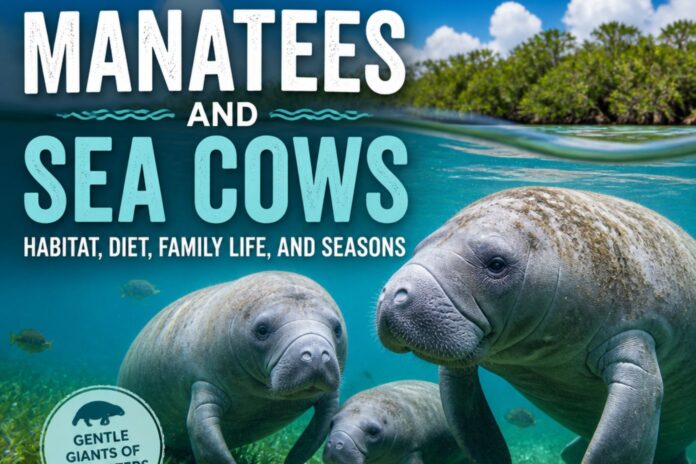
Manatees are large aquatic mammals with round bodies, paddle-like flippers, and broad tails. They are closely related to elephants, not dolphins or seals. Their bodies are built for slow movement and steady grazing rather than speed. Often called “gentle giants,” these slow-moving herbivores spend much of their lives grazing on underwater plants and drifting through shallow coastal waters, rivers, and estuaries. The phrase manatees and sea cows is often used together because manatees belong to a broader group of animals known as sirenians, which also includes dugongs. The group was named for the sirens of Greek mythology because sailors who hadn’t slept properly in weeks apparently looked at a gray, whiskered, thousand pound grazing animal and thought, yes, mermaid.
Meet the Family
The 4 types of sirenians
- West Indian manatee — the southeastern United States, the Caribbean, and Central and South America
- Amazonian manatee — the freshwater Amazon Basin
- West African manatee — coastal West and Central Africa, Senegal to Angola
- Dugong — the Indo-Pacific, from East Africa’s Red Sea coast to northern Australia
A fifth species, Steller’s sea cow, once grazed the cold kelp beds of the Bering Sea, and Russian sailors hunted it to complete extinction within twenty seven years of the species being formally described. That timeline still stops me cold every time I think about it. Twenty seven years is nothing. It is barely one long human life.
Here’s the fact that changes how you look at every one of these animals: their closest living relatives are elephants, not dolphins or whales. Manatees and elephants share an ancient common ancestor from a group called Afrotheria, and you can actually see it if you know where to look, toenails on the flippers of two of the three manatee species, molars that wear down and get replaced from the back of the jaw for the animal’s whole life the exact same way an elephant’s do, and a body built around grazing rather than hunting. A sea cow isn’t a cow at all. It’s a swimming elephant that traded a trunk for a paddle and never looked back.
All four living species are currently listed as Vulnerable by the IUCN, which tells you something important right up front. Nowhere on Earth is a sea cow population what you’d call secure. Every single one of them is doing the same basic, vulnerable thing every day, grazing quietly in shallow water that increasingly overlaps with boat traffic, fishing nets, dammed rivers, and coastal development.
West Indian Manatee
This is the sea cow most people picture, and the one I grew up around without fully realizing it. Trichechus manatus splits into two subspecies, the Florida manatee and the Antillean manatee, and between them they range from the southeastern United States down through the Caribbean, Mexico, Central America, and along the Atlantic coast of South America as far as Brazil. Adults typically run nine to thirteen feet long and can weigh well over a thousand pounds, with a body shaped like a gray, whiskered torpedo and a single round, paddle shaped tail that moves up and down rather than side to side.
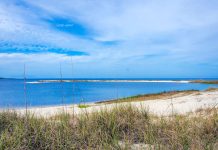
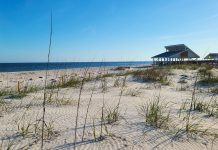
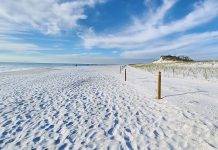
The terrain underneath a West Indian manatee is almost always the same recipe: shallow, warm, slow moving water over a sandy or silty bottom, thick with seagrass. That combination, soft sand holding seagrass roots in place, clear enough water for sunlight to reach the blades, is the entire reason a manatee shows up anywhere. No sandy seagrass meadow, no manatee. I’ll get into exactly why the sand matters a little further down, because as someone who has spent this whole project thinking about sand for a living, it turns out to be the real hero of the manatee story.
For the full rundown on where to see and legally swim with Florida manatees, including the one place in the entire country where that’s allowed, I wrote an entire companion piece just on that. Outside Florida, your best legal, ethical shot at an Antillean manatee is Belize, which is believed to hold the highest density of the subspecies anywhere in its range. Belize’s tourism board and licensed operators run guided encounters out of three protected areas, the Swallow Caye Wildlife Sanctuary near Belize City, the Gales Point Manatee Wildlife Sanctuary on the Southern Lagoon, and Corozal Bay’s Northern Lagoon, all under strict no touch, no chase rules enforced under Belize’s Wildlife Protection Act. Mexico’s Chetumal Bay, just across the border, holds a resident Antillean population too, tracked for years by satellite tag studies looking at how far these manatees actually roam.
Amazonian Manatee
Meet the family’s introvert. Trichechus inunguis is the smallest of the three manatee species and the only sirenian on Earth confined entirely to fresh water. It never touches salt water, not once, in its entire life. It lives in the blackwater lakes, oxbows, and flooded forests of the Amazon Basin, mostly in Brazil, with smaller and increasingly rare populations in Peru, Ecuador, and Colombia. Its species name actually means “without nails,” a nod to the smooth, clawless flippers that set it apart from its two Trichechus cousins.
The Amazonian manatee’s whole life runs on the river’s clock rather than the calendar. During the wet season, when the forest floods, it spreads out into flooded backwaters to gorge itself on fresh growth, feeding six to eight hours a day on whatever’s available among more than forty species of aquatic plants. When the dry season arrives and the water retreats, it hunkers down in permanent lakes and deep river channels and can fast for months at a time, living off fat reserves and an unusually low metabolic rate. I find that rhythm oddly moving, a whole life built around abundance and scarcity taking turns, and the animal just adapting rather than panicking either way.
This is the hardest of the four sea cows to see on purpose. It’s shy, it lives in dark tannin stained water with poor visibility, and it surfaces to breathe only briefly every few minutes before sinking back into the gloom. Responsible sightings mostly happen through community based ecotourism and rehabilitation projects along the Amazon in Brazil, where rescued orphaned calves are eventually released back into protected river systems. If you ever go looking, go through a program connected to real research or rescue work rather than anyone promising a guaranteed encounter, because an animal this elusive should stay that way.
West African Manatee
Trichechus senegalensis might be the least famous large mammal in the world, and that’s not an accident. It’s the least studied of all four sea cows, ranging along the Atlantic coast, rivers, and lagoons of West and Central Africa from Senegal all the way down to Angola, and pushing far inland along rivers like the Niger and the Senegal into landlocked countries such as Mali and Chad. Murky water and genuinely elusive behavior mean researchers often rely on acoustic monitoring, listening for the animal rather than looking for it, just to confirm it’s still there.
The threats here are heavier than anywhere else in the sirenian family. Hunting for meat, skin, and oil remains a real pressure across much of its range, incidental capture in fishing nets is common, and river damming has fragmented and isolated populations that once moved freely between watersheds. The IUCN estimates fewer than ten thousand individuals remain across the entire species’ range, spread thin across a dozen countries.
This isn’t a species with an established tourism circuit, and I’m genuinely glad about that. A hunted, understudied animal doesn’t need more boat traffic. What it needs is exactly what a handful of protected sites are trying to give it: Senegal’s Tocc Tocc Community Nature Reserve on Lake Guiers and similar protected wetlands along the Niger and Senegal Rivers exist specifically to give this manatee room to recover, out of sight, the way it seems to prefer.
Dugong
The dugong is the one true oddball, the only sirenian that never sets foot, flipper, or fluke in fresh water. Dugong dugon ranges across the coastal Indo-Pacific, from the Red Sea and East African coast, across the Arabian Gulf and South Asia, down through Southeast Asia, and all the way to northern Australia, which now holds the largest and healthiest dugong population left on the planet. You can tell a dugong from a manatee at a glance once you know the trick: a dugong has a fluked, two lobed tail like a dolphin’s, while every manatee has a single round paddle tail. Dugongs also carry a longer, more sharply downturned snout built for grazing directly off the seafloor, and older males grow small tusks.
Dugongs live and graze exclusively over seagrass meadows on sandy and silty seafloor, the marine equivalent of the manatee’s freshwater spring runs, and they can plow visible, snout wide trenches through the sand as they root up entire plants, roots included, rather than just cropping the blades. Western Australia’s Shark Bay is the single best place on Earth to understand what an intact dugong population looks like: it holds an estimated ten thousand or more dugongs, close to a tenth of the world’s entire population, sustained by roughly four thousand square kilometers of seagrass meadow, the largest such meadow known anywhere.
For an actual in water encounter, Egypt’s Red Sea coast near Marsa Alam is about as reliable as dugong sightings get anywhere in the world. Two sandy, seagrass filled bays, Abu Dabbab and Marsa Mubarak, hold a small resident population that regularly surfaces to feed within snorkeling distance of shore, and licensed local dive operators run supervised, no touch snorkel trips into both. Shark Bay itself is better suited to boat based viewing than in water encounters, since the population there is more widely dispersed across open water, but a wildlife cruise out of Monkey Mia will put you over some of the richest dugong grazing grounds on the planet.
The Whole Grazing Life
Manatees and sea cows are strict plant eaters and the only herbivorous marine mammals on Earth. Their diet mainly consists of aquatic vegetation, and they spend many hours a day feeding. Because they are such large animals, they need to eat a lot. Depending on species and season, a sea cow can eat anywhere from five to fifteen percent of its own body weight in vegetation every single day, grazing for six to eight hours at a stretch on seagrass, freshwater plants, algae, mangrove leaves, and whatever else grows in its particular corner of warm water.
To handle that volume of plant material, manatees and dugongs evolved something called marching molars, back teeth that wear down from constant grinding and get replaced continuously by new teeth migrating forward from the rear of the jaw, an adaptation manatees share almost exactly with elephants. Their intestines run remarkably long, over a hundred feet in an adult manatee, giving gut bacteria enough time and surface area to break down all that tough plant fiber. And their bones are unusually dense and heavy, a trait called pachyosteosclerosis, which works like a built in weight belt, helping a fundamentally buoyant, blubber light animal stay comfortably suspended just off the bottom while it grazes instead of bobbing helplessly at the surface.
The Type of Sand Under the Water That Grows Their Food
The food source for many manatees and sea cows depends on the bottom conditions of the water. Seagrasses and other aquatic vegetation grow best in soft, sandy, nutrient-rich bottoms.
Seagrass is an actual flowering plant with real roots, and those roots need something to root into, which is almost always sand or fine silt spread across a shallow, sunlit seafloor. A healthy seagrass meadow is really a sand story.
Seagrass beds need:
- Fine sand or muddy sand so roots and rhizomes can anchor
- Clear, shallow water so sunlight can reach the plants
- Stable bottoms that are not constantly shifted by strong waves
- Nutrients from sediment to support plant growth
In many places, the best underwater sand is not coarse beach sand, but a mix of fine grains, silt, and organic matter. This type of substrate allows seagrass to spread across the seafloor, creating the lush underwater meadows that manatees and dugongs rely on.
When the sand is too rocky, too deep, or too disturbed, seagrass cannot grow well. That means less food for these animals. Protecting the seabed is just as important as protecting the animals themselves.
Watch a sea cow feed for more than a minute and you’ll start to see it interact with that sand directly. Dugongs are famous for it, plowing shallow, snout width furrows through the sand to uproot entire seagrass plants, rhizomes and all, leaving a trail behind them that looks almost combed.
Manatees graze a little more gently, cropping blades near the base, but they still stir up visible clouds of fine sediment as they work a meadow, and biologists actually use that disturbed, freshly grazed look to identify active feeding grounds from the air. In a strange, quiet way, these animals are gardening the very seafloor they depend on, cropping and churning it in a pattern that keeps the whole meadow healthier and more productive than if nothing ever grazed it at all. Sand and seagrass and sea cow turn out to be one single, connected system, and pulling on any one thread eventually tugs the other two.
Family Life and Social Behavior
Manatees and sea cows are not highly social in the way dolphins are, but they do have interesting family patterns. Most are solitary or loosely grouped, especially while feeding. However, mothers and calves share a strong bond.
Mother and calf
A female gives birth to a single calf after a long pregnancy, usually lasting about a year or more depending on the species. The calf stays close to its mother for up to two years or longer, learning where to feed, travel, and rest.
The mother nurses the calf with milk and keeps it near the surface so it can breathe air. Since manatees are mammals, they must surface regularly for oxygen.
Social groups
Although not permanent pack animals, manatees may gather:
- In warm-water refuges
- Around rich feeding areas
- During mating season
- Near freshwater sources
Males may follow females during breeding periods, but there is no lifelong pair bonding like in some bird species. Their social life is simple, centered on survival, feeding, and raising young.
Seasonal Changes and Movement
Manatees are tropical and subtropical animals with almost no insulating body fat, which means cold water is a genuine, sometimes fatal problem rather than an inconvenience. Once water temperatures drop below roughly 68 degrees Fahrenheit for any real stretch of time, a manatee is at risk of cold stress syndrome, a slow moving condition that damages the immune system and can prove fatal if the animal can’t reach warmer water in time.
Dugongs, living entirely within tropical seas, mostly sidestep this problem altogether, though even Shark Bay’s dugongs shift seasonally between shallow summer feeding grounds and deeper, more temperature stable water in winter.
For manatees, that cold sensitivity is the whole reason for the dramatic winter gatherings you may have seen photos of, dozens or even hundreds of animals crowded together at a single warm water site. Nowhere on Earth is that migration more visible, more studied, or more accessible to actually go watch in person than Florida, which is exactly why I gave it its own full article. Read the Florida piece here for the complete story on where they go, why, and how to see it responsibly.
Rules Wherever You Go
Every sea cow encounter anywhere in the world runs on the same basic etiquette, and I don’t bend on any of it. Passive observation is the standard everywhere from Crystal River to the Red Sea: you float, you watch, and you let a curious animal choose to approach you rather than the other way around. Never chase, corner, ride, or grab a manatee or dugong, even one that seems completely unbothered by you. Never feed one, since manatees that learn to associate people with food start approaching boats and docks, which is exactly how so many end up scarred by propellers. Give a resting or nursing animal real space, keep noise and sudden movement to a minimum, and if you’re in a boat anywhere near seagrass in warm shallow water, slow down before you’re told to, not after.
Protecting the Sea Cows
The story of manatees and sea cows is really a story about warm waters, healthy seagrass beds, and fragile coastal ecosystems. These peaceful mammals depend on shallow habitats, soft sandy bottoms, and abundant aquatic plants to survive. Their lives revolve around eating, resting, and raising calves in places where the water is calm and the vegetation can thrive.
Protecting the sand beneath the water, the seagrass above it, and the clean, warm habitats they need is the best way to ensure these gentle animals continue to glide through our waters for generations to come.
All four species are protected under CITES and the Convention on Migratory Species, and the IUCN’s Sirenia Specialist Group coordinates the research and conservation planning behind all of it worldwide. In the United States, Save the Manatee Club, founded in 1981 by Jimmy Buffett and former Florida governor Bob Graham, funds rescue, rehabilitation, research, and habitat protection work that reaches beyond Florida’s borders into the wider Caribbean. In Belize, the Clearwater Marine Aquarium Research Institute runs an active field program tracking and rescuing Antillean manatees. And under the CMS Action Plan for the West African manatee, a coalition of range state governments and conservation groups is working to establish and protect reserves like Senegal’s Tocc Tocc for the family’s most vulnerable, least understood member.
Curiosity Corner
Are manatees really related to elephants?
Yes, genuinely. Manatees and elephants share a common ancestor from a group of mammals called Afrotheria, and they still share real physical evidence of it, continuously replacing molars and, in two of the three manatee species, actual toenails on their flippers.
Why are they called sea cows?
Because they spend six to eight hours a day grazing on underwater grass, the same slow, methodical way a cow grazes a pasture. The nickname predates the scientific name and honestly still fits perfectly.
What’s the fastest way to tell a manatee from a dugong?
Look at the tail. A manatee has one round, paddle shaped tail. A dugong has a fluked, two lobed tail like a dolphin’s. If you can see the tail clearly, you’ll know instantly which sea cow you’re looking at.
Do manatees or dugongs have any natural predators?
Almost none, once they’re grown. Their sheer size protects adults from nearly everything in the water. Calves are occasionally vulnerable to large sharks or crocodiles, but by far the biggest danger to a sea cow at any age is us, mainly boat strikes, entanglement, and habitat loss.
How long can a manatee hold its breath?
A resting manatee can comfortably hold its breath for fifteen to twenty minutes. An active, feeding manatee surfaces far more often, usually every three to five minutes, which is honestly the easiest way to spot one before you even see the body.
Is it ever okay to touch one if it swims right up to you?
No, even then. It feels almost rude to keep your hands to yourself when a thousand pound animal drifts up and looks you in the eye, but initiating contact is illegal nearly everywhere sea cows are protected, and it teaches wild animals to seek out human contact, which rarely ends well for them.
Thoughts & Reflections
I think about that first spring encounter. It wasn’t dramatic. Nothing happened. A very large, very calm animal drifted past me and kept going. Slowly, calmly and peacefully. Every time I have been in the water with a manatee, the whole experience gives me a complete sense of peace. Just thinking about it makes me want to slow down and appreciate the moment.
That unhurried movement of the manatee makes me reflect on how most of our lives we spend rushing, moving through life with a sense of urgency. And sometimes, I think we should all relax and slow down, take our time eating and find peace in our daily tasks.
