









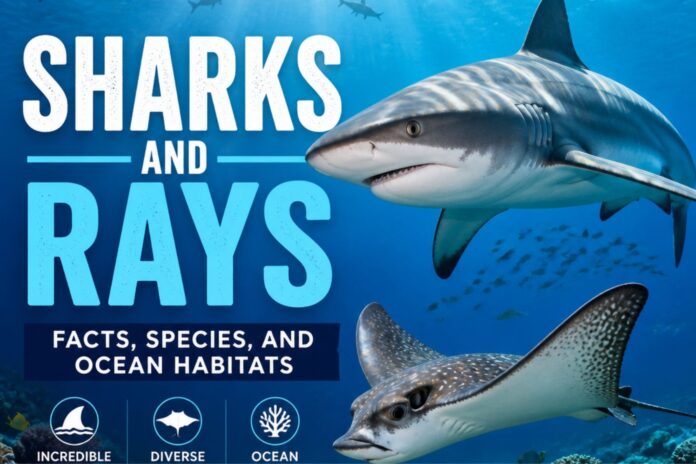
Growing up boating and skiing around the islands off Miami, sharks were just part of the scenery. Nurse sharks resting on the sandy bottom near the flats, the occasional hammerhead cutting through open water further out, though I’ll be honest, memory is a slippery narrator, and I couldn’t swear to every species under oath forty years later. What I can swear to is that seeing a shark shape under the boat never once stopped anyone from jumping in. Sharks have been misunderstood so thoroughly, for so long, that I think most people have never actually met the animal itself, only the movie version. Let’s fix that.
Meet the Family
Sharks belong to the class Chondrichthyes, cartilaginous fish, meaning their entire skeleton is built from flexible cartilage rather than bone, the same material that shapes your ears and the tip of your nose. There are more than 500 described species spread across roughly eight to nine orders, and sharks have been doing this, essentially unchanged in the basic blueprint, for over 400 million years, longer than trees, longer than dinosaurs, longer than almost anything else alive today. Every shark also carries a sense most other animals don’t: electroreception, a network of jelly filled pores around the snout called the ampullae of Lorenzini that can detect the faint electrical field given off by another animal’s heartbeat, letting a shark find prey buried completely out of sight under sand.
Jump to a species:
- Great white shark — cold, temperate coastlines worldwide
- Whale shark — warm tropical seas worldwide, the largest fish alive
- Hammerhead shark — tropical and warm temperate waters worldwide
- Tiger shark — tropical and subtropical waters worldwide
- Reef and nurse sharks — coral reefs and sandy shallows worldwide
- Mako shark — open ocean worldwide, the fastest shark alive
Great White Shark
Carcharodon carcharias is the ocean’s most famous predator and, honestly, one of its most misrepresented. Great whites can reach twenty feet and thousands of pounds, and while they’re formidable hunters of seals and other marine mammals, the vast majority of human encounters end in the shark simply swimming away once it realizes a person isn’t its usual prey. Guadalupe Island off Mexico’s Baja coast offers some of the clearest, most reliable cage diving anywhere, thanks to warm, visibility rich water. South Africa’s Gansbaai, once considered the great white capital of the world, has seen a genuinely strange recent shift: local orcas have started specifically hunting great whites for their livers, and sightings in the area have dropped sharply as the sharks avoid the area entirely, a reminder that even the ocean’s most feared predator has its own predator to answer to.
Whale Shark
Rhincodon typus is the largest fish in the entire ocean, reaching upwards of forty feet, and despite that almost incomprehensible size, it feeds exclusively on plankton and small fish, filtering enormous volumes of water through its gills rather than hunting anything at all. Every whale shark’s spot pattern is unique, essentially a fingerprint, which researchers use for photo identification the same way they track individual manatees and dolphins. Ningaloo Reef in Western Australia and Isla Holbox and Isla Mujeres off Mexico’s Yucatan Peninsula both offer genuinely ethical, well regulated seasonal encounters with wild, unfed animals. I have to flag one destination honestly: Oslob in the Philippines draws whale sharks daily through hand feeding, which guarantees a sighting but has drawn real, warranted criticism from marine biologists for altering the animals’ natural behavior. Choose an operator that lets the sharks come to you rather than one that’s trained them to show up for food.
Hammerhead Shark
The hammerhead family’s wide, flattened head, called a cephalofoil, isn’t just a striking shape. It spreads the shark’s electroreceptors across a much wider area, giving it an almost 360 degree sensory field and a serious advantage hunting its favorite prey, stingrays buried in sand. The great hammerhead, the largest species, is now critically endangered, and scalloped hammerheads are famous for forming massive, swirling schools of hundreds of individuals, best seen off Cocos Island in Costa Rica and the Galapagos Islands, both remote, current swept destinations that reliably deliver one of the most striking sights in the ocean.
Tiger Shark
Galeocerdo cuvier earns its name from the dark vertical stripes running down a juvenile’s body, stripes that fade as the shark matures. Tiger sharks have a well earned reputation as the ocean’s least picky eater, with a diet documented to include everything from sea turtles and rays to license plates and tires, which has led researchers to only half jokingly call it the garbage can of the sea. The Bahamas’ Tiger Beach, a shallow, sandy bank off Grand Bahama, is the single most reliable place on Earth to dive with tiger sharks, drawn there consistently enough that several individuals have become recognizable, named regulars to the dive community that visits.
Reef and Nurse Sharks
Smaller, generally docile, and often the first shark most divers ever meet, this group includes the Caribbean reef shark, the blacktip reef shark, and the nurse shark, a slow moving, bottom dwelling species that spends most of the day resting motionless on sand or under a ledge, only becoming active to hunt at night. French Polynesia’s Fakarava atoll hosts one of the most dramatic reef shark gatherings anywhere, a genuine wall of hundreds of gray reef sharks that assembles each year to feed on a massive grouper spawning event, a phenomenon so dense divers have nicknamed it simply the wall of sharks.
Mako Shark
The shortfin mako is the fastest shark in the ocean, capable of bursts up to 45 miles an hour, fast enough to launch itself completely out of the water when hunting fast swimming prey like tuna and swordfish. Built more like a torpedo than most other sharks, with a pointed snout and a nearly symmetrical tail, the mako ranges through open, deep water worldwide and is rarely seen close to shore, which makes any encounter with one a genuinely rare privilege even among experienced divers.
The Whole Ancient, Electric Life
Sharks replace their teeth continuously throughout life, with new rows migrating forward from the back of the jaw to take over as older teeth wear down or break off, meaning a single shark can go through tens of thousands of teeth over a lifetime. Most species also give birth to live young rather than laying eggs, though a handful, including some catsharks, do lay eggs in tough protective cases. Ecologically, sharks sit at or near the top of nearly every marine food web they’re part of, and removing them tends to destabilize everything below, a well documented ripple effect scientists call a trophic cascade. An ocean without its sharks isn’t a safer ocean. It’s a fundamentally different, less balanced one.
Sand and the Ambush Underneath
More sharks than you’d expect spend serious time on or in the sand rather than cruising open water. Nurse sharks rest directly on sandy or rubble bottoms by day, motionless enough that divers occasionally mistake them for rocks. The sand tiger shark, despite its fierce, ragged toothed look, is a genuinely docile species that patrols shallow, sandy nearshore waters and shipwrecks, feeding mostly at night. And hammerheads owe much of their hunting success to sand specifically, using that wide, electroreceptor packed head to sweep across the seafloor and detect stingrays hiding completely buried beneath it. For an animal group most people picture endlessly swimming through open blue water, an awful lot of shark behavior actually happens a few inches above, or directly on top of, the sand.
Rules Wherever You Go
Never touch, ride, or corner a shark, even a docile species like a nurse shark that seems unbothered by your presence. If you’re diving with an operator that uses chum or bait to attract sharks, choose one that follows a documented code of conduct limiting how much and how often it feeds, since poorly regulated feeding changes shark behavior in ways that can put both the animals and future divers at risk. Keep your distance from any shark exhibiting stress signals, rapid gill movement, jaw gaping, or arched posture, and never swim toward a shark that’s actively feeding on something else.
Who’s Protecting Them
The IUCN Shark Specialist Group conducts the population assessments behind every conservation status in this piece, and found in a landmark 2021 global study that more than a third of all sharks, rays, and their relatives are now threatened with extinction, making them the second most threatened vertebrate group on Earth after amphibians. The Shark Trust and the Save Our Seas Foundation both fund research and policy work across dozens of species worldwide, and OCEARCH runs the open access satellite tracking program that’s turned individual great white and tiger sharks into some of the most followed wild animals on the internet.
Curiosity Corner
How dangerous are sharks to people, really?
Far less than their reputation suggests. Unprovoked shark bites number in the dozens worldwide each year, and fatalities are rare, while humans kill an estimated hundred million sharks annually, mostly through fishing and finning.
Do sharks ever stop swimming to sleep?
It depends on the species. Some, like certain mako and great white sharks, need to keep moving to force water over their gills and breathe, while others, like nurse sharks, can pump water over their gills while resting motionless on the bottom.
Why do hammerheads have that strange shaped head?
It spreads their electroreceptors and eyes across a much wider area, giving them a nearly panoramic sensory field and a serious edge hunting stingrays buried in sand.
Is it true a shark can smell a single drop of blood from miles away?
That’s an exaggeration, though sharks do have an excellent sense of smell, capable of detecting blood and other chemical cues in extremely low concentrations at meaningful distances, just not the movie version of a drop from miles off.
Are whale sharks actually whales?
No, they’re fish, the largest fish species alive, and true sharks. The name comes purely from their whale sized proportions, not their biology.
Thoughts & Reflections
I think about those Miami boat days more than I expected to while writing this. A shark shape sliding under the hull used to be background noise to me, barely worth mentioning over lunch. It’s strange to realize now, decades later, how much quiet trust that actually required, not from the shark toward us, but from us toward an animal we’d been taught our whole lives to fear without ever really being taught to understand. I think that’s true of a lot of things in life, honestly. So much of what scares us is really just unfamiliarity wearing a more dramatic costume.
