




I have walked most of the Florida coastline more than once in my life, and I have never seen a whale here. Not once. Whales are not a Florida wildlife experience the way manatees, dolphins, and sea turtles are, and I’d rather tell you that plainly than pretend otherwise. But there is one real, seasonal, honest to goodness whale story unfolding off this state’s coast every single winter, plus a scattering of rarer sightings worth knowing about if you happen to be in the right place at the right moment.
Northeast Florida: Where the Right Whales Actually Come
So, no, I have not seen a whale in Florida, however, I was in Jacksonville one year and other people there said they saw them out there in the ocean.
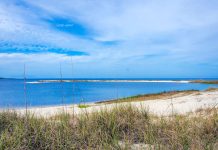
From roughly mid November through April, the coastal waters off Amelia Island, Jacksonville, and St. Augustine become one of only two known calving grounds on Earth for the North Atlantic right whale, one of the most endangered large whales alive, with a total population estimated at only 384 individuals. Pregnant females travel over a thousand miles from feeding grounds off Canada and New England to give birth in these specific shallow, warm coastal waters, and most mother calf pairs stay within a few miles of shore the entire season, which means shore based sightings from the beach itself are genuinely possible here in a way they simply aren’t anywhere else in Florida. Amelia Island hosts an annual Right Whale Festival celebrating exactly this migration.
The core calving area extends south from the Georgia border down through roughly the Space Coast, meaning beaches around Ponte Vedra, Flagler Beach, and even as far south as New Smyrna Beach and Cocoa Beach occasionally turn up a sighting during peak calving months, though the highest concentration stays closest to the Georgia line. If you’re walking any northeast Florida beach between December and March, it is worth glancing offshore now and then. These whales swim slowly, close to the surface, and lack a dorsal fin, so they can be surprisingly easy to miss even when they’re right there.
The law here is not casual. Federal regulations require boats, paddlers, and even drones to stay at least 500 yards from any right whale, ten times the standard distance for a dolphin, because a disturbed mother can abandon a calf, and because these whales are so critically low in number that every single individual matters to the species’ survival. If you spot one from a boat, cut your engine, do not approach, and report the sighting to the Coast Guard on VHF Channel 16 or the whale hotline at 1-877-WHALE-HELP.
The Gulf of Mexico: Home to the World’s Rarest Whale
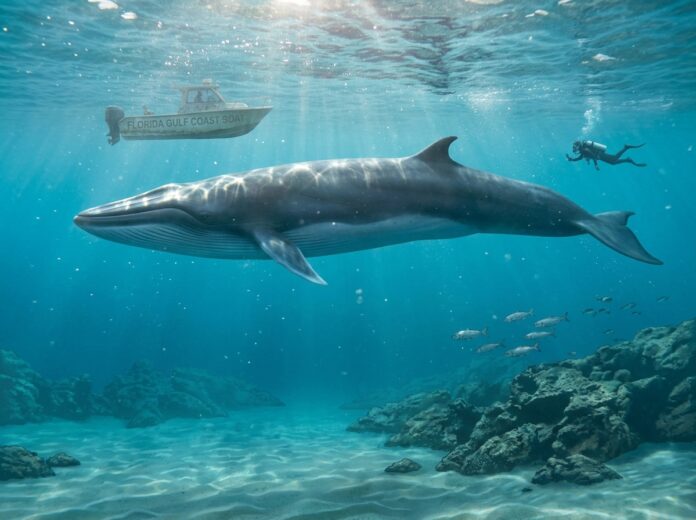
Most people have never heard of Rice’s whale, and that’s exactly the point of including it here. This baleen whale, formally recognized as its own species only in 2021, lives almost entirely in the northeastern Gulf of Mexico, largely in deep water off the Florida Panhandle and in the DeSoto Canyon area, and nowhere else on Earth. Fewer than a hundred individuals are believed to remain. The species was identified from a whale that stranded on Sandy Key inside Everglades National Park in January 2019, a discovery that quite literally rewrote the list of great whale species using evidence found on a Florida beach. Sightings of a living Rice’s whale are exceptionally rare and mostly limited to deep offshore federal survey work rather than anything a beachgoer or boater is likely to encounter, but it’s worth knowing that the most endangered whale species in American waters calls the Gulf off Florida’s own coast home.
The Everglades & the Keys: An Unlikely Stranding History
The shallow, remote waters of Everglades National Park and the backcountry near the Florida Keys have an unusual and recurring connection to one particular species: the short finned pilot whale, a large, deep diving member of the dolphin family prone to mass strandings worldwide. Florida has recorded multiple significant pilot whale strandings over the years in this exact stretch of coast, pods of dozens of animals found disoriented in shallow water off remote sections of the park, drawing extensive rescue efforts from NOAA, FWC, and volunteer stranding networks. These events are heartbreaking and not something to hope for or seek out, but they’re part of the honest record of large whale relatives in Florida waters, and they’re the closest most Floridians will ever come to witnessing one of these deep water species up close.
The Rare and the Occasional
Beyond the right whale’s reliable winter season and Rice’s whale’s quiet Gulf residency, Florida sees the occasional stray humpback whale reported well offshore, particularly off the northeast coast during winter migration months, and sperm whales are sometimes recorded in deep Gulf waters along the continental shelf edge, far beyond where any beachgoer would ever spot one. None of these should be treated as a plannable wildlife experience the way a manatee spring visit or a dolphin bay tour can be. They’re genuinely rare, headline making events when they happen, which is exactly why local news covers them when they do.
Thoughts & Reflections
I didn’t write this list to sell you on Florida whale watching. I wrote it because I think the actual story, one of the rarest whales on the planet quietly living in the Gulf, one of the most endangered whales on Earth choosing our coastline to give birth every winter, and a handful of true, documented rescue efforts in the Everglades, is more interesting than a manufactured tourist pitch would ever be. If you want a guaranteed, reliable, in person whale encounter, you’ll find it in the destinations covered in my worldwide whales piece. If you want to understand the quiet, mostly invisible whale story happening right here at home, now you do.
