
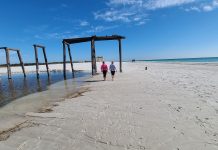
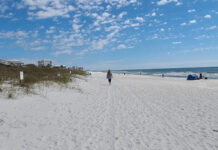
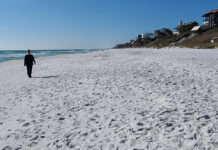
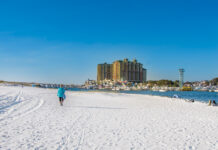

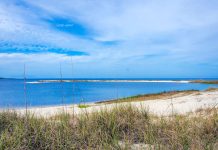
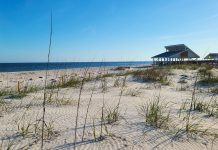
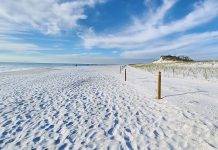
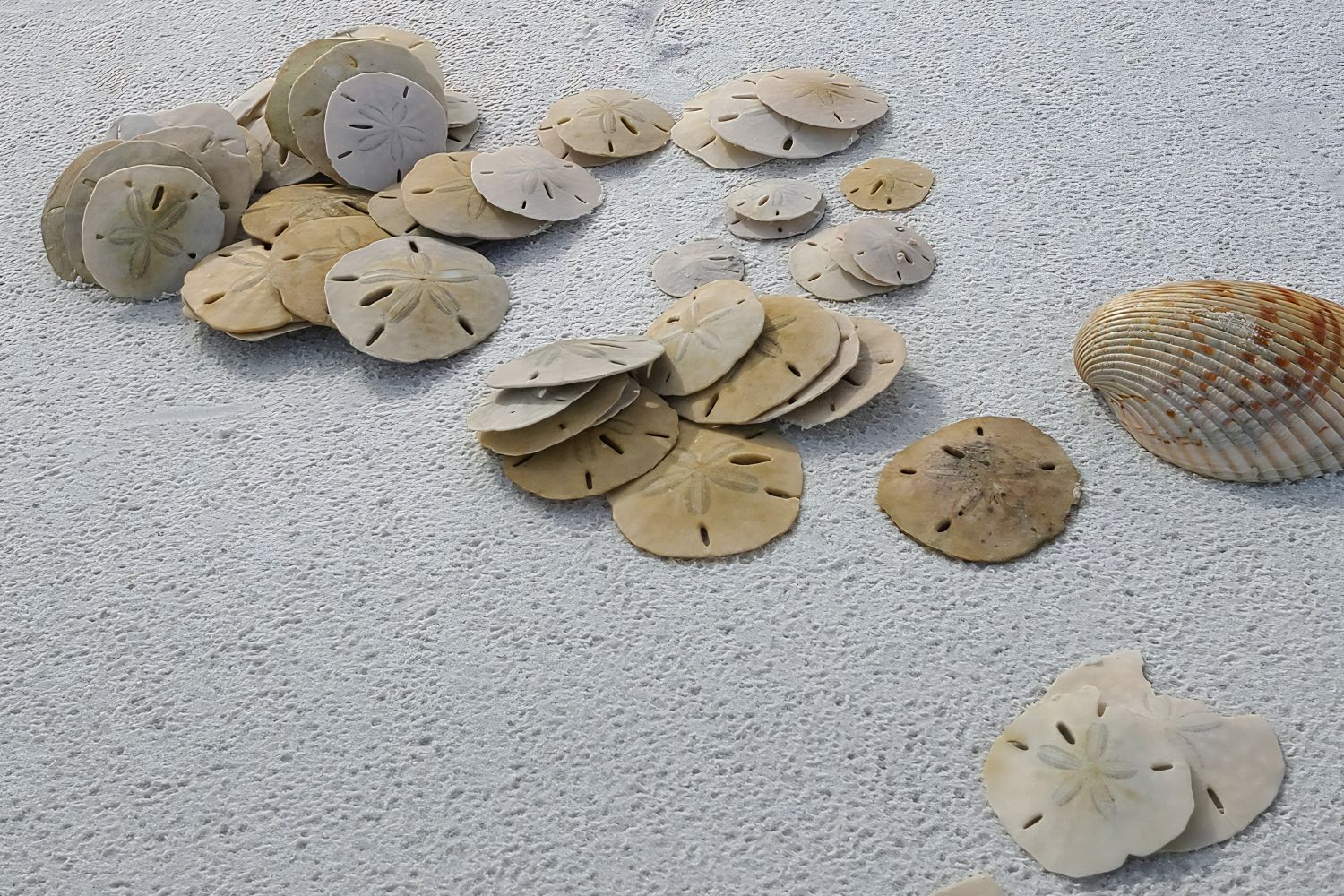
Every single family vacation to St. Pete Beach growing up came with the same unspoken assignment. Find a sand dollar. A whole one, not a broken half or a crumbled fragment, an actual intact disc, and if you found one, you’d better hang onto it, because in my family, finding a whole sand dollar meant good luck was coming your way. Nobody could tell me exactly where that belief came from. It didn’t need an origin. It was just true the way weather was true, a fact of the beach itself.
I spent years hunting for them, at St. Pete, down through the beaches of Southwest Florida, all the way up the East Coast on every family trip that ever put my feet on sand. And for most of that time, a whole sand dollar stayed exactly what the family lore said it should be: rare. You’d find broken pieces constantly, pale fragments scattered through the wrack line, but a genuinely whole one felt like it had been placed there specifically for you to find, on that day, at that hour, by whatever version of luck decides these things. My sister always seemed to find them. But I never did.
Then Everything Changed at Fort De Soto
After Covid, back at St. Pete and Fort De Soto, something shifted that I still don’t fully have an explanation for. We found hundreds of them. Not the occasional lucky whole one, hundreds, scattered across the sand like the beach had simply decided to stop being stingy. I remember standing there almost laughing, because an entire childhood’s worth of treasure hunting had just been quietly rewritten in a single afternoon. I’ve wondered since whether a couple of quiet, low traffic years gave that particular stretch of coast room to recover in a way I happened to walk right into at exactly the right moment. I don’t know the real answer. What I do know is that Fort De Soto turned out to be just the beginning of something much bigger than I understood at the time.
Thousands of Miles Away, the Same Discovery
Years later, during a petsitting stay in Hansville, Washington, along the edge of Puget Sound, I walked out onto the shore and stopped completely. Thousands of sand dollars, spread across the exposed tide flats as far as I could see. I genuinely didn’t know what I was looking at for a second, because in my mind, sand dollars belonged to Florida and the Caribbean. That was the whole geography of the thing, as far as I’d ever known it. Finding them scattered across a cold, gray, entirely different ocean on the opposite side of the country didn’t just surprise me. It quietly undid an assumption I hadn’t even realized I was carrying around.
And it kept happening. As I made my way down the Pacific coast afterward, Oregon, then California, I found them again. And again. What I’d spent my whole life treating as a rare, distinctly Florida kind of magic turned out to be a genuinely widespread, ordinary part of entire coastlines I’d simply never walked before. I later learned that the sand dollar scattered across a Puget Sound tide flat and the one I grew up hunting on St. Pete Beach aren’t even the same species, different animals entirely, arriving independently at the exact same flattened, disc shaped answer to the exact same problem: how do you live in sand without getting swept away by it. Two different oceans, two different species, the same quiet solution.
What the Bubble Was Actually Made Of
My whole understanding of where sand dollars belonged wasn’t wrong exactly, it was just incomplete in a way I had no way of noticing from inside it. Every vacation, every beach, every whole disc I ever found happened inside the same relatively small stretch of coastline, so of course that stretch of coastline felt like the entire world the sand dollar occupied. I wasn’t missing information because I wasn’t paying attention. I was missing it because I’d never had a reason to stand anywhere else.
That’s the part of this whole story that actually matters to me now, more than the sand dollars themselves. So much of what we treat as a fact about the world is really just a fact about the specific patch of it we’ve personally stood on. Getting out of that patch, actually leaving it, walking a shore you’ve never walked before, is the only thing that ever seems to reveal how much bigger and more connected everything already was the whole time, waiting there, indifferent to whether you’d noticed yet. I didn’t go looking for a lesson in Hansville. I went looking for sand dollars, the same thing I’d been looking for my entire life. The lesson found me anyway, the way the best ones always seem to.
I think about all those childhood summers now and feel something closer to fondness than correction. That family belief about luck wasn’t wrong either, not really. Finding something whole and rare in all that shifting sand really did feel like a small gift every single time, and I don’t think that feeling needs debunking just because I now understand there are entire coastlines covered in them that I’d simply never seen. Maybe that’s the actual trick of it. The magic was never really about scarcity. It was about paying close enough attention to notice something extraordinary sitting in plain sight, whether that something turns up once a summer or by the thousand, on a beach you’ve known your whole life or one you’ve never set foot on before.