


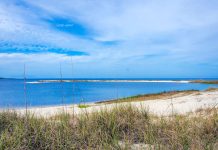
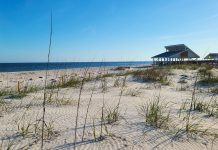

I have been startled by a crab more times in my life than I can honestly count, usually the same way, a sudden scuttle across sand I thought was empty, a flash of movement at the edge of a porch light on some island off Key West, gone again before I fully registered what I’d seen.
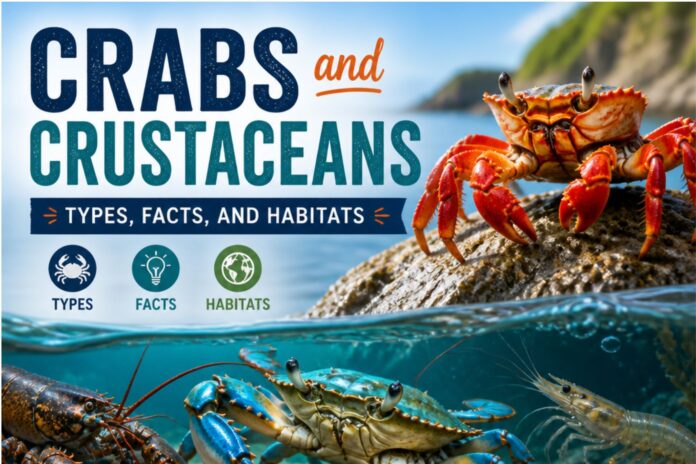
Crabs are among the most familiar animals in the sea, but they are only one part of a much larger group called crustaceans. From tiny shrimp to giant king crabs, these creatures share a surprising set of traits that help them survive in oceans, rivers, lakes, and even on land.
Understanding crabs and crustaceans gives us a better view of how diverse marine life really is. It also explains why these animals are so important in food chains, ecosystems, and human culture.
What Are Crustaceans?
Crustaceans are invertebrates, which means they do not have backbones. They belong to the arthropod family, the same broad group that includes insects and spiders. Their bodies are protected by a hard outer shell called an exoskeleton.
This shell acts like armor, helping crustaceans defend themselves from predators and physical damage. Since the shell does not grow with the animal, crustaceans must shed it from time to time in a process called molting.
Common crustaceans include:
- Crabs
- Lobsters
- Shrimp
- Prawns
- Barnacles
- Crayfish
Each of these animals has adapted to different habitats, but they all share some key features, such as jointed legs and segmented bodies.
Fascinating Crab Adaptations
Crabs have developed many clever adaptations that help them survive.
Strong Shells
Their hard shells protect them from predators and rough environments. For many species, the shell is their first and best defense.
Quick Movement
Although some crabs seem slow, many can move quickly when needed. Sideways movement helps them escape danger and navigate narrow spaces.
Camouflage
Some crabs blend into sand, rocks, or coral to avoid being noticed. Others decorate themselves with algae or debris for added protection.
Burrowing Behavior
Many crabs dig burrows in sand or mud. These shelters provide safety, moisture, and a place to rest or hide from predators.
How Crustaceans Grow
One of the most interesting things about crustaceans is how they grow. Because their exoskeleton is rigid, they cannot simply stretch like mammals or fish. Instead, they grow by molting.
During molting, the crustacean sheds its old shell and forms a new one underneath. At first, the new shell is soft and vulnerable. The animal often hides until the shell hardens.
This process is risky, but it is essential for growth. Without molting, crabs and other crustaceans would eventually become trapped inside their own armor.
Meet the Family
Crustaceans make up an enormous, ancient group, well over 67,000 described species, including every crab, lobster, shrimp, barnacle, and krill on Earth. Most of the ones we notice belong to the order Decapoda, meaning ten footed, and within that group there’s a distinction almost nobody knows to look for: true crabs, the infraorder Brachyura, versus everything else that merely looks crab shaped. King crabs, hermit crabs, and the coconut crab all evolved their crab like body plan independently, through a process scientists genuinely call carcinization, the tendency of very different crustacean lineages to converge on the same flattened, round, ten legged shape over millions of years. It’s happened at least five separate times in evolutionary history, which makes “crab” less a single family tree and more a shape evolution keeps arriving at from different directions, like it’s the correct answer to a question the ocean keeps asking.
Jump to a species:
- Coconut crab — Indo-Pacific tropical islands
- Hermit crab — coastlines and shallow seas worldwide
- King crab — cold northern seas worldwide
- Fiddler and ghost crabs — sandy beaches and mud flats worldwide
- Mantis shrimp — tropical and subtropical reefs worldwide
- Lobsters — temperate and tropical seafloors worldwide
- Barnacles — nearly every hard surface in the ocean
Coconut Crab
Birgus latro is the largest land living arthropod on Earth, reaching a leg span of nearly three feet and a weight over nine pounds, and it’s technically a giant, highly modified hermit crab that gave up carrying a shell entirely once it grew too large to find one that fit. Adults develop a hardened abdomen instead, breathe through specialized organs that function like lungs rather than gills, and can actually drown if held underwater too long, a genuinely strange fate for an animal descended from ocean dwelling ancestors. True to its nickname, the robber crab, it will climb trees and claw open coconuts with a grip strong enough to break a finger, though its diet is really far broader than the name suggests.
The sand only matters to the Coconut Crab at the very beginning of its life, and that narrow window turns out to be the whole reason it can exist at all. A female coconut crab releases her eggs into the surf, and the larvae drift as ocean plankton for weeks before the tiniest, most vulnerable stage of the crab’s life washes up onto open beach sand and immediately needs to find an empty, correctly sized snail shell in the wrack line to carry for protection. Once that shell dwelling juvenile leaves the open beach, it moves inland for good, digging its permanent burrow into looser, shaded, humus rich forest soil under vegetation rather than exposed dry sand, since that softer, moisture holding ground is what lets an adult maintain the humid microclimate its modified breathing organs actually require. The open beach, for a coconut crab, isn’t home. It’s a one time nursery and a shell shopping trip, and after that, dry ocean facing sand is somewhere this animal actively avoids for the rest of its life.
Hermit Crab
Over eight hundred species of hermit crab exist worldwide, ranging from ones small enough to disappear inside a periwinkle shell to species that could nearly fill your palm. Every hermit crab carries an asymmetrical, soft, unprotected abdomen, which is exactly why it spends its life scavenging empty snail shells for cover, trading up to a larger shell as it grows. When a good, larger shell becomes available and multiple hermit crabs are nearby, they’ll sometimes line up by size and swap shells down the line in sequence, each crab moving into the shell just vacated by the one ahead of it, an oddly cooperative housing chain for an animal with a reputation for being solitary.
The whole shell swapping economy this species runs on depends entirely on sand doing its job as a sorting machine. Wave action along a beach naturally tumbles and deposits empty gastropod shells at fairly predictable points along the tide line, which is exactly why a shoreline with a healthy, undisturbed wrack line tends to support a far larger hermit crab population than one that’s been repeatedly raked or cleaned. Marine species mostly forage and shelter in the shallow subtidal sand just offshore, tucking into loose sediment or old shells at the base of seagrass and rubble, while the fully terrestrial land hermit crabs found on tropical beaches worldwide dig shallow molting chambers directly into loose, dry upper beach sand, chambers that need to hold their shape just long enough to hide a soft, freshly molted crab for the several vulnerable days it takes the new shell underneath to harden.
King Crab
Despite the name and the unmistakably crab shaped body, king crabs aren’t true crabs at all, they’re more closely related to hermit crabs, another product of that same convergent carcinization story. Species like the red king crab of the North Pacific can span six feet across the legs and are the target of one of the most dangerous commercial fisheries in the world, conducted in the frigid, storm battered waters off Alaska’s coast. Look closely at a king crab’s asymmetrical body and you can actually still see the evolutionary fingerprint of its hermit crab ancestry, hidden underneath a shape that convinced almost everyone it was something else entirely.
King crabs never touch beach sand at all, and that’s worth pointing out precisely because everything else in this article does. They live on the cold, soft mud and sand seafloor of the continental shelf, often hundreds of feet down, walking across sediment rather than burrowing into it the way a ghost crab or fiddler crab does. The one moment sand truly matters to a king crab is during its own vulnerable molt, when a soft shelled animal needs loose, easily displaced seafloor sediment to partially bury into and disappear from predators until its new shell hardens, the same basic strategy as a beach dwelling crab’s burrow, just relocated to a completely different, sunless world.
Fiddler and Ghost Crabs
Fiddler crabs are unmistakable once you’ve seen a male: one claw normal sized, the other grotesquely oversized, waved and tapped rhythmically against the mud in a courtship display that genuinely looks like the crab is playing a tiny, invisible instrument, which is exactly where the name comes from. They live by the thousands in mud flats and salt marshes worldwide, sifting sand and mud through their mouths for edible particles and depositing tidy little cleaned pellets behind them. Ghost crabs, genus Ocypode, take the opposite strategy, pale, fast, and built for open sand rather than mud, capable of sprinting up to ten miles an hour in unpredictable zigzags to escape predators. Their stalked eyes give them nearly 360 degree vision, with one notable blind spot directly overhead, which is exactly where a hunting shorebird tends to come from. Scientists actually use ghost crab burrow density as a working indicator of overall beach health, since heavy foot traffic and vehicle use measurably reduce their numbers.
Fiddler and Ghost crabs split the exact same stretch of shoreline into two completely different sediment jobs, and the split comes down to grain size and moisture more than anything else. Fiddler crab species actually specialize by substrate down to a remarkably fine degree, some species are built with spoon shaped mouthpart hairs specifically tuned to feed on sandier sediment, while others are confined to the softer, muddier low shore where their burrows can run deep and stable in clay rich ground. Ghost crabs, by contrast, need sand that sits in a surprisingly narrow moisture window, wet enough that surface tension between individual grains holds a burrow wall together, but dry enough that it doesn’t collapse under its own weight, the exact same physics that makes a sandcastle possible in the first place. That’s also why ghost crab burrows are almost always dug well up the beach in drier sand rather than right at the waterline, while a fiddler crab’s entire world stays low, wet, and muddy just a short distance away.
Mantis Shrimp
Despite the name, a mantis shrimp isn’t a true shrimp at all, it belongs to its own ancient order, Stomatopoda, and it might be the single most physically remarkable animal in this entire family. The “smasher” type mantis shrimp throws a club like appendage forward with an acceleration comparable to a fired bullet, generating enough force to shatter aquarium glass and crack open the shells of crabs and snails instantly. The strike happens so fast it briefly boils the water around it, creating a collapsing bubble that delivers a second shockwave microseconds after the first hit lands. Its eyesight is just as strange: a mantis shrimp’s eyes carry up to sixteen types of color photoreceptors, compared to humans’ three, along with the ability to detect polarized light no other animal on Earth is known to perceive.
Most mantis shrimp live not on open sand but in a burrow excavated straight into it, usually a soft mix of sand and mud found on shallow reef flats, lagoons, and seagrass beds rather than a wave battered open beach. The burrow itself typically runs in a U or J shape with two openings, engineered so the animal can ambush prey right at the entrance while always keeping an escape route open behind it. Because the substrate has to be soft enough to dig through easily but cohesive enough to hold that tunnel shape underwater, mantis shrimp tend to cluster in the same calm, muddy sand patches generation after generation, effectively inheriting real estate the way a hermit crab inherits a good shell.
Lobsters
The lobster family splits cleanly into two very different body plans. Clawed lobsters, like the American or Maine lobster, carry heavy, asymmetrical front claws built for crushing shellfish, and live in the colder waters of the North Atlantic. Spiny lobsters, found throughout warmer tropical and subtropical seas worldwide, have no claws at all, relying instead on a spiny shell, powerful tail flip, and long, whip like antennae for defense. Every lobster grows by molting its entire exoskeleton periodically throughout its life, a vulnerable process that leaves a freshly molted lobster soft bodied and defenseless for days at a time while the new shell hardens.
Spiny and clawed lobsters use sand for two very different purposes, and neither species actually lives buried in it. A spiny lobster spends its daylight hours packed into rock ledges and reef holes for protection, then moves out over open sand flats and grass beds after dark specifically to hunt, since that’s where the mollusks, urchins, and worms it eats are hiding just under the surface, which makes sand less a home for this animal than a nighttime hunting ground it returns to on a schedule. Clawed lobsters take the opposite approach, excavating actual burrows into softer seafloor mud and sand with two separate openings, one for a quick entrance and one for a fast backward escape, structures they’ll maintain and defend for months or years at a stretch rather than treating as disposable.
Barnacles
Barnacles spend their adult lives permanently cemented, head down, to a single spot, whether that’s a rock, a ship’s hull, a sea turtle’s shell, or the skin of a living whale, and once attached, most species never move again for the rest of their lives. What looks like a small, unmoving shell is actually an animal constantly filter feeding, extending feathery, leg like appendages called cirri out through the shell to sweep passing plankton out of the water. Whale barnacles have evolved shell structures specifically adapted to anchor into living skin, and different species show real preference for different whale species and even different spots on the body, a level of specialization that took millions of years of hitchhiking to develop.
Barnacles are the true outlier of this entire article, the one animal in the whole family that actively needs to avoid sand rather than live in it. A barnacle larva drifting through open water is searching specifically for a hard, stable, sand free surface to cement itself to permanently, since loose, shifting sand offers nothing solid enough to anchor a lifetime commitment to. That’s exactly why you’ll find barnacles crusted onto rock jetties, pilings, shells, and hulls right along a sandy shoreline, but essentially never on the open sand itself, and it’s also why a sandy beach that erodes or shifts constantly tends to host far fewer barnacles than a rocky one just a short distance away with all the same water conditions.
The Whole Molting Life
Every single animal in this article shares one unavoidable biological fact: its skeleton is on the outside, and the only way to grow is to periodically shed that entire hard shell and grow a new, larger one underneath. Molting leaves a crab, lobster, or shrimp soft, exposed, and genuinely vulnerable for a period ranging from hours to days, which is exactly why so many species time their molts to coincide with safe cover, a burrow, a crevice, or simply the cover of darkness. It’s an inherently risky, unavoidable part of being a crustacean, growth that always requires a period of complete defenselessness first.
Sand and the Burrowing Life
An enormous share of this family’s diversity is built entirely around sand and soft sediment. Ghost crabs excavate burrows up to four feet deep above the high tide line, plugging the entrance during the hottest part of the day and emerging to hunt only after dark. Fiddler crabs process staggering volumes of mud and sand daily, sifting out organic material and leaving the cleaned sediment behind in small, distinctive balls that mark their territory. Even the coconut crab, for all its size and land based lifestyle, still depends on the same larval strategy nearly every crustacean shares, drifting as part of the ocean’s plankton for weeks before ever settling into a life on land or in sand at all.
Rules Wherever You Go
Never pour water or chemicals into a crab burrow to force an occupant out, and avoid driving or riding on any beach known to support ghost crab populations, since their burrow density is a genuine, measurable indicator of how much pressure a beach ecosystem is under. If you’re buying lobster, shrimp, or crab anywhere in the world, look for certifications like the Marine Stewardship Council label, since crustacean fisheries range from genuinely sustainable to seriously overexploited depending entirely on the species and the region.
Who’s Protecting Them
The NOAA Fisheries and equivalent agencies worldwide manage commercial crustacean fisheries through size limits, seasons, and catch quotas, and the IUCN Red List tracks conservation status for the family’s more vulnerable members, including several land crab species threatened by coastal development. Christmas Island National Park, managed by Parks Australia, protects the annual red crab migration through an entire island’s worth of purpose built infrastructure, including crab bridges and seasonal road closures, treating tens of millions of migrating crustaceans as a conservation priority worth genuinely inconveniencing traffic for.
Curiosity Corner
Is a hermit crab a true crab?
No. Hermit crabs belong to a separate group, the Anomura, and their asymmetrical, unprotected abdomen is the giveaway, true crabs have a fully hardened, symmetrical body that doesn’t need a borrowed shell for cover.
Why do fiddler crabs have one giant claw?
It’s exclusively a male feature, used for courtship display and territorial combat with other males, while the smaller claw handles the actual work of feeding.
Can a mantis shrimp’s punch really hurt a person?
Large smashing species have earned the nickname “thumb splitter” among aquarium keepers and fishermen for good reason. It’s not typically dangerous to an adult, but it can genuinely break skin or crack aquarium glass.
How does a crab regrow a lost claw?
Through the molting process. A new, smaller claw regenerates in stages each time the crab molts, gradually approaching full size again over several molt cycles.
Do all crustaceans live in the ocean?
No. Freshwater crayfish, terrestrial hermit and coconut crabs, and even a handful of fully land adapted species have moved well beyond salt water over evolutionary time, though nearly all still return to the sea to release their larvae.
Thoughts & Reflections
Crabs and crustaceans may seem like small parts of the natural world, but they have a big impact. They help keep ecosystems balanced, support marine food webs, and provide food and income for people.
They also remind us how varied life can be. From deep sea vents to tidal pools, crustaceans have adapted to almost every watery habitat on Earth.
