

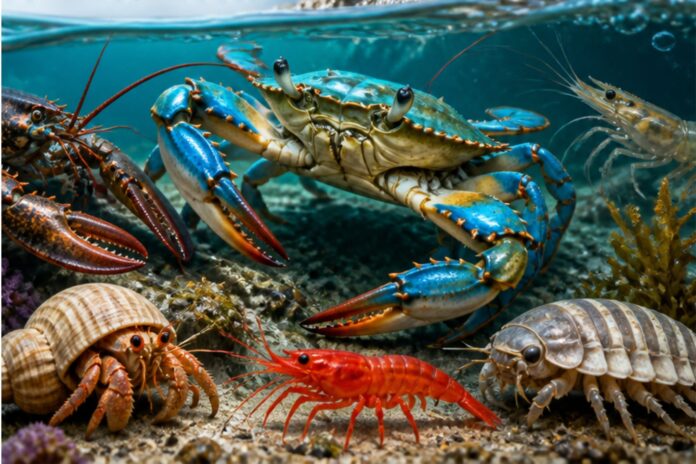
Some of my clearest crab memories aren’t even from the beach. They’re from a hotel courtyard in Key West, watching something the size of my hand skitter across the grass at dusk like it owned the place, which, honestly, it kind of did. Florida is genuinely one of the best crab and crustacean states in the country, home to a sustainable seafood industry built entirely around giving an animal back most of its body, a lobster with no claws at all, and a land crab migration most visitors have no idea is happening around them every single year.
Meet Florida’s Crowd
Florida’s waters and shorelines host a genuinely impressive lineup: the blue crab, working every estuary and grass flat in the state, the stone crab, built around one of the most sustainable harvest methods in American seafood, the clawless Florida spiny lobster, the fast, pale ghost crab patrolling every sandy beach after dark, fiddler crabs by the thousands in the state’s salt marshes, and the large, colorful blue land crab, which spends most of its life nowhere near open water at all.
The Claw You Can Return
The stone crab, Menippe mercenaria, is the centerpiece of one of the most sustainable fisheries in the country, and the whole system is built around a simple biological fact: this crab can regrow a lost claw. Harvesters remove one legal sized claw, at least 2 and 7/8 inches, from a live crab and return the rest of the animal to the water, where it can regenerate that claw over the next one to three years and keep living, feeding, and reproducing in the meantime. Everglades City, on the edge of the Ten Thousand Islands, calls itself the Stone Crab Capital of the World, and the title is earned honestly, generations of local families have run claw only trap lines through these same mangrove backwaters since the mid twentieth century, turning what was once considered a nuisance bycatch into a thirty million dollar a year industry. Florida’s stone crab season runs October 15 through May 1, deliberately timed to give the population room to reproduce and regenerate through the warmer months, and it’s illegal to harvest a claw from an egg bearing female under any circumstances.
You will not find a stone crab out on the open, sugar white sand most visitors picture when they think of a Florida beach. This crab wants soft, organic rich mud and sand mixed together, the kind found tucked among mangrove roots, oyster bars, and grass flat channels rather than an open, wave exposed shoreline, and it digs or occupies a burrow in that softer substrate for cover during the day, emerging to feed at night. That’s exactly why the Ten Thousand Islands, with its endless maze of mangrove lined, muddy bottomed backwaters, became the epicenter of this entire industry rather than, say, the open Gulf beaches a short drive away. The claw regrows in the water. The crab itself never leaves its muddy, root tangled neighborhood to begin with.
The Lobster Without Claws
Florida’s spiny lobster, Panulirus argus, throws off almost everyone who grew up picturing a Maine lobster’s heavy claws. This one has none at all, defending itself instead with a spiny shell, a powerful tail flip, and a pair of long, whip like antennae, and it’s most common throughout the Florida Keys, though it turns up on reefs as far north as Broward and Palm Beach counties too. Every July, the state holds a genuinely beloved two day sport season, known statewide as mini season, giving recreational divers first crack at the population before the regular commercial season opens in August. It’s a real event in the Keys specifically, hotels book out, US 1 backs up with traffic, and thousands of divers descend on the reefs for two days of legally sanctioned bug hunting before the lobsters get eight relatively undisturbed months to grow undisturbed.
Florida’s spiny lobster treats sand as a nighttime pantry rather than a home. By day it wedges itself into reef ledges, rock crevices, and holes on structure, often packed in tight with several others, then moves out over the pale, open sand flats and turtle grass beds ringing the Keys after dark specifically to hunt for the conch, urchins, and small mollusks that live buried or crawling just above that sandy bottom. The clear, bright sand flats you’ll see stretching between coral heads throughout the Keys aren’t incidental scenery on a lobstering trip. They’re the actual feeding ground the entire fishery depends on, which is part of why protecting those grass and sand flats matters just as much to this species as protecting the reef structure it hides in.
The Impostor in This Article
The horseshoe crab, one of the most recognizable “crabs” on any Florida beach, isn’t a crab, or even a crustacean, at all. It’s a chelicerate, more closely related to spiders and scorpions than to anything else in this entire article, and it’s been essentially unchanged in body plan for something like 450 million years, making it older than the dinosaurs by a wide margin. Every spring and fall, around the full and new moon high tides, horseshoe crabs come ashore in mating pairs to spawn right at the waterline, an event most Florida beachgoers never witness firsthand since it happens at night. Florida Horseshoe Crab Watch, a citizen science program run through FWC and the University of Florida, trains volunteers to count and tag spawning crabs during exactly those windows, and their blue, copper based blood is so valuable to modern medicine, used to test vaccines and medical equipment for contamination, that a live horseshoe crab is worth more to a pharmaceutical lab than any restaurant menu.
Here’s the detail that surprised me most in researching this entire piece, and it’s pure sand science. Researchers who study horseshoe crab spawning beaches have found that Florida’s sand is measurably different from the sand up in Delaware Bay, the species’ most studied stronghold. Delaware’s beaches run coarse grained and well drained, while Florida’s tend to be finer grained and hold water longer, and that difference matters enormously to an egg buried five to eight inches deep in it. A horseshoe crab egg needs sand moist enough to keep from drying out but loose and coarse enough for oxygen to actually reach the developing embryo, something close to three percent moisture saturation seems to be the sweet spot in the studies that have measured it. Bury those same eggs in sand that’s too fine and waterlogged, the way parts of a poorly draining Florida beach can run, and the embryo can suffocate before it ever gets the chance to hatch, which is exactly why a female horseshoe crab spends real time testing a spot with her legs before she ever commits to digging there.
Land Crabs and Key West’s Annual Surprise
The blue land crab, Cardisoma guanhumi, is exactly the animal I remember from that Key West courtyard, a large, strikingly colored crab, ranging from deep violet blue to pale tan, that spends nearly its entire life on land in a burrow dug near a freshwater source. Every summer and early fall, typically triggered by heavy rain, adult blue land crabs migrate en masse toward the coast to release their eggs into the sea, and in parts of South Florida and the Keys that migration is dense enough to genuinely affect local traffic for a night or two, crabs crossing roads and yards by the hundreds. The species is protected in Florida, and it’s illegal to harvest females carrying eggs, a rule that matters more than usual during exactly the migration window when you’re most likely to encounter one.
The sand a blue land crab needs has almost nothing to do with a beach at all, and that’s what makes this species such an interesting outlier in its own family. Its burrow typically runs straight down through sandy or loamy soil until it reaches the water table, sometimes several feet below the surface, because this animal still breathes with gills modified for limited air use and needs that below ground moisture to keep them functional even while living entirely on land. That’s exactly why you’ll find these burrows in a Key West courtyard, a vacant lot, or a roadside ditch well away from any open sand, wherever the ground stays damp underneath, rather than anywhere close to the dry, sun baked sand most people associate with a Florida crab. The one time this species truly needs the beach itself is that single, urgent nighttime dash to the water each year to release its eggs into the surf, the only appointment its entire landlocked life is actually built around.
Ghost Crabs and Sand Fleas: Life at the Swash Line
Nearly every Florida beach hosts ghost crabs after dark, pale, fast moving, and built for open sand rather than mud, digging burrows above the high tide line and closing themselves in during the hottest part of the day. Their preferred prey on open, ocean facing beaches is the humble mole crab, sometimes called a sand flea, the small, egg shaped crustacean kids dig up by the handful right where the waves are breaking, burrowing backward into wet sand between each wave with almost comical speed. Watch a ghost crab’s burrow density on any given beach and you’re actually looking at a rough, honest indicator of how much foot and vehicle traffic that beach has absorbed, since heavy use measurably thins their numbers out over time.
These two animals divide up the exact same beach into two completely different sand jobs, separated by only a few dozen feet. A ghost crab needs sand dug well above the waterline, in that dry to slightly damp zone where individual grains hold just enough moisture to stick together under tension without collapsing, the same principle that determines whether your sandcastle holds its shape or slumps into a pile. Too dry and the burrow walls cave in; too saturated and they liquefy just as fast. A mole crab lives the complete opposite lifestyle, right in the active swash itself, in loose, constantly churned, well sorted sand it can drive its whole body backward into in under a second between each incoming wave, using a paddle shaped tail rather than a dug shelter at all. One species needs sand still enough to hold a shape. The other needs sand moving constantly enough that holding a shape was never the plan to begin with.
Where You’ll See Crabs in Florida Region by Region
The Panhandle
Ghost crabs are common along Perdido Key and the wider Gulf Islands National Seashore, their burrows visible above the tide line on undisturbed stretches of dune. Blue crabs work the grass flats of Big Lagoon and Perdido Bay on the island’s bay side, and fiddler crabs colonize the marsh edges of Choctawhatchee Bay and St. Andrew Bay near Panama City by the thousands.
The Nature Coast & Big Bend
This stretch of coast holds healthy stone crab populations working the same grass flats favored by scallops and manatees, and Cedar Key runs its own respected, smaller scale stone crab and blue crab fishery alongside the more famous operations further south. Ghost crabs and ample mole crabs are common on the region’s quieter, less developed beaches.
Tampa Bay
Blue crabs are abundant throughout Tampa Bay’s grass flats and are a familiar sight to anyone crabbing off a dock or bridge in the area. Fiddler crabs work the marsh edges around Apollo Beach, and ghost crab burrows are common along the barrier beaches of St. Petersburg and Clearwater wherever the sand stays undisturbed.
Southwest Florida
Behind Lido Key and Siesta Key, blue crabs and stone crabs both work Sarasota Bay’s grass flats and passes, and ghost crab burrows are easy to spot on quieter stretches of both keys’ beaches after dark. Further south, Everglades City and the Ten Thousand Islands are the heart of Florida’s stone crab industry, the self proclaimed Stone Crab Capital of the World, where generations of local families have run claw only trap lines since the mid twentieth century. Charlotte Harbor and the passes around Boca Grande, Sanibel, and Captiva round out one of the state’s most productive stone crab and blue crab regions.
The Space & Treasure Coasts
Blue crabs are common throughout the Indian River Lagoon system from Titusville down through Vero Beach and Fort Pierce, and ghost crab burrows dot the dune line on the barrier island beaches around Cocoa Beach and New Smyrna Beach. This stretch of coast also sits within the range of Florida’s blue land crab, whose late summer migrations toward the water occasionally turn up in coastal neighborhoods well inland of the beach itself.
Southeast Florida & the Keys
Blue crabs and stone crabs both work Biscayne Bay’s grass flats behind Miami’s barrier beaches, and the region hosts one of Florida’s most visible blue land crab populations, migrations dense enough to occasionally affect local traffic for a night or two each summer. The Florida Keys are the heart of the state’s spiny lobster fishery, home to the annual two day sport mini season every July that draws thousands of divers to Key Largo, Marathon, and Key West, alongside a resident population of the state’s largest, most colorful land crabs turning up in yards and courtyards throughout the islands.
A Note on the Sand Underneath
Nearly every crab on this list depends on sand or soft sediment more directly than almost any animal in this series. Ghost crabs excavate burrows several feet deep into dry beach sand, fiddler crabs process staggering volumes of marsh mud daily sifting for food, and mole crabs, the sand fleas kids dig for at the water’s edge, spend their entire lives burrowing backward into wet sand between each incoming wave. A healthy population of any of these animals on a given stretch of beach is a genuinely good, low tech sign that the sand itself, undisturbed, unpaved, and left alone after dark, is still doing exactly what it’s supposed to do.
The Rules I Don’t Bend On
Never harvest a stone crab claw from an egg bearing female, and never take both claws from a single crab, since that dramatically reduces its odds of surviving to regrow either one. Respect spiny lobster size and bag limits exactly, measure the carapace in the water as required, and stay well clear of protected zones like John Pennekamp Coral Reef State Park and Dry Tortugas National Park where harvest is prohibited entirely. Leave blue land crabs alone during migration season rather than relocating or collecting them, and if you’re driving through a known migration area at night, slow down.
Who’s Protecting Florida’s Crustaceans
The Florida Fish and Wildlife Conservation Commission manages every regulated fishery mentioned in this piece, from stone crab claw size limits to spiny lobster season dates, and runs the Florida Horseshoe Crab Watch citizen science program alongside the University of Florida. Everglades City’s fishing families, many of them multi generational stone crabbers, have effectively become informal stewards of the Ten Thousand Islands fishery simply by having every incentive to keep it healthy for the next season.
Questions I Get All the Time
Does removing a stone crab’s claw actually hurt the crab long term?
A properly removed single claw, taken at the correct joint, allows the crab to survive, feed with its remaining claw, and regenerate the missing one over roughly one to three years. Taking both claws significantly lowers its odds of survival, which is why the practice is discouraged.
Why doesn’t Florida spiny lobster have claws?
It’s simply a different evolutionary strategy than cold water clawed lobsters, relying on a spiny shell, tail flip speed, and long antennae for defense instead of crushing claws.
Is it true horseshoe crab blood is used in medicine?
Yes, genuinely. Its unique blue, copper based blood clots in the presence of bacterial toxins, making it essential for testing the safety of vaccines and medical equipment, a real and ongoing reason horseshoe crab conservation matters beyond the beach.
What should I do if I see blue land crabs migrating near my home?
Leave them alone and let them pass, slow down if driving through the area, and avoid disturbing burrows near the water table if you notice them on your property, since the species is protected in Florida.
Are ghost crab burrows on the beach something I should avoid stepping near?
It’s good practice, yes. Their burrow density is an actual, measured indicator of beach health, so giving them space, especially avoiding driving on beaches known to host them, genuinely helps the population.
Thoughts & Reflections
The stone crab story is the one that stays with me longest out of everything in this piece. An entire multi generational industry, worth thirty million dollars a year, built around the radical idea of taking only what regrows and giving the rest back alive. I don’t know that I’ve encountered a cleaner metaphor anywhere else in this whole wildlife series for what sustainability is actually supposed to look like in practice, not abstinence, not a total ban, just genuine restraint paired with real respect for what a living thing can recover from. Everglades City didn’t need a slogan to figure that out. They just needed a crab willing to grow its claw back and generations of families smart enough to notice.
