



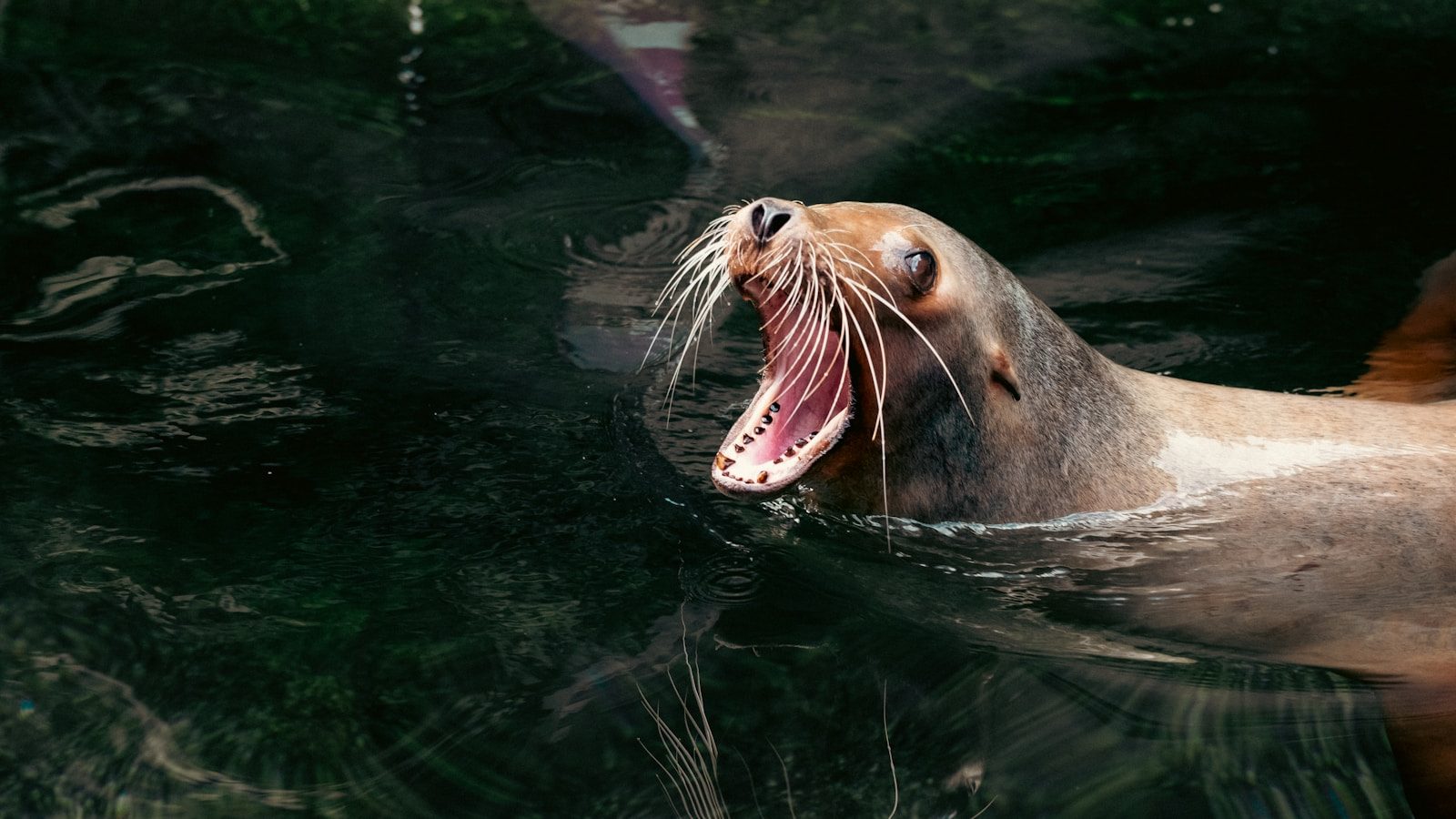
Elsie Mae, the elephant seal from my Anacortes petsit, can only hitch herself along a beach on her belly. Sea lions can’t relate. This is the branch of the pinniped family that can rotate its hind flippers forward, prop itself up on its front flippers, and actually walk, climb, and occasionally sprint faster than you’d expect from an animal shaped like that. They’re also the loud ones, the ones with visible ear flaps, the ones you’ve probably watched bark at each other over a dock somewhere. Six species are still alive today, spread across both hemispheres in wildly different numbers, and a seventh existed within living memory before we hunted it out of existence.
Jump to a species:
- California sea lion — Channel Islands, California
- Steller sea lion — Oregon’s Sea Lion Caves and the Gulf of Alaska
- South American sea lion — Peninsula Valdes, Argentina, and the coasts of Peru and Chile
- Australian sea lion — Kangaroo Island, South Australia
- New Zealand sea lion — Auckland and Campbell Islands, New Zealand subantarctic
- Galapagos sea lion — the Galapagos Islands
- Japanese sea lion — extinct, once the Sea of Japan and Korean Peninsula
Sea Lions: Loud, Social, and Agile
Sea lions are often confused with seals, but they have some noticeable differences. Sea lions belong to the Otariidae family, the eared seals, alongside their closer cousins the fur seals. The giveaway features are the visible external ear flaps and those forward rotating hind flippers, which is why a sea lion can climb a rock wall or a set of stairs while a true seal like Elsie Mae is stuck flopping. Sea lions are also generally larger and less densely furred than true fur seals, which matters more than it sounds like it should, since that thinner coat is exactly why fur seals were hunted almost to extinction for pelts while sea lions were mostly left alone.
Sea Lion Movement
Sea lions are more agile on land than true seals. They can rotate their hind flippers forward and “walk” on all fours, which gives them a distinct advantage on rocky beaches and docks.
Sea Lion Behavior
These animals are highly social and often gather in large groups called colonies or rookeries. They are also known for their loud barking calls, which is one reason people recognize them so easily.
Sea lions are intelligent and curious. They are often seen balancing balls in aquariums or performing behaviors that show their strong memory and trainability.
The Ones Most People Picture
California sea lions are the species behind most people’s mental image, the barking, balancing, trainable sea lion of aquarium shows and San Francisco’s Pier 39. In the wild, the largest breeding population anywhere gathers at Point Bennett on San Miguel Island, part of California’s Channel Islands, where Channel Islands National Park hosts hundreds of thousands of them alongside elephant seals and northern fur seals during breeding season, an acoustic spectacle audible from well offshore.
The wild version of that beach couldn’t be more different from a floating dock in San Francisco. Point Bennett is a wide, wind scoured flat of sand and cobble on the exposed western tip of San Miguel Island, one of the foggiest, windiest stretches of coastline in California, backed by low dunes that never fully stop moving. It’s about as far from a tourist boardwalk as California coastline gets, accessible only by boat and only with a permit.
The Biggest of Them All
Steller sea lions are the largest of all the eared seals, with mature males topping out around 2,500 pounds and developing the thick, maned neck that gives the species its common alternate name, the northern sea lion. On the Oregon coast, the Sea Lion Caves near Florence hold the only known mainland rookery for Stellers anywhere in the world, a sea cave large enough to walk down into via an elevator and observation platform. Most of the species breeds much farther north, on remote rocky rookeries scattered from British Columbia through the Gulf of Alaska and out along the Aleutians, and the western Alaska population has been listed as endangered since the 1990s after a still not fully explained decline of more than 75 percent from 1970s numbers.
There’s essentially no sand anywhere in this section. The Oregon cave is a hollowed out basalt cavern with a wave polished rock floor, and the vast majority of Steller rookeries scattered through the Gulf of Alaska and the Aleutians tell the same story, exposed rocky islets and skerries battered by open ocean swell, chosen for being remote and defensible rather than comfortable.
The Southern Hemisphere’s Locals
South American sea lions range along both coasts of the continent, from Peru and Chile in the west to Brazil and Argentina in the east, and one of the best places on Earth to see them is Peninsula Valdes in Argentine Patagonia, a UNESCO World Heritage site that also hosts a major southern elephant seal colony and the orcas that have famously learned to strand themselves intentionally to hunt sea lion pups off the beach. This species has also proven unusually comfortable around people, with an established colony living inside the city of Valdivia, Chile, hauling out along the riverfront fish market like it’s just another part of the neighborhood.
Peninsula Valdes gives them pale gravel and packed sand beaches backed by dry Patagonian steppe, flat enough in places that those orcas can time a stranding run through the shallows and still wriggle back out on the next wave. The Valdivia colony trades all of that scenery for a riverfront of concrete embankment and cobble beside a working fish market, proof that this species will take a comfortable, food-rich stretch of shoreline over a scenic one every time.
The Rare Ones
Two sea lion species are in real trouble, and both are worth knowing by name. The Australian sea lion is found nowhere else on Earth and does something almost no other pinniped does, breeding on an irregular cycle that runs anywhere from 5 to 18 months between colonies instead of the tidy annual cycle most pinnipeds keep. Seal Bay Conservation Park on South Australia’s Kangaroo Island is the place most visitors actually get to walk a boardwalk through a wild colony, though the species is listed as endangered, with a total population estimated under 15,000.
The New Zealand sea lion is rarer still, one of the least numerous sea lion species in the world, with the overwhelming majority of the population breeding on the remote subantarctic Auckland Islands and Campbell Island, hundreds of miles south of the New Zealand mainland. Research on lactating females at these colonies has found they dive deeper and longer than almost any other sea lion species, pushed to the physiological edge of what a sea lion can do just to find enough food to nurse a pup, a population still recovering from near extinction at the hands of nineteenth century commercial sealers.
Seal Bay’s dunes are classic South Australian coastline, pale sand backed by low coastal heath, the kind of beach that would be packed with sunbathers anywhere else if it weren’t reserved for the colony. The Auckland Islands offer nothing like that comfort, windswept, tussock backed beaches at the edge of the subantarctic, cold sand mixed with bare rock, hundreds of miles from the nearest paved road.
The One With No Fear of People
The Galapagos sea lion is found only in the Galapagos Islands and has become genuinely famous for having almost no wariness of humans at all. They haul out directly on the docks, benches, and boat ramps of towns like Puerto Baquerizo Moreno, sharing sidewalk space with tourists in a way that would be unthinkable almost anywhere else on the planet, protected throughout by Galapagos National Park.
Away from town, they haul out on the islands’ dark volcanic sand beaches, the same black sand that makes the Galapagos famous among beach lovers, but plenty of the population has simply decided a concrete dock or a painted park bench works just as well, which might be the most unusual shoreline preference of any pinniped in this entire series.
The One We Lost
The Japanese sea lion once bred on open, sandy beaches around the coasts of Japan and the Korean Peninsula in numbers substantial enough to support a commercial hunt through the early twentieth century. That hunt, combined with wartime pressures, drove the population to collapse, and the last confirmed sighting was a juvenile captured off Hokkaido’s Rebun Island in 1974. It’s considered extinct, one of the more recent marine mammal losses on record, alongside the Caribbean monk seal that vanished around the same era. It’s a hard fact to sit with in an article that’s otherwise about where to go see these animals alive, but it belongs here anyway.
The beaches it once used were, by every account, unremarkable in the best way, open, flat, sandy stretches along the coasts of Japan and Korea, the kind of shoreline that wouldn’t earn a second look in a guidebook today. There’s a particular kind of sadness in that. It wasn’t lost from somewhere exotic or hard to reach. It was lost from ordinary coastline, the kind you could have walked to.
Rules Wherever You Go
Sea lions are more mobile than true seals, which means the old assumption that a hauled out pinniped can’t reach you fast is exactly backwards with this family. Keep a minimum of 50 to 150 feet of distance depending on local guidance, never let a sea lion feel cornered against a wall, dock, or vehicle, and remember that an animal that can climb a rock face can also close ten feet of sand faster than you can react. Bull sea lions defending territory during breeding season are especially unpredictable, and a colony that looks lazily asleep can be on its feet in a second if it decides you’ve gotten too close.
Curiosity Corner
How do I tell a sea lion from a fur seal if they’re both eared seals?
Size and coat are the quickest tells. Sea lions are generally larger and have a single coarse layer of fur, while fur seals are smaller and carry a dense double coat with a thick underlayer, the same underfur that made them a commercial hunting target for centuries. If you want the deeper dive on fur seals specifically, that’s its own article in this series.
Why are sea lions so loud?
Vocalizations are central to how sea lions establish and defend breeding territory, and bulls in particular use a deep, repeated bark to warn off rivals before it ever comes to a physical fight, since fighting costs energy neither animal can easily spare during a fasting breeding season.
Can sea lions actually climb?
Yes, genuinely well. Those forward rotating hind flippers let them scale rock faces, stairs, and steep terrain that would be completely impossible for a true seal, which is part of why sea lions turn up in parking lots and on docks far more often than their true seal relatives do.
Why are some sea lion species declining so much faster than others?
Fisheries interaction is the common thread across the hardest hit species, both the Australian and New Zealand sea lions have suffered significant losses from becoming bycatch in commercial fishing gear targeting completely different species, on top of historical hunting pressure some populations still haven’t recovered from.
Thoughts & Reflections
Six species, and the differences between them aren’t subtle once you actually look. Some are famous enough to headline an aquarium show. One is rare enough that most marine biologists will never see one in the wild. One existed within my own mother’s lifetime and doesn’t anymore. I keep thinking about how easy it would have been to write one generic paragraph about “sea lions” and call it done, the way I used to lump every barking, whiskered creature on a dock into a single mental folder. Looking closer didn’t just add facts. It changed which ones I worry about.