




Few beach treasures feel as charming as a sand dollar. Softly patterned, perfectly round, and often found resting in pale tide pools or buried in the shoreline sand, these delicate sea creatures have long fascinated beach lovers. But sand dollars are more than pretty shell-like keepsakes. They are living members of the echinoderms family, related to sea stars, sea urchins, and sea cucumbers.
If you love the beach, tide combing, and the magic of the ocean, sand dollars are one of the most delightful creatures to learn about. They are tiny wonders of marine life, shaped by the sea and built for life just beneath the waves.
That white disc you pick up on the beach is a skeleton. The living sand dollar was a fuzzy, purplish brown, slightly velvety animal that spent its life plowing through sand with thousands of spines too small to see. Sand dollars are the one echinoderm that lives on my favorite subject, sand, so this is the article where the beach itself gets to be the main character.
What Is a Sand Dollar? (Think Flat Sea Urchin)
A sand dollar is a sea urchin that spent a few million years getting flatter. It belongs to the same big family as sea stars, urchins, and sea cucumbers, the echinoderms, and it shares the five part symmetry you can see in the petal pattern on top of the shell.
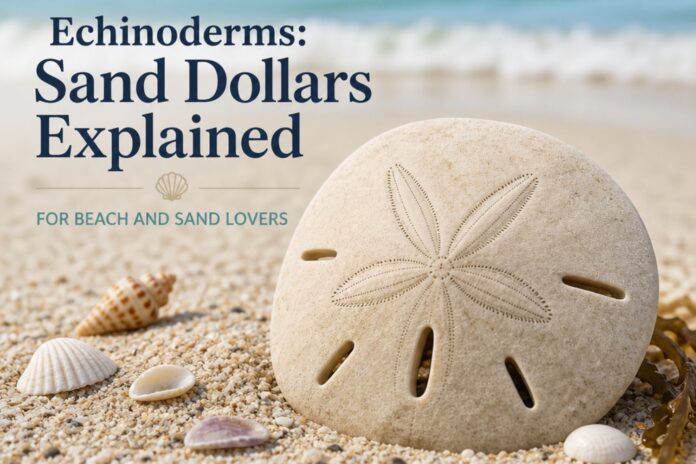
Their name comes from their coin-like shape, though they are not actually shells or coins. The “dollar” you may find washed up on the beach is usually the dried skeleton, called a test, and it is built from fused plates that are only bare and white once the animal has died and the sun and surf have done their work.
In life, sand dollars are covered in tiny velvety spines that help them move, burrow, and feed. Their bodies are much more colorful when alive, often appearing dark brown, purple, or reddish-gray rather than the bright white pieces people commonly collect on the shore. The mouth sits in the center of the underside, and the five petal shape on top is where it breathes.
Fun fact: Break an old test open and five small, dove shaped pieces rattle out. They are actually the animal’s jaw parts, a set of teeth called Aristotle’s lantern.
How Many Species of Sand Dollars Are There?
Sand dollars and their thicker cousins, the sea biscuits, belong to an order of about 250 species. They live in sandy shallows on nearly every continent, from cold northern bays to warm tropical flats. These are the ones you are most likely to meet:
- Eccentric sand dollar (also called the Pacific sand dollar), Dendraster excentricus: the sand dollar of Washington, Oregon, and California, usually found in dense beds. It is the only sand dollar along the Washington and Oregon coasts.
- Keyhole sand dollar (also called the five slotted sand dollar), Mellita quinquiesperforata: the Florida and Gulf favorite, with slots cut through the shell. It ranges from the Carolinas down through the Caribbean.
- Arrowhead sand dollar, Encope michelini: a Gulf of Mexico and Florida species with a notched, arrow shaped outline.
- Six holed sand dollar, Leodia sexiesperforata: a warm water species of Florida, the Caribbean, and the Gulf, with a ring of small holes.
- Common sand dollar, Echinarachnius parma: the sand dollar of cold northern waters, found in the North Atlantic and the North Pacific.
- Brown sea biscuit, Clypeaster rosaceus: a tall, rounded cousin that lives in Caribbean and Florida seagrass and sand.
- Pancake urchin, Arachnoides placenta: an Indo-Pacific sand dollar found around Australia.
How Do Sand Dollars Move?
With spines, not legs. Sand dollars are covered in thousands of tiny moving spines that act as little oars, and they push themselves forward through sand at roughly the pace of a very sleepy snail. The spines also help them tip, slide, and bury themselves. The slots (or lunules) cut through some species, like the keyhole sand dollar, are thought to help them hold to the bottom when waves roll across, and to help them bury quickly. Pacific sand dollars have a trick of their own. They stand on edge with the bottom third of their body buried in the sand, tilted into the current like a row of little sails, so the water brings the food to them. It is a farm of sideways discs, standing in rows, and when you see it at low tide you can’t un-see it.
What Do Sand Dollars Eat?
Sand dollars are gentle filter feeders, and their diet is part of what makes them so interesting.
They usually eat tiny food particles floating in the water or settled in the sand: diatoms, algae, and bits of organic matter drifting in the water or settled on the sand. They have no tentacles and don’t chase anything. Their spines and tube feet work together to catch particles and pass them along little grooves on the underside and move food toward the mouth, which is located on the underside of the body. This subtle feeding style makes them peaceful little recyclers of the sea floor.
Pacific sand dollars standing in a current let it deliver lunch. Those that live buried in the sand sift particles from the sand around them. Their jaws are small and strong enough that the animal can scrape and crunch food as it passes through, and nothing about a sand dollar’s diet is fast.
How Do Sand Dollars Reproduce?
By spawning, like most echinoderms. Males and females release eggs and sperm into the water, and the fertilized eggs become free swimming larvae that drift as plankton. This is where sand dollars get strange. Researchers found that Pacific sand dollar larvae can clone themselves when they detect the scent of a fish nearby, splitting off a smaller copy that is harder for a predator to spot. A larva that senses danger makes two of itself. After a while the larvae settle on the bottom and turn into the flat, round juveniles we know. Young Pacific sand dollars have another surprise: they swallow heavy, dark, iron rich grains of sand and use them as ballast, which helps keep them from being rolled around by the surf. A sand dollar can live close to a decade, and the growth rings on the test hold the record.
Sand Dollars and Sand: Why They Live Where They Do
Here is where I get to geek out. Sand dollars are built for one kind of address, and it is the one I care most about: clean, fairly fine sand that the waves keep moving.
Sand dollars are found in shallow coastal waters around the world, especially along sandy beaches and continental shelves. They prefer soft ocean bottoms where they can burrow and hide from predators and strong currents.
The flat disc shape is a wonderfully practical answer to the question of how to live in sand without being washed away. A thin, flat shell slides under the surface and lies close to the bottom instead of tumbling like a round object would. The fine spines let the animal glide through grains the way a hand glides through flour.
The zone matters too. Live sand dollars mostly stay in the subtidal sand and in the low tide flats, the wet, compacted sand at the edge of the water, where food keeps arriving. The dry sand above the high tide line is not the home. It is where the dead ones end up.
And the grain size is its own story. A beach of coarse, steep sand gets rolled too hard for them, so the big beds tend to sit on gently sloping flats of fine to medium grains that stay steady. So when you find a spot with sand dollars, you have found a place where the sand is calm enough to hold still for them. I think that is one of the best compliments a beach can get.
The Beautiful Test You Find on the Beach
When people find a white sand dollar on the beach, they often notice the delicate star-like pattern on the top side. This is one of the most beloved features of the animal. The design is not just beautiful; it reflects the sand dollar’s body structure.
The test is actually made of fused plates of calcium carbonate. Over time, after the animal dies, the skeleton dries, becomes bleached by the sun, and turns the pale white or light gray that beachcombers treasure.
Live or Dead? How to Tell, and Can You Take One Home?
This is the question everyone asks, and the answer is on the shell. A live sand dollar is brownish, purplish, or greenish, and covered in a velvety layer of fuzzy spines. It may feel like it’s gently moving or tickling your palm, and it can leave a yellowish stain on your hand. A dead one is white or pale gray, dry, bare, and brittle, and often has a few cracks. Dry and white means it is yours to enjoy, in most places. Anything fuzzy, dark, or moving should go back in the water, flat and gently, in the same place you found it. A live sand dollar can only last a few minutes out of water, and one that has already dried out will not recover.
The rules about taking a live one are layered, and they differ by place. State marine life rules, park rules, local ordinances, and protected areas all have a say, and many parks and sanctuaries ban removing anything alive. In Florida, check the FWC’s sea shell page and the park’s own rules before pocketing a living one. The simple, kind rule works everywhere: take home the white, empty ones, and leave the fuzzy ones to finish their lives.
Where to See Sand Dollars Around the World (and Where to Keep Them in the Sea)
Florida’s Gulf Coast
This is keyhole sand dollar country, and the Gulf beaches around St. Petersburg, Fort De Soto, and the Southwest Florida barrier islands are where many of us first learned what one looked like. Most of the whole white discs you find on the sand are empty tests that washed in. The living ones sit just offshore, in shallow sand, and the best view is wading or snorkeling in calm water. You can leave a live one where it is and still get a lovely look.
Florida’s Atlantic Coast and the Keys
Sand dollars show up on the Atlantic side too, along with the six holed sand dollar and the thicker sea biscuits in sandy patches near seagrass. The Florida Keys National Marine Sanctuary protects everything alive within its boundaries, so the Keys are strictly a look-don’t-take place for living animals.
The Pacific Northwest: Washington and Oregon
If you’ve only seen sand dollars in Florida, a Puget Sound low tide will rearrange your brain. Pacific sand dollars gather in beds on the sandy flats, and a single square yard can hold hundreds of them standing on edge. Washington protects most intertidal animals from harvest, and Oregon’s tide pool rules also bar collecting intertidal life, with very few exceptions. Look, photograph, and let the beds stay beds.
California
Pacific sand dollars range down the California coast into Baja. California requires a fishing license for most collecting, and marine protected areas generally allow no collecting at all, so the rules depend on exactly where you’re standing. The current regulations are on the California Department of Fish and Wildlife site, and checking before you bend down is part of the walk.
New England and the Canadian Maritimes
The common sand dollar, Echinarachnius parma, handles the cold. It lives in northern waters of the Atlantic, from roughly New England northward, and it turns up on cold, clean sand where you might never think to look for one.
The Caribbean
Keyhole and other warm water sand dollars live in the sandy shallows of many Caribbean islands, often beside seagrass, with sea biscuits close by. The best way to see them is the way you would see anything in the Caribbean: float over them and stay in the water. Many islands have their own protections, so ask a local guide what’s allowed.
Japan and Australia
Sand dollars aren’t an American thing. Japan has its own species living on the sandy bottoms of its coastal bays, and Australia’s coasts are home to the pancake urchin, which burrows in tropical and subtropical sand. If you are traveling, a beach walk at low tide with a local guide is often the best way to meet them.
A Symbol of the Sea
Sand dollars have become beloved symbols of the beach because they feel both delicate and mysterious. Many people associate them with peace, renewal, and the gentle rhythm of the ocean. Their beauty has inspired crafts, stories, and seaside traditions for generations.
For beach lovers, finding a sand dollar can feel like discovering a small message from the sea. It is a reminder of the life hidden beneath the waves and the quiet elegance of marine ecosystems.
Who’s Protecting Sand Dollars
Most sand dollar protection comes from place based rules rather than species based ones. The Florida Fish and Wildlife Conservation Commission sets the state marine life rules, and the Florida Keys National Marine Sanctuary protects living animals within its waters. On the Pacific coast, the Washington Department of Fish and Wildlife, Oregon Department of Fish and Wildlife, and California Department of Fish and Wildlife manage intertidal collecting. Beyond that, the most important protection is the one you control: telling a live sand dollar from a dead one before you pick it up.
Sand Dollar Curiosity Corner
Are sand dollars alive?
The white discs you find on the beach are empty skeletons, but the animals are alive when they’re fuzzy, brownish, purplish, or greenish, and covered in tiny moving spines.
Is a sand dollar an animal?
Yes. It’s an echinoderm, a flattened relative of the sea urchin, and it’s related to sea stars and sea cucumbers.
How can I tell if a sand dollar is alive?
Look at the color and the surface. Live ones are dark and velvety, with spines that may move against your palm, and they can leave a yellowish stain. Dead ones are white or pale gray, bare, dry, and brittle.
Is it illegal to take sand dollars from the beach?
It depends on where you are and whether the animal is alive. Empty, dry white ones are fine in most places, but taking live sand dollars is restricted by many states, parks, and sanctuaries. Check local rules first.
What do sand dollars eat?
Tiny particles: algae, diatoms, and organic bits drifting in the water or resting on the sand, which their spines and tube feet pass to the mouth underneath.
How do sand dollars move?
They glide slowly across and through the sand on thousands of tiny spines, and some, like the Pacific sand dollar, stand on edge in the current to catch food.
How many species of sand dollars are there?
The order that holds sand dollars and sea biscuits has roughly 250 species worldwide.
What is the difference between a sand dollar and a sea biscuit?
A sea biscuit is a thicker, more rounded cousin of the sand dollar. Both belong to the same order, but sand dollars are flat discs and sea biscuits look like little puffed loaves.
Are there sand dollars on the West Coast?
Yes. The Pacific, or eccentric, sand dollar lives from Washington and Oregon down through California, and it’s the only sand dollar along the Washington and Oregon coasts.
What are the white pieces inside a broken sand dollar?
They are the animal’s jaw parts, five small pieces known as Aristotle’s lantern. A popular beach legend turns them into doves, which is a nice story for a skeleton.
A Tiny Treasure Worth Knowing
Sand dollars are one of the ocean’s sweetest surprises: elegant, resilient, and beautifully built. As echinoderms, they remind us that the beach is full of living wonders, not just scenery. The next time you spot one near the tide line, take a moment to appreciate the story it carries.
From their graceful movement under the sand to the intricate star pattern on their skeletons, sand dollars truly are little masterpieces of the sea.
