




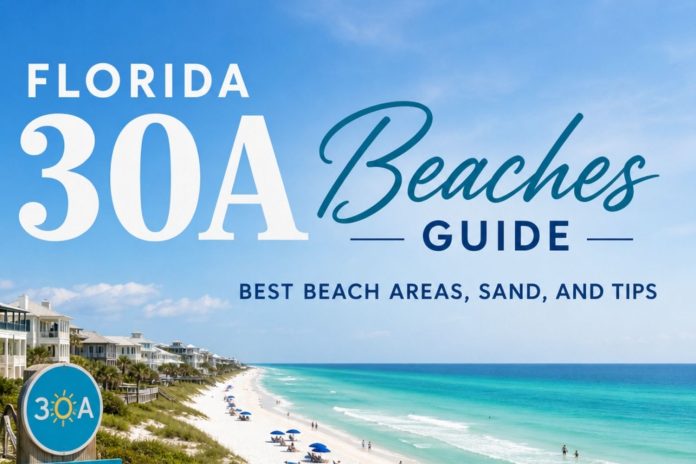
Florida’s 30A Beaches: The Complete South Walton Guide
Scenic Highway 30A runs 20 miles along the Gulf in South Walton County, and I’ll be honest with you: it’s one of the most fun stretches of Florida coast to walk. Sixteen planned communities, each with its own architecture and personality, are strung along the same quartz sand and emerald water, and the experience shifts noticeably every few miles. Bohemian one block, polished the next, then suddenly a quiet public access point between two gated communities where nobody’s around. It’s a stretch of coast that rewards curiosity more than almost anywhere I’ve walked in this state.
30A, officially Scenic Highway 30A or County Road 30A, is the two-lane highway that cuts through South Walton County between Topsail Hill Preserve on the west and Inlet Beach on the east, where it rejoins US 98 near Panama City Beach. Everything on this stretch is in Walton County, which means it falls under a set of development standards and community design requirements that produced something you won’t find anywhere else on the Florida Gulf Coast: a coherent corridor of walkable, bikeable, architecturally distinctive beach towns, each with its own character, and all of them sharing the same white quartz sand and emerald water.
The 16 communities along 30A range from the tiny and local, like Dune Allen Beach at the western end, to the nationally known, like Seaside, which was the first New Urbanist town in America and served as the filming location for The Truman Show. What they all share is proximity to one of the rarest geological features on earth: coastal dune lakes. Walton County holds 15 of approximately 30 of these freshwater lakes in the world, bodies of water that sit just behind the dune line and occasionally overflow through the sand to connect with the Gulf. Watching that happen at any of the lake outfall zones along 30A is one of the more extraordinary things the Florida coast has to offer, and most people driving through never notice it.
In this guide I’m covering every distinct stretch of 30A from east to west, including my personal favorites and the spots most visitors overlook. I’ll go deep on the sand and water that make this entire corridor worth visiting, score it across all the categories that matter, and give you my honest read on who 30A is built for and where you’d be better off on a different stretch of coast. I also close with my own take on which communities along here I keep coming back to.
The Vibe and Culture of Florida’s 30A
Sixteen Communities, One Corridor, Zero Sameness
The thing I keep telling people about 30A is that there’s no single vibe here. There’s a Seaside vibe, a Grayton vibe, an Alys Beach vibe, and they feel genuinely different from each other even though you can bike between them in 20 minutes.
What holds it together is the road itself. 30A runs low and slow, two lanes, speed limit 35, lined with live oaks and slash pines in the interior sections and pastel-painted communities at the waterfront. Biking it from one end to the other takes the better part of a day and gives you a moving panorama of what happens when a lot of creative people spent decades trying to design beach towns from scratch. Some of them got it right. Some of them got it very right. A few of them got so right that other beach towns started copying them.
The overall tone of 30A skews toward families and couples with money to spend on a beach vacation, and the real estate prices reflect that: 30A is one of the most expensive vacation rental markets in the Southeast, with a week in a Gulf-front home running anywhere from a few thousand to tens of thousands depending on the community and the season. But spending money here isn’t required for a good time. The beach access points are public, the Timpoochee Trail is free to ride, and a coffee and a walk through Seaside costs whatever you spend on the coffee. The outdoor dining tables and the food trucks and the town squares are open to everyone who shows up.
The arts culture is real and not decorative. Grayton Beach has had working galleries and art studios for decades, long before 30A became a design destination. The 30A Songwriters Festival runs every January and draws serious national talent to small venues across the corridor. You’ll notice this in the kind of creative, expressive energy that turns up at the free events and the local restaurants even in the off-season. It’s not beach art at the boardwalk shop level. It’s people who actually live here making things.
Seasonally, 30A has a stronger rhythm than most Panhandle destinations. Spring break brings families and college crowds, especially to the eastern communities closer to the Destin corridor. Summer is full capacity: the rental market is at its ceiling, Seaside’s town square is at its most buzzing, and the beach is as populated as it gets while still feeling less crowded than Destin or Panama City Beach. Fall is my favorite window here, specifically September and October when the water is still warm, the crowds have thinned, and the restaurant reservations stop being necessary. Winter on 30A is quiet and beautiful, and the January Songwriters Festival makes early winter worth the trip specifically.
Florida’s 30A Beach Communities: A Guide to All 16 Stops from East to West
The 30A corridor runs east to west across South Walton County, and the character shifts significantly as you move along it. I’m covering the major communities in sequence, grouping smaller ones together where they share a similar feel, so you can plan your day or your week knowing what you’ll actually find at each stop.
Inlet Beach, Rosemary Beach, and Alys Beach
Eastern 30A: The Upscale Design Corridor
Inlet Beach sits at the far eastern end of 30A where the highway meets US 98 again. It’s less formally designed than the communities further west, and it has a more accessible, slightly more local feel as a result. The beach access here is public and relatively uncrowded, with the wide white quartz sand and clear Gulf water that runs the whole corridor. It’s a good entry point for a 30A trip, and the proximity to Pier Park and the Destin/Fort Walton Beach service corridor means you have more hotel and dining options nearby than anywhere further west on the road.
Rosemary Beach is where 30A’s design intentions become unmistakable. The community pulls from Dutch West Indies and Caribbean architectural influences, with stucco finishes, wood shutters, cobblestone streets, and courtyard homes that feel more like a European village than a Florida beach town. The boardwalks and footpaths through the neighborhoods are designed for pedestrians, not cars, and the intimacy of the layout means you can walk from your front door to the beach in minutes without crossing a main road. The Pearl Hotel anchors the social scene, with rooftop bar Gulf views that make it worth a stop even if you’re not staying there. The beach itself is reached through a series of wooden walkovers that protect the dune system, and the sand is the same excellent quartz you’ll find along the whole corridor.
Alys Beach is 30A at its most architecturally austere. Where Rosemary Beach is warm and European, Alys Beach is all-white, geometric, and walled. The homes are compounds with private courtyards, more Mediterranean than Caribbean, and the design language is deliberate enough to look like a movie set. The beach access is elegant and the sand is excellent, but Alys Beach is the least porous of the 30A communities for a casual day visitor. You’re welcome on the beach and the paths, but you’ll feel the private community character more here than anywhere else on 30A.
Seacrest Beach and WaterSound
The Quieter Middle East
Seacrest Beach sits just west of Alys Beach and has a quieter, more family-residential feel than its polished neighbor. The community is walkable with a tidal pool feature that draws families with small children, and the beach access is easy without the design formality of Alys Beach or Rosemary Beach. The sand is the same excellent quartz, the water is the same emerald, and the crowd is noticeably less designer-adjacent. Seacrest is where you go if you want the 30A beach without the 30A performance of it.
WaterSound Beach is a gated community with access primarily for residents and guests, but the beach on its Gulf side shares the same shoreline as the public access points on either side. What sets WaterSound apart geographically is its position next to Deer Lake State Park, a small Florida State Park protecting another of the 30A coastal dune lakes. The Deer Lake area is one of the more ecologically active sections of the corridor, with great shorebird activity around the lake outfall zone and the dune scrub vegetation that grows between the lake and the Gulf.
The WaterSound area captures what I love about the middle sections of 30A: the planned communities run close together but the dune lakes and natural corridors between them create gaps in the development that let the landscape breathe. If you walk the beach rather than drive the road, you pass through these transitions constantly, going from manicured community boardwalk to wild dune grass to community boardwalk again. It gives the walking experience a rhythm that the road driving doesn’t communicate.
Seagrove Beach and Walton Dunes Beach Access
Old Florida Lives Here
Seagrove Beach is one of the oldest beach communities on 30A, and it shows in the best possible way. The architecture is organic rather than designed: original Gulf-front cottages mixed with newer vacation homes, old oak trees shading the street level, and a community that feels like it grew up rather than was planned. The beach access points here are simple, with small parking areas and wooden walkovers over well-maintained dunes. The beach itself is just as wide and white as anywhere else on 30A, but Seagrove has never had the designed-community overlay, and you feel that in how relaxed everything is.
Walton Dunes Beach Access sits within the Seagrove Beach area, tucked at the end of a residential street called Beachfront Trail. There’s limited parking, no amenities, and no commercial activity in any direction, which is exactly why I love it. The access point puts you right at the Gulf with Eastern Lake just behind the dunes. Eastern Lake is one of the coastal dune lakes that occasionally overtops its sand barrier and runs directly to the Gulf, and the spot where that happens is one of the more visually spectacular things I’ve seen along this entire stretch of coast. Fresh water moving through the dune face and fanning out in a delta pattern into the turquoise Gulf, with birds working both sides of the fresh-salt junction. Watching that is free, it’s accessible, and almost nobody who drives 30A in a car ever sees it.
The Seagrove and Walton Dunes stretch is where old Florida still lives between the planned communities, and it’s worth seeking out specifically. You’re not going to find a food truck or a town square here. You’re going to find quiet sand, a dune lake that sometimes opens to the sea, and the realization that the most interesting things on this corridor are often the ones without a sign pointing to them.
Seaside
The Town That Started It All
Seaside is the community that turned 30A from a local beach road into a national design destination. Built in 1981, it was the first town in America planned under New Urbanist principles: walkable streets, mixed-use buildings, front porches and picket fences, and everything oriented toward foot traffic rather than cars. It also became famous beyond architecture circles as the set for The Truman Show, which means a lot of visitors show up with a specific visual memory of the place and find it mostly accurate. The pastel houses and white picket fences and the town square are all real.
The beach at Seaside is reached through a series of architecturally distinctive pavilions, each designed differently, each framing the Gulf view as you walk through. My personal favorite is the central Seaside Pavilion, which takes the most minimalist approach and just opens the frame straight to the water. The beach here is well-used but wide enough to absorb the crowd, and the emerald water on a calm summer morning looks exactly like every photo you’ve ever seen of it. Seaside’s town square is directly across 30A from the beach, with Amavida Coffee and Tea opening early, Airstream Row food trucks running lunch and dinner, and the amphitheater hosting free events throughout the summer and fall. The Saturday farmers market is a morning institution.
What I appreciate about Seaside beyond the architecture is that it has a genuine community pulse. The town was designed to make you want to be outside and near other people, and it works. The evening energy around the town square, with families on blankets in the amphitheater and kids running between the food trucks, is the kind of thing beach towns talk about creating and rarely actually achieve. Seaside achieved it and has held it for four decades. Go for the architecture, stay for the evening.
WaterColor
Resort Amenities with a Nature Backstory
WaterColor is the most resort-like of the 30A communities, built around the WaterColor Inn and Resort and a network of neighborhood homes with managed amenities. The design here is more contemporary than Seaside’s neo-traditional style, and the community sits directly adjacent to Grayton Beach State Park on its western edge, which means the natural landscape bleeds into the community character in a way you can feel. The WaterColor Boat House on Western Lake is where you rent a kayak or paddleboard to get onto the lake, and Western Lake is worth every minute of it: the water is calm and reflective, herons work the shoreline, and the boundary between the lake and the Gulf is just a dune-width away.
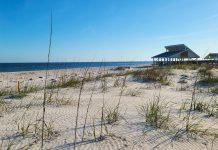
The beach at WaterColor is reached through nature-forward walkways that weave through coastal scrub and feel more like a nature trail than a resort path. The boardwalk over the dunes gives you the same dual view that appears throughout 30A: dune landscape behind you, Gulf stretching out ahead. The crowd here leans toward couples and families staying at the Inn or in the vacation homes, and the beach has a managed, well-kept quality that reflects the resort investment in the property.
WaterColor occupies an interesting position on 30A: it’s the bridge between the Seaside-Rosemary design world to the east and the more organic, older-Florida feel of Grayton Beach just to the west. You can see both personalities from a single bike ride through the community, and if you’re only going to stay in one place on 30A for a week, WaterColor is a competitive choice for combining resort service with quick access to both the designed corridor and the state park.
Grayton Beach
Old Soul, Artsy Heart, Best Dune Lake
Grayton Beach is my personal favorite on the whole corridor, and I’ll tell you exactly why. The town doesn’t try to be anything. It has sandy streets and quirky cottages and old live oaks and original beach houses that predate the whole 30A design movement by decades. You’ll see metal sculptures wired into someone’s fence. You’ll see a beach bar with a handwritten menu and a line out the door because the food is genuinely good. You won’t see a cobblestone streetscape or a style guide enforced by an HOA.
The beach at Grayton is wide and the sand is the same excellent quartz as everywhere else on 30A, but the community backing it has soul in a way that’s harder to find the further east you go. Grayton is also one of the most dog-friendly communities on the corridor, and the crowd reflects that: dogs on leashes, families who’ve been coming here for years, and a relaxed culture of people who seem to have collectively agreed to take the day slowly. Grayton Beach State Park protects a substantial stretch of natural beach just west of the community and offers cabins and camping for overnight stays in a setting that looks nothing like the resort corridor to the east.
Western Lake is what sets Grayton apart geologically. The lake sits directly behind the dunes, one of the largest coastal dune lakes along 30A, and it periodically breaches through the dune face to connect with the Gulf in a merging of fresh and salt water that draws wildlife and curious walkers in equal measure. Paddling Western Lake at sunrise is one of those experiences that doesn’t photograph well but stays with you after. Herons and egrets in the still water, the dunes white on one side, the cypress trees on the other, and the sound of the Gulf just over the sand rise.
Blue Mountain Beach, Gulf Place, and Dune Allen Beach
Western 30A: Where the Local Personality Comes Through
Blue Mountain Beach sits on a bluff that rises roughly 65 feet above sea level, the highest point on the Gulf Coast east of Mexico. That elevation gives Blue Mountain Beach a different relationship with the dune landscape than any other community on 30A: the drop from the road to the waterline is more dramatic, the views from the bluff edge are longer, and the natural character of the landscape is more pronounced because the topography is working harder. The crowd here is noticeably more local and more relaxed than the eastern design corridor, and the beach access is simple and uncrowded even on weekends.
Gulf Place is a small planned community with a free-spirited character that sets it apart from the more formal design of Rosemary Beach or Alys Beach. The shops lean artistic: galleries, hand-crafted furniture, surf and yoga studios. Café Thirty-A has been a local institution here long enough to count as essential 30A culture. The beach access at Gulf Place is easy and uncrowded, and the vibe is closer to the Grayton Beach personality than to the polished eastern end of the corridor.
Dune Allen Beach is the westernmost community on 30A before the highway transitions into the park land around Topsail Hill Preserve State Park. Allen Lake, a coastal dune lake at the western end of the corridor, sits just behind the dunes here and represents one of the most accessible and peaceful spots to watch the dune lake ecosystem doing its thing. The beach at Dune Allen is quiet, the crowd is mostly local, and the entire vibe of this western end of 30A is one of the corridor shedding its designed-community self and returning to the natural landscape that started all of this in the first place.
Florida’s 30A Rankings: Expert Scores Across 11 Categories
These scores weigh the entire 30A corridor. The corridor has genuine range: the most polished communities score differently than the quiet access points, so these scores represent the honest average across the full 20-mile stretch.
Sand Quality
9/10
Near-pure white quartz, fine to powdery, consistent across the full corridor. The same ancient Appalachian erosion formation that built Pensacola Beach and Perdido Key runs through here without interruption. The dune preservation standards enforced along 30A keep the sand in better condition than most Panhandle public beaches.
Hiking and Beach Walking
9/10
The 19-mile Timpoochee Trail runs the length of 30A for biking and walking, connecting every community from Topsail Hill to Inlet Beach. The beach walking is uninterrupted for long stretches between communities, with the coastal dune lake outfall zones adding genuine ecological interest at multiple points along the route.
Shelling at 30A
6/10
Moderate overall and inconsistent. The best shelling happens at the quieter access points between communities, particularly in the Seagrove Beach and Walton Dunes stretch and the western Dune Allen end. After a storm or northeast wind the wrack line improves significantly across the whole corridor.
Water Conditions
8/10
Emerald to turquoise on calm days, with the quartz seafloor contributing to the famous color shifts. Generally calm to moderate surf, gradual entry, and warm water through October. Lifeguards are present only at Seaside and at the state parks; most 30A beach accesses are unsupervised.
Scenery and Natural Beauty
9/10
One of the most visually varied stretches of Florida Gulf coast. The planned communities add architectural interest behind the dunes while the dune lakes, state parks, and natural access points provide wild landscape in between. The corridor’s development standards have kept high-rise buildings off the beachfront in a way that almost no other developed stretch of the Panhandle has managed.
Birding and Wildlife
8/10
Fifteen coastal dune lakes along the corridor support osprey, herons, egrets, and a wide variety of migratory species. Sea turtle nesting runs May through October on the Gulf beach sections. Grayton Beach State Park and Deer Lake State Park add protected habitat that feeds directly into the wildlife activity on the adjacent beach and lake sections.
Family Friendliness
9/10
30A is primarily a family vacation destination. The walkable planned communities, bike-everywhere infrastructure, seasonal lifeguard coverage at Seaside, calm Gulf water, and the abundance of family-sized vacation rentals make this one of the most family-built stretches of coast in Florida. Seaside especially is designed for families to live without cars for a week.
Dog Friendliness
7/10
Dogs are permitted on most 30A public beach accesses on a leash. Grayton Beach is the most welcoming community on the corridor for dogs. Individual private communities like Rosemary Beach and Alys Beach may have their own rules. State park beaches at Grayton Beach State Park do not allow dogs. Check rules at each specific access point before bringing your dog to the beach.
Solitude and Peace
7/10
Highly variable by location. Seaside in July feels like a city park. The Walton Dunes access point on a Tuesday in September feels like the world ended. The corridor’s range means you can find genuine quiet by walking away from the community centers or by choosing the less-trafficked western communities. The score reflects the full range, not just the busy sections.
Entertainment and Nightlife
8/10
Seaside’s town square, amphitheater events, and food truck rotation; Grayton Beach’s Red Bar with live music; Gulf Place’s Café Thirty-A; the 30A Songwriters Festival in January; and the WaterColor resort scene all add up to a corridor with considerably more cultural and evening activity than a typical Florida beach community. Not nightlife in a party-beach sense, but genuinely lively in a cultured way.
Parking and Beach Access
6/10
The single biggest friction point on 30A. Parking is genuinely limited throughout the corridor, with most communities designed for residents on bikes and guests in vacation rentals rather than day visitors in cars. Public beach access points often have fewer than 10 spaces. The Timpoochee Trail is excellent for getting around without a car if you’re staying on the corridor. First-time day visitors who drive should arrive before 9 AM or expect to park on US 98 and bike in.
30A Sand & Water
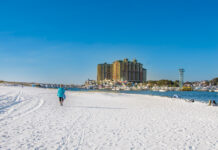
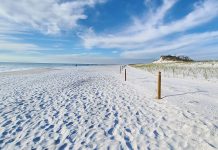
The sand along 30A is about as soft and forgiving as beach sand gets, a fine, powdery white that feels close to sugar when it’s dry. Up near the dunes it’s deep enough to slow you down and work your calves a little, while the packed sand right at the water’s edge firms up nicely for a long walk, a game of beach volleyball, or a round of catch with the kids. It holds a sandcastle reasonably well once you add some water from the wash, though the dry sand higher up the beach is too fine and loose to shape on its own. Overall, it’s wide, flat, and easy on your feet nearly the entire twenty miles, whether you’re walking a mile at Grayton Beach or setting up a whole day of chairs and umbrellas at Seaside.
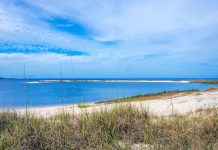
On a calm day, the water goes from a pale turquoise right at your ankles to a rich emerald a little further out, clear enough most of the year that you can see your own feet in waist-deep water. The entry is gradual almost everywhere on this corridor, no sudden drop-offs to worry about, which makes for an easy, comfortable swim at almost any confidence level. It isn’t always postcard-perfect though. After a storm or a stretch of onshore wind, the water can turn cloudy and olive-toned for a couple of days, and rip currents become a real risk during and after any weather event. Lifeguards are only posted at Seaside and the three state parks, so check the beach flags before you swim anywhere else on 30A.
-
Walkability. Wide, flat sand and the Timpoochee Trail running alongside make this one of the easiest beaches in Florida to just keep walking, mile after mile, without hitting a rocky patch or a steep drop.
-
Softness & Playability. Soft enough for sandcastles with a splash of water, forgiving enough for barefoot football, frisbee, or a long afternoon of digging with the kids on the packed sand.
-
Barefoot Comfort. Cool white quartz keeps the sand comfortable underfoot most of the year, though the dry sand right at the boardwalk exits can get genuinely hot on a July afternoon.
-
Swimmability. Gradual entry and generally calm water make for an easy swim in season, just check the flags first since lifeguards only cover Seaside and the state parks.
Want the full geology, grain composition, and the complete sand and water condition ratings? I broke it all down separately in Sand & Shore: 30A.
Dogs & Pet Accessibility
Are Dogs Allowed on the Sand? MOSTLY YES, WITH THREE CLEAR EXCEPTIONS.
Leashed dogs are welcome at most of 30A’s public and regional beach accesses. The exceptions are the three state park beaches on the corridor, which prohibit dogs on the sand to protect nesting shorebirds and sea turtles.
Where Dogs Are Allowed
- ✓Grayton Beach, the community itself (not the state park), widely regarded as the most consistently dog-friendly beach on the whole corridor.
- ✓Most Regional and Neighborhood Beach Accesses along 30A, on a leash. Individual private communities like Rosemary Beach, Alys Beach, and WaterSound may layer on their own rules, so confirm locally if you’re staying inside one of them.
- ✓Inland nature trails at Deer Lake State Park and Topsail Hill Preserve State Park, leashed.
- ✓The Topsail Hill Preserve campground, leashed.
Where Dogs Are NOT Allowed
- ✗The beach at Grayton Beach State Park.
- ✗The beach and boardwalk at Deer Lake State Park.
- ✗The beach at Topsail Hill Preserve State Park.
Paws on the Ground Reality
If your dog is the whole reason you’re picking a beach, base yourself at Grayton Beach. It’s flat, easy walking, genuinely welcoming, and close enough to the state park that you can still get a longer inland trail walk in on the days your dog needs to stay leashed on hardpack rather than hot open sand. Bring your own fresh water wherever you go, most access points don’t have a dog-specific water source.
Plan around the three state parks if a beach day with your dog is the priority. They’re worth visiting for the trail systems and the dune lakes, just not for a day of sand time with your dog at your side.
Crowd Levels and the Overall Feel of Florida’s 30A
The crowd along 30A is more varied than the corridor’s upscale reputation suggests. At Seaside in July you’ll find families from across the Southeast who booked their vacation rentals a year in advance and paid accordingly. At the Walton Dunes Beach Access on the same day you’ll find two people and some shorebirds. The corridor contains both of those experiences within a few miles of each other, and your 30A trip looks entirely different depending on which version you seek out.
The communities closest to the Destin corridor on the eastern end draw a slightly broader crowd than the Grayton Beach and Seaside communities. The parking challenge naturally filters the crowd toward committed visitors who stay on the corridor rather than day-tripping in. That filtering works in 30A’s favor: the beach generally feels less crowded than comparable sand and water quality elsewhere because the access friction keeps casual visitors at the more convenient Destin and Okaloosa Island beaches instead.
The seasonal shape of 30A runs like this:
- Spring break: the eastern communities and Seaside fill fast with families. The western end stays relatively quiet by comparison. Rental prices are at their annual high.
- Summer: full capacity across the corridor. The town squares, food trucks, and beach access points are at their most active. Parking is at its worst.
- Fall: the best window by almost every measure. Water stays warm through October, crowds thin dramatically after Labor Day, and the Seaside Amphitheater events continue on a lighter schedule. Fall driving on 30A with the windows down is genuinely one of the better ways to spend an afternoon.
- Winter: quiet and local, with the January 30A Songwriters Festival providing a concentrated burst of cultural energy at the beginning of the year.
Who Is 30A Really For?
✓ Who Will Love Florida’s 30A
-
Families who want a week-long beach vacation in a community designed for walking, biking, and not needing a car for anything: 30A is essentially designed for this
-
Architecture and design enthusiasts who want to see what New Urbanism and intentional community planning look like actually built and lived in across 16 different iterations
-
Nature-minded visitors who want the same white quartz beach but with coastal dune lakes, state park habitats, and birding opportunities built into the corridor
-
Cyclists and walkers who want a multi-day adventure along the 19-mile Timpoochee Trail through communities and natural landscape
-
Anyone interested in the arts and music scene, from Grayton’s galleries to the Songwriters Festival, who wants culture built into a beach vacation rather than bolted on as an afterthought
-
Couples who want to move between an upscale dinner in Rosemary Beach, a casual evening at the Grayton Red Bar, and a quiet morning on a nearly empty stretch of sand, all without leaving one beach destination
✗ Consider Another Beach If…
-
You’re a day-tripper who wants to park at the beach and walk straight to the water. Parking on 30A is genuinely difficult, and most of the corridor is designed for people staying in vacation rentals, not driving in from elsewhere.
-
You want a budget beach vacation. 30A vacation rental rates are among the highest in Florida. Day use is affordable, but staying on the corridor for a week is a significant investment.
-
You want a lively nightlife and bar scene in the Destin sense. 30A’s evening culture is restaurants, amphitheater events, and the Red Bar. It’s not the Pensacola Beach boardwalk.
-
You’re expecting lifeguard coverage at your specific beach access. Lifeguards are at Seaside during the season and at the state parks, and nowhere else on the 30A stretch.
-
You want the amenities of a traditional full-service beach resort with activities, chair rentals, and food service on the sand. Most 30A beach accesses are simple walkovers with no services.
Things to Do on Florida’s 30A
30A’s activity list is significantly wider than a typical beach corridor because the planned communities and natural areas each contribute their own offerings.
-
Biking the Timpoochee Trail. The 19-mile multi-use trail runs the length of 30A from Topsail Hill Preserve to Inlet Beach. Biking the full length takes the better part of a day and passes through every community and most of the natural landscape in between. Bike rentals are available at multiple points along the corridor. This is the best way to experience the full range of 30A in a single day.
-
Beach Walking. The full Gulf shoreline is walkable for miles in either direction from any access point. The most interesting beach walks incorporate the coastal dune lake outfall zones, particularly at Eastern Lake near Walton Dunes and Western Lake near Grayton Beach. The beach between Seagrove Beach and Grayton runs especially long and quiet and is one of the best morning walks on the Panhandle.
-
Kayaking and Paddleboarding the Coastal Dune Lakes. Western Lake at WaterColor and Grayton Beach, Eastern Lake near Walton Dunes, and Allen Lake near Dune Allen are all accessible for paddling. Rentals are available at WaterColor Boat House and from several outfitters along the corridor. Paddling at sunrise on Western Lake with the dunes glowing on one side and the cypress trees on the other is the single best thing you can do on 30A that doesn’t involve sand.
-
Exploring the Planned Communities on Foot. Walking through Rosemary Beach, Alys Beach, and Seaside at leisure is an architectural experience worth doing slowly. Each community has a different visual language and a different relationship to the beach. Seaside’s town square, Rosemary Beach’s cobblestone streets, and Alys Beach’s all-white compounds are all worth half a morning each to explore properly.
-
Grayton Beach Art Galleries and Studios. Grayton Beach has been an art community longer than it’s been a design destination, and the galleries here are the real kind, not the beach souvenir kind. Walk the neighborhood streets and look for metal sculptures, gallery signs, and studio openings. The Red Bar doubles as a gallery and a live music venue and is the single most authentic cultural destination on the whole corridor.
-
Seaside Farmers Market. Every Saturday morning at the Seaside amphitheater area. Local produce, handmade goods, prepared food, and a genuinely social atmosphere that feels like the town square doing what it was designed to do. Worth getting there before 9 AM when the best vendors still have product.
-
Sea Turtle Nesting Season Programs. Sea turtles nest along the 30A Gulf beach from May through October. The South Walton Turtle Watch program runs nesting surveys and educational programs during nesting season. Check the South Walton Tourist Development Council’s calendar for specific events. Leave all beach equipment off the sand by sunset during nesting season.
-
30A Songwriters Festival. Held annually in January, this multi-day festival brings nationally known and emerging songwriters to small venues across the corridor. The intimate scale of the venues, the quality of the performers, and the off-season timing combine to make it one of the more distinctive music experiences in the Southeast. It’s worth building a trip around specifically.
-
Shelling the Quiet Access Points. The beach between communities and at the western end of the corridor at Dune Allen and around the dune lake outfall zones holds the best shelling material on 30A. After a northeast wind or a storm, the wrack line at Walton Dunes and the Seagrove area delivers the best finds. Bring a mesh bag and plan to stop repeatedly.
-
Birding at Grayton Beach State Park and Deer Lake State Park. Grayton Beach State Park and Deer Lake State Park protect coastal scrub and dune lake habitat that supports a wide range of shorebirds, wading birds, and migratory species. Both parks are part of the Great Florida Birding Trail and offer trail access into the interior habitat beyond the beach. Ospreys, herons, snowy plovers, and migrant warblers in season are reliable sightings.
Local Knowledge and Practical Advice
A few things I’ve picked up walking the full 30A corridor that would have saved me time or changed my plans if I’d known them first:
-
Parking and traffic are the biggest challenges on 30A. If you’re staying on the corridor, you won’t need a car most of the time. If you’re day-tripping, arrive before 9 AM in summer or plan to park on US 98 and bike in on the Timpoochee Trail. The public beach access points along 30A typically have 6-10 spaces each. They fill by mid-morning on any day between Memorial Day and Labor Day.
-
Renting a bike is worth it even for just one day. The Timpoochee Trail makes the whole corridor accessible without a car. You’ll see things biking that you can’t see driving: the transitions between communities, the natural corridors between the dune lake access points, the neighborhoods between the main streets. Most communities have bike rental shops, and rates are reasonable for full-day rentals.
-
Check the beach flag system before you swim anywhere on 30A. The South Walton flag system posts conditions at access points across the corridor. Flags are updated based on current conditions. Single red flag means high hazard and strong rip currents. Double red means the water is closed. This is especially important because lifeguard coverage is limited to Seaside and the state parks; every other access point is unsupervised.
-
Dogs are generally welcome on 30A beaches with a leash, but check community rules. The general South Walton rule permits dogs on leash at most public beach access points. Individual private communities may have their own restrictions, and Grayton Beach State Park does not allow dogs on its beach. Grayton Beach town beach is excellent for dogs and has been for decades. If you’re dog-dependent on your beach day, base at Grayton.
-
The dune lake outfall zones are the most interesting spots on the corridor. When a coastal dune lake overfills and breaches through the dune face, you’ll see discolored water and a small delta pattern at the breach. This happens at multiple lakes along the corridor and the timing is determined by rainfall and lake water levels. Eastern Lake near Walton Dunes and Western Lake near Grayton Beach are the most accessible. If you see it happening, stop and watch. You’re looking at a geological feature found in fewer than 30 locations worldwide.
-
The best 30A experience starts early. Seaside at 7 AM feels completely different from Seaside at 11 AM. The beach walks before 9 AM at the Walton Dunes and Seagrove sections routinely deliver the kind of empty shoreline that the photos of 30A always show but that midday visitors rarely find. Get up early, make your coffee, and walk before the tram traffic starts.
-
Sea turtle nesting season runs May through October. Remove all beach furniture, tents, and umbrellas from the sand by sunset. If you’re on the beach after dark, use a red-filtered flashlight only. Turtle nesting signs are posted along the corridor at active nests. The South Walton Turtle Watch program posts updates on the current season’s nesting activity.
-
The 30A Songwriters Festival in January is worth planning a trip around. Held annually in the first or second week of January, the festival uses small venues across multiple communities for an intimate music experience that feels nothing like a typical festival. Hotel and rental rates are at their annual low, the weather is mild, and the cultural energy of the event makes January one of the best times to see 30A’s community character without the summer pressure.
-
Grayton Beach State Park requires a separate day-use fee. The state park at Grayton Beach charges $5 per vehicle for day use and offers a beach experience distinctly different from the community beaches: no development visible from the waterline, no food service, no rental chairs. Camping and cabin reservations go through the Florida State Parks system and fill well in advance for summer dates.
-
No chain restaurants are permitted in most 30A communities. This isn’t an accident: South Walton’s development standards actively restrict chain commercial development to keep the local food culture intact. What that means for visitors is that every restaurant on 30A is locally owned, and the range is genuinely good. Budget an evening for a sit-down dinner at Seaside or Rosemary Beach. Budget another for the Red Bar at Grayton.
Where to Stay on Florida’s 30A
30A is primarily a vacation rental market, and that shapes the lodging experience more than anywhere else in Florida I’ve covered. Here’s how the options break down.
Vacation Rental Homes Across the Corridor
The dominant lodging type on 30A is the vacation rental home, ranging from two-bedroom cottages in Seagrove Beach to large Gulf-front houses in Rosemary Beach and WaterColor. The corridor’s walkable community design means that where you stay determines which community you live in for a week, and that choice significantly shapes your experience. Choose Grayton Beach for the bohemian arts vibe, Seaside for the designed community experience, Rosemary Beach for European architectural character and upscale dining, or Dune Allen for the quietest version of 30A. Book early: the summer season at desirable properties fills six to twelve months in advance.
WaterColor Inn and Resort
The WaterColor Inn is the primary full-service hotel on the corridor, offering resort amenities including pools, the WaterColor Boat House on Western Lake, and direct access to the adjacent beach and Grayton Beach State Park. It’s the most comprehensive lodging option for visitors who want hotel service rather than a vacation rental, and the location between WaterColor and Grayton Beach puts you in the corridor’s most interesting stretch geographically. Rates run premium in-season.
Grayton Beach State Park Camping and Cabins
Grayton Beach State Park offers tent and RV camping plus furnished cabins within the park. Camping here puts you inside a state park with protected beach on one side and coastal scrub trail access on the other, all within walking distance of the Grayton Beach community. Reserve through the Florida State Parks system well in advance for summer dates. This is one of the most affordable overnight options on the corridor and one of the most experientially distinctive.
Budget Options: US 98 and Freeport
For significantly lower rates, the US 98 corridor between Destin and Panama City Beach runs a full range of budget to mid-range hotels within 10-15 minutes of the 30A access points. The town of Freeport, north of 30A on US 331, offers more affordable options for visitors who want to day-trip to the corridor. Neither option gives you the walkable community experience of staying on 30A, but both are workable for tight-budget visitors who primarily want the beach.
Nearby State Park Camping at Henderson Beach
Henderson Beach State Park in Destin, about 20 minutes west at the junction of US 98 and 30A, offers campground facilities with beach access at a state park price point. The park has its own protected dune beach and is a strong option for visitors who want a camping-based trip that also allows easy bike or car access to the 30A corridor.
What Makes Florida’s 30A Different from Other Panhandle Beaches
30A sits on the same quartz sand formation as every other Panhandle beach from Perdido Key to Panama City, but it’s the unique communities with several specific features that make it a distinctly different experience from anything else on this coast.
The coastal dune lakes exist almost nowhere else in the world
Walton County holds 15 of the approximately 30 coastal dune lakes documented globally. These freshwater lakes sit behind the dune line and periodically connect with the Gulf when they overfill. That ecological feature is not decorative: the lakes support bird life, fish populations, and rare plant communities, and the outfall zones where lake water meets Gulf water are genuinely extraordinary spots that no other stretch of the Florida coast can replicate.
The design experiment is real and it worked
Sixteen communities, each with its own architectural language, built over four decades along a 20-mile stretch of highway. You can see the progression from Seaside’s 1981 New Urbanist founding principles through the Caribbean-European synthesis at Rosemary Beach to the contemporary resort aesthetic at WaterColor to the all-white minimalism at Alys Beach. No other beach corridor in Florida offers this as a walking and biking tour through architectural history.
The Timpoochee Trail makes it a complete destination
The 19-mile multi-use trail connects every community on the corridor and makes 30A accessible without a car in a way that almost no other Florida beach destination can claim. You can base in one community and bike to every other in a single day. This fundamentally changes what a beach vacation here feels like.
No chains, no high-rises, no conventional resort infrastructure
South Walton’s development standards have maintained a corridor without chain restaurants, high-rise condos, or resort row infrastructure. Every restaurant is locally owned. Every community has building height limits and design standards. The result is a beach corridor that has held its character across four decades of increasing development pressure on both sides.
Florida’s 30A vs. Other Panhandle Beaches
30A vs. Destin
Destin has the same quartz formation and comparable sand quality, particularly at Henderson Beach State Park. Destin is more commercial, easier to navigate by car, and has a broader range of dining and hotel options at every price point. 30A has more architectural intentionality, the dune lakes, the no-chain restaurant policy, and a fundamentally different relationship between the beach and the community behind it. Choose Destin if you want convenience. Choose 30A if you want character.
30A vs. Panama City Beach
PCB is the high-volume resort corridor, a completely different model from 30A. High-rise condos, chain hotels, chain restaurants, major water parks, and a spring break culture built over decades make it a genuinely different destination type. PCB has more direct beach access and more budget lodging options. 30A has better sand preservation, better architecture, and a quieter community scale. The two experiences don’t really compete: they appeal to different kinds of beach visitor.
30A vs. Pensacola Beach
Pensacola Beach offers a full-service beach destination, complete with a boardwalk, pier, free Casino Beach parking, and direct access from a toll-free bridge. The sand quality is nearly identical. Pensacola Beach is easier to access for a day visit, has lifeguards at multiple points, and offers more entertainment and dining options within the beach corridor itself. 30A has more natural character, better community design, and the dune lakes. Choose Pensacola Beach for convenience and a traditional beach town experience; choose 30A for walkable community culture and ecological richness.
30A vs. Navarre Beach
Navarre Beach runs on the same quartz formation and is notably quieter and less developed than any community on 30A. It’s the choice for anyone who wants Panhandle sand quality without the design and culture overhead. 30A offers far more variety across its length and a broader activity range. Navarre Beach is simpler and more direct about what it is.
Bottom line: 30A is the most architecturally and culturally distinct beach corridor in Florida. It shares its sand and water quality with the entire western Panhandle but has built something unique on top of it: a stretch of intentionally designed, ecologically conscious, arts-forward beach communities that stay interesting across multiple visits and multiple days. It’s not the easiest Florida beach destination to navigate, but it rewards the effort more consistently than almost anywhere else I’ve walked.
Florida’s 30A Beaches: Frequently Asked Questions
What is Florida’s 30A?
30A refers to Scenic Highway 30A (County Road 30A) in South Walton County, a 20-mile two-lane road that runs along the Gulf of Mexico through 16 distinct planned beach communities between Topsail Hill Preserve State Park on the west and Inlet Beach on the east. It’s part of the Florida Panhandle’s “Emerald Coast” and is known for white quartz sand, emerald water, New Urbanist architecture, and 15 rare coastal dune lakes.
Which 30A beach community is best?
It depends entirely on what you want. Seaside is the most famous and most active, with a designed town square, food trucks, and the amphitheater scene. Rosemary Beach is the most architecturally striking and upscale. Grayton Beach is the most laid-back and artsy, with the best dog-friendly beach and the Western Lake access. For quiet and local character, Blue Mountain Beach or Dune Allen are the answer. Each community genuinely is different from the others.
Is parking available along 30A?
Limited parking exists at public beach access points along the corridor, typically 6 to 10 spaces each. These fill by mid-morning on summer weekends. Most visitors staying on 30A park at their rental and walk or bike everywhere. Day visitors should arrive before 9 AM in peak season or park on US 98 and bike in on the Timpoochee Trail.
Are dogs allowed on 30A beaches?
Generally yes, on a leash, at most public beach access points. Grayton Beach town beach is the most dog-welcoming community. Individual private communities may have their own rules, and Grayton Beach State Park does not permit dogs on its beach. Confirm the rules at the specific access point you plan to use.
Are there lifeguards on 30A beaches?
Lifeguards are present at Seaside’s beach during the summer season and at state park beaches with ranger coverage. The majority of the 30A beach access points are unsupervised. Always check the South Walton beach flag system before swimming, as conditions can change quickly.
What are the coastal dune lakes on 30A?
Walton County has 15 freshwater coastal dune lakes, a geological feature found in fewer than 30 locations worldwide. These lakes sit just behind the dune line and occasionally overflow through the sand to connect with the Gulf. The outfall zones where the lakes meet the Gulf are extraordinary wildlife and geological observation points. Western Lake (at Grayton Beach and WaterColor), Eastern Lake (near Walton Dunes), and Allen Lake (at Dune Allen) are the most accessible.
What is the best time to visit 30A?
Fall, specifically September and October, offers the strongest combination of warm Gulf water, lighter crowds, and reasonable rental rates. Summer is peak season with the highest rates and most activity. The 30A Songwriters Festival in January makes early winter worth the trip for music fans. Spring has good weather but high prices due to family spring break bookings.
What is the Timpoochee Trail?
The Timpoochee Trail (part of the South Walton Scenic Bicycle Trail) is a 19-mile multi-use paved trail that runs the length of 30A connecting all communities from Topsail Hill to Inlet Beach. Biking the full trail takes most of a day and passes through every community and most of the natural corridors in between. Bike rentals are available throughout the corridor.
Is 30A good for families?
Yes. 30A is primarily a family beach destination. The walkable and bikeable planned communities mean kids can have independence without car access. The Seaside town square, the community pools, the calm Gulf water, and the range of activities across the corridor all suit family trips well. Seaside in particular was designed with family community living as a central value, and that intention shows in how the place functions.
How does 30A compare to Destin?
Both sit on the same white quartz sand formation. Destin is more commercial, easier to access by car, and has a broader range of budget lodging and dining chain options. 30A has more architectural and cultural character, the coastal dune lakes, a no-chain-restaurant policy, and a fundamentally more walkable experience. They’re different enough that choosing between them is more about what kind of beach trip you want than which has better sand and water.
Patti’s Perspective: My Honest Take on Florida’s 30A
I’ll tell you what I tell anyone who asks me about 30A: this stretch is just so fun. And I mean that in the way that a local means it, not the way a brochure does. I’ve walked the whole corridor from Topsail Hill to Inlet Beach, hit every community, eaten at the food trucks and the sit-down restaurants and the coffee shops that open before the sun comes up. It’s the most entertaining 20 miles of beach I’ve walked in Florida, not because it’s the most dramatic or the most natural, but because it’s genuinely different around every corner and it rewards paying attention.
My personal favorite is Grayton Beach, and I’ve been saying that consistently. It has something most of the designed communities on this corridor don’t, which is a sense of having grown up rather than been installed. The artsy, quirky, sandy-street personality of Grayton is something that took decades to develop and can’t be replicated by a developer with a style guide. The Western Lake experience is something I keep coming back to specifically: paddling that lake in the early morning, or walking the beach at the outfall zone when the lake has just breached through the dunes, is the version of 30A that I describe to people when they ask me what’s actually interesting here beyond the pastel houses.
The Walton Dunes area near Seagrove Beach is the other place I return to without fail. Eastern Lake and the way it occasionally connects with the Gulf at the dune base is one of the most spectacular things I’ve seen along this entire stretch of coast, and almost nobody knows to look for it. You see the discolored water near the dune base, the fresh water fanning out into the turquoise Gulf, the birds working both sides of the fresh-salt junction, and you realize you’re looking at something rare and active and alive. I think about that spot more than any single Instagram-worthy view on the whole corridor.
My honest caveat on 30A: the parking situation is real, the rental prices are real, and if you go expecting it to be a traditional Florida beach destination with easy access and budget options, you’ll be frustrated. 30A rewards planning, rewards biking or walking, rewards choosing the quieter access points over the famous town squares, and rewards returning. It’s one of those places that keeps giving you more the more times you come back and the more corners you turn.
My verdict: 8/10 for the corridor overall, 10/10 for Grayton Beach specifically. The 30A corridor is the most varied and most interesting beach stretch in Florida. The sand and water are excellent throughout. The architecture and community character make it unlike any other beach destination in the state. It loses points for traffic and parking friction and the high cost of staying on the corridor, but gains everything back from the dune lakes, the Timpoochee Trail, and the fact that no two miles of it feel the same.
Want to Live by the Water?South Walton and the 30A corridor represent one of the most sought-after coastal real estate markets in the Southeast. Properties range from original beach cottages in Seagrove Beach and Grayton Beach to Gulf-front homes in Rosemary Beach and WaterColor that routinely sell for millions. The market is driven by second-home buyers, vacation rental investors, and a growing number of remote workers who have made 30A their primary residence after discovering that the town square and the bike trail can replace a commute.The vacation rental income potential along the corridor is among the strongest in Florida, supported by a year-round visitor base that extends well beyond summer. The development standards that have kept chains and high-rises off the corridor also protect long-term property values in a way that makes 30A a different investment calculation from most Florida beach markets. If a 30A property has been on your list, now is a good time to understand what’s actually available.Explore Waterfront Living at LiveByTheWater.com
Real estate referral partner