



Mexico Beach, Florida
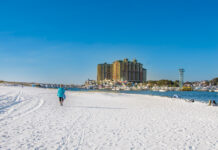
Mexico Beach is 25 miles east of Panama City and it doesn’t feel like the same stretch of coast. The road opens up and you see it all at once: wide white sand running to your right, a row of low-rise cottages and mom-and-pop seafood spots to your left, and not a resort tower anywhere in either direction. I’ve visited this beach before Hurricane Michael hit in October 2018 and after, and what’s remarkable isn’t just that Mexico Beach came back. It’s that it came back as itself.
This guide covers the five distinct stretches that make up Mexico Beach’s shoreline from the Canal at the western edge of town all the way to the quiet east end where the cottages thin out and the shorebirds have the beach mostly to themselves. I go deep on what the sand and water are actually doing, score it honestly across every category that matters, and lay out exactly who this beach is built for. The Hurricane Michael recovery story matters here more than at most beaches, not as a warning but as context for what you’ll find when you arrive. The MBARA artificial reef system, the boat ramp culture, and the rebuilt waterfront are all part of this beach’s current identity. I close with my own take on what makes Mexico Beach genuinely worth the detour off the highway.
The Vibe and Culture at Mexico Beach
Small-Town Florida That Actually Stayed Small
Mexico Beach is the beach the Panhandle’s commercial development passed by. Then Hurricane Michael tried to take it entirely. The town came back anyway, and the character came with it.
Drive in from the west and the first thing you’ll notice is what’s missing. No high-rise condos, no chain hotel row, no resort tower anywhere along the waterfront. The buildings lining Highway 98 on the land side are low-slung: rebuilt beach cottages on new concrete pilings, small seafood restaurants, a marina, and the occasional local shop. The canal system that runs north-south through the middle of town adds something you won’t find anywhere else on the Panhandle, a navigable waterway that flows right alongside the highway and feeds into the Gulf at Canal Park. In most beach towns, the water is only on one side. In Mexico Beach, it’s in the middle too.
What you’ll feel driving in is the same thing I felt on my first visit and again after the storm: this is a working fishing town that happens to have exceptional Gulf-front sand. The culture here is practical and salt-air real, not resort polished. The people who live here year-round are serious anglers, business owners, and retirees who chose this place for the fishing, the quiet, and the pace of life. The Mexico Beach Artificial Reef Association (MBARA), now with over 290 reef structures deployed since 1997, is one of the most ambitious community-run fishing conservation programs in the state. That tells you something about what this town actually values.
You can’t talk about Mexico Beach without talking about Hurricane Michael. The storm hit on October 10, 2018 as a Category 5 with sustained winds of 160 mph. FEMA called the town “wiped out.” Eighty-five percent of structures were destroyed. Three residents lost their lives. What came back looks a little different from what was here before: the cottages sit higher on new concrete pilings, the new construction has a cleaner and more deliberate look, and the town adopted one of the toughest building codes in Florida. New construction must withstand 140 mph winds and meet standards the old buildings never had. The Shell Shack, which opened in 1967 and was about 80 percent destroyed, was rebuilt using old cypress salvaged from the original structure. The rebuilt Driftwood Inn sits six feet higher than the original. This is what resilience looks like in practice, not in a press release. When I walk this town now, I notice the pride in it.
Seasonally, Mexico Beach runs quiet by design and busier than you’d guess in the summer. Summer brings the highest visitor numbers, but the beach stays uncrowded by Panhandle standards even in July. The annual MBARA Kingfish Tournament, held each July at the public boat ramp, draws over 800 people and more than 120 boats and represents the biggest single-weekend event the town has all year. Fall is my personal favorite window here: warm water lingers well into October, the crowds drop fast after Labor Day, and bird activity picks up along the shoreline as the fall migration moves through. Winter drops to almost pure local character, with some restaurants reducing hours between seasons and the beach returning to the shorebirds and the long-distance walkers.
Mexico Beach Areas: Five Stretches, Five Different Experiences
Mexico Beach runs about five miles from the Canal at the western edge of town to the quiet east end where the shoreline opens up beyond the last cottages. Most visitors only ever see one stretch of it. Here’s how the beach actually breaks down, west to east.
Sunset Park and the Central Beachfront
Main Public Beach · 1813 Highway 98
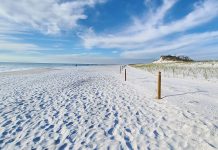
Sunset Park is Mexico Beach’s most developed public beach access and the one most first-time visitors find first. You’ll arrive via a short parking lot off Highway 98, walk through a covered picnic pavilion area, and step down an ADA-accessible ramp onto the sand. The first thing most people do is stop and take a handful of the sand. I’ve watched it happen enough times to call it a reflex. The sand here is the same near-pure quartz you find across the Panhandle, fine and powdery white, but it carries a quality that surprises visitors on first contact: at the right moisture level, underfoot, it genuinely squeaks. The city’s own materials note this, and it’s true enough that kids turn it into a game almost immediately. The water in front of Sunset Park runs turquoise to emerald, shallow and gently sloping outward, and calm on most days.
This is where the day’s heaviest foot traffic lands. Families spread out on the sand in front of the pavilion. Beach chair and umbrella rentals are available through Top Notch Beach Rentals, which operates out of this area and also rents kayaks, paddleboards, coolers, and surf-fishing poles if you want to get into it properly. The El Governor Beachfront Resort sits directly adjacent to Sunset Park, making this stretch the intersection of the resort crowd and the day visitor crowd. One thing to know before you swim: there are no lifeguards anywhere on Mexico Beach. You’re swimming at your own risk here and at every other access point in town. In peak summer it’s the busiest stretch on the beach, but busy by Mexico Beach standards still means room to set a towel down without crowding someone.
Sunset Park earns its name. The sightlines west from this stretch of sand give you the Gulf horizon with nothing blocking the view, and the late evening light here stays remarkable well past the moment the sun actually sets. I’ve watched the sky go through four or five distinct color shifts after the sun drops, from orange to coral to deep pink and then a slow blue-gray that’s hard to walk away from. The crowds that gather for sunset at Sunset Park tend to stay longer than at most Panhandle beaches. Come here for ADA access, for the facilities, for the free parking, and for the first real taste of what Mexico Beach sand actually is. Then keep walking in either direction.
The Canal District and West End
Canal Park · End of Canal Parkway
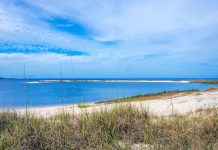
The Canal is Mexico Beach’s most unusual geographic feature, a navigable waterway that runs through the heart of town and opens into the Gulf at its southern end, creating a small natural harbor where Canal Parkway meets the water. Walk out to Canal Park at the end of the road and you’re standing at the exact point where the canal and the Gulf meet, with a stretch of beach running west from that opening. This western strip is narrower than the central beach and carries a different character: quieter, more wind-worked, and with the constant visual anchor of the canal mouth to the east. The dune line is less maintained here, the foot traffic is noticeably lighter, and the whole western end of Mexico Beach feels like a different level of solitude from the Sunset Park area even though they’re less than a mile apart.
This is the only stretch on Mexico Beach where leashed dogs are permitted. The city’s beach rules ban animals on all beaches within city limits with one exception: the beach west of Canal Parkway. That gives you roughly a mile of Gulf-front sand where a leashed dog can walk with you, and the crowd that gathers here reflects that. Mostly locals and repeat visitors who know this is the one permitted spot in town. The Mexico Beach public boat ramp sits at 109 44th Street just west of the canal and serves as the launch point for offshore fishing trips, charter boats heading to the MBARA reef fields, and kayakers accessing the canal system. Daily use is $25 for non-residents; annual passes are $200 and available at City Hall or the 24-hour kiosk at the ramp. Canal boat slips are also available through the city for longer stays.
I’d make the Canal District a deliberate stop rather than an afterthought. The meeting point of the canal and the Gulf is something you won’t find anywhere else on this stretch of coast, and the view down the canal corridor toward the highway has a low-key Old Florida scene quality that the central beach doesn’t have. If you’re walking the full length of Mexico Beach’s shoreline, start here at the western end and walk east. You’ll cover the dog-friendly strip, pass through Canal Park, and have the full town laid out in front of you with the Gulf on one side the whole way.
The Former Pier Stretch at 37th Street
Beach Access and Parking · 120 S 37th Street
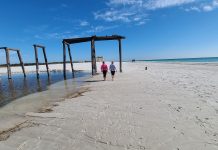
Mexico Beach had a city pier at 37th Street that was one of the anchors of local life before Hurricane Michael removed it in October 2018. What stands there now is the access street and public parking lot that leads directly to the sand, with no pier at the end. The beach itself is good, a wide stretch of the same quartz sand with Gulf views in every direction, but you walk out onto it aware of the absence of something. The old pier’s location is still a reference point locals use to navigate the beach. The city is working with FEMA to rebuild the pier, with current targets aimed at completion around 2027.
Without the pier as a focal point, the 37th Street stretch attracts a looser and more self-directed crowd than Sunset Park. You’ll find shore fishermen who remember the pier and still come out to cast from the surf targeting pompano and redfish, day visitors using the parking lot as a starting point for a long beach walk, and people simply sitting in their chairs with a Gulf view and nothing in particular to do. This stretch took some of the heaviest damage in Hurricane Michael and much of the nearby construction is newer and higher than what you’ll see further west, the new homes on concrete pilings set distinctly higher than the pre-storm waterline. You can read the storm’s reach in the age of the buildings as you walk.
Walk the shoreline here at low tide after any overnight chop and the shell count goes up noticeably. The 37th Street stretch consistently produces better shelling than the central beach simply because fewer people are walking it. You’ll find tulip shells, keyhole sand dollars, shark eye moons, and the occasional fighting conch working into the wrack line. It also gives you the clearest picture of what post-hurricane Mexico Beach looks like: the rebuilt cottages set back higher from the waterline, the new construction blending with the occasional lot still waiting for its next chapter. It’s an honest picture of where the town stands, not a performance of recovery.
The Highway 98 Mid-Town Walkovers
Public Access Points Throughout the Main Town Stretch
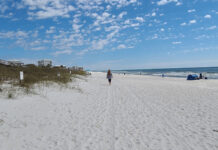
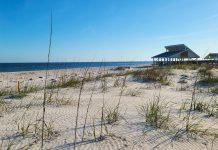
Between Sunset Park to the west and 37th Street to the east, Mexico Beach has a series of marked walkover access points directly off Highway 98. These range from simple pull-offs with a short sand path to the waterline to small lots with low-profile access boards over the natural dune line. The beach itself at these mid-town walkovers is consistent: wide, white, and uncrowded even on peak summer days because whatever foot traffic does show up spreads naturally across the available sand. No single walkover becomes a choke point. The water is uniformly good, turquoise to emerald, gently sloping, warm through September and into October.
The mid-town walkovers attract Mexico Beach regulars, people staying in the cottages and vacation rentals that line Highway 98, and visitors who figured out that you can walk off the main road, cross a short path, and be standing on a largely empty beach within sixty seconds. No parking garage, no shuttle, no paid lot. Pull over, walk across, and you’re there. The crowd at these access points skews toward local and repeat visitor rather than first-timer, and the energy is quieter and less transactional than what you find near Sunset Park.
If you’re staying in one of the vacation rentals near central Mexico Beach, your walkover is probably within a hundred yards of wherever you’re standing right now. Use it early. The mid-town walkovers give you the cleanest version of Mexico Beach in the early morning, the kind where you step onto the sand and find shorebirds working the wrack line twenty feet from your beach chair before the day-trip crowd arrives. The bird activity along this stretch is consistently better than near the main park areas simply because foot traffic stays lighter, and this is where I’ve spotted the best shorebird variety on my walks through town.
The Quiet East End
East of the Main Town Stretch · Toward the Gulf County Line
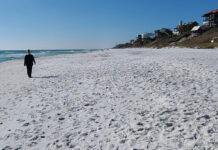
East of the main town, the cottages thin out and the beach gets quieter faster than you’d expect. The Highway 98 walkovers become more widely spaced, the dune line grows taller and more natural-looking, and by the time you’ve walked past the last cluster of rebuilt homes, you can look in either direction along the waterline and see almost no one. The sand holds the same quartz quality as the rest of Mexico Beach: fine, white, powdery at the upper beach and firm and flat at the waterline. The water runs the same emerald green, the same gently sloping bottom, the same calm surf on most mornings. What changes is the silence and the space.
The east end gets a fraction of the foot traffic of Sunset Park, which means the wildlife count goes up. You’ll find more shorebirds working the waterline out here: sanderlings racing the waves, willets probing the wet sand, and during migration months, a wider variety than you’d see in the busier central stretches. Dolphin sightings are more reliable here in the early morning when the boat traffic from the marina hasn’t started yet. During nesting season from May through October, the familiar orange stakes and rope markers show where loggerhead sea turtles have come ashore. Mexico Beach is officially designated as a bird sanctuary by the city, and this eastern stretch is where that designation shows up most clearly on the ground.
This is where I go when I want the beach to feel like mine for an hour. Get out early, walk east past the last few houses, and the horizon opens up in a way the busier sections of town simply don’t give you. The offshore sandbars shift here with the weather, and on calm mornings with light swell, you’ll see the water break in patterns that reveal where they are. Worth noting for anyone doing shallow wading or shore fishing the east end’s surf: the bottom topography changes more out here than it does in front of the main access points, and with it, the fish movement.
Mexico Beach Rankings: Expert Scores Across 11 Categories
These scores reflect the beach as a whole, weighing the exceptional solitude and sand quality against the limited amenities and entertainment that come with a genuinely small-town Gulf Coast destination.
Sand Quality
9/10
Near-pure quartz from Appalachian origin, fine and powdery, brilliant white in direct sun. The squeaky texture underfoot is a genuine feature of this sand and not something you find at every quartz beach on the coast. One of the best sand beaches on the Panhandle, full stop.
Hiking & Beach Walking
7/10
Five miles of flat, firm waterline walking with almost no crowds even in peak season. Loses ground to St. Joseph Peninsula and Fort Pickens for not having a longer wilderness section, but for an uncrowded early-morning walk along good sand, it more than delivers.
Shelling at Mexico Beach
7/10
Better than Panama City Beach, consistently good after storms and at low tide. Tulip shells, keyhole sand dollars, shark eye moon shells, fighting conchs, and calico scallops all show up in the wrack line. The east end and 37th Street stretch outperform the central beach for finds.
Water Conditions
8/10
Turquoise to emerald, gently sloping entry, consistently calm. The MBARA artificial reefs offshore help buffer some wave action. No lifeguards anywhere in Mexico Beach is the practical caveat: always know your swimmers and check conditions before getting in past your knees.
Scenery & Natural Beauty
9/10
No high-rise condos, no resort tower row, no commercial clutter in the sightlines. Wide beach, clear water, the canal as a visual anchor through town, and Gulf sunsets that are genuinely among the best I’ve seen on this coast. The low-density skyline is part of the scenery score.
Birding & Wildlife
8/10
Designated city bird sanctuary. Five sea turtle species nest here from May through October, with loggerheads representing the majority of nests. Dolphin pods are regular offshore on calm mornings. Fall migration brings exceptional shorebird diversity to the east end and mid-town walkovers.
Family Friendliness
7/10
Calm water, uncrowded sand, and a genuinely manageable beach experience for families. The practical caveat: no lifeguards on any beach in Mexico Beach. Sunset Park’s ADA access and the shallow, gentle water entry are genuine positives. Families with strong swimmers will enjoy this beach enormously.
Dog Friendliness
4/10
No animals allowed on any Mexico Beach city beach except the stretch west of Canal Parkway, which gives you about one mile of leashed-dog beach access. Every other access point in town, including Sunset Park and the 37th Street area, is strictly off limits to dogs. Know this before you arrive with a dog.
Solitude & Peace
9/10
One of the quietest beach towns in Florida even in peak summer. The east end and mid-town walkovers approach genuine solitude at almost any time of year. The MBARA Kingfish Tournament in July is the biggest crowd event in the town’s calendar, and it’s still a fishing tournament, not a spring break weekend.
Entertainment & Nightlife
3/10
Mexico Beach is not an entertainment destination. A handful of local seafood restaurants, a farmers and craft market on select mornings, and the annual Kingfish Tournament represent most of the organized activity in town. If you need a boardwalk, a bar scene, or live music after the sun goes down, this is not your beach.
Parking & Beach Access
9/10
Free parking at Sunset Park, Canal Park, and the 37th Street lot. Multiple walkovers along Highway 98 with easy roadside access. No paid parking lots to navigate, no permit system to understand. The Kingfish Tournament weekend in July is the only time parking gets genuinely competitive.
Mexico Beach Sand & Water
Mexico Beach sand is fine, bright white quartz, and it does something most beach sand doesn’t: it squeaks under your feet on a dry day. Beyond that party trick, this is a genuinely easy beach to spend a day on. It’s wide and flat enough that you can walk it for miles without fighting the terrain, soft and a little sugary on the upper beach where the dune line starts, and firm and packed down at the waterline where wave action keeps it solid underfoot. That firm wet sand is great for a long walk, a jog, or letting a kid chase the tide out and back in, and once you add water, the sand near the edge holds a sandcastle shape just fine, it’s the dry upper beach that’s too loose and fine to mold on its own.
The water follows the same easygoing pattern. On a calm day it runs turquoise to emerald with good clarity, often visible to waist or chest depth, and the entry is gradual the whole way in, no steep drop-off to catch you off guard. Conditions stay swimmable well into October most years, with water temperatures peaking in the mid-80s°F by August. The one real caution here is that Mexico Beach has no lifeguards at any access point, at any time of year, so always know your swimmers and keep an eye on conditions rather than relying on a flag system or a stand to warn you.
-
Walkability. Wide, flat, and firm at the waterline for the full five miles. One of the easiest long walks on this stretch of the Panhandle.
-
Softness & Playability. Soft and a little sugary on the upper beach, with plenty of flat, wide sand for games, sunbathing, or just spreading out. Great for sandcastles once you add water from near the tide line. Firmer and less forgiving right at the water’s edge.
-
Barefoot Comfort. Genuinely comfortable most of the year, and the waterline stays cool nearly always. The dry upper sand between the parking areas and the water gets hot enough by mid-morning in July and August to send you looking for shoes.
-
Swimmability. Gradual entry, generally calm water, warm through October. No lifeguards anywhere in town, so always know your swimmers before wading in past your knees.
Want the full geology, grain composition, and the complete sand and water condition ratings? I broke it all down separately in Sand & Shore: Mexico Beach.
Dogs & Pet Accessibility
Are Dogs Allowed on the Sand? RESTRICTED / MOSTLY NO.
Mexico Beach bans animals from every public beach within city limits with one specific exception: the stretch of Gulf-front sand west of Canal Parkway.
Where Dogs Are Allowed
- ✓The beach west of Canal Parkway, roughly one mile, leashed dogs welcome on the sand and in the water.
- ✓The Mexico Beach Canal corridor and boat ramp area generally tolerate leashed dogs accompanying their owners to the water, though the open Gulf beach rule still applies once you’re on the sand proper east of the canal.
Where Dogs Are NOT Allowed
- ✗Sunset Park and the entire central beachfront, no exceptions.
- ✗The Highway 98 mid-town walkovers, all of them.
- ✗37th Street and the quiet east end, both strictly off limits.
Paws on the Ground Reality
The dog-friendly mile west of Canal Parkway is genuinely pleasant walking, flat, easy on paws, with calm water for a dog who likes to wade without dealing with real surf. It’s also enforced, and locals will tell you so if you wander east of the canal with a dog off leash or on the wrong stretch of sand.
If your dog needs more than a mile, look inland. Nearby preserve lands around St. Joseph Bay, closer to Port St. Joe, offer leashed-dog trail walking away from the beach itself, and make a reasonable pairing with a Mexico Beach trip if you want a longer walk with your dog on the same day.
Crowd Levels and the Overall Feel of Mexico Beach
Mexico Beach runs consistently less crowded than any major Panhandle beach destination to its west, and that’s not a seasonal thing, it’s the baseline. The town’s small year-round population (under a thousand residents), its height and density limits (maintained even after Hurricane Michael), and its location on a stretch of Highway 98 that most Panhandle visitors don’t specifically seek out all contribute to a beach that feels calm even in the middle of summer.
You’ll find different visitors depending on where you stand. Near Sunset Park, it’s families with young children, couples staying at the El Governor or in nearby vacation rentals, and day visitors from Panama City who made the drive east. Out at the Canal District, it’s anglers, boat owners, and the dog-owner crowd that knows that’s the one spot in town. Along the mid-town walkovers and east end, it’s repeat visitors and locals who choose these access points precisely because most tourists don’t know they’re there.
The crowd and vibe shift by season more predictably than at most beaches:
- Spring (March through May): Quieter than summer, water warming toward comfortable swimming temperatures by May, good shelling conditions, and the best time to see migratory birds moving through the shoreline. One of the under-appreciated windows on this beach.
- Summer (June through August): Peak season with the highest visitor numbers, though peak here is modest by Panhandle standards. The MBARA Kingfish Tournament in July draws over 800 people and represents the biggest single-weekend crowd event in Mexico Beach’s year.
- Fall (September through October): My preferred window. Warm water lingers well into October, crowds drop sharply after Labor Day, the sunset quality picks up as the light angle changes, and shorebird variety increases along the east end and mid-town walkovers during migration.
- Winter (November through February): Nearly purely local. Some restaurants reduce hours or close between seasons. The beach returns to the birds, the long-distance walkers, and the occasional anglers. The quietest and most reflective version of Mexico Beach, and genuinely worth experiencing if you can manage a winter visit.
Who Is Mexico Beach Really For?
✓ Who Will Love Mexico Beach
-
Visitors who want the Panhandle’s quartz sand and turquoise water without the resort development, spring break crowds, or condo towers that come with the more famous destinations to the west
-
Serious fishing families and anglers: the MBARA reef system puts over 290 artificial reef structures within easy reach of the public boat ramp, and the charter fleet here focuses on kingfish, grouper, snapper, and other offshore species year-round
-
Wildlife watchers who want sea turtle nesting beaches, designated bird sanctuary shoreline, and reliable dolphin sightings without having to drive to a state park to find them
-
Couples and retirees looking for extended, peaceful beach time with genuinely good sand and almost no crowd management required at any hour of the day
-
Anyone drawn to Old Florida authenticity and the community resilience story of a town that rebuilt from a Category 5 hurricane with its character and height limits intact
-
Shellers who want better odds than Panama City Beach with far less competition than Cape San Blas or Sanibel; the east end and 37th Street stretch produce good finds after storms and at low tide
✗ Consider Another Beach If…
-
You need lifeguards on the beach. There are none at any Mexico Beach access point, at any time of year. If swimming safety support is essential for your group, this beach is not set up for that.
-
You’re traveling with a dog and want more than about a mile of leashed beach access. Only the stretch west of Canal Parkway permits dogs; every other access point in town is off limits.
-
You want boardwalk energy, live music, nightlife, or a commercial dining and shopping strip after dark. Mexico Beach has a handful of good seafood spots and not much else after sunset.
-
You’re a surfer or looking for consistent wave action. This is flat Gulf water at this location, with no reliable break even in the windiest conditions.
-
You want a wide range of dining, retail, and entertainment options within the beach town itself. Mexico Beach’s selection is intentionally small and genuinely limited compared to any major Panhandle destination.
Things to Do at Mexico Beach, Florida
Mexico Beach rewards visitors who brought their own agenda rather than expecting the beach to entertain them. Here’s what actually fills a day here, and what fills several.
-
Beach Walking. Five miles of flat, firm waterline running from Canal Park on the west to the quiet east end, almost entirely uncrowded at any hour of the day. Early morning is the best window: the light is low, the shell activity is highest right after the overnight tide, and the bird life along the east end is most active before the day warms up.
-
Offshore Fishing. The MBARA reef system is the defining fishing feature of this beach. More than 290 artificial reef structures with over 4,000 individual components are deployed offshore in nine permitted areas, creating habitat for kingfish, grouper, red snapper, amberjack, and cobia in water that would otherwise be flat sandy bottom. Charter boats launch from the Mexico Beach marina and access these reefs daily. The annual MBARA Kingfish Tournament in July is the biggest event in town.
-
Shore Fishing. Pompano, redfish, and flounder work the nearshore surf year-round, with pompano running strongest in spring and fall. The 37th Street beach access and the Canal area are the two best shore-fishing spots in town. Top Notch Beach Rentals has surf-fishing pole rentals if you didn’t bring your own setup. A Florida saltwater fishing license is required for adults.
-
Swimming. Warm, calm water with a gently sloping bottom through the entire town. Water temperatures peak in the mid-80s°F in August and stay swimmable through October. No lifeguards anywhere in Mexico Beach: always communicate your swimming plan and stay within your comfort level and skill set.
-
Kayaking and Paddleboarding. The Canal area on the west end provides protected launch access into the canal system and out toward the Gulf. The canal itself is navigable and interesting to paddle, with the waterway running several blocks north toward Highway 98 and beyond. Rentals are available through Top Notch Beach Rentals near Sunset Park.
-
Snorkeling and Diving. The MBARA artificial reef fields give Mexico Beach surprisingly good snorkeling and diving access for a Panhandle beach. The nearshore reefs host a consistent variety of Gulf species including sheepshead, flounder, spadefish, and occasional grouper. Charter dive operators access the sites regularly; visibility improves significantly during calm summer conditions.
-
Shelling. Best on the east end and the 37th Street stretch where foot traffic stays low, and most productive after an overnight high tide or the first calm morning after a storm. Tulip shells, keyhole sand dollars, fighting conchs, shark eye moons, and calico scallops are the consistent finds. The squat-to-see technique works especially well here: the low-angle light catches the shells before you walk past them. That’s your free leg day built right into the morning walk.
-
Wildlife Watching. Dolphin pods work the nearshore waters regularly on calm mornings, most reliably in front of the east end before boat traffic picks up. Sea turtle nesting runs May through October with five species documented here, loggerheads representing the majority. If you find an unmarked turtle crawl during nesting season, call (850) 647-8238 to report it. The city’s bird sanctuary designation means hunting or disturbing birds anywhere in Mexico Beach is unlawful.
-
Sunset Watching. Among the best Gulf sunsets I’ve seen on this coast, and they deliver almost nightly. The low-density skyline and the unobstructed western sightline from Sunset Park and the mid-town stretches give you a clean horizon shot with no resort towers interrupting the view. Plan to stay through the full afterglow: the best color often comes in the ten to fifteen minutes after the sun actually sets.
-
Boating. The Mexico Beach marina and public boat ramp give access to both the canal system and the open Gulf. The boat ramp at 109 44th Street is $25 per day for non-residents. Canal rules require idle speed only through the waterway, with no fishing, swimming, or disposal of any materials allowed in the canal itself.
Local Knowledge and Practical Advice
A few things I’ve picked up walking Mexico Beach across different seasons and both before and after the hurricane:
-
Get to the east end early for the best combination of shelling and solitude. Walk east past the last row of cottages before 8am and you’ll cover sand that no one else walked the previous evening, with the overnight tide still showing in the wrack line. That’s where the better shell finds are and where the shorebirds are most active.
-
No lifeguards, anywhere, ever. This is not a seasonal or hours-based policy. Mexico Beach has no lifeguard program at any access point. Know your swimmers, communicate a plan before anyone gets in the water, and keep an eye on conditions throughout the day. The water is calm most of the time, but conditions change, and there’s no backup if something goes wrong.
-
Dogs are allowed only west of Canal Parkway, and only on leash. Every other public beach area in Mexico Beach city limits is strictly off limits to dogs, including Sunset Park and the 37th Street access. The one-mile dog-friendly strip at the west end past the canal is the only option, and the rule is enforced.
-
The sunset is worth planning your dinner around, not the other way. Mexico Beach sunsets are genuinely among the best I’ve seen on the Panhandle, and they show up almost every evening. Stay on the sand through the afterglow rather than rushing to a restaurant table at 7pm, and plan dinner for 8pm when the light show is over and the best part of the evening has already happened on the beach.
-
Parking is free at all main beach access points, but Sunset Park fills first on peak summer weekends. If Sunset Park is full, the 37th Street lot and the Canal Park lot both offer free parking and easy beach access without the central park’s foot traffic. The mid-town Highway 98 walkovers are free roadside pull-offs that never fill, even in July.
-
Book fishing charters early for summer and especially for the July Kingfish Tournament weekend. The MBARA Kingfish Tournament typically draws over 120 boats and 800 attendees. Charter availability gets tight in the weeks around it, and accommodations near the boat ramp book up earlier than the rest of the town. If you want to participate or just watch the tournament, plan accordingly.
-
Nesting season runs May through October. Remove all beach chairs, umbrellas, and equipment from the sand by sunset during nesting season. If you’re on the beach after dark during this window, use a red flashlight rather than white light: white light disorients hatchlings navigating to the water. Five sea turtle species nest on this beach and the city takes the protection seriously.
-
The best shelling conditions in Mexico Beach come from a specific setup: a storm followed by calm. One or two calm mornings after any overnight blow, the wrack line on the east end and the 37th Street stretch will hold more finds than a typical day. Set an alarm, walk the waterline first, and look at the shells before they get buried by the next wave set moving them around.
-
The new construction in town is genuinely more resilient than what was here before. If storm anxiety is part of how you think about Gulf Coast travel, knowing that Mexico Beach’s post-Michael building code requires structures to withstand 140 mph winds, to be elevated on concrete pilings, and to meet fire-resistive standards the old buildings never had is actually relevant to where you stay. The rebuilt town is physically tougher than the one Hurricane Michael hit.
Where to Stay Near Mexico Beach, Florida
Mexico Beach’s lodging options reflect the town itself: small-scale, locally run, and weighted toward vacation rentals rather than chain hotels. There are no high-rise resorts and no nationally branded hotel chains within the city limits, by design.
El Governor Beachfront Resort
The El Governor sits directly adjacent to Sunset Park and is the closest thing Mexico Beach has to a full-service beachfront resort. It’s still low-rise and locally operated, not a chain property, and its location gives guests the most direct Gulf-front access in the main town area. The resort went through significant rebuilding after Hurricane Michael; check current amenities and availability before booking since the property has continued to update since reopening.
The Driftwood Inn
A Mexico Beach institution that was nearly completely destroyed in Hurricane Michael and has since been rebuilt to current building code standards, sitting six feet higher than the original and built to withstand 140 mph winds. The rebuilt Driftwood was the first major business to reopen in Mexico Beach after the storm. It carries both the Old Florida character of what it was and the structural resilience of what it became, which makes it a meaningful place to stay if you want to understand this town’s recovery from the inside.
Vacation Rentals Throughout Town
Vacation rental cottages and homes make up the majority of Mexico Beach’s lodging inventory, and many of them are the post-hurricane rebuilt cottages on new pilings that now line the waterfront. Gulf-front rentals give you direct beach access and the ability to walk onto the sand any time, morning included. Booking platforms like Airbnb and VRBO both list Mexico Beach properties, as do local property management companies. Summer weekends, especially July during the Kingfish Tournament, book early.
Camping at T.H. Stone Memorial St. Joseph Peninsula State Park
The nearest camping to Mexico Beach is at T.H. Stone Memorial St. Joseph Peninsula State Park, about 30 miles east near Port St. Joe. The park offers Gulf-front campsites, both primitive and with full hookups, tucked into the scrub and dune habitat of the St. Joseph Peninsula. An entrance fee applies and camping fees are separate. This is one of the best camping experiences in the entire Florida Panhandle if you’re willing to drive the extra distance from Mexico Beach.
Port St. Joe Mainland Options
Port St. Joe, about 15 miles east of Mexico Beach, offers a wider range of budget to mid-range hotel options for visitors who want to day-trip to Mexico Beach rather than stay on the beach itself. The drive east on Highway 98 along the Forgotten Coast is scenic and takes under 20 minutes, which makes Port St. Joe a reasonable base for exploring both Mexico Beach and the Cape San Blas area in the same trip.
What Makes Mexico Beach Different from Nearby Beaches
Most Panhandle beaches are variations on a theme: quartz sand, emerald water, resort row, boardwalk, condos. Mexico Beach is a genuine departure from that pattern, and not accidentally. These are the things that actually set it apart.
No high-rise condo row, by design and by code
Mexico Beach maintained its height and density limits after Hurricane Michael even while accepting $100 million in federal rebuilding grants. The town could have gone the route of high-density resort development. It chose not to. The skyline here will not resemble Destin or Panama City Beach in ten years, because the zoning won’t allow it. The low sightlines are a deliberate outcome, not a coincidence.
The MBARA artificial reef system
No other beach town of this size in Florida has built what Mexico Beach has built offshore. Since 1997, the Mexico Beach Artificial Reef Association has deployed over 290 reefs comprising more than 4,000 individual structures in nine permitted areas. What was once flat sandy bottom supporting little marine life has become a reef system that draws kingfish, grouper, snapper, and amberjack within easy reach of the public boat ramp. This is what community-driven marine conservation at its most effective looks like on the water.
Post-hurricane construction quality
Everything built in Mexico Beach after October 2018 meets a standard that most coastal Florida construction does not. New structures are elevated, fire-resistive, and built to withstand 140 mph winds. If you’re choosing between Gulf-front beach towns and resilience to future storms is a factor in that decision, Mexico Beach’s rebuilt inventory is among the most structurally prepared on the entire Gulf Coast.
A working fishing town that’s still actually working
This is not a fishing-themed resort experience. The boat ramp at 109 44th Street has working charter boats leaving for the reef fields early every morning. The marina handles real anglers running real gear. The Kingfish Tournament draws over 120 boats competing seriously. The fishing culture here is organic and present, not manufactured for tourism.
Mexico Beach vs. Other Florida Panhandle Beaches
These are the beaches visitors most often weigh against Mexico Beach, and the honest case for when you’d choose each.
Mexico Beach vs. Panama City Beach
Same quartz formation, completely different world. Panama City Beach has massive high-rise resort development, a boardwalk strip, heavy spring break traffic, and far more dining and entertainment than Mexico Beach can offer. Panama City Beach is the right choice if you want the full commercial Panhandle experience. Mexico Beach is the right choice if you want the sand without any of that coming with it. They’re about 25 miles apart and might as well be different planets in terms of character.
Mexico Beach vs. Cape San Blas
Cape San Blas sits about 45 miles east in Gulf County and is the closest comparison to Mexico Beach in character. Both are quiet, both have exceptional quartz sand, both feel like a different era of Florida beach travel compared to the western Panhandle. Cape San Blas edges ahead for dedicated shelling (the Gulf County beaches are among the best shelling stretches in North Florida) and offers the dramatic St. Joseph Peninsula State Park as a wilderness adjunct. Mexico Beach has the canal system, the MBARA reef program, and a slightly more accessible small-town infrastructure. Both are worth visiting. If you can only do one in a trip, the drive between them is 45 minutes and you can do both.
Mexico Beach vs. Navarre Beach
Navarre Beach is a quieter alternative to Pensacola Beach with comparable quartz sand, but it’s still in Navarre’s more developed suburban context. Mexico Beach is genuinely more remote and more independently characterized. Navarre Beach has lifeguards and more amenities. Mexico Beach has better solitude and more authentic local character. If lifeguards matter to your group, Navarre Beach is the better practical choice.
Mexico Beach vs. St. George Island
St. George Island is further east and has its own exceptional quiet beach character, with the bonus of St. George Island State Park on the east end offering 9 miles of essentially undeveloped Gulf-front walking. St. George Island is harder to reach, completely surrounded by water (bridge access only), and even quieter than Mexico Beach. Shelling is good on both. Mexico Beach has the canal, the MBARA reef access, and more of a working-town feel. St. George Island feels more like a destination you reach intentionally and stay for a while.
Bottom line: Mexico Beach is the fishing-town version of the Panhandle’s quartz sand coast. It doesn’t try to be a resort experience and it doesn’t succeed at being one. What it does exceptionally well is deliver near-pure quartz sand, calm emerald water, genuine solitude, and a small-town character that survived both time and a Category 5 hurricane. If what you want from a beach trip is the beach, this is one of the most honest choices on the entire Florida coast.
Mexico Beach, Florida: Frequently Asked Questions
Is Mexico Beach worth visiting?
Yes, especially if you’re looking for the Panhandle’s quartz sand and turquoise water without the resort development and crowds that come with more famous Panhandle destinations. The sand quality is exceptional, the beach is genuinely uncrowded, and the sunset views are among the best I’ve seen on this coast.
Is Mexico Beach crowded?
Not by Panhandle standards. Even at peak summer, the beach stays noticeably less crowded than Destin, Panama City Beach, or Pensacola Beach. The MBARA Kingfish Tournament in July brings the largest single-weekend crowd the town sees all year, but it’s still a fishing tournament, not a spring break event.
Are there lifeguards at Mexico Beach?
No. Mexico Beach has no lifeguard program at any beach access point, at any time of year. This applies to Sunset Park, Canal Park, the 37th Street access, and every mid-town walkover. Swim with awareness of your own skills and always let someone know your plan before getting in the water.
Are dogs allowed on Mexico Beach?
Only in one specific area: the beach west of Canal Parkway, where leashed dogs are permitted for approximately one mile. Every other beach access point in Mexico Beach city limits bans animals, including Sunset Park. The rule is enforced. If you’re traveling with a dog, plan your beach time around the Canal Park west end strip specifically.
Is the water clear at Mexico Beach?
Yes, on calm days. The near-pure quartz seafloor reflects light upward and produces turquoise to emerald water with good clarity to waist or chest depth in good conditions. Clarity drops quickly after wind events and typically takes two to three calm days to recover. The MBARA artificial reef structures offshore also help buffer some swell energy.
What happened to Mexico Beach in Hurricane Michael?
Hurricane Michael made landfall near Mexico Beach on October 10, 2018 as a Category 5 storm with sustained winds of 160 mph, the strongest hurricane to make U.S. landfall since Hurricane Andrew in 1992. FEMA declared the community “wiped out.” Approximately 85 percent of structures were destroyed. Three residents died. The city pier was destroyed, 85 percent of buildings were lost, and recovery took years. The town has since rebuilt to some of the toughest building codes in Florida.
Has Mexico Beach fully recovered from Hurricane Michael?
Substantially, but not completely. The vast majority of homes, businesses, and infrastructure have been rebuilt to the new code standards. The El Governor Resort, the Driftwood Inn, and most local businesses are open. The city pier, destroyed in 2018, is under FEMA-funded reconstruction planning with a target completion around 2027. Some properties remain in various stages of rebuilding, but visiting Mexico Beach today means visiting a functional, welcoming beach town.
What is the MBARA reef system at Mexico Beach?
MBARA stands for the Mexico Beach Artificial Reef Association, a nonprofit founded in 1997. The organization builds and deploys artificial reef structures in nine permitted areas off the Mexico Beach coast, using concrete pyramids, reef balls, and other materials to create habitat on what would otherwise be flat sandy bottom. Since 1997, MBARA has deployed over 290 reefs comprising more than 4,000 individual structures. The reefs create habitat for kingfish, grouper, red snapper, amberjack, and cobia, making Mexico Beach a serious nearshore fishing and diving destination.
Where is the best parking at Mexico Beach?
All public beach access in Mexico Beach is free. Sunset Park at 1813 Highway 98 has the main parking lot with ADA spaces but fills first on busy summer days. Canal Park at the end of Canal Parkway and the 37th Street lot both offer free parking with easy beach access and rarely fill. The Highway 98 mid-town walkovers are roadside pull-offs that never have a parking problem.
What is the best time of year to visit Mexico Beach?
Late spring and fall offer the best balance of warm water and lighter crowds. Summer delivers the warmest water and the Kingfish Tournament in July, but also the heaviest visitor numbers, which are still modest by Panhandle standards. Fall is my personal preference: water stays warm through October, crowds drop fast after Labor Day, and the sunset quality in September and October is exceptional.
Is Mexico Beach good for families?
Yes, with one important caveat: there are no lifeguards on any Mexico Beach beach access. The water is calm, the entry is gently sloping, and the uncrowded sand makes it easy to keep eyes on children. Families with strong swimmers and confident water parents will find this a great beach experience. Families that need lifeguard coverage should consider Pensacola Beach or Panama City Beach instead.
Patti’s Perspective: My Honest Take on Mexico Beach
I first drove into Mexico Beach before Hurricane Michael, when the old bungalows and low-slung beach cottages lined both sides of Highway 98 and the wide white sand was already wider and emptier than anything I’d seen between there and Pensacola Beach. I came back after the storm and the town was still putting itself back together: the new homes on higher pilings, the occasional empty lot where something used to stand, the rebuilt Driftwood Inn sitting noticeably taller than the original had. And something about that visit stuck with me more than most beach stops do.
What you’ll feel when you drive in, either visit, is that this is a place that knows what it is and isn’t trying to be anything else. The wide beach on your right, the mom-and-pop storefronts on your left, the canal cutting through the middle of town toward the Gulf. No resort tower, no chain hotel, no commercial strip trying to get between you and the water. The canal especially surprised me on my first visit: you don’t expect a navigable waterway to be part of the character of a Gulf beach town, and Mexico Beach has made it central to its identity in a way that feels organic rather than engineered.
My honest caveat: if you’re coming here looking for evening entertainment, a bar scene, or anything beyond a handful of good local seafood options, you’ll exhaust the choices inside a night. That’s not a failure of the place. It’s a feature for the right traveler and a mismatch for the wrong one. Come here to be on the beach. Stay for the sunset. Walk the east end in the early morning when the shorebirds are working the waterline and the Gulf is still flat. That’s when Mexico Beach earns every one of the miles I’ve put on my feet in walking this coast.
Want to Live by the Water?
Mexico Beach’s post-hurricane rebuilding created a waterfront real estate market unlike anything else on the Panhandle. New Gulf-front homes are elevated on concrete pilings, built to 140 mph wind standards, and constructed with materials the pre-storm inventory never had. Gulf-front lots have been trading in the $500,000 to $1 million range, and the town’s retained height and density limits mean the character of the neighborhood will not change into a high-rise condo market. For buyers who want resilient Gulf-front construction in a genuinely small-town setting, Mexico Beach is one of the more interesting markets on the entire Florida coast right now. The surrounding Bay County area and nearby Gulf County both offer a wider range of price points for buyers who want proximity to the beach without the Gulf-front premium.Explore Waterfront Living at LiveByTheWater.com
Real estate referral partner