









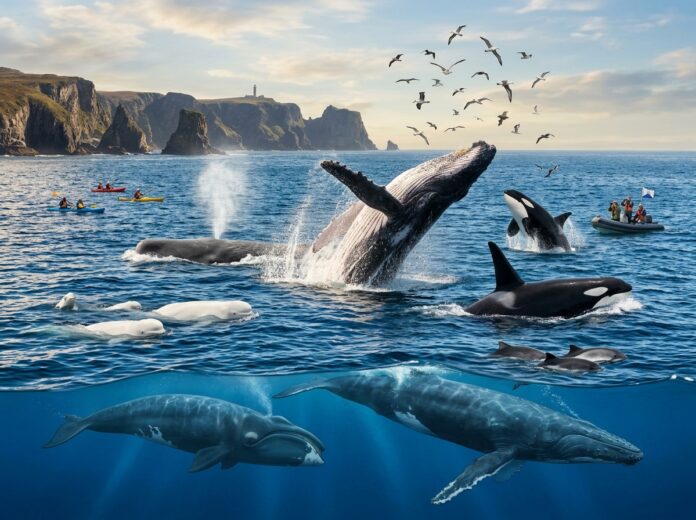
I have never seen a whale in Florida, and after a lifetime on this state’s water, I’ve made a strange kind of peace with that. My first wild whale sightings actually happened thousands of miles away, during a petsit in Anacortes, Washington, where I could occasionally spot one right from the front porch, and later on a whale watching tour out of that same harbor that showed me even more. Whales are like that, the rarest encounter in this entire wildlife series and somehow still the most universally recognized animal on Earth, a creature nearly everyone can picture instantly and almost no one has actually stood in front of. Let’s talk about the biggest animals that have ever lived, and where in the world you can actually go find them.
Meet the Whales
Whales split into two fundamentally different suborders, and once you know the difference, everything else about them starts to make sense. Baleen whales, the Mysticeti, have no teeth at all. Instead they filter enormous mouthfuls of water through comb like plates of baleen, straining out krill, small fish, and plankton by the ton. This group includes the true giants: blue, fin, humpback, gray, and right whales. Toothed whales, the Odontoceti, hunt individual prey with actual teeth and navigate by echolocation, and this group technically includes every dolphin and porpoise alive, plus the sperm whale and its smaller relatives. For this piece, I’m sticking to the animals most people actually mean when they say “whale,” the great baleen giants and the sperm whale, since the dolphin family, orca included, gets its own full treatment in my companion piece on dolphins and porpoises worldwide.
Jump to a species:
- Blue whale — every ocean except the Arctic, largest animal ever to exist
- Humpback whale — every ocean on Earth, famous for its songs
- Gray whale — the North Pacific, the longest mammal migration known
- Right whale — three species, one of them wintering off Florida and Georgia
- Sperm whale — every ocean, the largest brain on Earth
- Rice’s whale — the Gulf of Mexico, discovered from a stranding in the Florida Everglades
Blue Whale
Balaenoptera musculus is, without qualification, the largest animal that has ever lived on this planet, bigger than any dinosaur, reaching up to a hundred feet long and weighing as much as 150 tons. Its heart alone weighs as much as a small car. Blue whales are also the loudest animals on Earth, producing low frequency calls that can travel hundreds of miles underwater, loud enough that whales on opposite sides of an ocean basin may genuinely be able to hear each other. Despite that unmatched size, they feed almost entirely on krill, tiny shrimp like crustaceans, filtering tens of thousands of pounds of them a day through baleen plates instead of teeth. Sri Lanka’s waters off Mirissa, California’s Channel Islands, and the Azores all offer some of the most reliable blue whale sightings anywhere in the world.
Humpback Whale
Megaptera novaeangliae is the whale most people picture first, thanks to its long, wing like pectoral fins, its habit of breaching clear out of the water, and above all, its song. Male humpbacks compose long, structured songs that can last twenty minutes or more, repeated for hours, and every male in a given population sings roughly the same evolving song each season, changing gradually year to year the way a slow moving cultural trend spreads. Humpbacks migrate between cold, food rich feeding grounds and warm, calm breeding grounds every year, some of the longest migrations of any mammal on Earth. The Dominican Republic’s Silver Bank, a protected sanctuary where thousands of North Atlantic humpbacks gather every winter to mate and calve, is one of only a handful of places in the world where permitted operators can legally bring swimmers into the water with them, alongside Tonga and parts of French Polynesia.
Gray Whale
Eschrichtius robustus makes the longest documented migration of any mammal, up to twelve thousand miles round trip between Arctic feeding grounds and the warm, sheltered lagoons of Mexico’s Baja California peninsula, where females give birth every winter. What makes Baja’s San Ignacio Lagoon genuinely famous, though, is a behavior nobody fully predicted: some gray whale mothers there actively approach small tour boats and appear to invite gentle contact, nudging their calves up alongside the boat to be touched. Researchers still don’t fully understand why this population became so comfortable with people after generations of being hunted by whalers along this exact coastline, but it’s now one of the most moving, tightly regulated wildlife encounters on Earth.
Right Whale
Three right whale species exist worldwide, the North Atlantic, North Pacific, and Southern right whale, and all three were named by whalers who considered them, grimly, the “right” whale to hunt, since they swim slowly near the surface and float once killed. That history left a mark. The North Atlantic right whale is now one of the most endangered large whales on Earth, with roughly 384 individuals left as of the most recent population count, and it happens to winter in United States waters closer to home than almost anyone realizes, which gets its own full story further down. The Southern right whale has recovered far better and gathers reliably each year off Argentina’s Peninsula Valdes, where mothers and calves linger close to shore in numbers that make it one of the best land based whale watching sites in the world.
Sperm Whale
Physeter macrocephalus is the largest toothed predator on the planet, reaching up to sixty feet, and carries the largest brain of any animal that has ever existed, roughly five times the size of a human brain. Its enormous, square head, making up a full third of its body length, houses a waxy substance called spermaceti once prized by whalers for oil and candles, the very thing that gave the species its name. Sperm whales dive deeper than almost any other mammal, over a mile down in some documented cases, hunting giant squid in complete darkness using echolocation clicks loud enough to be one of the most powerful sounds produced by any living creature. Females and calves live in stable social units for life, while mature males roam largely alone except during breeding season. The waters around Dominica in the eastern Caribbean host a genuinely resident sperm whale clan that has been studied for decades, and permitted operators there offer some of the most respectful, well regulated sperm whale encounters anywhere.
Rice’s Whale
Balaenoptera ricei was formally recognized as its own species only in 2021, and the whole discovery traces back to a single stranded whale on Sandy Key inside Everglades National Park in January 2019. For decades, scientists assumed the handful of Bryde’s whale-like animals occasionally spotted in the Gulf of Mexico were simply a local subspecies. Genetic and skeletal analysis of that Everglades carcass proved otherwise; this was an entirely distinct species, found nowhere else on Earth, living year round in the northeastern Gulf of Mexico. With likely fewer than a hundred individuals left, Rice’s whale is now considered one of the most critically endangered whale species on the planet, threatened by vessel strikes, oil and gas activity, and the same kind of plastic pollution that was found lodged in the very whale whose stranding led to its discovery. It is, quietly, Florida’s own contribution to the list of the world’s rarest whales, and almost nobody outside marine biology circles has ever heard its name.
The Whole Deep, Singing Life
Whales are built around two very different survival strategies depending on which suborder they belong to. Baleen whales are built for volume, filtering enormous quantities of small prey in the most food rich waters on the planet, usually the cold, productive seas near the poles, before migrating thousands of miles to warmer, calmer water to give birth, since a newborn calf has almost no insulating blubber yet and can’t survive in frigid seas the way its mother can. Toothed whales like the sperm whale hunt individually, using echolocation to find prey in total darkness at incredible depths, and tend to live in longer term, more complex social groups built around matrilineal family lines. What nearly every great whale shares, regardless of strategy, is scale: scale of size, scale of migration, scale of sound. A blue whale’s call and a humpback’s song both travel distances that make a human shout look almost comically small by comparison.
Where to Actually Go See Them, Region by Region
I mentioned my own first wild whale sighting up top, and I want to actually tell that story properly here, because it taught me something about whale watching that no single species section could. I was staying in Anacortes, Washington, on a petsit right on the water, and more than once I looked up from whatever I was doing on the front porch to see a whale surface out in the bay, no boat, no tour, no plan involved at all. Later, I went out on an actual whale watching cruise from that same harbor and saw considerably more. Anacortes taught me it can be just as easy to spot a whale while you’re doing the dishes, if you happen to be standing in the right stretch of water at the right time of year.
The Pacific Northwest
The Salish Sea, the network of waterways connecting Washington’s Puget Sound to Canada’s Strait of Georgia, is one of the richest whale watching regions in North America, and Anacortes sits right in the middle of it as a working departure point rather than a resort town built around the industry. From spring through fall, tours out of Anacortes regularly encounter humpback whales, which have made a real comeback in these waters over the past decade, alongside minke whales and seasonal gray whales, a small, resident feeding group locally nicknamed the “Sounders” that lingers in Puget Sound’s Saratoga Passage each spring rather than continuing the full migration north. Orcas are the other headline species here, both fish eating resident pods and marine mammal hunting transients, though since orcas are technically dolphins, I’ve given them their full due in my companion piece on dolphins and porpoises worldwide rather than repeating it here.
Alaska
Alaska’s coastal waters host some of the densest humpback whale feeding grounds on Earth each summer, as whales that wintered and calved in Hawaii’s warm water travel north to gorge on the region’s rich krill and small fish stocks. Icy Strait Point near Hoonah and the waters around Juneau and Kenai Fjords National Park all offer reliable summer viewing, often alongside the same humpback bubble net feeding behavior, groups of whales cooperatively blowing rings of bubbles to trap fish before lunging through the surface together, that makes Alaska one of the more visually dramatic whale watching destinations anywhere in the world.
Hawaii and Baja California
These two warm water destinations are really opposite ends of the same migration story. Hawaii’s waters fill with humpback whales every winter as the same animals feeding in Alaska all summer arrive to mate and calve, making it one of the most dependable, low effort whale watching destinations anywhere. Baja California’s San Ignacio Lagoon, covered in more detail above, plays a nearly identical role for gray whales, a warm, sheltered nursery at the southern end of the longest migration of any mammal on Earth.
New England
Stellwagen Bank National Marine Sanctuary, a shallow, current rich underwater plateau just off Cape Cod and Boston, draws feeding humpback and fin whales all summer, close enough to shore that half day whale watching trips out of Provincetown and Boston are genuinely reliable rather than a gamble. This same stretch of Atlantic coast, further south toward Georgia and Florida, is also where the critically endangered North Atlantic right whale spends its winters calving, a story I cover in full in the companion piece on Florida’s own whales.
The Caribbean
The Dominican Republic’s Silver Bank and the waters around Dominica, both covered in detail above, make this region a genuine two species destination: humpback whales gathering to mate and calve in the former, and a resident, decades studied sperm whale clan in the latter, both offering some of the only legally permitted in water whale encounters anywhere on Earth.
South America
Argentina’s Peninsula Valdes, covered above as one of the best land based whale watching sites in the world, draws Southern right whales close enough to shore each year that a pair of binoculars from a cliff top often outperforms a boat.
Europe and the North Atlantic
The Azores, a remote Portuguese island chain in the mid Atlantic, benefits from a seafloor that plunges steeply just offshore, letting resident sperm whales and passing blue and fin whales feed within sight of the harbor. Iceland’s Húsavík, on the country’s north coast, has built an entire whale watching identity around Skjálfandi Bay, where humpback, minke, and occasionally blue whales feed through the summer months in water cold and nutrient rich enough to support them close to shore.
Africa
Hermanus, South Africa, may be the single best land based whale watching town on Earth. Perched above Walker Bay in the Western Cape, its cliff paths put Southern right whales, and to a lesser extent humpbacks, within yards of shore from June through November, close enough that the town still employs an official whale crier, who walks the streets blowing a kelp horn to announce fresh sightings to everyone within earshot, a wonderfully old fashioned system that works precisely because the whales cooperate by showing up so reliably.
Asia-Pacific and Oceania
Tonga, covered above as one of the few places permitting in water humpback encounters, shares the South Pacific migration route with Australia’s Hervey Bay, a sheltered stretch of Queensland coast where humpbacks pause to rest and socialize on their way south each year, often approaching boats with the same curious, unhurried confidence found in the calmer parts of this species’ range worldwide.
The Indian Ocean
Sri Lanka’s waters off Mirissa, covered above, round out this list as one of the most reliable places on Earth to encounter the blue whale, the largest animal that has ever lived, in water shallow enough for a half day boat trip to reach.
Rules Wherever You Go
In United States waters, NOAA Fisheries recommends observing large whales from at least a hundred yards, roughly double the distance recommended for dolphins, since whales are large enough that even an unintentional collision can be fatal to both the animal and anyone in a small boat nearby. Commercial whaling has been under an international moratorium since 1986 through the International Whaling Commission, though a small number of countries continue limited hunts under exceptions and objections to that moratorium. Wherever you encounter a whale, in water or from a boat, the same principle from every other species in this series applies: let the animal set the terms of the encounter, never chase, and treat every sighting as the genuinely rare privilege it actually is.
Who’s Protecting the Whales
The International Whaling Commission oversees the global moratorium on commercial whaling and coordinates international research. Whale and Dolphin Conservation works on stranding response, entanglement prevention, and policy advocacy across nearly every species mentioned here. In the United States, NOAA Fisheries manages recovery plans and critical habitat designations for endangered species including the North Atlantic right whale and Rice’s whale, both of which get real, ongoing protection specifically because of NOAA’s monitoring and rulemaking in Gulf and Atlantic coast waters.
Curiosity Corner
What’s the actual difference between a whale and a dolphin?
There isn’t a hard biological line, technically dolphins are toothed whales. In practice, “whale” is generally used for the larger baleen species and the sperm whale, while “dolphin” covers the smaller, more social oceanic species, orca included.
Why do humpback whales sing?
Almost certainly related to mating, since only males sing and mostly during breeding season, though the full purpose is still debated. What’s remarkable is that the song itself evolves each year, and every male in a population tends to sing the current version.
How deep can a sperm whale actually dive?
Documented dives exceed a mile down, among the deepest of any air breathing animal, hunting giant squid in total darkness using echolocation rather than sight.
Is Rice’s whale really that rare?
Yes, genuinely. With an estimated population under a hundred individuals confined to a small part of the Gulf of Mexico, it’s considered one of the most endangered whale species on the planet, and it was only formally described as its own species in 2021.
Do whales have any natural predators?
Adult great whales have very few, mainly orcas, which occasionally target calves or weakened individuals. For virtually every species on this list, humans and human activity, vessel strikes, entanglement, historical whaling, remain the dominant threat by an enormous margin.
Thoughts & Reflections
I still think about standing on that porch in Anacortes, half expecting to see nothing, and then a shape breaking the surface out in the bay like the water had simply decided to show me something. No boat, no ticket, no plan, just the right stretch of water at the right moment. Some of the most enormous, ancient things on this planet are simply out there living their lives, completely indifferent to whether anyone happens to be watching from a porch that day or not, and once in a while you get to be the one who happened to look up.
“I used to think you had to go looking for something as big as a whale. Then one surfaced in front of me while I was doing nothing more remarkable than standing on a porch, and I realized the looking up is the only part that was ever actually up to me.”
