



Camp Helen State Park, Florida
Camp Helen State Park sits at the border of two completely different worlds: the commercial beach strip of Panama City Beach on one side and the curated coastal communities of 30A on the other. The park belongs to neither. It’s 180 acres of protected land wrapped on three sides by Lake Powell, the largest coastal dune lake in Florida, and the Gulf of Mexico, with a wide, quiet beach that takes real effort to reach and historic buildings that have been here since the 1930s. What you get when you step through the gate is the Florida that existed before either world crowded in around it.
Camp Helen State Park sits on US 98 at the Bay-Walton county line, just west of the Phillips Inlet bridge. The Inlet Beach community on 30A begins immediately to the west. Panama City Beach continues to the east. The park itself faces south toward the Gulf of Mexico while Lake Powell wraps around it to the north and east, and Phillips Inlet closes the circuit to the west where the lake exchanges water with the Gulf. It is, in the most literal geographic sense, nearly surrounded.
In this guide I’m walking you through every distinct zone of the park, going deep on the sand quality and what the Gulf and lake water are actually doing, scoring it honestly across all 11 categories, and telling you clearly who this park is built for and who might do better at a neighboring beach. I cover the historic district, the lake shoreline, the beach trail, the Gulf beach itself, and the Phillips Inlet outfall, and I close with my own honest take on why this place stays with you after you leave.
The Vibe and Culture at Camp Helen State Park
Old Florida, Flanked by Both Coasts at Once
Camp Helen doesn’t feel like it belongs to the world on either side of it. It feels like what was here before either of those worlds showed up.
Drive west from Panama City Beach on US 98 and the commercial strip drops away fast. A few miles past the high-rise resorts and chain restaurants, you cross a bridge over the inlet and the entrance to Camp Helen appears on the south side of the highway. The shift in atmosphere is immediate. Instead of resort signage, you’re looking at a weathered historic building on a bluff overlooking a lake. Instead of a beach umbrella rental setup at the entrance, there’s a visitor center with binoculars available for birders and interpretive panels about a park that has been in continuous human use for nearly a century.
The character here comes from the layered history as much as the landscape. Prehistoric peoples used this peninsula for over 4,000 years, leaving middens and mounds that are still visible within the park. The 1920s brought early Florida tourism with the Inlet Beach Hotel. In the late 1920s, Robert E. Hicks purchased the land as a summer retreat and his wife Margaret named it Loch Lomond, building the lodge and the Rainbow Cottages that still stand on the bluff above Lake Powell. By 1945, the Alabama textile company Avondale Mills had purchased the property and operated it as a company resort for their employees until 1987, adding duplexes, a recreation hall, and a fishing pier. The state acquired it in 1994, and what you walk into today is the accumulated character of all those eras at once.
Most visitors find the park by exploring the 30A corridor and following the thread a few miles east, or by escaping the PCB strip for a day. Both crowds arrive and both tend to stay longer than they planned, which is the clearest sign that the place works on people. I’ve watched people discover the bluff above Lake Powell for the first time, stop cold, and just stand there. It does that.
The overall feel shifts noticeably by season. Fall and winter offer the quietest and most atmospheric experience. Summer brings school groups on ranger programs, families who planned the day around fishing the lake, and people who discovered the park while looking for something more than the PCB strip. Spring is when the birding peaks and the migratory species pass through. The park runs ranger-led guided nature hikes and historical tours throughout the year, which are worth building your visit around if the schedule lines up.
Camp Helen State Park: Six Distinct Zones, Six Completely Different Experiences
Most people who visit Camp Helen for the first time come for the beach. They leave surprised by everything else they found on the way there and on the way back.
The Entry Drive, Visitor Center, and Historic District
Park Entrance · Bluff Above Lake Powell
The entrance road from US 98 drops you into the park’s southern section and immediately puts you in front of the visitor center, a converted historic building on a bluff above Lake Powell. Before you take a single step toward the beach, take the interpretive loop around the historic structures. The Rainbow Cottages, originally built in the 1930s by the Hicks family and later used by Avondale Mills employees, sit in a row with their colorful exteriors and simple floor plans on a ridge that gives you an open view across Lake Powell. The Lodge and the gazebo overlooking the bluff’s edge are close enough to the water that on a calm morning, you can hear the lake before you can fully see it through the oak canopy.
The interpretive panels throughout this section are unusually good for a state park. They tell the full story from the prehistoric middens to the Phillips Inlet pirate legend to the Avondale Mills era when employees from an Alabama textile company would spend a week here boating, fishing, and dancing in the recreation hall. You can almost see it if you stand still long enough. The visitor center also keeps binoculars behind the counter for anyone who wants them for birding, which is one of the more quietly useful things any park visitor center could offer.
I love this section for the light in the late afternoon, when the sun comes in at a low angle through the old oaks and the Lake Powell surface catches it. Spend 20 minutes here before heading to the beach. It changes how the rest of the visit feels.
The Lakeside Bluff and Lake Powell Shoreline
Freshwater and Brackish · Kayak Launch and Pier
Lake Powell is the park’s defining natural feature and its largest single asset: 800 acres of the biggest coastal dune lake in Florida, brackish and tea-colored from the surrounding cypress and pine vegetation, running calm and wide on most mornings and wild in its own way when wind moves across it. From the bluff near the historic buildings, the lake reads as almost theatrical. The far shoreline is unbroken forest. The near edge has the old boathouse pilings still visible in the water, remnants from the Avondale years before hurricanes took the structure in 1975 and 1995.
The kayak launch points are accessed from the lakeshore trails south of US 98. As of spring 2026, kayak rentals are no longer available directly through the park. Check the Friends of Camp Helen website for current equipment availability before visiting, and plan to bring your own kayak or paddleboard if you want to get on the water. The lake is excellent for paddling, genuinely excellent, and paddling it early in the morning before the wind picks up, when osprey and great blue herons are working the shallow margins and the water surface reads everything that moves, is one of the more complete sensory experiences this park offers.
For fishing enthusiasts, the brackish mix of fresh and saltwater in Lake Powell supports both freshwater and saltwater fish species in the same body of water, and fishing from the shore or from a kayak toward the edges of the emergent vegetation can yield redfish, speckled trout, and flounder alongside largemouth bass. A Florida fishing license is required.
It’s also worth knowing that the park allows swimming in the lake itself, not just in the Gulf, which makes a calm morning on the lake an option for anyone who would rather skip the beach walk.
The Inlet Beach Trail: Causeway, Dunes, and the Approach to the Gulf
Signature Trail · Requires Effort
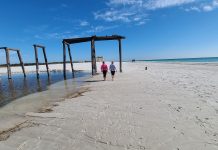
Reaching the Gulf beach at Camp Helen is not a parking lot to shoreline stroll. From the main lot and visitor center area, the trail descends the bluff, follows the Lake Powell shoreline to the south, crosses a causeway over a marshy arm of the lake where the water runs shallow and clear enough to see the bottom, and then climbs through coastal scrub and dunes before the beach opens up ahead of you. The whole route takes 15 to 20 minutes depending on pace, and beach mats are provided on some of the softer sand sections to give your footing a little help.
The causeway section is worth slowing down for. The marshy arm of Lake Powell that the causeway crosses is a concentrated birding spot: wading birds work the shallow margins on both sides of the trail, and the open water view to the east down the lake’s length is as good as any in the park. Least terns and shorebirds use the sandy banks near the causeway for nesting in season, and the interpretive signage in this zone explains why undisturbed sandy bluffs alongside the lake are critical nesting habitat that has largely been destroyed by development along the rest of this coastline.
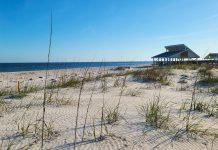
The dune section above the causeway puts you in Choctawhatchee sand pine scrub, a habitat dominated by low, gnarly pines and coastal scrub oaks that doesn’t look like much from a distance but reveals real botanical detail up close. The Choctawhatchee beach mouse lives in these dunes and you won’t see it in the daytime, but the burrow entrances and track marks in the sand on a calm morning are visible to anyone who looks for them. By the time you clear the scrub and the beach opens up ahead, you’ve earned the view.
The Gulf Beach (Inlet Beach)
Wide, Quiet, West-Facing Gulf Front
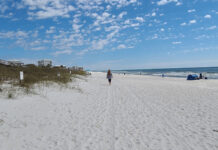
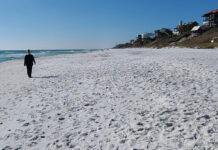
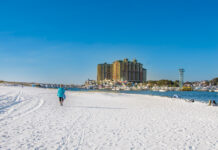
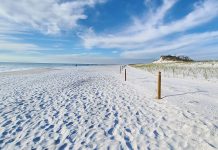
When the trail deposits you on the Gulf beach at Camp Helen, the width of it stops most first-timers for a moment. This is a genuinely wide beach, and it reads differently from the heavily developed stretches of Panama City Beach just a few miles east. No umbrella racks, no lounge chair operations, no vendors. The sand runs white and clean from the waterline to the dune base, and the only footprints on a weekday morning are from the shorebirds working the wrack line and the occasional ranger doing a turtle nest check.
The sand here is the same near-pure quartz that runs the entire Panhandle coast, and my description of it as the “whitest quartz sand” holds up every time you arrive. The beach faces west, which creates the sunset situation that becomes the reason a lot of people come back. Late afternoon turns this stretch gold in a way that the east-facing beach access points simply don’t offer, and because the crowd here is sparse by the time the sun drops toward the Gulf, the experience tends to be intimate in a way that PCB’s main beach never is.
There are no lifeguards on duty at the Gulf beach at Camp Helen. Check the warning flag conditions posted at the beach before entering the water, and plan your swimming for calm conditions when the flags indicate safe entry. The beach faces directly west and south, which means westerly winds in fall and winter can kick up real surf and occasional rip current risk. On calm summer and fall mornings the water here runs emerald and clear and the gradual sand shelf makes the approach comfortable. This is one of those beaches where the effort of getting here filters the crowd to people who came specifically for this, and that changes the whole feel of the water.
Phillips Inlet and the Lake-Gulf Exchange
Where the Lake Meets the Gulf
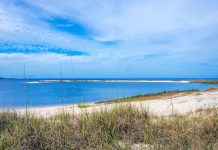
West of the Gulf beach, Phillips Inlet cuts through the barrier and connects Lake Powell to the Gulf of Mexico. This is not a wide, navigable channel for most recreational vessels, the park is clear that unguided boating through the inlet is risky due to the shifting, shallow, unmaintained nature of the passage. What it is, for someone standing on the beach or watching from the bluff, is one of the more dynamic landscape features on this stretch of coast: the point where a lake the size of 800 acres periodically exchanges its water with the Gulf, creating a brackish mixing zone that drives the productivity of the entire park ecosystem.
When the inlet is running, the color difference between the tannin-stained lake water and the clear Gulf is visible at the shoreline, the same pine-straw tea phenomenon you see at Deer Lake on 30A but on a much larger scale here. The outfall zone at the beach west side of the inlet is a concentrated shorebird feeding area: piping plover and snowy plover work the wet sand edges, black skimmers skim the surf, and in the right season you’ll find least terns nesting in the sandy bluffs nearby. The Phillips Inlet area is also where the “sea monster” was allegedly spotted in the 1950s. A sketch of the creature, nicknamed “Eric,” hangs in the visitor center. The legend adds color to an already layered place.
The inlet’s name comes from its own legend: a passing band in the early 1800s reportedly attacked a stranded schooner near this location, and the story was handed down by the sole survivor. Earned or not, that history sits underneath every quiet morning walk on the beach near the inlet, and it makes this the most layered single spot in the park: the ecological, the historic, and the half-remembered all at once.
The North Trail (North of US 98)
Pine Scrub and Lake’s Northern Shoreline
The North Trail sits on the opposite side of US 98 from the main park. To access it, walk back through the park toward the entrance road, pass under US 98 next to the lake, and pick up the trail on the northern shoreline. This part of the park is half accessible surface and half natural footpath, and it follows the edge of Lake Powell for nearly half its length before turning into Choctawhatchee sand pine scrub above the lake.
The view of Lake Powell from the North Trail is different from the bluff view to the south: lower, closer to the water’s surface, more intimate. The far shoreline from the north bank is the park’s protected south section, which from this vantage looks like undisturbed forest meeting the lake. On calm mornings the surface is glassy and the bird activity along the margins is excellent. Osprey nest nearby and fish the lake regularly. Bald eagles show up in winter. The rare Cooper’s hawk and kingfisher both work the lake edges on this side.
This trail gives you the northern half of the Lake Powell experience that the southern trail network can’t provide, and if you’re visiting specifically for birding, the north side is worth the additional time. The combination of the sand pine scrub habitat type, the lake shoreline, and the relative lack of foot traffic compared to the main south-side trail makes the North Trail the section of the park most likely to give you an encounter with the park’s resident wildlife at close range. I’ve watched white-tailed deer drink from the lake’s edge here on quiet mornings, which doesn’t happen on the south side.
Camp Helen State Park Rankings: Expert Scores Across 11 Categories
These scores weigh the full park experience, including what it is like to access the beach, the quality of the lake experience, the historical character, and the practical realities of a day-use-only park with no lifeguards and a trail-dependent beach approach.
Sand Quality
9/10
Near-pure quartz from the same Panhandle geological system, wide beach with low foot traffic relative to the surrounding coastline. My description of it as the “whitest quartz sand” holds up on every visit. The beach stays cleaner and more consistent underfoot than the high-traffic PCB access points just a few miles east.
Hiking & Beach Walking
9/10
The most varied trail system of any dune lake park in the Florida Panhandle: the Inlet Beach Trail through the causeway and dunes, the Lake Powell Trail along the bluff, the North Trail following the lake’s upper shoreline, and the Oak Canopy Trail through the hammock uplands. The beach walk is short once you arrive on the sand, but you earn it with a meaningful trail approach that’s part of the experience.
Shelling
5/10
Not a dedicated shelling destination. Post-storm mornings after an overnight Gulf blow can produce decent wrack-line finds, but the beach length here is limited enough that shell volume is modest. Come for the lake, the history, and the solitude. Pick up any shells you find as a bonus.
Water Conditions
8/10
Clear emerald Gulf water on calm days, gradual sand shelf entry, and a west-facing orientation that catches good light in the afternoon. No lifeguards is the primary constraint. The Phillips Inlet area west of the beach has its own currents and shifting channels: swim in the clear Gulf zone away from the inlet rather than near it, especially when the inlet is actively running.
Scenery & Natural Beauty
9/10
The combination of high bluffs overlooking Lake Powell, historic 1930s buildings on the ridge line, an 800-acre brackish dune lake, a narrow barrier beach with the Gulf on the other side, and unbroken forest on the lake’s far shore adds up to a visual depth that pure beach parks can’t match. The west-facing sunsets over the Gulf from this beach are reliably worth sitting down for.
Birding & Wildlife
9/10
Designated as part of the Great Florida Birding Trail, with habitat that supports genuinely exceptional diversity: bald eagle, osprey, kingfisher, Cooper’s hawk, piping plover, snowy plover, least tern, reddish egret, and numerous migratory species through spring and fall. The combination of Gulf beach, brackish lake, salt marsh, oak hammock, and pine scrub within 180 acres creates a species list that dedicated birders plan visits specifically for.
Family Friendliness
7/10
Good for families with kids 8 and up who can handle the trail to the beach and are comfortable swimming without lifeguard oversight. No concessions in the park means you need to bring food and water. The historic buildings give older kids and curious teenagers something to engage with beyond the sand. The lake is also available for swimming, which adds a second water option if the Gulf flags are not favorable.
Dog Friendliness
4/10
Leashed dogs are welcome on all of the park’s trail system, including the North Trail, the Lake Powell Trail, and the wooded sections. They are not allowed on the Gulf beach. The trail system here is genuinely better for a leashed dog walk than the equivalent at Deer Lake or most other dune lake parks, which makes the beach restriction less of a dealbreaker than it might otherwise be.
Solitude & Peace
8/10
Dramatically quieter than the Panama City Beach strip a few miles east, and quieter than any commercial beach access on 30A. The park’s day-use-only character, the trail-required beach approach, and the small parking lot all limit how many people can be here at once. The Gulf beach in particular stays uncrowded by any Panhandle standard, and on weekday mornings in fall or winter you may have it almost to yourself.
Entertainment & Nightlife
2/10
Day use only, no alcohol, no commercial operations in the park. The historically interesting buildings and the ranger programming substitute for entertainment in a very different register. The park closes at sunset. Nightlife is available five minutes in either direction on US 98, but the park itself is fully off the clock by dark.
Parking & Beach Access
6/10
$4 per vehicle is reasonable for the quality of the park, and the lot is adequately sized for the park’s capacity. The main limitation is the beach itself: reaching the Gulf requires a 15-to-20-minute walk through the trail system including a bluff descent, a causeway crossing, and a dune approach. That’s not a complaint but a fact that first-timers need to plan for. Wear shoes for the walk and bring everything you need before you leave the lot.
Camp Helen State Park Sand & Water
The sand at Camp Helen is classic Panhandle quartz, fine, pale, and soft enough on the upper beach and dune crossing that it pulls at your calves a little with every step. Get down to the waterline and that story flips, wave action packs it firm and flat, easy walking whether you’re barefoot or not. The beach itself runs wide and gradual once you’re past the dunes, plenty of room to spread out, dig, toss a ball, or start a sandcastle, though you’ll want damp sand pulled from near the water for anything you want to hold its shape. It’s an easy beach to walk the full length of, provided you stick closer to the packed waterline than the loose sand up top.
The water on a calm day runs emerald to bright turquoise, clear enough to see your feet at waist depth, with a gradual, easy entry that doesn’t demand much of you before you’re swimming. There are no lifeguards here, so check the posted flags and use your own judgment on conditions. The one real caution worth knowing is Phillips Inlet at the beach’s western end, where Lake Powell periodically exchanges water with the Gulf, shifting sandbars and unpredictable current make that specific channel a look-don’t-swim zone. Stick to the main Gulf beach east of it and you’re in good shape.
-
Walkability. Wide and gradual with a firm, easy waterline once you’ve made the trail walk in. Comfortable for a long walk in either direction.
-
Softness & Playability. Fine, powdery sand on the upper beach and dune crossing, good for lounging and digging. Sandcastles hold their shape best with damp sand from near the water.
-
Barefoot Comfort. Cool quartz keeps this comfortable most of the year. The dry dune crossing and upper beach can genuinely heat up by late morning in July and August, worth having shoes along for that stretch.
-
Swimmability. Gradual entry and generally calm on flag-clear days. No lifeguards on duty, and Phillips Inlet’s channel carries real current risk, so keep swimming to the open Gulf beach east of it.
Want the full geology, grain composition, and the complete sand and water condition ratings? I broke it all down separately in Sand & Shore: Camp Helen State Park.
Crowd Levels and the Overall Feel of Camp Helen State Park
Camp Helen draws a more deliberate crowd than the commercial beach access points surrounding it on both sides. The trail requirement to reach the Gulf beach and the absence of any commercial services filter out the spontaneous, cooler-and-umbrella crowd that fills the PCB strip. What you get instead is a mix of local birders, families on a planned outing who packed their own food, paddlers who came specifically for Lake Powell, history enthusiasts who’ve heard about the buildings, and beach walkers who discovered the park while exploring the 30A-to-PCB corridor.
The crowd and atmosphere shift meaningfully through the year:
- Spring: the best birding window, with migratory species passing through the Gulf Coast corridor; wildflowers in the scrub and along the lake margins; ranger-led hikes often scheduled for this season; the park is at its most botanically active
- Summer: busiest window; families with school-age children; the ranger program schedule is fullest in summer; afternoon thunderstorms can shorten beach time and come up fast along this coast; the lake is warmest and the paddling conditions are best in the morning before the heat builds
- Fall: my personal favorite here; warm water through October, shorebirds and waders peak in September and October, the park empties out after Labor Day and the historic district feels especially atmospheric in the cooler temperatures; the Phillips Inlet area can see its most active outfall events after fall rains raise the lake level
- Winter: the park stays open year-round from 8 AM to sunset; the historic buildings read most clearly in winter when the oak canopy thins; Patti walked this park in December and the solitude of the lake shoreline at that time of year is the version she returns to in her memory
Who Is Camp Helen State Park Really For?
✓ Who Will Love Camp Helen State Park
-
Birders and wildlife watchers: the Great Florida Birding Trail designation reflects genuinely excellent habitat diversity, and the combination of Gulf beach, brackish lake, salt marsh, and multiple forest communities within 180 acres is hard to match anywhere on this coast
-
Paddlers and anglers who want to get on a large, calm, wildlife-rich freshwater-to-brackish lake without a motorboat crowd around them
-
History enthusiasts and people who want to understand what this coastline looked like and who was here before the high-rises: the National Register historic district and the interpretive programming deliver genuine depth
-
Families with kids 8 and up who can handle the trail to the beach and benefit from having a lake as a swimming alternative to the Gulf
-
PCB visitors who want a break from the strip: this park is less than 10 minutes from the most commercial stretch of Panama City Beach and feels like a completely different planet
-
Sunset seekers: the west-facing Gulf beach at Camp Helen delivers one of the more reliably photogenic sunsets on the Panhandle and almost never has a crowd for it
✗ Consider Another Beach If…
-
You’re bringing your dog expecting beach access: dogs are not allowed on the Gulf beach, and that’s enforced
-
You have very young children and need lifeguard coverage, easy water access, and food within reach: none of those things exist here
-
You want chair and umbrella rentals set up on arrival: there is no beach service of any kind at Camp Helen
-
You want to stay past sunset: the park closes at sunset and the day-use-only policy applies to everyone, no exceptions
-
You want to bring drinks for the beach: alcohol is prohibited throughout the entire park
Things to Do at Camp Helen State Park, Florida
The activity list here is broader than most people expect from a 180-acre day-use park. The three-sided water situation alone opens up options that pure beach parks can’t offer.
-
Beach Walking and Swimming. The Gulf beach is quiet, wide, and west-facing with a gradual entry. No lifeguards: always check the warning flag before swimming. The beach walk east toward the inlet zone and west along the shoreline gives a full picture of the park’s Gulf frontage in either direction.
-
Kayaking and Paddleboarding on Lake Powell. The signature water activity at Camp Helen. Bring your own equipment: kayak rentals are no longer available at the park as of spring 2026. Two launch points are available on the lake. Early morning on flat water, with wading birds along the margins and the lake surface reflecting the surrounding forest, is the most complete version of this experience.
-
Fishing. Lake Powell supports both saltwater and freshwater species in its brackish water: redfish, speckled trout, flounder, and largemouth bass are all present depending on the season and conditions. Surf fishing is available along the Gulf beach. A Florida fishing license is required and all state regulations apply.
-
Birding. A designated Great Florida Birding Trail park with habitat that draws bald eagle, osprey, kingfisher, Cooper’s hawk, piping plover, snowy plover, least tern, and numerous migratory species. Binoculars are available at the visitor center. The North Trail, the Lake Powell Trail causeway section, and the beach near Phillips Inlet are the three highest-yield birding zones within the park.
-
Historic District Exploration. The Rainbow Cottages, the Lodge, the Recreation Hall, and the water tower are all part of the National Register historic district. The interpretive loop around the buildings is self-guided, with panels covering the Hicks family era and the Avondale Mills period. Ranger-led historical tours run periodically: check the Florida State Parks events calendar for the current schedule.
-
Wildlife Watching. Beyond birds, the park hosts white-tailed deer, squirrels, opossums, and occasional black bears. The Choctawhatchee beach mouse lives in the dune system. Sea turtles nest on the Gulf beach from May through October. The evening ghost walk and history tour, when it runs, adds a uniquely atmospheric wildlife and history combination.
-
Hiking the Trail Network. The South Trail system includes the Lake Powell Trail along the bluff, the Inlet Beach Trail crossing the causeway and dunes to the Gulf, and the Oak Canopy Trail through the hammock uplands. The North Trail follows the lake’s upper shoreline and runs into pine scrub habitat north of US 98. Each trail offers a genuinely different ecosystem experience within a compact park area.
-
Sunset Photography. The west-facing Gulf beach delivers one of the better sunset views in the entire PCB-to-30A corridor. The combination of the open Gulf horizon, the quiet beach, and the absence of condo towers in the sightline makes this a photography destination in its own right. Late afternoon also catches the light on the Lake Powell bluff views from near the historic buildings.
-
Swimming in Lake Powell. The lake is open for swimming in addition to the Gulf. On days when Gulf flags are not favorable, the calm, protected lake surface provides a solid alternative. The lake is brackish rather than purely fresh, which means it carries a slight color cast from the tannins, but the water quality is good and the swimming environment is peaceful.
-
Picnicking. Picnic tables are available throughout the park, with one small covered pavilion. No alcohol is allowed. Pack a complete meal, since there are no concessions anywhere in the park. The shaded area near the historic buildings by the lake is the best picnic location: moss-draped oaks, the lake visible through the canopy, and a consistent breeze that keeps the temperature comfortable even in summer.
Local Knowledge and Practical Advice
A few things I’ve picked up walking this park across multiple visits that I wish I’d known on the first one:
-
Bring $4 in cash for the vehicle fee. The park uses a self-pay honor box at the entrance. Pedestrians and cyclists pay $2 each. There is no card reader and no attendant. Stop at a gas station on US 98 before you turn into the park if you’re not carrying small bills.
-
The visitor center closes at 4 PM even though the park stays open until sunset. This matters because the visitor center is where binoculars are available for birding, where the interpretive materials are, and where the restrooms are easiest to access. Plan to arrive before 4 PM if you want any of those things, even if you’re planning to stay for the sunset.
-
Kayak rentals are no longer available at the park (as of May 2026). If getting on Lake Powell is your main reason for visiting, bring your own kayak or paddleboard, or check the Friends of Camp Helen website at friendsofcamphelen.org before driving in to confirm current equipment options. Arriving to find no rentals when you planned your day around them is a significant disappointment.
-
Wear shoes for the full trail to the beach and bring them back in a bag. The beach trail involves a bluff descent, a causeway crossing, and a dune approach with some soft sand sections. Beach mats are in place on the worst sections, but your feet will thank you for the trail portion. Take your shoes off at the waterline and carry them in a small bag for the beach itself.
-
Dogs are welcome on all trails but not on the Gulf beach. The Lake Powell Trail, the North Trail, and the wooded sections of the park are all good leashed-dog walks. The rule about the beach is enforced and is in place to protect nesting shorebirds along the sandy bluffs adjacent to the inlet area.
-
Alcohol is prohibited throughout the entire park, not just in specific zones. This applies to the beach, the picnic areas, the trails, and the parking lot. It’s a full park-wide prohibition and it’s posted at the entrance. Plan accordingly.
-
Sea turtle nesting season runs May through October on the Gulf beach. Remove all personal equipment from the beach by sunset and avoid any white light on the sand after dark. If you’re timing a sunset visit in summer, plan to leave before the light fully fades and carry a red-filtered flashlight if you want to stay longer.
-
The North Trail trailhead requires crossing US 98. It is NOT accessible from within the main parking area on the south side. You walk back up the entrance road, cross the highway, and pick up the trail on the lake’s northern shore. It is worth the extra steps and is the least-visited section of a park that already sees fewer visitors than it deserves.
-
Check the Florida State Parks events calendar for ranger tours before visiting. Camp Helen runs ranger-led guided nature hikes and historical tours of the Hicks-era buildings throughout the year. If a tour happens to line up with your visit, it completely transforms the experience of the historic district. The historical tour in particular brings the Avondale Mills and Hicks family eras to life in a way that the self-guided panels alone don’t fully deliver.
Where to Stay Near Camp Helen State Park, Florida
Camp Helen is a day-use-only park with no camping and no lodging on site. All accommodation options are in the surrounding communities, which give you a choice between the full PCB experience and the quieter 30A-adjacent options just to the west.
Inlet Beach and Rosemary Beach (30A, Western Edge)
The Inlet Beach community begins immediately west of the park entrance, at the Walton County side of the Phillips Inlet bridge. This is the easternmost community on 30A and offers vacation rentals ranging from small cottages to Gulf-front homes. Rosemary Beach, the planned community further west along 30A, is a short drive and offers upscale rentals with full community amenities. Staying in this area puts you on the 30A side of the park, which means easy access to the park in the morning and 30A’s dining and shopping in the evening.
Panama City Beach West End
The west end of Panama City Beach, closest to the park, is significantly quieter than the main PCB strip and offers a range of rental condos, vacation homes, and resort properties within a few miles of the park entrance on US 98. This is the right base if you want the convenience of a full PCB vacation setup (restaurants, shops, activities) while keeping the park an easy drive away each morning.
Panama City Beach Main Strip
The main PCB resort corridor is about 5-10 miles east of Camp Helen along US 98, offering the full range of Gulf-front hotels, resorts, and short-term rentals in every price category. Several of the larger resorts near the west end of the main strip offer private beach chair and umbrella service on the Gulf side. The drive to Camp Helen is straightforward and takes 10-15 minutes.
Camping: St. Andrews State Park and PCB Area
There is no camping within Camp Helen State Park. The nearest state park camping option is St. Andrews State Park on the eastern end of PCB, which has full camping facilities and direct Gulf beach access. Private campgrounds and RV parks are available along US 98 between Camp Helen and the PCB strip. Campers wanting the 30A park experience without driving far can also check Grayton Beach State Park, about 20 miles west on 30A.
Budget and Mainland Options
The US 98 corridor through the Panama City Beach area has a wide range of budget to mid-range motels and budget chain hotels that offer significantly lower nightly rates than Gulf-front PCB resorts. Panama City itself, about 10-12 miles east on US 98, has the broadest selection of budget lodging and is a practical base for day-tripping to Camp Helen and other Panhandle parks.
What Makes Camp Helen State Park Different from Nearby Beaches
Several state parks and beach access points border Camp Helen on both sides, and this park is genuinely different from all of them in ways worth naming specifically.
The largest coastal dune lake in Florida as the park’s central feature
Lake Powell is not a pond or a small lake backdrop. It is 800 acres of Florida’s largest coastal dune lake, and it wraps around the park on two sides. No other beach park in the Panhandle positions a body of water this large in that relationship to the Gulf, and the resulting three-sided water situation creates an ecological density, a paddling experience, and a visual depth that straight Gulf-access parks simply can’t replicate.
A fully intact historic district on the National Register of Historic Places
The Rainbow Cottages, the Lodge, and the remaining Hicks and Avondale Mills-era buildings give Camp Helen a human narrative that no other dune lake park in the Panhandle has. Walking the interpretive loop before heading to the beach gives the park a specific sense of place that has nothing to do with sand. It’s a genuinely unusual combination: an ecologically significant coastal park that also tells a readable human story going back to the 1920s.
A peninsula geography that puts you nearly surrounded by water
The Gulf to the south, Lake Powell to the north and east, and Phillips Inlet to the west mean that every compass direction from the park’s interior faces water. That three-sided dynamic creates views from the historic bluff that are unlike any other park perspective on this coast: lake in front of you, Gulf audible behind you, inlet channel to one side, and protected forest as the only backdrop.
The boundary position between Panama City Beach and 30A
Camp Helen sits on the county line between Bay County (PCB) and Walton County (30A). Both worlds are within minutes. The contrast between the commercial PCB strip just east and the design-controlled 30A communities just west, with this undeveloped park sitting between them, is one of the most interesting pieces of context on the whole Panhandle coast.
Camp Helen State Park vs. Other Florida Panhandle Beaches
Camp Helen vs. Deer Lake State Park
Both are coastal dune lake parks with protected Gulf beaches, no lifeguards, and dogs restricted from the beach. The key differences: Camp Helen’s lake is massively larger (800 acres vs. the small Deer Lake), the trail system is more varied, and the historic district adds a dimension that Deer Lake doesn’t have. Deer Lake’s dune boardwalk crossing is the more dramatic beach reveal. Camp Helen’s causeway approach is subtler but the lake views are more expansive. Choose Camp Helen for the fuller historical and ecological experience. Choose Deer Lake for the specific boardwalk-over-the-dunes reveal and the more intimate dune lake character.
Camp Helen vs. St. Andrews State Park
St. Andrews State Park on the eastern end of PCB offers a longer Gulf beach, the Shell Island ferry access, a jetty fishing pier, camping, and snorkeling in a cut between the mainland and Shell Island. It’s a larger, more fully developed park experience with more beach mileage. Camp Helen wins on solitude, historical character, and dune lake experience. For a camping trip or a longer beach day with more activities, St. Andrews. For the park that feels like it was found rather than driven to, Camp Helen.
Camp Helen vs. Panama City Beach West End
The community beach access points at the west end of PCB sit just east of Camp Helen on the same coastline. They have easier beach access (parking directly to the waterline), some with commercial chair and umbrella service, and are part of the developed PCB beach strip. Camp Helen has dramatically more ecological and historical character, requires a trail hike to reach the same Gulf water, and offers solitude the PCB accesses never will. They serve different purposes entirely.
Camp Helen vs. Grayton Beach State Park
Grayton Beach, about 20 miles west on 30A, is the most frequently compared state park for anyone doing the dune lake circuit. It has camping, a larger beach footprint, and Western Lake as its signature dune lake, with kayaking and paddleboarding available from the campground. Camp Helen has a bigger lake, better historical story, and more varied trail system. Grayton has the camping option and slightly better public profile. Both are worth visiting, and doing the two together in a trip gives a comprehensive picture of the 30A dune lake system.
Bottom line: Camp Helen is the right choice when you want history, ecology, paddling, and a quiet Gulf beach in one place, without driving deep into the 30A corridor or staying in a PCB resort. It occupies a unique position, ecologically, geographically, and historically, that no other Panhandle park matches.
Camp Helen State Park, Florida: Frequently Asked Questions
Is there a fee to enter Camp Helen State Park?
Yes. The entry fee is $4 per vehicle and $2 per pedestrian or cyclist. The park uses a self-pay honor box at the entrance. There is no card reader and no attendant, so bring cash in the correct amount before you arrive.
Are dogs allowed at Camp Helen State Park?
Dogs are welcome on a leash throughout the park’s trail system, including the Lake Powell Trail, the North Trail, and the wooded sections. They are not permitted on the Gulf beach. The restriction is in place to protect nesting shorebirds along the sandy bluffs adjacent to the inlet. The trail system here is genuinely good for a dog walk even without the beach component.
Can you swim at Camp Helen State Park?
Yes, in both the Gulf of Mexico and in Lake Powell. No lifeguards are on duty at either swimming area. Check the warning flag signs at the Gulf beach before entering the Gulf, and stay well away from the Phillips Inlet channel when swimming. Lake Powell’s calm, brackish water is a good alternative on days when Gulf conditions are not favorable.
Can you rent kayaks at Camp Helen State Park?
As of May 2026, kayak rentals are no longer offered directly by the park. Check the Friends of Camp Helen website at friendsofcamphelen.org for current paddlecraft availability before visiting. If you plan to paddle Lake Powell, bring your own kayak or paddleboard. There are two kayak launch points on the lake.
What is Lake Powell at Camp Helen?
Lake Powell is the largest coastal dune lake in Florida, approximately 800 acres of freshwater to brackish water that periodically exchanges water with the Gulf of Mexico through Phillips Inlet. Coastal dune lakes of this type exist in only a few places worldwide, and the US population occurs only along the Gulf Coast of the Panhandle. The lake supports both freshwater and saltwater fish species in its brackish water and is one of the most ecologically significant bodies of water in Florida.
Is there camping at Camp Helen State Park?
No. Camp Helen is a day-use-only park that closes at sunset. The nearest state park camping option is St. Andrews State Park on the eastern end of Panama City Beach. Private campgrounds are available along US 98 in the PCB area. For a camping experience near a dune lake on 30A, Grayton Beach State Park, about 20 miles west, offers tent and RV sites.
What are the historic buildings at Camp Helen State Park?
The park’s historic district, listed on the National Register of Historic Places, includes the Hicks family Lodge, the Rainbow Cottages (originally built in the 1930s and painted in individual colors), a recreation hall, a water tower, and duplexes added during the Avondale Mills era. The Lodge is available to rent for weddings and the Recreation Hall for meetings. Ranger-led historical tours run periodically: check the Florida State Parks events calendar for the current schedule.
Are there lifeguards at Camp Helen State Park?
No. There are no lifeguards on duty at either the Gulf beach or at Lake Powell. Warning flag signs are posted at the Gulf beach entrance and you should check them before swimming. Plan Gulf swimming for calm, flag-clear conditions and pay particular attention to the Phillips Inlet zone at the beach’s western end, where tidal currents and shifting sandbars create unpredictable conditions.
What wildlife can you see at Camp Helen State Park?
The park is part of the Great Florida Birding Trail and supports exceptional diversity: bald eagle, osprey, kingfisher, Cooper’s hawk, piping plover, snowy plover, least tern, reddish egret, and many migratory species through spring and fall. Resident mammals include white-tailed deer, squirrels, opossums, and occasional black bears. The Choctawhatchee beach mouse lives in the dune system and is active at night. Sea turtles nest on the Gulf beach from May through October. Lake Powell supports wading birds, waterfowl, and large fish visible from the lake’s surface on calm mornings.
How crowded does Camp Helen State Park get?
Significantly quieter than Panama City Beach proper and quieter than the busier 30A community beach accesses nearby. The park’s trail-required beach approach, day-use-only character, and no-alcohol policy filter out the spontaneous beach crowd. Weekday mornings in fall and winter are the quietest. Summer weekends and school vacation windows are busiest but still rarely approach the crowd levels of any commercial PCB beach access.
Patti’s Perspective: My Honest Take on Camp Helen State Park
I first walked into Camp Helen in 2020, not long into my Florida coast journey, and I remember standing on the bluff above Lake Powell next to the old Hicks family lodge and thinking: this is a completely different kind of park. Not because of the beach, which I hadn’t reached yet, but because of what I was looking at from the bluff: an 800-acre lake, calm and dark and wide, framed by unbroken forest on the far shore, with the original Rainbow Cottages behind me in a row. That combination of the rare lake and the old buildings, the two completely different kinds of history happening at once, is something I wasn’t expecting and couldn’t have guessed from the highway.
The dune lake is my favorite feature here. I’ve said it every time someone asks me about Camp Helen, and I mean it specifically: not lake in general, but this lake, this size, with this shoreline and this wildlife density. I love the early mornings when the surface is glassy and the osprey are flying overhead and the sound of the Gulf comes over the dune crest to the south. That is the version that stays with me.
The beach itself is genuinely lovely, and I want to make sure it gets its credit. The trail to reach it filters the crowd and the sand on the other side rewards the walk: wide, clean, white quartz, west-facing, with a Gulf view that has no development in any direction. Staying for sunset is not optional here, it’s the point. I’ve sat on this beach in December with a handful of people and watched the sky go from gold to orange to purple over the Gulf, and it’s the version of this coast that makes the rest of the work feel like the right thing to be doing.
For the full trail route, the approach through the causeway, and what the beach walk looks like start to finish, my beach hike guide to Camp Helen State Park has the on-the-ground detail. But what I want to say here is simply this: this park is built for people who want all of it at once, the history, the lake, the trail, and the beach. If that’s you, it delivers.
My verdict: 8/10. Camp Helen State Park is the most layered and historically rich state park experience between Destin and Panama City Beach. The largest coastal dune lake in Florida, a National Register historic district from the 1930s, a quiet Gulf beach that requires a real trail walk to reach, and sunset views that belong on a different coast than the PCB strip just east of here. It’s a day-use-only park with no camping, no lifeguards, and no concessions. Come prepared, come curious, and come with enough time to do all of it.
Want to Live by the Water?Camp Helen State Park sits directly on the Bay-Walton county line, meaning it borders two of the most distinct real estate markets on the Florida Panhandle. The Inlet Beach community on the Walton County (30A) side has become one of the most sought-after addresses on the entire 30A corridor: new construction, walkable to the water, and backed by the protective buffer of the state park land immediately east. Properties here command pricing consistent with the broader 30A market, which runs among the highest on the Panhandle.On the Bay County (Panama City Beach) side, the western end of PCB offers a substantially more affordable entry point into Gulf-adjacent living while keeping the park, the 30A communities, and the full PCB amenity base within easy reach. The presence of Camp Helen as a permanent protected natural buffer on the county line adds long-term character to properties on both sides of it by ensuring that a meaningful stretch of coastline here will never be developed. If the combination of Gulf access, dune lake proximity, and the transition between two coastal worlds is the kind of setting that interests you, this particular stretch of US 98 is worth looking at closely.Explore Waterfront Living at LiveByTheWater.com
Real estate referral partner