

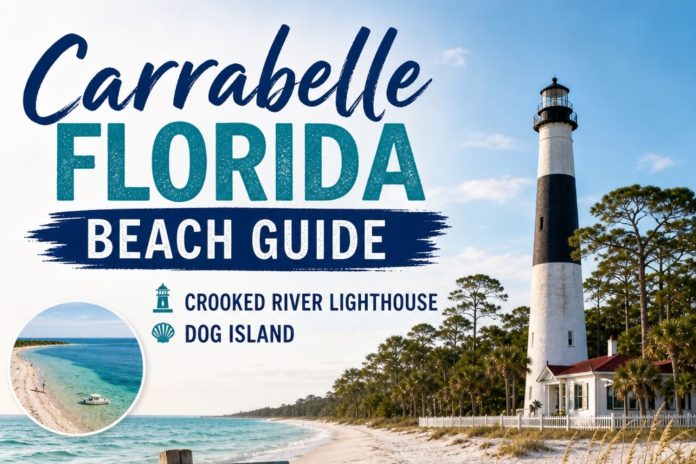
Carrabelle Beach, the Crooked River Lighthouse, and Dog Island, Florida
Carrabelle is the kind of small Gulf town that made its living from the water and never tried to be anything else. It has a public beach protected by Dog Island sitting offshore, a 130-year-old lighthouse still in operation, the World’s Smallest Police Station (a converted phone booth on US 98 that genuinely gets more visitors than city hall), and a working waterfront where the fishing boats come in before most people have had breakfast. Three and a half miles offshore, Dog Island sits on the Gulf with seven miles of near-empty white sand beach that you can only reach by ferry, kayak, or boat. Getting there requires planning. It is worth every bit of it.
Carrabelle sits in Franklin County on US 98, at the point where the Crooked River and the Carrabelle River meet and drain into St. George Sound. It’s the last real town before the coast turns the corner into Wakulla County and the Big Bend begins. The Forgotten Coast character is fully intact here: no high-rises, no resort strip, no chain restaurants worth mentioning. What you’ll find is a working waterfront, a lighthouse that’s been guiding boats into the Sound since 1895, and a public beach that gets protected from Gulf swells by the barrier island sitting offshore.
That barrier island is Dog Island. Most of it belongs to The Nature Conservancy, which makes it one of the most intact undeveloped barrier islands in the entire Florida Panhandle. About 100 residents have cottages scattered on the island. There are no paved roads, no stores, no public restrooms, and no way to get there without a boat. The ferry runs on a limited schedule from Carrabelle, and getting it right requires a call to Captain Mike 24 hours in advance.
I’ve walked Carrabelle Beach and climbed the Crooked River Lighthouse and written about both in my Carrabelle and Crooked River Lighthouse guide. This article brings the whole picture together: the beach, the lighthouse, the town, Dog Island, and a brief look at Lanark Village to the east with its deep WWII history.
The Vibe and Character of Carrabelle
A Fishing Town That Kept Being a Fishing Town
Most small Gulf coast towns got absorbed into the tourism economy at some point. Carrabelle mostly didn’t, and you can feel that the moment you pull off US 98 onto the waterfront road and the boat trailers outnumber the rental cars three to one.
The Carrabelle River waterfront is the soul of this town. Shrimping boats and fishing charters tie up along the dock, the bait shops open before dawn, and the morning crowd at the coffee counter is talking tides and bait rather than where to eat brunch. The working-waterfront character isn’t performed for visitors. It simply hasn’t been replaced yet by anything else, which puts Carrabelle in a rare category among Florida Gulf coast towns.
The famous World’s Smallest Police Station is a converted telephone booth on US 98 that the town has maintained as a genuine working police dispatch point and a genuine roadside attraction simultaneously. It has been featured in Ripley’s Believe It or Not, photographed millions of times, and it still does exactly what a police station is supposed to do even if the officer has to take calls outside. That combination of practical and absurd is distinctly Carrabelle.
The town has a small but committed dining and nightlife scene for a community this size. Harry A’s on the waterfront is a Carrabelle institution, known for fresh Gulf seafood and the kind of wooden bar where regulars have their usual stool. The nearby marinas serve the charter fleet that runs offshore for grouper and snapper, and the inshore guides who know the St. George Sound redfish flats spend their off-time at the same places. For anyone coming off the Big Bend coast to the east or working east from St. George Island, Carrabelle is the right place to land for a night and get your bearings.
Carrabelle Beach, the Lighthouse, Dog Island, and More: Every Stop
Carrabelle Beach
US Highway 98 West · Free Parking · Dogs Welcome on Leash
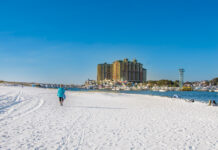
Carrabelle Beach sits about 1.5 miles west of town on US 98, a public beach park that earns its place in any Forgotten Coast guide through a combination of genuine sand quality, calm swimmable water, and facilities that make a full beach day easy. You’ll notice the parking situation immediately: it’s free, it’s ample, and it’s covered pavilions and grills and outdoor showers and a genuine Gulf beach right in front of you, none of which cost you anything to use. For a beach this quality on this coast, that combination is not something to take for granted.
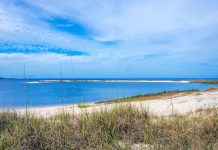
The sand here is worth paying attention to. This is quartz-influenced Forgotten Coast sand, white to warm cream, finer and softer than what you’ll find further east at Alligator Point and fading toward the Big Bend. Dog Island offshore blocks the direct Gulf swell from most directions, which means the water at Carrabelle Beach runs calm and relatively flat with only modest wave action even when conditions elsewhere on the Gulf are rough. That protection is the defining feature of the beach experience: you can reliably plan a swimming day here when beaches on the open Gulf are dealing with surge and chop.
Dogs are welcome on leash at Carrabelle Beach, which puts it in a small category of Forgotten Coast beaches that genuinely accommodate traveling with a pet. The calm, protected water is as good for dogs as for children, and the low crowds outside of summer mean your dog has room to move without navigating a dense beach scene. Sea turtle nesting runs May through October on the upper beach; give any nest markers a wide berth and keep your dog away from the dune line during nesting season. The beach is low-key enough that local wildlife, particularly shorebirds, works the wrack line without constant human pressure, which is worth noting for anyone with binoculars.
The Crooked River Lighthouse
Built 1895 · Still Operating · Open for Tours
The Crooked River Lighthouse stands 100 feet on the east bank of the Crooked River just north of US 98, a white iron tower that replaced an earlier lighthouse on Dog Island after the 1873 lighthouse there was repeatedly battered by storms. The current lighthouse has been operating continuously since 1895, making it one of the longer-running light stations on the Apalachee Bay coast. It’s automated now, but the light still turns, and the keeper’s quarters and grounds have been restored and are open for tours.
You’ll notice the tower’s white iron construction sets it apart from the brick lighthouses further west. The spiral staircase inside climbs 127 steps to the lantern room, and the view from the top is the best justification for the climb: St. George Sound opens in front of you to the west and south, Dog Island sits offshore just three and a half miles away, the Big Bend marsh begins at the horizon to the east, and the Carrabelle River winds into town below you. That single view explains the entire geography of this corner of the coast more clearly than any map. I stood up there for longer than I planned to.
The Crooked River Lighthouse Association manages the site. Tours are available, and the keeper’s cottage museum covers the history of the lighthouse, the town, and the maritime culture of the Sound. Check current hours before you go, as tour schedules vary seasonally. The lighthouse grounds include a small gift shop and interpretive panels covering the history of the Dog Island lighthouse system, the storms that shaped it, and the keepers who maintained the light across the generations. If you have children with you, the climb itself is the activity that earns the visit for them.
Carrabelle Town and the Working Waterfront
The Carrabelle River · Charter Fleet · World’s Smallest Police Station
The town of Carrabelle is compact enough to walk in an afternoon, and the waterfront is the part worth your time. The Carrabelle River runs through the center of things, with the marina and charter fleet on the east bank and the commercial fishing docks further down. The boats that come through here work the offshore grouper and snapper grounds and the inshore redfish and sea trout flats in St. George Sound, and the town’s economy still turns on what those boats find.
The World’s Smallest Police Station at the intersection of US 98 and Avenue A is a genuine local landmark with a genuine history. The city installed a telephone booth as a working police dispatch station in 1963 after the original station burned down, and the arrangement worked well enough that it stayed. Guinness World Records eventually took note. The booth has been replaced and updated over the decades but the concept has remained the same, and it still works as a police call point, which makes it simultaneously a tourist attraction and a functioning piece of municipal infrastructure. Stop and photograph it. Everyone does.
The Camp Gordon Johnston WWII Museum on US 98 is worth an hour for anyone interested in the history of this corner of Florida. Camp Gordon Johnston was one of the largest amphibious training bases in the country during World War II, with 40,000 troops trained here on the waters of Apalachee Bay before amphibious landings in Europe and the Pacific. The museum covers the history of the base and the role the local coast and water played in preparing soldiers for some of the war’s most consequential operations. For the scale of what happened here, the museum is remarkably little-known outside the local area.
Dog Island
3.5 Miles Offshore · Ferry by Reservation · No Facilities
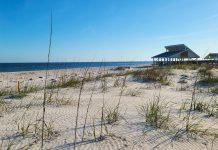
Dog Island is what most of the Panhandle’s barrier islands looked like before resort development arrived. The Nature Conservancy owns the bulk of the island as a wilderness preserve, and the rest is held by a small community of private landowners with cottages scattered among the dunes and maritime forest. There are no paved roads, no stores, no restaurants, and no public restrooms anywhere on the island. What there is: seven miles of Gulf-side white sand beach on the south shore, interior marshes and pine forest, and a quiet that the mainland hasn’t had since before the highway arrived.
The beach on the Gulf side is the real thing. Quartz white, fine-grained, wide in places, and almost entirely free of foot traffic on any given day. Loggerhead and green sea turtles nest here from May through October. The nesting is active enough that the Florida Fish and Wildlife Conservation Commission monitors it, and the east and west ends of the island have designated bird nesting zones that are strictly off-limits for people and pets at all times. Stay out of those areas. The shorebird concentrations in the areas open to visitors are excellent, and the shelling after a north wind on the Gulf side is consistently among the best on the Forgotten Coast chain.
Getting there requires planning. The official ferry runs from Carrabelle’s waterfront on a schedule that has changed as of June 2026 and no longer operates Tuesday or Wednesday. The ferry is primarily intended for island residents and their guests, with beach tour availability varying by season and capacity. Call Captain Mike at 850-879-4579 at least 24 hours in advance to check availability and current schedule. The crossing is about 20 minutes and runs roughly $15 each way. Private water taxis and charter boats from the Carrabelle marina can also make the crossing by arrangement. Kayaking from the Carrabelle waterfront launch is possible for experienced paddlers in calm conditions, roughly 3.5 miles across the Sound; check wind and current before committing to that crossing. There is also a small private airstrip on the island for those arriving by small plane.
Bring everything you need for the day: water, food, sunscreen, a bag for any trash, and a full understanding that there is nothing on the island to resupply you. The absence of facilities is also the absence of crowds, and that trade is the entire point of Dog Island.
Lanark Village and the Camp Gordon Johnston Coast
Franklin County · Five Miles East on US 98 · Historical Coast
Lanark Village is a quiet retirement community about five miles east of Carrabelle on US 98, situated along Ochlockonee Bay where the county line with Wakulla is just ahead. It doesn’t have a traditional beach in the resort sense, but the small waterfront park and bay access point there give you a calm, flat view across the bay toward St. George Island and Dog Island in the distance. The water here is sheltered and shallow, more suited to birdwatching and fishing than swimming, and the community itself is the kind of old Florida place that doesn’t make noise about itself.
What Lanark Village has that most people don’t associate with a beach stop is history. The shoreline here was the eastern training ground for Camp Gordon Johnston during World War II, the amphibious training base that used the shallow, flat-bottomed waters of Apalachee Bay to train tens of thousands of soldiers in landing craft operations before some of the war’s defining amphibious assaults. Driving east on US 98 through this area, the flat coastal landscape and the wide open bay make it easy to picture the scale of what happened here.
The stop doesn’t need to be long. The bay view is worth a pause, and the historical context it adds to the broader Carrabelle area deepens the visit in a way that’s easy to miss if you’re only thinking about sand and water. If you’re interested in the full Camp Gordon Johnston story, the museum back in Carrabelle covers it in depth and is worth the hour before or after your time on the coast.
Carrabelle and Dog Island Rankings: Expert Scores
These scores cover the mainland Carrabelle Beach and the overall experience including Dog Island as a day trip option. The scores would shift notably if you’re scoring Dog Island alone, where sand quality, shelling, and solitude would each be a point or two higher. I’ve weighted the combined experience here.
Sand Quality
7/10
Carrabelle Beach runs white to warm cream quartz sand, genuine Forgotten Coast quality, protected enough by Dog Island that it doesn’t get churned by heavy surf. Dog Island’s Gulf-side beach is a step up in purity and texture with less foot traffic compacting the surface. Together they represent some of the best sand quality east of St. George Island on this stretch of coast.
Hiking and Beach Walking
7/10
Carrabelle Beach itself is a comfortable walk in both directions along the protected shoreline. Dog Island’s seven miles of Gulf-side beach is among the longest uninterrupted walking stretches accessible from Carrabelle, though getting there requires the ferry or a boat. The Crooked River Lighthouse climb is a vertical 127-step walk with the best view on the coast at the top.
Shelling
7/10
Better than most of the Forgotten Coast east of Carrabelle, and significantly better on Dog Island than on the mainland beach. The Gulf-side beach of Dog Island after a north wind produces lightning whelks, fighting conchs, horse conchs, and calico scallops from the open Gulf with minimal competition. Carrabelle Beach’s protected position limits the deposit, but the wrack line after storms is reliably worthwhile.
Water Conditions
7/10
Carrabelle Beach’s Dog Island-protected water is calm and swimmable in almost all conditions, with clarity running good on calm days and dropping after rain or strong north wind. Dog Island’s Gulf-side beach has more honest wave action and better water clarity on calm days, behaving more like a traditional Panhandle beach than the Sound-side mainland. Together they score well for a Forgotten Coast location.
Scenery and Natural Beauty
8/10
The view from the Crooked River Lighthouse top is the signature scenery moment: the Sound, Dog Island offshore, the Big Bend coast beginning to the east, and the Forgotten Coast chain to the west. The Dog Island beach is the unmarked wilderness version of what most people imagine when they think of a Florida barrier island. The river waterfront at Carrabelle adds a working-waterfront layer most Forgotten Coast beaches don’t offer.
Birding and Wildlife
8/10
Sea turtle nesting at both mainland and Dog Island. Shorebirds working the Carrabelle Beach wrack line. Dog Island’s Nature Conservancy land supporting nesting colonies that are strictly protected in the east and west end zones. Dolphins common in St. George Sound. Pelicans, ospreys, and herons working the river and Sound consistently. The combination of mainland and island access makes this a strong wildlife stop.
Family Friendliness
8/10
Carrabelle Beach is one of the better family beach setups on the Forgotten Coast: calm water, free parking, covered pavilions, outdoor showers, and a town within easy driving distance for food and supplies. Dog Island is a more independent experience requiring planning, but the empty beach and sea turtle habitat make it a compelling add-on for families with older children. No lifeguards at either location.
Dog Friendliness
8/10
Carrabelle Beach allows leashed dogs, and the calm protected water and low crowds make it one of the more comfortable dog beach experiences on the Forgotten Coast. Dog Island allows dogs with important restrictions: the east and west end bird nesting zones are strictly off-limits for people and pets at all times. The open central section of the island beach is dog-accessible with a leash.
Solitude and Peace
7/10
Carrabelle Beach gets enough local and Tallahassee weekend traffic in summer to feel moderately active, though never crowded by any Florida standard. Dog Island is an entirely different proposition: the ferry access limits the crowd to whoever makes the reservation and crossing, and the beach is routinely empty in sections even during summer. The solitude score would be a 10/10 for Dog Island alone.
Entertainment and Nightlife
4/10
Carrabelle has Harry A’s and a handful of other local options that punch above their weight for a town this small. There is no evening scene on Dog Island. The score reflects the mainland offering: good enough for a genuine Gulf town dinner and a quiet night, not a late-night restaurant district. Apalachicola, about 40 miles west, expands the evening options significantly for anyone based here.
Parking and Beach Access
8/10
Carrabelle Beach has free parking and is easy to find on US 98. The town waterfront has informal free parking near the marina. Dog Island access requires the ferry reservation and the $15 each-way crossing, which is a different category of access planning than a parking lot, but the experience delivered justifies the effort. The combined score reflects the ease of the mainland beach and the required intention of the island.
Carrabelle Beach Sand & Water
Carrabelle Beach is flat and easy underfoot, a gentle curve of sand that doesn’t ask much of you to enjoy it. The upper beach is soft enough for lounging, blankets, and building with the kids, while the sand right at the waterline packs down firm, giving you solid footing for walking, wading, or just standing to watch the water without sinking in. It’s a comfortable width rather than a sprawling one, plenty of room for a cooler and a game of catch without feeling crowded, and the gentle slope means there’s no steep drop-off to manage on your way in. Sandcastles hold together reasonably well close to the water, and the flat, groomed sand makes for an easy, relaxed walk in either direction.
The water here is calm, protected by Dog Island sitting a few miles offshore, so you get a gentle blue-green to turquoise color on a good day rather than the rougher chop of an open Gulf beach. Entry is gradual, no steep drop right off the sand, which makes this a comfortable spot for cautious swimmers, kids, and anyone who wants an easy float rather than a wave to fight. Clarity is good on calm mornings and drops for a day or two after rain or a strong north wind. Because Dog Island blocks most of the direct Gulf swell, rip currents aren’t the concern here that they are on more exposed beaches, though there are still no lifeguards on duty, so keep young or inexperienced swimmers within easy reach regardless.
-
Walkability. Comfortable and easy along the curve of the beach, flat and gently sloped with no steep berm to navigate. Modest in length compared to the barrier islands further west, better suited to a relaxed stroll than serious distance.
-
Softness & Playability. Soft enough on the dry upper beach for lounging and games, with plenty of room for a blanket, a cooler, and sandcastles that hold their shape best right near the waterline.
-
Barefoot Comfort. Comfortable through most of the beach, just expect a bit more shell underfoot than you’d find on the purest Panhandle beaches further west.
-
Swimmability. Calm, shallow, and protected by Dog Island offshore, making this one of the easier, lower-risk beaches on this stretch of coast for casual swimming. No lifeguards, so keep an eye on kids regardless.
Want the full geology, grain composition, and the complete sand and water condition ratings? I broke it all down separately in Sand & Shore: Carrabelle Beach.
Dogs & Pet Accessibility
Are Dogs Allowed on the Sand? YES, ON LEASH.
Carrabelle Beach is genuinely dog-friendly, one of the more comfortable Forgotten Coast beaches to bring a dog to, with calm, protected water and low crowds outside of summer weekends.
Where Dogs Are Allowed
- ✓Carrabelle Beach, the main public beach park, leashed dogs welcome on the sand and in the calm water.
- ✓Old Carrabelle Beach, the quieter extension past the main park, same leash rule applies.
- ✓The central section of Dog Island’s beach, leashed, if you make the ferry crossing.
- ✓Downtown sidewalks along the Carrabelle Riverwalk and waterfront.
Where Dogs Are NOT Allowed
- ✗The east and west end bird-nesting zones on Dog Island, strictly off-limits to people and pets at all times, clearly signed and enforced.
- ✗The Crooked River Lighthouse tower itself. Check current policy for the grounds and museum before bringing a dog to that stop specifically.
Paws on the Ground Reality
The calm, Sound-protected water at Carrabelle Beach is genuinely pleasant for a dog, shallow and easy compared to open Gulf surf, and the low crowds outside of summer mean plenty of room to move. Bring your own fresh water regardless, there’s none on the beach itself past the restroom facilities at the main park, and there’s none at all on Dog Island.
Dog Island takes real planning if you’re bringing a dog along. The ferry crossing is about 20 minutes, the central beach section is leash-friendly, and the nesting zones at both ends are non-negotiable closures. Confirm your dog is welcome on that particular ferry crossing when you call Captain Mike to book.
Crowd Levels and the Overall Feel of Carrabelle
Carrabelle Beach runs at a comfortable local pace with seasonal peaks that never approach the scale of the Panhandle resort beaches to the west. Summer weekends see the most traffic: Tallahassee day-trippers make up a significant portion of the summer beach crowd, taking advantage of Carrabelle’s position about 75 miles southeast of the capital on a straightforward highway route. The beach handles that traffic comfortably because the facility is well-designed for a volume that stays well below its theoretical limit.
Dog Island operates on an entirely different crowd scale. The ferry capacity and the residents-first booking system mean the island beach sees a handful of people on a typical day and occasionally no one at all on a weekday in the off-season. Summer weekends at Carrabelle Beach feel moderately active. A summer weekday at Dog Island can feel like you have a seven-mile barrier island to yourself.
- Spring: Light to moderate at Carrabelle Beach, ideal conditions for weather and water temperatures. The lighthouse is active with tours. Good shelling window if north winds cooperate. Dog Island is quiet and highly accessible for anyone who books the ferry.
- Summer: Peak season at the mainland beach, with weekends seeing the most activity. Water is warmest. Sea turtle nesting on both shores from May onward. Dog Island gets occasional private boat traffic but never feels crowded. The offshore charter fishing is at its most productive.
- Fall: My preferred season. Water stays warm well into October. Crowds drop. Hurricane season requires attention to weather systems moving through, which can affect both the mainland beach and the Dog Island ferry schedule. Shelling improves significantly with fall storm activity on the Gulf.
- Winter: Quiet on the mainland beach, with the water too cold for most swimmers. The lighthouse tours continue on a reduced schedule. Dog Island at its most solitary. Offshore fishing remains productive. The town’s local character is most visible when the summer visitor layer peels away.
Who Is Carrabelle and Dog Island Really For?
✓ Who Will Love This Stop
-
Families who want a calm, safe, well-equipped public beach with free parking and no admission cost, in a setting that still feels like an actual community rather than a resort development.
-
Lighthouse enthusiasts and history lovers who want the combination of a working lighthouse tour and the Camp Gordon Johnston WWII history in the same afternoon.
-
Dog owners who want a Forgotten Coast beach that genuinely welcomes dogs on leash, with calm water and low crowds that make the experience comfortable for the animal.
-
Adventure-minded travelers who want to experience an undeveloped barrier island without needing their own boat, and are willing to plan around the ferry schedule to get to Dog Island.
-
Shellers who want serious post-storm finds from the open Gulf system on Dog Island with minimal competition, paired with a comfortable mainland base at Carrabelle Beach.
-
Road trippers working the Forgotten Coast east-to-west or west-to-east who need a full-destination stop with a beach, a landmark, and a town character that earns an overnight stay.
✗ Consider Another Stop If…
-
You want a beach with a lifeguard. There are no lifeguards at Carrabelle Beach or anywhere on Dog Island.
-
You want the Dog Island experience without planning ahead. The ferry requires a 24-hour advance call, runs a limited schedule, and is not a walk-up public service. Showing up in Carrabelle and expecting to get to the island that day without a reservation is not a reliable strategy.
-
You need resort amenities, nightlife, or a significant restaurant scene. Carrabelle has the essentials and a couple of genuinely good local spots, but it’s a small working town, not a dining destination.
-
You want the quartz-sand open Gulf swimming experience on the mainland. Carrabelle Beach is protected by Dog Island, which creates calm water but also limits the open Gulf beach character. Head to St. George Island for that version.
Things to Do at Carrabelle and Dog Island
-
Climb the Crooked River Lighthouse. 127 steps to the lantern room and the best single view on this stretch of the Forgotten Coast. The keeper’s cottage museum adds context. Check current tour hours with the Crooked River Lighthouse Association before arriving, as the schedule varies by season.
-
Swim and Walk at Carrabelle Beach. Free parking, covered pavilions, calm Sound water protected by Dog Island. Good for young swimmers and dogs alike. Walk east from the main access point for the quietest section of beach, where shorebirds work the wrack line without much competition. Check nesting markers during summer and give them a wide berth.
-
Day Trip to Dog Island. Call Captain Mike at 850-879-4579 at least 24 hours ahead to check availability and the current ferry schedule (as of June 2026 the ferry no longer runs Tuesday or Wednesday). Bring everything: food, water, sunscreen, a bag for shells, and a trash bag for anything you bring onto the island. The round trip on the ferry takes about 40 minutes and the crossing is approximately $15 each way.
-
Shell Dog Island After a North Wind. The Gulf-side beach of Dog Island after a north wind event is one of the more productive shelling opportunities on the Forgotten Coast. Lightning whelks, fighting conchs, horse conchs, and olives all come in from the open Gulf with minimal competition. Go first thing in the morning before anyone else makes the crossing.
-
Charter Fishing from Carrabelle Marina. Offshore grouper and snapper, inshore redfish and sea trout in the flats of St. George Sound. The Carrabelle charter fleet works both the offshore grounds and the exceptional inshore fishery that the Sound’s seagrass beds support. Several captains operate from the Carrabelle waterfront and can be booked through the marina.
-
Kayak the Carrabelle River. The Carrabelle and Crooked Rivers offer quiet paddling through tidal marsh and the working waterfront, with osprey fishing the shallow edges and occasional dolphin sightings in the Sound. The crossing to Dog Island is 3.5 miles and should only be attempted by experienced paddlers in calm wind and current conditions.
-
Photograph the World’s Smallest Police Station. This is not optional. The converted phone booth at the intersection of US 98 and Avenue A in Carrabelle is a genuine piece of Florida roadside history that has been featured in Ripley’s Believe It or Not and photographed by more people than most museums. Stop. Take the photo. Accept that you’re part of a tradition now.
-
Camp Gordon Johnston WWII Museum. An hour well spent for anyone interested in the history of this coast. The museum covers the training of 40,000 soldiers on the waters of Apalachee Bay before amphibious operations in Europe and the Pacific, with artifacts, photographs, and firsthand accounts from the largest amphibious training base in the country during World War II.
Local Knowledge and Practical Advice
A few things I picked up about Carrabelle and Dog Island that save time and improve the visit:
-
Call the ferry 24 hours in advance, not the morning you want to go. The Dog Island ferry is primarily for residents and their guests, with day-visitor beach tours available when capacity permits. Captain Mike’s number is 850-879-4579. Call the afternoon before you plan to cross, not the morning of. As of June 2026, the ferry does not run on Tuesday or Wednesday. Confirm the current schedule when you call.
-
Dog Island has no facilities at all. No public restrooms, no stores, no restaurants, no fresh water sources. Everything you need for the day goes in your bag before you board the ferry. Pack more water than you think you need. Bring a bag for shells and a separate bag for trash, since leave-no-trace is not a suggestion on a Nature Conservancy island.
-
The east and west ends of Dog Island are strictly off-limits for people and pets. Bird nesting zones at both tips of the island are protected at all times. This is enforced and the signage is clear. The central section of the island beach is where you want to be anyway for the best shelling and walking, so the restriction rarely conflicts with a well-planned day.
-
Sea turtle nesting runs May through October at both locations. At Carrabelle Beach, stay off any marked nest areas on the upper beach. At Dog Island, the nesting density is higher and the beach is less managed, so pay attention to any disturbed-looking upper beach material and give it significant space. Dogs must be leashed specifically because of nesting activity and do not allow them to dig in or near the dune base.
-
Check current lighthouse tour hours before making it the centerpiece of your day. The Crooked River Lighthouse Association manages tours on a seasonal schedule that varies by time of year. The lighthouse is worth a dedicated stop, and arriving to find tours aren’t running that day is avoidable with a quick check on the current schedule before you drive out.
-
The Dog Island ferry doesn’t run in bad weather. The 3.5-mile crossing across St. George Sound can be rough when wind is up, and Captain Mike will cancel the run rather than take risks on the water. If you’re planning a Dog Island day, build flexibility into your schedule so a weather cancellation doesn’t collapse the entire trip. Morning crossings tend to be calmer than afternoon when the sea breeze builds.
-
Stock up before you arrive. Carrabelle has a grocery store and gas stations, but the selection is small-town. If you’re heading to Dog Island the next morning, do your provisioning the afternoon before. Apalachicola, 40 miles west, has more options for anything you can’t find in Carrabelle.
-
The lighthouse view is best in the morning before heat haze builds. The 100-foot elevation gives you a clear sightline to Dog Island, St. George Island, and the beginning of the Big Bend coast to the east. On a clear morning that view is sharp and worth the climb on its own. By early afternoon in summer, haze reduces the distance visibility noticeably.
Where to Stay Near Carrabelle and Dog Island
Vacation Rentals in Carrabelle
Carrabelle’s vacation rental market runs the range from basic fishing cottages on the river to more comfortable Gulf-view houses along US 98 near the beach. Staying in town gives you walking access to the waterfront, the lighthouse grounds, and the marina, with the beach a short drive west. VRBO and Airbnb both list properties in the immediate Carrabelle area. The town’s small scale means almost any rental puts you within five minutes of everything.
Dog Island Vacation Rentals
A small number of private vacation rental cottages are available on Dog Island itself, primarily through word of mouth and island community connections rather than major platforms. Staying on the island overnight is the full Dog Island experience: no ferry schedule to catch, no mainland noise, and a barrier island beach that belongs entirely to whoever is there that night. Research availability through the Dog Island community networks or contact local Carrabelle real estate contacts for cottage availability. Book well ahead, as the inventory is genuinely small.
The Old Carrabelle Hotel
The Old Carrabelle Hotel in the historic downtown is a locally celebrated lodging option with character that goes with the town rather than against it. Walkable to the waterfront, the lighthouse, and the few restaurants and bars the town maintains. The right choice for anyone who wants to be embedded in Carrabelle’s own rhythm rather than arriving from a motel on US 98.
Camping Nearby
Carrabelle itself doesn’t have a developed campground within town, but the surrounding Apalachicola National Forest has primitive and developed camping options within driving range. St. George Island State Park, about 45 minutes west, has a full campground with 60 sites and is the best-equipped camping option in the immediate region for anyone who wants both camping and quality beach access.
Apalachicola as a Base
Apalachicola, 40 miles west on US 98, offers the widest range of lodging in the region: historic inns, bed-and-breakfasts in the Victorian downtown, and more dining options than Carrabelle alone provides. Staying in Apalachicola and day-tripping to Carrabelle works well for a multi-day Forgotten Coast exploration that also takes in St. George Island and the Apalachicola waterfront.
What Makes Carrabelle and Dog Island Different from Nearby Beaches
The Only Ferry-Access Wilderness Island on the Forgotten Coast
St. Vincent Island to the west is a federal wilderness accessible only by private boat or chartered ferry, and Little St. George is the same. Dog Island occupies a unique position: it’s a Nature Conservancy wilderness preserve accessible by a scheduled ferry service from a town that has everything you need to plan the crossing and spend the day. That combination of accessible ferry and genuinely undeveloped island beach doesn’t exist anywhere else on the Panhandle at this scale.
A Working Lighthouse in Context
The Crooked River Lighthouse is not a museum piece. It operates. The light still turns. Climbing it puts you at the geographic and historical intersection of the Forgotten Coast’s lighthouse system, with Dog Island visible offshore and the entire Panhandle chain stretching west. The lighthouse story here is also a Dog Island story: the current lighthouse was built specifically because the earlier lighthouse on Dog Island couldn’t survive the storms that repeatedly battered the barrier island.
The Sand-to-Town Balance
Most Forgotten Coast beach stops ask you to choose between a good beach and a genuine town. Carrabelle provides both at comfortable driving distance of each other: Carrabelle Beach for the water, the lighthouse for the history, and the working waterfront for the evening. Dog Island adds a third dimension that most coastal towns in Florida can’t provide: a wilderness barrier island day that requires planning but rewards it in proportion.
The WWII Dimension
Camp Gordon Johnston’s presence in the history of this coast is disproportionate to how much it’s discussed in most Florida travel contexts. Forty thousand soldiers trained in the shallow waters of Apalachee Bay within sight of this coastline. The museum in Carrabelle makes that history accessible. Very few Florida beach destinations have a WWII training legacy this direct and this well-documented.
Carrabelle vs. Nearby Forgotten Coast Beaches
Carrabelle Beach vs. Alligator Point
Both are local, low-key Forgotten Coast beaches without resort infrastructure. Alligator Point has a more dramatic peninsula character and better access to the Nature Conservancy’s aquatic preserve habitat. Carrabelle Beach has better facilities, a town immediately behind it, and the lighthouse as a bonus. The ferry to Dog Island tips the scale toward Carrabelle for any visitor who wants more than a beach.
Carrabelle and Dog Island vs. St. George Island
St. George Island is the more famous and more developed version of this coastline, with the state park at one end delivering one of the finest undeveloped Gulf beaches in the state. Dog Island is quieter, smaller, and less accessible, but it delivers the undeveloped barrier island experience without the crowd even the state park draws on busy days. The sand at Dog Island’s Gulf side is comparable to the state park’s best sections. Getting there is harder. That’s the trade.
Carrabelle Beach vs. Bald Point State Park
Bald Point is a state park bay beach a short drive east with superior wildlife habitat and the fall migration corridor. Carrabelle Beach is a more comfortable, more conventional beach day with better sand and calmer water. They’re complementary rather than competitive, and doing both in a two-day visit covers the full range of what the Forgotten Coast east end offers.
Bottom line: Carrabelle works as a Forgotten Coast destination rather than a stop specifically because it gives you three things in one address: a good beach, a landmark worth visiting for its own sake, and a ferry to a wilderness island that almost no one on the mainland beach has been to. That combination is harder to find than it sounds, and it’s what makes Carrabelle the right answer to the question of where the Forgotten Coast’s eastern edge actually lands.
Carrabelle Beach, the Crooked River Lighthouse, and Dog Island: Frequently Asked Questions
Is there a fee to park at Carrabelle Beach?
No. Parking at Carrabelle Beach is free. The beach is a public access area on US 98 with covered pavilions, outdoor showers, and restrooms available at no charge. This is one of the few well-equipped free public beaches on the Forgotten Coast.
Are dogs allowed at Carrabelle Beach?
Yes. Dogs are allowed at Carrabelle Beach on a leash. The calm, protected water and low crowds make it a comfortable beach experience for dogs. Keep dogs away from any sea turtle nest markers on the upper beach, particularly during nesting season from May through October.
How do I get to Dog Island?
By ferry, private boat, kayak, or small plane. The Dog Island Ferry (dogislandferry.org) is the most accessible option: call Captain Mike at least 24 hours in advance to check availability and schedule. As of June 2026, the ferry does not run on Tuesday or Wednesday. The crossing from Carrabelle takes approximately 20 minutes and costs around $15 each way. The ferry is primarily for residents and guests, with beach tour availability varying by day and season.
What should I bring to Dog Island?
Everything you need for the day, since there are no stores, restaurants, or public restrooms on the island. Water, food, sunscreen, a hat, bug repellent, a shell bag, and a trash bag for packing out what you bring in. The island is a Nature Conservancy wilderness preserve and operates on leave-no-trace principles.
Are dogs allowed on Dog Island?
Dogs are allowed in the central section of Dog Island beach with a leash. The east and west end bird nesting zones are strictly off-limits for both people and pets at all times. The ferry may have specific policies about dogs on board, so confirm when making your reservation.
Is the Crooked River Lighthouse open for tours?
Yes, tours are available. The lighthouse is managed by the Crooked River Lighthouse Association and the keeper’s cottage museum is open on a seasonal schedule that varies by time of year. Check the current hours before planning a visit, as the schedule changes seasonally and on holidays.
How tall is the Crooked River Lighthouse?
100 feet tall, with 127 steps to the lantern room. It was built in 1895 to replace a lighthouse on Dog Island that was repeatedly damaged by storms. The lighthouse is still operational, with an automated light that still guides vessels into St. George Sound.
Is there anything to do on Dog Island besides the beach?
Shelling is exceptional after north winds. Birding is excellent throughout the open central section of the island. The maritime forest interior has walking routes through scrub and pine habitat. There are lighthouse ruins from the 1850s at the eastern tip. There are no facilities, commercial activities, or organized amenities anywhere on the island.
What is the World’s Smallest Police Station?
A converted telephone booth on US 98 at Avenue A in Carrabelle that has functioned as a working police dispatch point since 1963, when the original police station burned down. It has been featured in Ripley’s Believe It or Not, recognized by Guinness World Records, and photographed millions of times. It is still a functional piece of municipal infrastructure.
How far is Carrabelle from Tallahassee?
About 75 miles southeast of Tallahassee, roughly 90 minutes on US 98. Carrabelle is a common day-trip destination for Tallahassee residents, which is the source of much of its summer weekend beach traffic. The drive on US 98 through the Apalachicola National Forest corridor is one of the more scenic highway routes in the Panhandle.
What is the Camp Gordon Johnston WWII Museum?
A museum in Carrabelle documenting the history of Camp Gordon Johnston, one of the largest amphibious training bases in the country during World War II. Approximately 40,000 soldiers trained in the shallow waters of Apalachee Bay here before amphibious operations in Europe and the Pacific. The museum covers the history with artifacts, photographs, and firsthand accounts from the era.
Patti’s Perspective: My Honest Take on Carrabelle and Dog Island
The lighthouse view is the thing I keep going back to when I think about this stop. I climbed it on a clear morning in early spring, before the heat built and before anyone else had shown up for the tour, and from the lantern room 100 feet up I could see the whole picture at once: St. George Island to the west, Dog Island sitting right offshore across the Sound, and the Big Bend marsh beginning to the east. That’s the entire transition of the Florida coast compressed into a single view from one place. I took a lot of photos up there that morning, and then I put the phone down and just looked for a while.
Carrabelle Beach surprised me the way good simple things do. I had higher expectations for Alligator Point and Bald Point, which delivered on them. Carrabelle Beach I came to with no particular expectation, and the calm water, the free parking, the covered pavilions, and the decent sand all added up to a beach that did exactly what a good public beach is supposed to do without making any fuss about it. The dogs on the beach, leashed, having the time of their lives in the calm Sound water while their owners walked the shoreline, was the kind of scene that tells you a beach is genuinely working for the people and animals who use it.
Dog Island is on my return list. I saw it from the lighthouse and from the beach at Carrabelle and I didn’t get the ferry reservation sorted out in time for that visit. Everything I know about it from research and from the view across the Sound tells me it’s one of the more significant undeveloped barrier island beach experiences left accessible to someone without their own boat. I’ll write up the full crossing and the island walk when I get back there.
My walking guide to the Carrabelle coast covers the beach walk and the Crooked River route: Hiking and Walking Carrabelle Beach and the Crooked River.
My verdict: 5/10. Carrabelle earns its score not by doing any one thing at an exceptional level but by doing four things well at the same address: a decent beach, a real working lighthouse, a town that kept its own character, and a ferry to a wilderness island that almost no one on the mainland beach has been to. The lighthouse view alone might be worth the stop. Dog Island as a day trip option is the thing that makes this a destination rather than a pleasant overnight on the Forgotten Coast.
Want to Live on the Forgotten Coast Near Carrabelle?
Carrabelle and Franklin County sit at one end of the Forgotten Coast real estate market, which has seen growing interest from buyers priced out of more developed Gulf coast markets and drawn by the combination of water access, intact natural character, and a small-town culture that hasn’t been standardized out of existence. Carrabelle’s waterfront and river-adjacent properties are the most sought-after in town, with vacation rental cottages near the beach and working waterfront homes along the Carrabelle River offering different versions of the same Gulf access story.Dog Island vacation rental properties represent a genuinely rare market: a small inventory of cottage properties on a Nature Conservancy wilderness island with no development pressure and no infrastructure expansion planned. Ownership on Dog Island is the most private version of Forgotten Coast real estate available, and the community’s deliberate maintenance of the island’s character means that what you buy there is what you keep.For anyone drawn to the Forgotten Coast lifestyle but looking for more services than Carrabelle alone provides, Apalachicola and the Franklin County market as a whole give buyers a range from the working fishing-town character of Carrabelle to the Victorian historic district of Apalachicola, all within the same county and the same coastline character that keeps this part of Florida from becoming what the areas to the south already are.
Explore Waterfront Living at LiveByTheWater.com
Real estate referral partner