




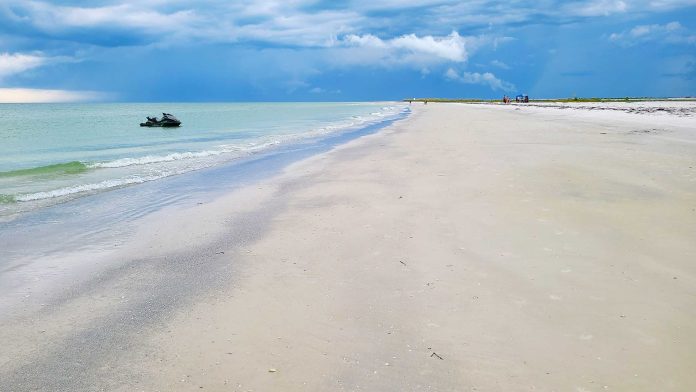
Fort De Soto Park Beaches, Florida
Fort De Soto is the beach I kept coming back to. During a four-month stay in the St. Pete area with my daughter, we drove out here week after week, and it never stopped delivering. Most people treat it as a day trip. After walking every inch of these five keys, I’d argue you need at least two days to actually understand what you’re standing on.
Fort De Soto Park is a county park, not a state park, and that distinction matters. Pinellas County has kept 1,136 acres spread across five interconnected keys at the mouth of Tampa Bay almost completely free of commercial development, and what you get as a result is one of the rarest things on Florida’s Gulf Coast: a genuinely wild beach within 20 minutes of a major city. No hotel wall behind the dunes. No condo towers blocking the view. Just native quartz sand, mangrove keys, clear Gulf water, and more wildlife per square mile than almost anywhere else in the Tampa Bay region.
The park sits on the southern tip of Tierra Verde, reached by the Pinellas Bayway from the St. Pete side. You’ll pay the Bayway toll on the way in, then the $6 parking fee at the park entrance kiosk. From that point on everything is free, including the self-guided tour of the fort and fishing off both piers. The park runs from 7 a.m. to sunset daily, with the campground operating around the clock.
In this guide I’m walking you through each distinct section of the park, going deep on the sand and what makes it different from the renourished beaches further up the coast, scoring everything honestly across every category that matters, and closing with my own experience of this place, including the afternoon my son found more than fifty sand dollars in a single walk.
The Vibe and Culture at Fort De Soto Park
A Park That Happens to Have Beaches, or Beaches That Happen to Have a Park
Fort De Soto doesn’t feel like a beach destination. It feels like a nature preserve that has exceptional beach access built in, and that’s exactly why people drive past three closer beaches to get here.
The crowd is different from what you’ll find anywhere else on the Pinellas coast. At North Beach you’ll see families with kids who want the pirate ship playground and the tidal pool, but mixed in you’ll find birders with binoculars, photographers with tripods set up at the waterline, serious shellers wading into the shallows at the northern tip, and cyclists on the seven-mile paved trail threading between the beaches and the fort. Nobody is performing beach vacation at Fort De Soto. People are actually doing something, whether that’s watching for a roseate spoonbill, chasing sand dollars, or just walking until the crowds thin out enough that they can hear the water.
Spring is when the park earns its international reputation among birders. April in particular draws people from across the country who know that Fort De Soto sits right in the path of songbirds crossing the Gulf of Mexico after a long overwater flight, and the trees along the Arrowhead Picnic area and East Beach have historically been thick with exhausted warblers, tanagers, and orioles in the first calm days after a front. The beaches themselves are also alive in spring with shorebirds staking out nesting territory, including American oystercatchers, snowy and Wilson’s plovers, and least terns on the sand flats near the water.
Summer fills North Beach with families and the campground books solid for months, but the park is large enough that you can nearly always find space. Fall quiets down fast after Labor Day and the white pelicans start showing up in the lagoons by October. Winter is when the locals reclaim this place, and it’s a genuinely different experience on a January Tuesday morning when you can walk the length of North Beach in the early light with almost no one else on it.
Fort De Soto Park Beach Areas: Six Distinct Experiences in One Park
Fort De Soto is not one beach. It’s a collection of distinct environments all within a few miles of each other, and most visitors only ever see one of them. Here’s how the park actually breaks down.
North Beach: The Main Sweep
North End of Mullet Key · Primary Beach Area
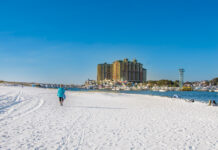
North Beach is what the rankings and awards are talking about. You’ll cross a wooden bridge over a shallow lagoon to reach it, and the first thing you’ll notice when the sand opens up in front of you is the sheer width of it. On a calm morning the beach stretches flat and white in both directions with the Gulf lying turquoise beyond the low tide break, and the backdrop is nothing but dunes and palms. No hotels. No condos. No parking structure. Just the coastline doing what it was doing before anyone thought to develop it.
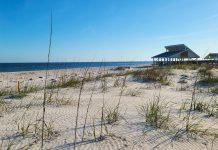
The sand here is the genuine article. Fine native quartz that was not brought in or pumped from offshore, which matters more than it sounds in a state where most popular beaches are running on borrowed sand. When Hurricanes Helene and Milton hit in the fall of 2024 and the park was forced to close for four months, the county made a deliberate choice to leave the beach as close to its natural state as possible during cleanup. The park manager said it directly: the sand you’re standing on is native and they intended to keep it that way.
The crowd at North Beach is the park’s most varied. On summer weekends it draws families, couples, and day-trippers from across the Tampa Bay area, but even then the beach is large enough that you can walk north from the main cluster of picnic shelters and find stretches with room to spread out. The pirate ship playground near the parking area pulls younger kids toward the dune side, which helps keep the waterline itself cleaner for walking. I’d park at the northern end of the lot every time to have a shorter walk to the quiet end of the beach.
The Northern Tip: The Sand Dollar Walk
End of North Beach · The Point
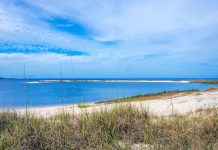
The northern tip of North Beach is the single most rewarding walk in the entire Pinellas beach system, and most people who visit Fort De Soto never make it there. From the last parking area you walk north along the waterline until the beach curves away from the Gulf and the channel between Fort De Soto and Shell Key Preserve opens up in front of you. At low tide a small sandbar appears just offshore that you can easily wade to. The shelling and sand dollar hunting in this area is genuinely different from anywhere else on the coast.
This is where my son and I had the kind of beach day that sounds made up when you describe it afterward. He was visiting during our long stay in St. Pete, and we walked north from the last parking area on a calm, partly cloudy morning. By the end of that day he had found more than fifty sand dollars on his own, and together we accumulated over a hundred. You stop reading that sentence the way it’s meant because it sounds like an exaggeration, but it isn’t. The sand dollar concentration at the tip, especially in the shallow water just off the sandbar, was dense enough that other visitors were literally leaving piles of them on the shore, having gathered more than they wanted to carry. We found our own. I’ll write more about the specific route and what the shoreline conditions looked like in the hike guide for Fort De Soto, but the short version is: go at low tide, wade in, and look in the water rather than the dry sand.
The crowd at the tip is a self-selecting one. You have to walk to get there, at least a mile or more from the main parking areas depending on which lot you started from, and that filters out anyone who’s not committed to the walk. What you find when you arrive is a loose mix of serious shellers, birders working the channel edge, and occasionally a kayaker or two who’ve come around from the other side. The feel is quiet and collaborative, the kind of crowd that knows what they’re looking for and shares information freely if you ask.
East Beach
East Side of Mullet Key · Bay Side
East Beach faces Tampa Bay rather than the Gulf, and it’s a completely different experience from North Beach on every level. The water here is calm and flat, with the Sunshine Skyway Bridge visible against the sky to the east in a way that would make any photographer stop walking. The sand is darker and finer near the water’s edge, with more organic content than the pure quartz you get at North Beach, and the palm canopy here is dense enough to provide genuine shade, unlike the more open dune system on the Gulf side.
The crowd at East Beach is noticeably smaller and quieter than North Beach on most days. Three large pavilions make this the event venue section of the park, so if you arrive and see a triathlon setup or a private group function taking over the pavilions, the beach itself still has room, but the parking lot will be fuller than usual. Outside of scheduled events, East Beach tends to draw the people who came specifically for kayaking or kite boarding rather than swimming, since the bay conditions are ideal for both and the Gulf’s modest breaks are less present here.
I’ve found East Beach most useful as a transition point in a long park day, something to visit in the early afternoon after a morning walk at North Beach. The Skyway Bridge views are worth sitting with for a while, especially on a morning when the clouds are moving, and the eastern tip of the park near the historic seawall offers some of the best quiet birding in the whole system. Worth noting: some areas near the historic site and portions of the eastern seawall remain closed or restricted due to ongoing repairs from the 2024 hurricanes. Check current conditions at the park entrance before planning a long walk in that direction.
The Dog Beach and Paw Playground
Near the Bay Pier · Only Off-Leash Dog Beach in Pinellas County
The dog beach at Fort De Soto is the only place in the entire St. Pete-Clearwater area where your dog can run off-leash on a beach, and the crowd that comes here every day knows it and appreciates it. The beach section itself sits just off the Bay Pier parking area, with two fenced Paw Playground sections adjacent for large and small dogs separately if you’d rather not deal with the water. There are dog showers for cleanup before you leave. The whole setup is genuinely thoughtful.
The dog beach draws a consistent, mostly local crowd of dog owners who have made this part of their routine. It has a neighborhood dog park feel rather than a tourist attraction feel, even in peak season, mostly because the visitors here are almost always regulars. You’ll see labs and retrievers doing what labs and retrievers live for, chasing a ball into the bay shallows, while their owners chat in the shade of the nearby trees. The water is calm and relatively shallow here, which makes it comfortable for dogs of all sizes.
The one thing I’d tell you before bringing a dog to Fort De Soto is to understand clearly where dogs are and aren’t allowed before you arrive. Dogs are permitted only in the Paw Playground area, on the designated dog beach, in the Camping Area 2 campground sites (86-164 with proof of current rabies vaccination), and on the paved multi-use trail on a leash. North Beach, East Beach, and the nature trails are off limits to pets entirely, and those restrictions are there to protect nesting shorebirds and sea turtle habitat. The rules are posted and they’re enforced.
The Historic Fort and Gulf Pier
Mullet Key Southernmost Point · Free Entry
The fort is the reason this park has its name, and it’s the part of the day that most families treat as an afterthought but should treat as an anchor. Built between 1898 and 1907 for a war that ended before it was finished, the fort never fired a shot in anger. What it does have, still intact and climbable, are the last carriage-mounted 12-inch seacoast mortars remaining in the continental United States. You can stand at the gun battery on top and look out over the Gulf and Tampa Bay at the same time, which puts the geography of this whole chain of keys into sudden perspective.
The fort is built from reinforced concrete and opens for self-guided tours every day. The rooms inside are cool and echo in a way that younger kids universally love, and the interpretive markers are thorough enough that you come out actually knowing what the soldiers were doing here and why. The Quartermaster Storehouse Museum on site adds more context. None of this costs anything beyond your park entry fee, which is one of the better deals on this coast.
The Gulf Pier extends roughly 1,000 feet into the Gulf from near the fort, and there’s no fishing license required to fish from it. Friends of Fort De Soto Inc. has purchased group licenses for both piers, so the piers function as open public fishing without the licensing hassle. Bait and tackle are sold at the concession on the pier. Dolphins are a consistent presence here, and they’ve learned that hooked fish means an easy meal, so don’t be surprised if your catch is claimed on the way in.
Bay Pier, Egmont Key Ferry, and Shell Key Connections
Bay Pier Area · Island Access Points
The Bay Pier on the east side of the park is a 500-foot fishing pier with its own bait and tackle concession, and it’s also where you board the ferry to Egmont Key State Park. The ferry runs weekdays at 11 a.m. and on weekends at 10 a.m. and 11 a.m., with an additional 2 p.m. departure running March 1 through Labor Day. Rates for the 2025 season were $45 for adults and $25 for children, and the ride itself takes about 20 minutes with dolphins alongside more often than not.
Egmont Key is a different experience from Fort De Soto, wilder and more remote, with the ruins of Fort Dade scattered among the sea grape and gopher tortoise burrows, and snorkeling in the clear water around the lighthouse foundation. I’d send anyone who’s been to Fort De Soto more than twice across to Egmont for a day, because it does things Fort De Soto doesn’t, including better snorkeling and more shells, while Fort De Soto does things Egmont doesn’t, including overnight camping and a full suite of amenities.
Shell Key Preserve is the other nearby island connection, though the shuttle for Shell Key actually departs from Merry Pier at Pass-a-Grille rather than from within Fort De Soto itself. I mention it here because if your day at North Beach’s northern tip leaves you wanting more of that sand dollar energy, Shell Key is where you go next. The shelling there runs even better on a regular basis, and the bird sanctuary on Shell Key is one of the more significant nesting colonies in the county.
Fort De Soto Park Rankings: Expert Scores Across 11 Categories
These scores weigh the park as a whole, which means the sand dollar tip walk and the birding get balanced against the one long road in and out and the parking situation on busy weekends.
Sand Quality
9/10
Fine native quartz that has never been renourished or pumped in from offshore. The county kept it that way even after the 2024 hurricanes, and the result is beach sand that walks and feels completely different from the managed beaches up the coast.
Hiking & Beach Walking
9/10
A seven-mile paved multi-use trail connecting every part of the park, plus the North Beach waterline walk to the tip, plus nature trails through the mangrove and hardwood areas. This is the most walkable beach park in Pinellas County by a wide margin.
Shelling
9/10
Best shelling at the North Beach tip at low tide, where sand dollars accumulate in the shallows in concentrations you won’t find anywhere on the developed Pinellas beaches. A trip specifically for sand dollar hunting is fully justified here.
Water Conditions
8/10
Calm, gradual, clear Gulf water at North Beach. The tidal pool near the playground is ideal for small children. East Beach adds sheltered bay water for kayakers. No dangerous currents under normal conditions.
Scenery & Natural Beauty
10/10
No hotel behind the dunes. No condo row visible from the water. Native dunes, palms, mangroves, and open sky in every direction. The Skyway Bridge from East Beach and the open channel view from the northern tip are two of my favorite single views in the state.
Birding & Wildlife
10/10
328 documented species and one of the top birding sites in the eastern United States. Spring migration brings 40 or more warbler species through the park’s trees in a matter of days. Year-round you have oystercatchers, roseate spoonbills, reddish egrets, osprey nests, and up to 500 magnificent frigatebirds roosting on the mangrove keys in summer.
Family Friendliness
9/10
Pirate ship playground, tidal pool for wading, seasonal lifeguards at North Beach from April through September, and a beach wide enough that families don’t feel crowded even on busy days. One of the best family beach parks in Florida.
Dog Friendliness
9/10
The only place in Pinellas County where your dog can legally run off-leash on a beach. Two fenced Paw Playground sections, a dedicated dog beach, and dog showers on-site. Loses one point only because North Beach and East Beach are off limits to dogs entirely.
Solitude & Peace
8/10
The park draws 2.7 million visitors annually, but 1,136 acres is a lot of real estate. Walk north past the main North Beach pavilions and the crowd thins quickly. The tip walk is almost always quiet. Holiday weekends are the exception, when the parking lot fills before 10 a.m.
Entertainment & Nightlife
2/10
There is a snack bar and a gift shop. There are no beach bars, no live music, no restaurants, no nightlife. The park closes at sunset. This is emphatically a feature for the right person and a dealbreaker for the wrong one.
Parking & Beach Access
6/10
Large parking lots at North Beach, East Beach, and the fort area, but there is one road in and one road out of the entire park. On major holiday weekends, traffic backs up on the Bayway. The $6 parking fee is on top of the Bayway toll.
Fort De Soto Sand & Water
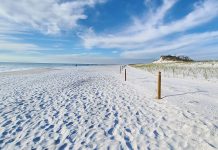
Fort De Soto’s sand earns its reputation honestly. This is native quartz that’s never been pumped in or renourished, fine and talcum soft on the dry upper beach, wide and flat enough at North Beach that you can walk a mile and a half out toward the tip without the terrain ever fighting you. The waterline packs firm the whole way, one of the easiest, most reliable surfaces for walking or jogging in the county, and the dry sand near the dune line holds a shape nicely once you add water, good news if sandcastles are on the agenda.
The water matches the sand’s easygoing character. On a calm day it runs turquoise to deep green-blue, clear enough to see the bottom to waist depth most of the time, and entry is gradual with a modest, manageable shore break. East Beach, facing the bay instead of the Gulf, is even calmer, essentially flat water year round. Seasonal lifeguards cover North Beach from April through September, the only guarded stretch anywhere in the park, so keep that in mind before you swim at the tip or at East Beach.
-
Walkability. Wide, flat, and firm at the North Beach waterline for well over a mile out to the tip. One of the best long walks anywhere on this coast.
-
Softness & Playability. Talcum soft on the dry upper beach, genuinely fine underfoot. Packs well with water for sandcastles, firm and easy at the water’s edge.
-
Barefoot Comfort. Genuinely comfortable nearly year round, even in July, since this native quartz reflects rather than absorbs heat. The one exception is the densely packed sand right around the picnic shelters on a crowded day.
-
Swimmability. Gradual entry, calm conditions, seasonal lifeguards at North Beach from April through September. East Beach and the northern tip have no lifeguard coverage, so self-monitor conditions there.
Want the full geology, grain composition, and the complete sand and water condition ratings? I broke it all down separately in Sand & Shore: Fort De Soto.
Dogs & Pet Accessibility
Are Dogs Allowed on the Sand? YES, IN ONE SPECIFIC PLACE.
Fort De Soto is the only park in Pinellas County with a genuine off-leash Gulf beach, and that single fact makes it essential for a huge share of the local dog-owning population. It’s also more restricted than that headline makes it sound, so know the boundaries before you go.
Where Dogs Are Allowed
- ✓The designated dog beach and both Paw Playground sections (separated for large and small dogs), off-leash, near the Bay Pier.
- ✓The paved, 7-mile multi-use trail, on a leash, park-wide.
- ✓Camping Area 2 (sites 86-164), with proof of current rabies vaccination.
Where Dogs Are NOT Allowed
- ✗North Beach, in its entirety.
- ✗East Beach, in its entirety.
- ✗All nature trails, including Arrowhead, Soldier’s Hole, and the Barrier-Free Trail.
Paws on the Ground Reality
The dog beach and Paw Playground area is genuinely well designed, calm, relatively shallow water, fenced sections split by dog size, and dog showers on site for cleanup before you leave. The crowd here is almost entirely regulars, and it has the feel of a neighborhood dog park rather than a tourist stop, even during the park’s busiest weekends.
Bring your rabies vaccination paperwork if you’re also camping, the rule is enforced at Camping Area 2. And keep in mind that this restricted setup, one beach for dogs, everywhere else off limits, exists specifically to protect nesting shorebirds and sea turtle habitat on North Beach and East Beach. It’s a real trade-off, and a fair one.
Crowd Levels and the Overall Feel of Fort De Soto Park
Fort De Soto draws 2.7 million visitors annually, which is more than you’d expect for a park that most casual beach visitors wouldn’t include on a Pinellas trip. The crowds are real on peak summer weekends and holidays, but the park is big enough to absorb them in a way that a narrow developed beach simply can’t. On a busy July Saturday, the main North Beach picnic shelters will be full, the parking lot will approach capacity by mid-morning, and the pirate ship playground will have a wait. Walk a quarter mile north from the main cluster and that density drops sharply. Walk a full mile and you’re likely alone on the sand.
The crowd profile changes significantly by what section you’re in. Families with young kids cluster at North Beach near the playground and tidal pool. Birders and photographers gather near the water’s edge at the northern tip and around the Arrowhead Picnic area. Dog people occupy their corner near the Bay Pier without much crossover elsewhere. The fort area draws couples and history-minded visitors who may not spend much time on the beach itself. The campground has its own tight-knit community of regulars who book a year out.
The seasonal rhythm runs noticeably different here than at the resort beaches up the coast:
- Spring (April-May): The peak birding window, when the migration drops exhausted songbirds into the park’s trees after a Gulf crossing. North Beach is busiest on spring break weekends but manageable otherwise.
- Summer: Families and day-trippers fill North Beach, the campground books solid, and the water is at its warmest. Arrive before 9 a.m. on summer weekends to get good parking without the line.
- Fall (October): My favorite window in the park. The summer crowd clears, the migrating shorebirds come back through, the weather drops, and the northern tip walk becomes one of the most peaceful mornings I can think of on this coast.
- Winter: The park slows but never empties. Snowbirds fill the campground from January through March, local walkers and birders have the trails mostly to themselves, and the American white pelicans arrive in the lagoons by November.
Who Is Fort De Soto Really For?
✓ Who Will Love Fort De Soto
-
Shellers and sand dollar hunters who want the northern tip walk at low tide, where concentrations genuinely justify a day trip on their own
-
Families with young kids who want a safe, gradual-entry beach with a playground nearby and seasonal lifeguard coverage from April through September
-
Dog owners who want the only off-leash Gulf beach in the county and a park that has genuinely designed the dog experience into the overall layout
-
Birders at any level, from casual shorebird watchers to serious listers chasing migration days in April
-
Campers who want a waterfront site with beach access, kayak trails, and bike paths within the same park
-
Anyone who wants one day on a beach with no hotel wall behind the dunes and no commercial noise anywhere in the park
✗ Consider Another Beach If…
-
You want beach bars, restaurants, or nightlife. There is a snack bar and a gift shop and the park closes at sunset. That’s the full extent of it.
-
You want lodging on-site or within walking distance of the beach. The campground is the only sleep option and it books out months in advance.
-
You’re traveling on a major holiday and aren’t willing to arrive before 9 a.m. The parking situation on holiday weekends is the park’s only serious weak point.
-
You want your dog to have beach access across the whole park, not just one designated area near the Bay Pier.
-
You need watersports rentals readily available. Kayak rentals are on-site when concessions are fully staffed, but this is not a destination for parasailing, jet skis, or other high-activity rentals.
Things to Do at Fort De Soto Park
Fort De Soto gives you more ways to spend a day than any other beach park in the area, and most of it requires nothing more than walking. Here’s what actually fills a day here, and what justifies the second day if you have it.
-
Beach Walking to the Northern Tip. The signature experience at Fort De Soto. From the last North Beach parking area, the walk north to the tip and back runs about two to three miles depending on how far you wade out. Low tide is the target window for shelling.
-
Shelling and Sand Dollar Hunting. Best at the northern tip at low tide, where sand dollars accumulate in shallow water near the sandbar. Bring a mesh bag. Only take shells that are bleached white or clearly empty, and never take live sand dollars.
-
Swimming. North Beach’s gradual entry and calm conditions make it one of the safest swimming beaches in Pinellas County. Seasonal lifeguard coverage runs April through September. East Beach is flat bay water, good for wading and kayak launches.
-
Kayaking the Mullet Key Bayou Trail. A 2.25-mile designated paddle route through mangrove tunnels with dolphin, manatee, and wading bird sightings. Kayak rentals are available in the park when concessions are operating. Bring your own to guarantee access.
-
Biking the 7-Mile Paved Trail. A flat, paved trail connecting North Beach, the campground, the fort, both fishing piers, and East Beach. Bike rentals are available in the park. Driving south from North Beach to the fort takes about four miles each way.
-
Birding. Year-round, but April migration is the peak event. The park has visitor center loaner binoculars and a current sightings log. Key spots: North Beach waterline for oystercatchers and plovers, East Beach woods for songbirds during migration, and the mangrove lagoons on the north end for spoonbills and reddish egrets.
-
Exploring the Fort. Self-guided, free with park entry. Climb to the gun battery for the best views in the park and walk through the cool, echoing rooms at the base. The Quartermaster Storehouse Museum adds context. Budget 45 minutes at minimum.
-
Pier Fishing. Both the Gulf Pier (1,000 ft) and Bay Pier (500 ft) require no fishing license thanks to group licenses purchased by Friends of Fort De Soto Inc. Bait and tackle are sold on both piers. Target species include snook, redfish, snapper, and sheepshead. Watch for dolphins working the lines.
-
Egmont Key Ferry. A 20-minute ride from the Bay Pier to a wilder, more remote island with Fort Dade ruins, a working lighthouse, gopher tortoises, and better snorkeling than Fort De Soto itself. Book in advance; weekday departures at 11 a.m., weekend departures at 10 and 11 a.m. (and 2 p.m. in season).
-
Wildlife Watching. Dolphin pods are visible from the beach and the piers on most mornings. Manatees appear in the warm shallows in summer. Sea turtle nesting runs May through September. The Nanday parakeets that nest near the campground are a Florida quirk worth knowing to listen for.
Local Knowledge and Practical Advice
A few things I’ve picked up from spending more mornings at Fort De Soto than I can count:
-
The parking fee and the Bayway toll are two separate charges. You’ll pay the Bayway toll at the booth before you cross the bridge (about $1.75 cash if you don’t have a SunPass), and then the $6 park parking fee at the entrance kiosk inside the park. Credit card is accepted at the kiosks. Have exact change ready for the toll if you’re driving a rental or don’t have a SunPass.
-
Arrive before 9 a.m. on summer weekends and any holiday weekend. The parking lot fills early, and there is one road in and one road out of the entire park. Once the lot is full, the line on the Bayway can back up. Weekday mornings are almost always easy to park.
-
Check the tide chart before planning your shelling walk. The northern tip experience at high tide is pleasant but ordinary. At low tide with a calm sea, the sandbar appears and the sand dollar count in the shallows shifts dramatically. Low tide by a half hour or more is the target window.
-
Seasonal lifeguards cover North Beach from April through September. East Beach, the northern tip, and the bay areas are unguarded all year. Swim near the staffed tower at North Beach when it’s set up, and self-monitor conditions everywhere else.
-
Only take shells that are clearly empty and bleached. Gray or brown sand dollars are still alive and belong in the water. The live ones are easy to identify by their fuzzy texture and darker color. Pick up the white ones all day long, leave the gray ones where you found them.
-
Dogs require current rabies vaccination paperwork to enter the campground pet area. The rule is enforced. Dogs are only allowed at the Paw Playground and dog beach near the Bay Pier, on the paved multi-use trail on a leash, and in Camping Area 2 (sites 86-164). North Beach and East Beach are off limits.
-
No fishing license is required on either pier. Friends of Fort De Soto Inc. maintains group licenses for the Gulf Pier and Bay Pier. A standard Florida saltwater fishing license is still required if you’re fishing from the beach, a kayak, or a boat within the park.
-
The visitor center has loaner binoculars and a current bird sightings log. The volunteer birders at the park are generous with information. If you’re there in April and see someone with a spotting scope set up near the North Beach sandbars, stop and ask what they’re watching. The answer is almost always worth your time.
-
Book the Egmont Key ferry in advance for weekends. It fills. The ferry departs from the Bay Pier, not the Gulf Pier, so don’t get turned around on the road in. Check current ferry schedules and pricing before you go, since they update seasonally.
-
Fort De Soto campground reservations open six months in advance for non-Pinellas County residents and seven months for Pinellas residents. Waterfront sites book out the day the window opens. If you want to camp here in peak season (January through March especially), set a calendar reminder for the exact day your window opens and act fast.
Where to Stay Near Fort De Soto Park
Fort De Soto has no lodging within the park boundaries beyond the campground, and the surrounding Tierra Verde island community is residential rather than resort-oriented. Here’s how to think about basing yourself near the park.
Fort De Soto Campground
The campground is one of the best in the state, and I mean that without qualification. All 236 sites have water and electric hookups (30 to 50 amp), a picnic table, and a charcoal grill. Waterfront sites along the bay give you views of mangrove keys and open water from your campsite, and the campground store, coin laundry, and dump stations are all on-site. Nightly rates run from roughly $34 for tent sites to $46 for waterfront RV sites, making this one of the most affordable waterfront camping experiences in Florida. Reserve through the Pinellas County Parks reservation system. The six-month advance window for non-residents fills fast, especially from January through April.
Tierra Verde Area Rentals
The Tierra Verde community immediately surrounding the park is a deed-restricted, predominantly residential island, not a hotel strip. Short-term vacation rentals through VRBO and similar platforms exist here and tend to be well-maintained waterfront homes, though pricing reflects the upscale character of the neighborhood with median home values well over a million dollars.
St Pete Beach and Pass-a-Grille
For a wider range of lodging options at various price points, St Pete Beach and Pass-a-Grille are about fifteen to twenty minutes north via the Pinellas Bayway and Gulf Boulevard. From there you can commute to Fort De Soto for beach days while having the resort amenities and dining of St Pete Beach available in the evenings.
Mainland St. Petersburg
For the most affordable option, the mainland St. Petersburg hotel corridor near I-275 puts you 25 to 30 minutes from the park entrance and within easy reach of downtown’s restaurants and waterfront. Not a walkable option to the beach, but viable as a base for day trips.
What Makes Fort De Soto Different from Nearby Beaches
Fort De Soto stands apart because it offers something genuinely rare on this stretch of Florida coast: a natural, undeveloped beach experience at a scale large enough that you never feel crowded even when the park is busy. A few things distinguish it specifically.
Native sand that hasn’t been renourished
Most popular beaches in Pinellas County have had sand pumped in from offshore at least once, usually multiple times. The county made a deliberate choice after the 2024 hurricanes to avoid mechanical sand disturbance at North Beach wherever possible, and the result is beach sand with a natural, settled character that renourished beaches simply don’t have.
An internationally recognized migration corridor
The park sits at the mouth of Tampa Bay where the Gulf funnel shapes bird movements during spring and fall migration. In April, Fort De Soto may be the single best land-based birding spot in Florida, drawing 40 or more wood warbler species through its trees after a Gulf crossing. No other Pinellas beach comes close to this level of wildlife significance.
The only off-leash dog beach in the county
This is a practical fact that shapes the park’s draw in a concrete way. If you live in Pinellas County and want to take your dog to the Gulf, Fort De Soto is the only legal option for off-leash beach access. That alone makes it essential for a significant part of the local population.
Island access without needing your own boat
The Egmont Key ferry from the Bay Pier gives anyone the ability to reach a genuinely remote, undeveloped island just 20 minutes away. That combination of developed-park amenities with immediate remote-island access is unusual enough that it makes Fort De Soto a different kind of destination from any other beach in the region.
Fort De Soto vs. Other Pinellas County and Tampa Bay Beaches
These are the beaches visitors most often weigh against Fort De Soto, and where I’d honestly send you depending on what you’re after.
Fort De Soto vs. St Pete Beach
St Pete Beach is the developed, resort-oriented counterpart to Fort De Soto’s natural character. St Pete Beach has restaurants, bars, hotel beach service, and walking distance to nightlife. Fort De Soto has better sand, better wildlife, an off-leash dog area, and camping. They’re solving for different trips. Do both if you’re in the area long enough.
Fort De Soto vs. Clearwater Beach
Clearwater Beach is the biggest, loudest, most visited beach in Pinellas County. Its Pier 60 nightly sunset event draws more people in one hour than Fort De Soto draws in a quiet Tuesday. Choose Clearwater if you want the action, the restaurants on the sand, and the resort strip. Choose Fort De Soto if you came to Florida for the beach itself rather than what’s built around it.
Fort De Soto vs. Caladesi Island State Park
Caladesi Island State Park, accessible by ferry from Honeymoon Island near Dunedin, is the other consistently top-ranked natural beach on this coast and draws similar comparisons. Caladesi has longer undeveloped beach frontage and no road access at all, which pushes the crowd away further than Fort De Soto can. Fort De Soto wins on amenities, the variety of experiences within the park, and the campground. Both rank among the top beaches in the country in any given year. Worth visiting both.
Fort De Soto vs. Egmont Key
Egmont Key, reachable by ferry from Fort De Soto’s own Bay Pier, is the next step up in remoteness and the next step up in shelling. No roads, no facilities, no overnight amenities beyond primitive camping. If Fort De Soto is as far as most people go, Egmont Key is where the serious shellers and wildlife photographers go when Fort De Soto starts feeling crowded.
Bottom line: Fort De Soto is the standard against which every other Pinellas County beach should be measured for natural quality, and it rarely loses that comparison. The question isn’t whether it’s good, it’s whether what you want from a beach day is what a park can provide. If you want a chair dropped at the water’s edge by a resort attendant and dinner at a beachfront restaurant, go to St Pete Beach. If you want the best sand, the best wildlife, and a walk that might net you a hundred sand dollars, come here.
Fort De Soto Park Beach, Florida: Frequently Asked Questions
Is Fort De Soto a state park or county park?
County park, run by Pinellas County Parks and Conservation Resources. It’s the most common misconception about the place and it matters because state park pass holders don’t get free entry here. You pay the $6 parking fee plus the Pinellas Bayway toll regardless of any pass you carry.
How much does it cost to enter Fort De Soto Park?
There are two separate costs. The Pinellas Bayway toll runs about $1.75 cash if you don’t have a SunPass, payable before the bridge. The park parking fee is $6 per vehicle, payable at the entrance kiosk by credit card or through the mobile app. Entry on foot or bicycle is free. Disability placard or plate holders park for free at the park entrance.
Are there lifeguards at Fort De Soto?
Seasonal lifeguards cover North Beach from April through September. East Beach, the northern tip, and the bay areas have no lifeguard coverage year round.
Are dogs allowed at Fort De Soto Park?
Yes, with restrictions. Dogs are allowed off-leash at the designated dog beach and Paw Playground near the Bay Pier, on a leash on the paved multi-use trail, and in Camping Area 2 (sites 86-164) with proof of current rabies vaccination. Dogs are not permitted on North Beach, East Beach, or the nature trails.
What is the best beach area at Fort De Soto for families?
North Beach, near the pirate ship playground and tidal pool. The gradual water entry, calm surf, seasonal lifeguards, and nearby amenities including restrooms, showers, and the snack bar make it the most complete family setup in the park.
Is Fort De Soto good for shelling?
The main North Beach area is moderate for shelling. The northern tip at low tide is exceptional, particularly for sand dollars in the shallow water near the sandbar. Go at low tide and wade in close to the sandbar for the best finds.
How do I get to Egmont Key from Fort De Soto?
The ferry departs from the Bay Pier inside Fort De Soto Park. Weekday departures run at 11 a.m., weekend departures at 10 and 11 a.m., with an additional 2 p.m. departure from March 1 through Labor Day. Adult fare was $45 for 2025. Book in advance for weekends.
How far in advance do I need to book the Fort De Soto campground?
Pinellas County residents can book 7 months in advance. Non-residents can book 6 months in advance. Waterfront sites fill on the day the reservation window opens, especially for January through March dates. Set a calendar reminder.
Do I need a fishing license to fish at Fort De Soto?
No license is required to fish from either the Gulf Pier or Bay Pier because Friends of Fort De Soto Inc. has purchased group licenses for both piers. A standard Florida saltwater fishing license is required for fishing anywhere else in the park, including from the beach, a kayak, or a boat.
What is the best time of year to visit Fort De Soto for birding?
April for spring migration, when neotropical songbirds crossing the Gulf land exhausted in the park’s trees and 40 or more warbler species may be present in a single day. October is the fall migration window. Year-round the park supports 328 documented species, with roseate spoonbills, oystercatchers, reddish egrets, and osprey present in most seasons.
Patti’s Perspective: My Honest Take on Fort De Soto
My daughter and I kept coming back here every week for four months. We were based in the St. Pete area for a long stretch, and with every beach in Pinellas within driving distance, Fort De Soto was the one we returned to more than any other. There was always something different to notice. The tide was running differently. The birds were working a new section of the flat. The sand dollar count at the tip was inexplicably better than last week.
The day my son came to visit is the one I’ll probably tell people about the longest. We walked north from the last parking area, out to the tip, and what happened in the shallows there that morning was unlike anything I’ve found on any other beach in my entire walking mission. He found over fifty sand dollars that day, and together we passed a hundred. Other visitors were piling them on the shore and walking away from them because they had more than they could carry. We waded through those shallows for hours without feeling like we’d come close to covering the whole area.
What Fort De Soto does that no developed beach in this state can replicate is give you the feeling that you’re inside nature rather than beside it. The resort beaches of Pinellas are beautiful and I love them for different reasons, but they’re always clearly the human version of the coast. At Fort De Soto, walking north until the campground and the picnic shelters disappear behind you, with the Gulf on one side and the mangrove channel on the other and nothing man-made in your sightline, you’re in the kind of place that teaches you something if you pay attention.
It’s also where my nostalgia for this part of Florida is most intact. The Pinellas coast has been my family’s coast for my whole life, and Fort De Soto has changed less than almost anywhere else in the chain. That matters to me in ways I notice every time I’m back.
My verdict: 9/10. The best beach park on Florida’s central Gulf Coast, and I don’t think it’s particularly close. Native sand, world-class birding, the only off-leash dog beach in the county, a historic fort to walk through, two fishing piers with no license required, and the northern tip sand dollar walk that earned this place its reputation before any awards list ever said so. The only thing it doesn’t have is nightlife, a hotel, or a restaurant on the beach, and if you’re coming here for those, you were going to be disappointed before you left the parking lot.
Want to Live by the Water?Tierra Verde, the island community that gates Fort De Soto Park, is one of the most exclusively waterfront communities in Pinellas County. It is a deed-restricted island of canal homes, bay-front estates, and a small downtown strip with a handful of restaurants and a marina, connected to the mainland by the Pinellas Bayway. Homes here run from the high $400,000s for smaller canal properties to multi-million-dollar bay-front estates with private docks and immediate Gulf access. The median listing price has hovered above $1.5 million, which reflects both the waterfront orientation and the direct access to Fort De Soto’s trails, beach, and launch points. Most properties have dock access. This is a boater’s community first and a beach community second, with Fort De Soto functioning essentially as the community’s backyard park.For buyers who want waterfront character without the Tierra Verde price point, the St. Pete Beach and Pass-a-Grille area to the north offers a wider range of condo and single-family options with a 15 to 20 minute drive to the park. Mainland St. Petersburg south of downtown puts the park within 25 minutes without the barrier island premium attached.Explore Waterfront Living at LiveByTheWater.com
Real estate referral partner