


Panama City Beach, Florida
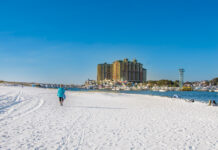
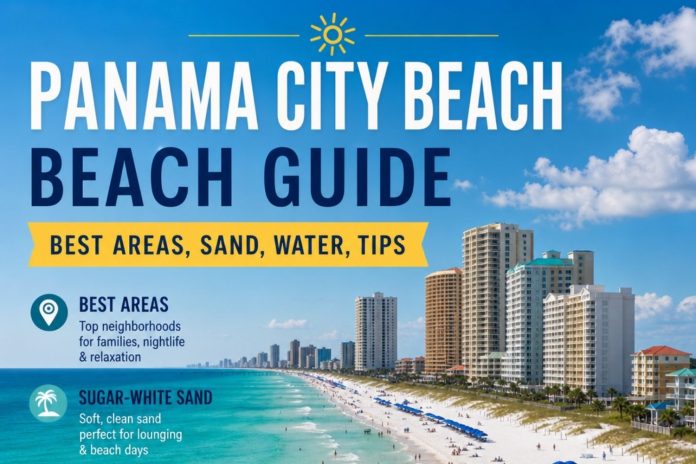
Panama City Beach is 27 miles of white quartz beach on the Florida Panhandle, and it is honestly one of the most misunderstood stretches of coast I’ve walked. Most people know it as the spring break capital and the high-rise resort corridor on US 98. Both of those things are accurate. What most people miss is how much the beach itself changes as you move along it: from a quiet, residential west end where I stayed and had the shoreline nearly to myself every morning, through a lively center with two 1,500-foot fishing piers and a walkable entertainment district, to one of Florida’s best state parks anchoring the eastern tip. The sand is good across all 27 miles. The experience depends almost entirely on which part of it you choose.
Panama City Beach runs along the south face of a peninsula in Bay County, bordered by the Gulf of Mexico to the south and St. Andrews Bay to the north. The city has roughly 100 public beach access points distributed across the full 27-mile length, making it one of the most accessible beach corridors in Florida. Three areas have seasonal lifeguard coverage: the Russell-Fields City Pier (from April 1 through Labor Day), M.B. Miller County Pier, and Rick Seltzer Park (both from Memorial Day weekend through Labor Day), all staffed from 10 AM to 6 PM.
In this guide I’m walking you through every distinct stretch of Panama City Beach from west to east, going deep on what the sand and water are actually doing at each point, scoring it honestly across all 11 categories, and telling you clearly who this beach is built for and who might be happier elsewhere. I cover the quiet west end, mid-beach, the two piers and their distinct personalities, the only dog-permitted stretch, and the state park that anchors the eastern tip with its own dedicated guide. I close with my honest read on why where you stay on these 27 miles matters more than anywhere else on this coast.
The Vibe and Culture at Panama City Beach
Full-Service Resort Town, All 27 Miles of It
Panama City Beach doesn’t pretend to be something it isn’t. It’s a full-build resort destination that draws millions of visitors a year, and the center of the strip delivers exactly what it promises: everything within reach, all the time.
The cultural reputation of PCB is built largely on spring break, which runs through March and into early April and packs the central corridor to a density that alters the entire character of the place. Bars and clubs along Front Beach Road stay open late, the resorts fill months in advance, and the pier beach becomes a social event as much as a beach day. Outside of that window, the identity softens: summer is family-dominant, fall and winter belong to retirees and locals, and the whole 27 miles settles into a more easygoing version of itself.
What most people discover quickly is that the PCB experience changes dramatically depending on how far you are from the Pier Park and Russell-Fields Pier center point. Drive or walk five minutes west and the commercial density drops. Drive five minutes further west and you’re in residential communities with quiet beach access, pelicans gliding over the shoreline, and neighbors sitting on their front porches. Drive east from the pier and the energy stays higher until you cross under the bridge near the County Pier, after which it softens again. The far east end leads directly to St. Andrews State Park, which is one of the most ecological and natural beach experiences in the state, sitting at the end of one of the most developed beach corridors in Florida.
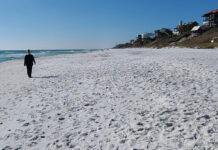
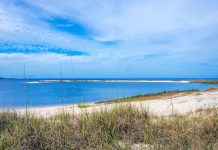
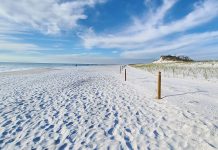
The beach itself, the actual sand and water, runs consistently good across the full length. Near-pure Appalachian quartz, white and fine, the same geology as 30A to the west. The water reads emerald-to-turquoise on calm days and stays swimmable deep into October. PCB’s slogan “World’s Most Beautiful Beaches” is its own marketing, but the sand earns most of what that implies. What it cannot claim is solitude or natural scenery, because the development is extensive and visible from the waterline across most of the central and eastern stretch. The west end is the exception, and it’s where I based myself.
Panama City Beach: Six Distinct Stretches, Six Different Experiences
The character of Panama City Beach changes every few miles. Most visitors pick a spot based on where they booked their lodging and never leave it. That’s a reasonable approach, but it misses how much range these 27 miles actually have.
Laguna Beach and the Quiet West End
Western Edge · Most Private Access Points
The west end of Panama City Beach, anchored by the communities of Sunnyside and Laguna Beach, is where the resort strip thins out and a different version of PCB begins. Drive west on Front Beach Road from the pier area and the high-rise condos start spacing further apart, the vacation rental cottages get smaller and older, and by the time you reach Laguna Beach the road feels residential rather than commercial. The beach access points here are mostly walkover ramps from residential lots or small public paths, and the majority carry signs indicating private access. Public options exist but they’re fewer and quieter than the central strip.
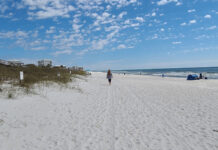
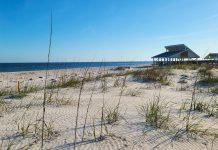
The beach itself on the west end is wide and clean, with the same near-pure quartz that runs the full length of PCB, but noticeably less churned than the central stretches. On morning walks here, footprints are sparse and the upper beach stays powdery and undisturbed in a way that’s hard to find at any of the high-traffic central access points. The dunes along this stretch are better preserved than in the commercial center, adding visual depth to the beach and providing habitat buffer that the more developed zones have largely lost. The water is the same emerald Gulf as everywhere on this coast, with a gradual sand shelf and light surf under typical conditions.
I stayed at Laguna Beach and it was the right call. Ten minutes from the Russell-Fields Pier when I wanted energy, ten minutes from the 30A beaches when I wanted something else entirely. Every morning I walked out the door and had a gorgeous, quiet shoreline essentially to myself. Pelicans overhead, locals fishing in the shallows, neighbors chatting across the fence. The west end has a community feel that the resort center doesn’t, and if your priority is actually being on the sand rather than being in the middle of everything, this is where you want to base yourself.
Mid-Beach and Rick Seltzer Park
Between the Two Piers · Natural Dune Systems
The mid-beach stretch between the County Pier and the City Pier is the section of PCB that most visitors pass through without stopping, which makes it one of the better-kept practical secrets on this coast. Rick Seltzer Park, sitting between beach accesses 15 and 16, is a nearly five-acre public park with parking, restrooms, a gazebo, and a section of undeveloped beach with preserved gulf dune systems. It’s the most visible piece of natural beach landscape between the two pier areas, and it reads differently the moment you step through the public access onto the sand.
The beach at Rick Seltzer Park is wide and less impacted than the pier access points on either side, and the dune line behind it stands higher and more intact than at most public points along the commercial corridor. You’ll find families with beach setups, locals who know to park here specifically because the crowd is thinner than at the pier beaches, and walkers working the shoreline between the two 1,500-foot piers. The water here is the same Gulf of Mexico, clear and emerald on calm days, with nothing distinguishing it from what you’ll find at either pier access. What’s different is the beach itself: more space, better dune preservation, lighter foot density.
If you’re staying somewhere in the middle of the PCB strip and you want a beach day that isn’t anchored to either pier, Rick Seltzer Park deserves to be your default access point. It has lifeguards in season, which most mid-beach accesses don’t, and it gives you the best picture of what PCB’s natural dune character actually looks like when it isn’t consumed by beach chair operations. I’ve used this park as a midpoint rest on longer beach walks between the two piers and found it consistently quieter than either endpoint.
M.B. Miller County Pier and the Original East End
Older PCB · East End Villages · Historical Center
The M.B. Miller County Pier sits at what Patti describes as the original side of PCB, the stretch where the beach town started before the resort strip expanded westward. The pier itself is one of the Twin Piers, identical in dimension to the City Pier but sitting in an older, more established beach neighborhood near Thomas Drive and Shipwreck Island Water Park. The surrounding area carries more of an old-Florida beach town character: smaller motels and family-owned properties mixed in with the larger condos, a bait and tackle shop at the pier base, and a crowd that skews toward repeat visitors and locals rather than first-timers.
The pier extends 1,500 feet into the Gulf, matching the City Pier exactly, and offers the same panoramic view at depth of approximately 30 feet. It costs $3 to walk as a spectator and $6 for a daily fishing license. The on-site bait and tackle shop has rod rentals. Flounder, Spanish mackerel, king mackerel, and cobia are the target species here, and on calm mornings you’ll find serious anglers spaced along the rail from before sunrise. The beach on both sides of the pier is publicly accessible, with free parking in the lot at the pier base, and lifeguards staffed seasonally from Memorial Day weekend through Labor Day.
The east end stretching from the County Pier back toward Rick Seltzer Park gives you access points numbered from 42 down to about 15, covering roughly seven miles of beach with hotels, resorts, and condos lining the Front Beach Road side and the Gulf on the other. It’s less concentrated commercially than the Pier Park zone but still developed. The beach here is the same quartz as the rest of PCB, and this stretch can actually offer better shelling than the central areas after a Gulf storm because the configuration of the shoreline concentrates wrack line material more effectively near the pier structure.
Russell-Fields City Pier and Pier Park
Social Center of PCB · Open 24 Hours
The Russell-Fields City Pier is the most recognized landmark in Panama City Beach, and the energy on the beach surrounding it is the version of PCB that most people picture when they think of this place. The pier extends 1,500 feet into the Gulf, directly across from Pier Park’s 120-plus shops, restaurants, and attractions, and operates 24 hours a day, 365 days a year. It costs $4 to walk as a spectator and $7 to fish. On busy summer weekends the pier draws a crowd that makes even the open Gulf viewpoint feel social.
The beach surrounding the pier is where PCB shows its most animated face. Eleven regulation volleyball courts line the east side of the pier. The SkyWheel at Pier Park is visible across the street. Music drifts from beachfront restaurants. On the west side of the pier, a 400-foot designated Dog Beach is the only section of PCB’s full 27-mile coastline where leashed dogs are permitted on the sand. In the water, stingrays, sea turtles, dolphins, and manatees all appear regularly under or near the pier structure, and the pier is tall enough at 25-30 feet above the surface that the views looking back at the beach and looking out toward the open Gulf are genuinely worth the $4 spectator fee. Lifeguards are on the beach here from April 1 through Labor Day, the earliest start date of any PCB lifeguard operation.
Pier Park itself is a legitimate all-day stop if you want everything in one place: Target, Old Navy, and over 120 other shops alongside seafood restaurants, chain dining, the SkyWheel ($18.89 for four revolutions), and various attraction venues. It’s a pedestrian-friendly outdoor mall with the beach a short walk away. I found it genuinely useful as a shopping destination during my PCB stay, and the food options at lunch on a beach day are hard to beat for convenience. The energy here runs high from mid-morning through late evening, and if that level of activity is what you came for, this is the center of gravity for all of it.
Dog Beach
West Side of Russell-Fields Pier · Leash Required
Dog Beach at Panama City Beach is the only officially designated dog-permitted beach stretch in the entire 27-mile corridor. It sits on the west side of the Russell-Fields Pier, directly adjacent to Pier Park, and covers approximately 400 feet of Gulf-front sand. Dogs must be leashed at all times. The street address for navigation is 16230 Front Beach Road, and the closest parking is in the Pier Park lot across the street since the dedicated pier lot fills quickly in peak season.
The crowd on Dog Beach is a distinct subset of the larger Pier Park beach crowd: almost exclusively dog owners, a good mix of repeat visitors and locals who know this is their only sanctioned option, and people who stumbled onto the beach from the Pier Park lot and found their dog suddenly welcome. The atmosphere is more relaxed and friendly than the main pier beach, with strangers pausing to introduce dogs the same way you’d stop at a dog park. The beach itself is identical in sand quality to the rest of the pier zone, fine quartz, and the water access is the same Gulf water everyone else is swimming in. Dogs can wade in, and most of them do.
The 400-foot length is genuinely limiting if you were hoping for a long beach walk with your dog. This is not that. It’s a designated swim and hang spot for dog-owning beachgoers, and it delivers what it promises within those dimensions. Fall is the best season here because the smaller crowd and cooler temperatures make the beach more comfortable for dogs and owners alike. If you’re traveling with a dog and PCB is your destination, this is your beach. Plan your lodging to be within easy reach of the pier.
St. Andrews State Park
Eastern Tip · Full Guide Available Separately
The eastern end of Panama City Beach terminates at one of the most ecologically rich state parks in the Florida Panhandle. St. Andrews State Park sits on a peninsula at the end of Thomas Drive, flanked by the Gulf of Mexico on one side and St. Andrews Bay on the other, with a rock jetty at the tip that offers some of the best shore snorkeling on the entire Gulf Coast. The park has over 1.5 miles of Gulf beach, a calm Grand Lagoon side perfect for families, 176 full-hookup campsites, two fishing piers, and seasonal shuttle access to Shell Island, a seven-mile undeveloped barrier island offshore.
The contrast between the commercial PCB strip and St. Andrews State Park five minutes east of it is one of the more striking transitions on the Panhandle coast. The same quartz sand you’ve been walking for miles is inside the park, but surrounded by intact dunes, pine flatwoods, coastal scrub, and the absence of any condo development in your sightline. The park costs $8 per vehicle to enter and opens daily at 8 AM. In summer it reaches capacity and may close temporarily, so arriving early is the same advice that applies at every high-quality protected park on this coast.
The experience of St. Andrews is distinctive enough, with its dual beach types, its jetty snorkeling, Shell Island access, and wildlife density, that I’ve written a full dedicated guide to every zone of the park and everything it takes to plan a day there. Everything from the snorkeling conditions at the jetty to the campground reservation process to the Shell Island Shuttle schedule is covered in detail in that guide.
Panama City Beach Rankings: Expert Scores Across 11 Categories
These scores weigh the full 27-mile stretch as a whole, which means the excellent family infrastructure in the center gets balanced against the limited solitude, the strong sand quality gets weighed against the commercial development in the sightline, and the exceptional entertainment gets measured as the feature it is.
Sand Quality
8/10
The same near-pure Appalachian quartz as the 30A beaches to the west, fine-grained and genuinely white. Scores an 8 rather than a 9 because heavy foot traffic in the commercial center keeps the upper beach more churned than the quieter Panhandle parks. The west end and the state park on the east end deliver noticeably better sand condition.
Hiking & Beach Walking
8/10
27 miles of continuous walkable shoreline is a genuine asset, and the Twin Piers give you two landmark endpoints for linear beach walks. The commercial development dominates the sightline across most of the central and eastern strip. The west end and St. Andrews at the eastern tip are where the walking experience is closest to the quieter Panhandle parks.
Shelling
6/10
Decent and consistent after a Gulf storm, with the east end near the County Pier and St. Andrews being the most productive stretches. Not a dedicated shelling destination in the 30A state park sense, but you’ll find scallops, augers, and the occasional sand dollar in the wrack line if you’re out within a couple of hours of high tide after significant weather.
Water Conditions
7/10
Clear emerald Gulf water on calm days, same geology as the rest of the Panhandle. Scores a 7 (rather than the 8-9 you’d see at state park beaches) because watercraft traffic in peak summer season adds turbidity to the near-shore zone near the main access points and piers. Flag conditions vary day to day: always check before swimming.
Scenery & Natural Beauty
6/10
Honest score: PCB is commercially developed along most of its coastline, and the high-rise condo backdrop is part of the visual. The west end and St. Andrews are the exceptions. The water and sand are genuinely good, but if you want an unobstructed natural sightline, you’re at the wrong Panhandle destination. This beach is built for access and amenities, not uninterrupted horizon.
Birding & Wildlife
6/10
Adequate wildlife for a beach vacation: pelicans, herons, and dolphins are regular sightings, and sea turtles nest along the full length from April through November. This is not a birding destination in the state park sense. St. Andrews State Park on the eastern tip and Camp Helen State Park on the western edge are where the wildlife density and variety actually warrant a birder’s attention.
Family Friendliness
9/10
This is Panama City Beach’s strongest category and where it genuinely leads the Panhandle. Lifeguards at three locations in season, 100 public beach access points, Pier Park with activities for every age, Shipwreck Island Water Park, Shell Island access from St. Andrews, and endless dining options within walking distance of the beach. Full-service family vacation infrastructure from end to end.
Dog Friendliness
4/10
400 feet of Dog Beach on the west side of the Russell-Fields Pier is the only sanctioned dog access on all 27 miles of PCB beach. Every other stretch of the coastline is off limits to dogs. The 400 feet is a genuine beach experience with Gulf water access, but the limitation is real. If your dog needs room to walk, you’ll need a different beach.
Solitude & Peace
3/10
This is not the beach you choose for solitude, and rating it a 3 isn’t a criticism, it’s a description. PCB is built for energy, amenities, and activity, and it delivers all of that at scale. The west end is the quietest stretch and offers a genuine relative quiet compared to the central strip. If solitude is your priority, head to Navarre Beach, Perdido Key, or the 30A state parks.
Entertainment & Nightlife
10/10
Panama City Beach earns its 10 here without debate. Pier Park alone covers shopping, dining, a Ferris wheel, and ropes courses. Add dolphin cruises, the Shell Island Shuttle, Shipwreck Island Water Park, mini golf, go-karts, live music venues, beachfront bars, and a nightlife corridor that stays active from spring through late fall. No other Panhandle beach city comes close to this entertainment range.
Parking & Beach Access
8/10
Nearly 100 public access points across 27 miles, most with free parking, is a genuine infrastructure achievement. The central strip around Pier Park fills up during peak season and events, but the 27-mile spread means finding access is rarely impossible. Loses points because the commercial center does have real parking competition in summer, and peak events like Gulf Coast Jam push the whole system to its limits.
Panama City Beach Sand & Water
The sand here is soft, white, and wide enough that you rarely feel crowded even on a busy day. The upper beach is genuinely soft underfoot, especially at the west end and around Rick Seltzer Park, while the sand right at the waterline packs down firm from the waves, easy, stable footing whether you’re walking, setting up chairs, or letting kids run wild. There’s plenty of flat, open room for volleyball, football, or a proper sandcastle build, and the width of this beach means you can usually find your own patch of space even in front of the busier stretches near the piers.
The water runs a clear emerald to turquoise on a calm day, especially in the morning before boat traffic picks up near the piers. Entry is gradual almost everywhere along the 27 miles, easy for kids and casual swimmers to wade in without a sudden drop-off. Conditions are generally swimmable most of the year, but this is real Gulf water, so check the color-coded flag system at your access point before you swim out past your waist. Rip currents are a genuine risk when red or double-red flags are posted, and they can develop even on days that look calm from the shore.
-
Walkability. Wide, flat, and easy the entire 27 miles. Stick close to the firm waterline for the easiest walking, especially if you’re covering real distance.
-
Softness & Playability. Genuinely soft on the upper beach, plenty of room for games, sandcastles, and blankets. Firms up nicely near the water for building and packing.
-
Barefoot Comfort. Comfortable most of the year, especially near the water. The dry sand around the piers can get hot on summer afternoons, so plan on sandals for that crossing in July and August.
-
Swimmability. Good on calm, flag-clear days with an easy, gradual entry. Always check the flags at your specific access point, since rip currents are a real risk when the surf kicks up.
Want the full geology, grain composition, and the complete sand and water condition ratings? I broke it all down separately in Sand & Shore: Panama City Beach.
Dogs & Pet Accessibility
Are Dogs Allowed on the Sand? MOSTLY NO, WITH ONE EXCEPTION.
Dogs are prohibited on the Gulf sand across the vast majority of Panama City Beach’s 27 miles. There is exactly one designated exception.
Where Dogs Are Allowed
- ✓Dog Beach, a 400-foot stretch on the west side of the Russell-Fields City Pier at 16230 Front Beach Road. Leashed dogs only, and the only sanctioned Gulf sand on this entire coastline.
- ✓St. Andrews State Park permits leashed dogs on its trails and in the campground, though not on the park’s beach itself.
- ✓Camp Helen State Park’s trails are generally leashed-dog-friendly like most Florida state parks, though it’s worth checking current posted rules at the entrance before you go.
Where Dogs Are NOT Allowed
- ✗Every stretch of the main Gulf beach outside the 400-foot Dog Beach, from the west end through Pier Park to the County Pier and into St. Andrews State Park.
- ✗Shell Island, both for conservation reasons and because it’s boat-shuttle access only.
Paws on the Ground Reality
The 400 feet at Dog Beach is a real, pleasant stretch of Gulf sand, calm water access, a friendly crowd of fellow dog owners, and Pier Park a two-minute walk away if you want to make a longer day of it. It is not a place to log real mileage with your dog. If your dog needs a proper walk rather than a swim-and-hang spot, plan on driving inland or west toward less-developed stretches of the Panhandle where dog-friendly beach mileage is easier to come by.
If a long walk with your dog is the priority, this isn’t the beach built for it. Nearby, more residential stretches of the Panhandle coast, and inland parks and trails around Bay County, are a better fit for that specific goal.
Crowd Levels and the Overall Feel of Panama City Beach
Panama City Beach is one of the highest-visitation beaches in the United States, and the crowd reflects that scale. The central corridor from roughly the County Pier to the City Pier carries the densest visitor concentration, with the Pier Park area being the absolute maximum point. Walk west or east from that center and the density drops noticeably with every mile.
The crowd and atmosphere shift through the year more dramatically here than at almost any other Panhandle beach:
- Spring break (March into early April): the busiest and most intense window; the central strip fills to capacity and the entire character of the place shifts toward a younger, evening-active crowd; accommodation prices peak and availability disappears; not the right time for a quiet family beach trip
- Summer (late May through August): peak family season; lifeguards staffed at three locations; Pier Park, water parks, and attractions all operating at full schedule; the beach is busy but energized in a family-friendly rather than spring-break way
- Fall (September through October): my preferred window for PCB; warm water lingers into October, crowds drop after Labor Day, and the west end and state park are especially quiet on weekday mornings; Shipwreck Island Water Park closes but most restaurants and attractions stay open
- Winter (November through February): local season; the strip quiets significantly, many seasonal attractions close, and the beach belongs largely to retirees, snowbirds, and locals; the sand and water are still there and the solitude is as close to real as PCB gets outside the west end
Who Is Panama City Beach Really For?
✓ Who Will Love Panama City Beach
-
Families who want a complete beach vacation with full infrastructure: lifeguards in season, a walkable entertainment and dining complex at Pier Park, water parks, boat tours, and nearly 100 access points to spread across 27 miles
-
Groups who want a beach headquarters with evening activities: the PCB entertainment scene is the most developed on the Panhandle and genuinely delivers for anyone who wants more than sand and water
-
Anglers who want Gulf fishing from a major 1,500-foot pier with a bait shop and rod rentals without chartering a boat
-
Visitors who want the flexibility of the full Panhandle coast: staying in the west end puts you 10 minutes from 30A and 10 minutes from the central strip, which is the most versatile base position in the corridor
-
Dog owners who want Gulf beach access: the Dog Beach at Russell-Fields Pier is the only sanctioned option on this 27-mile coast, and it’s a real beach with real Gulf water
-
First-time Panhandle visitors who want one destination that offers everything, from the white quartz sand to the nightlife to one of Florida’s best state parks a few miles east, before deciding which part of this coast to come back to
✗ Consider Another Beach If…
-
You want solitude: PCB is the wrong destination if uninterrupted quiet is the goal; even the west end has more development than the Panhandle’s quieter parks
-
You’re a dedicated birder or nature photographer who wants ecological depth: head to St. Andrews, Camp Helen, or the 30A state parks instead
-
You’re traveling with a dog who needs beach access beyond 400 feet: Perdido Key and Navarre Beach have more dog-accessible options
-
Spring break coincides with your vacation dates and you prefer a quieter scene: PCB in March is genuinely intense, and shifting your dates by four weeks either direction makes it a completely different experience
-
You want the same quartz sand without the commercial development: Navarre Beach, 30A, or Perdido Key all deliver equivalent or better sand quality with substantially less surrounding development
Things to Do at Panama City Beach, Florida
PCB has the widest activity menu of any beach on the Florida Panhandle. The following covers what’s actually available across the full 27-mile stretch.
-
Beach Walking. 27 miles of continuous Gulf-front beach with a firm, flat waterline surface. The best walking experience is on the west end residential stretch and near Rick Seltzer Park for dune scenery, or through St. Andrews State Park for a natural landscape. The full pier-to-pier walk between the Twin Piers covers about four miles and passes through every character of this beach in one stretch.
-
Pier Fishing. Two 1,500-foot piers, Russell-Fields City Pier and M.B. Miller County Pier, both with bait shops, rod rentals, and daily fishing licenses. Cobia, king mackerel, Spanish mackerel, and flounder are regular catches. The piers are open 24 hours a day with turtle-friendly lighting at night. No separate Florida fishing license required when fishing from either pier.
-
Swimming. Available at all public access points with seasonal lifeguards at three locations. Always check the color-coded flag system before entering the water. The calm Grand Lagoon at St. Andrews State Park is the best option for families with small children when Gulf conditions are rough.
-
Dolphin Cruises and Boat Tours. Multiple operators run dolphin watching cruises from the PCB waterfront and from St. Andrews Bay. Atlantic bottlenose dolphins are frequent year-round in the bay and Gulf approaches. Sunset cruises, snorkeling tours, and pontoon rentals are all available from the marina areas near the pier zone.
-
Shell Island Day Trip. The Shell Island Shuttle runs seasonally from St. Andrews State Park to the seven-mile undeveloped barrier island offshore. No facilities on the island: bring everything you need. Excellent shelling, snorkeling in the calm water behind the jetty, and wildlife including sea turtles, ghost crabs, and deer. Adults $19.95, children $12.95, ages 2 and under free.
-
Shipwreck Island Water Park. One of the larger seasonal water parks in the Panhandle, with slides and pools. Open seasonally near the County Pier area. Complements a beach day for families with children who want variety in their water activities.
-
Pier Park. 120-plus shops, restaurants, and entertainment options across from the City Pier. SkyWheel for Gulf-view rides ($18.89), ropes course, dining from local seafood to national chains, and shopping that covers everything from swimwear to housewares. Open most days until 9 PM for shopping and later for dining.
-
Shelling. Best on the east end near the County Pier and within St. Andrews State Park after a Gulf storm. Check the wrack line within a few hours of high tide following significant weather for the best finds. Augers, scallops, jingle shells, and sand dollars are the most common species. Shell Island via the shuttle offers the richest shelling on the PCB coast.
-
Beach Volleyball. Eleven regulation volleyball courts on the east side of the Russell-Fields City Pier, available on a first-come, first-served basis for public use. Available for tournament rental. No fee for recreational play.
-
Wildlife Watching. Sea turtles nest along the full PCB coastline from April through November. Remove all equipment from the beach by 7 PM, use only turtle-safe red lighting on the sand after dark, and follow the Leave No Trace ordinance, which prohibits personal items on the beach between 7 PM and 7 AM. St. Andrews State Park also has an accessible overlook at Gator Lake for alligator and bird watching without entering the Gulf beach zone.
Local Knowledge and Practical Advice
A few things I’ve picked up across multiple visits to Panama City Beach that aren’t in the brochure:
-
Your lodging position on this 27-mile beach matters more than almost any other Panhandle destination. Staying at the west end gives you quiet beaches and short drives to both the central pier energy and the 30A communities. Staying at the Pier Park center gives you walkable everything. Staying near the County Pier puts you in the older, more established part of town. Pick based on your actual priorities rather than defaulting to whatever has vacancy.
-
The color-coded beach flags are your most useful daily tool. Green means low hazard. Yellow means moderate conditions. Red means high hazard. Double red means no swimming. Purple means dangerous marine life. PCB posts flags at multiple access points and the color can change multiple times in a day. Check the flag at your specific access point before entering the water, not just the first flag you see driving in.
-
The Dog Beach at the City Pier is 400 feet long and requires a leash. It is on the WEST side of the pier, not the east side. Parking at the pier lot fills early; use the Pier Park lot across the street and walk over. This is the only beach access in all of PCB where your dog can touch the sand, so plan your day around it rather than trying to improvise.
-
Arrive at St. Andrews State Park by 9 AM in summer. The park reaches capacity and temporarily closes to all vehicles on busy summer and holiday weekends. The entrance is 3 miles east of the main PCB strip on Thomas Drive. This is worth building your entire morning schedule around if you’re planning a park day from a PCB base.
-
The pier beaches are the most crowded part of this coastline. If your access point is anywhere within a quarter mile of either pier in peak summer, you will have a significantly better beach experience arriving before 9 AM and leaving by early afternoon before the full crowd builds. The afternoon sun is strong and the beach is at its hottest and most crowded between noon and 4 PM.
-
The Leave No Trace ordinance is enforced. All personal belongings including beach chairs, tents, towels, and equipment must be removed from the beach between 7 PM and 7 AM. PCB Parks and Recreation collects and discards items left after the cutoff. Factor this into any extended sunset stay or early morning arrival plan.
-
Both piers are free to walk at night and offer some of the best Gulf views on the coast. The City Pier charges $4 for daytime spectators and is open 24 hours. The County Pier charges $3 per spectator. Both have turtle-safe lighting and allow non-alcoholic drinks. If you only have time for one pier walk, do it at sunset from the City Pier for the Gulf view with Pier Park lit up behind you.
-
Sea turtle nesting season runs April through November. White light on nesting beaches after dark can disorient nesting females and hatchlings: use red-filtered flashlights if you’re on the sand after sunset. The full PCB coastline is nesting habitat, so this applies everywhere along the 27 miles, not just at the state park access points.
Where to Stay Near Panama City Beach, Florida
PCB has more lodging variety than any other Panhandle beach, from Gulf-front resort towers to quiet vacation cottages on the west end to campground sites inside a state park. Here’s how the options break down.
Gulf-Front Resorts and High-Rise Condos (Central Strip)
The central strip from the County Pier to the City Pier has the highest concentration of Gulf-front resorts, hotel towers, and condo vacation rentals in the Panhandle. Many of the larger properties in this zone offer private beach chair and umbrella service delivered directly to the sand, poolside food service, and watersports rentals. Rates here are the highest in PCB and availability during spring break and summer peak fills months in advance. These properties put you walking distance from Pier Park and both piers.
West End Vacation Rentals (Laguna Beach and Sunnyside)
The west end residential communities offer a mix of vacation rental cottages, single-family Gulf-front homes, and smaller condo properties at generally lower rates than the central strip. This is where I stayed, and it’s the right call if you want quieter beach mornings and the flexibility to drive to the pier energy when you want it. The 30A communities at Inlet Beach and Rosemary Beach are about 10 minutes west, making the west end the most versatile base position in the corridor. Note that most beach access here is via walkover ramps from residential lots rather than large public lots.
East End Properties (County Pier Area)
The Thomas Drive area near the County Pier has a mix of family-oriented hotels, motels, and condo rentals at mid-range pricing. This is the older tourist development area with a more established neighborhood character than the central high-rise strip. Good choice for families who want to be near the water park and the older beach-town atmosphere without paying central strip rates.
Camping at St. Andrews State Park
St. Andrews State Park has 176 full-hookup campsites in the pinewoods near the Grand Lagoon, with electricity, water, picnic tables, and grills. RVs up to 40 feet are accommodated. Dump stations, bathhouses, and a laundry facility are on site. Glamping options are also available. This is among the most sought-after camping in the Florida State Park system: book well in advance for any summer or holiday weekend dates through the Florida State Parks reservation system.
Panama City Mainland (Budget Option)
Panama City itself, about 10-15 miles north and east via US 98, offers significantly lower nightly rates at chain hotels, budget motels, and extended-stay properties. The drive to PCB’s beaches is straightforward and makes a mainland base practical for visitors who want beach access without Gulf-front rates. Good choice for multi-day trips where lodging budget matters more than beach proximity.
What Makes Panama City Beach Different from Nearby Beaches
Several things genuinely set PCB apart from every other Panhandle beach destination.
Scale: the only 27-mile Panhandle beach with full-service infrastructure
No other developed beach on the Panhandle approaches the length and infrastructure depth of PCB. With nearly 100 public access points, two 1,500-foot fishing piers, a full outdoor shopping and entertainment complex, multiple water parks, and a state park at its eastern tip, PCB is the Panhandle’s only truly full-service beach city. Every other developed Panhandle destination is a subset of what PCB offers.
The Twin Piers
Russell-Fields City Pier and M.B. Miller County Pier are identical 1,500-foot structures built in 2009-2010 and sitting less than four miles apart on the same Gulf-front coastline. No other Panhandle beach has two piers of this scale in close proximity, and they give PCB a fishing and Gulf-viewing infrastructure that draws anglers from across the region for year-round use.
The full spectrum in one address
PCB spans from quiet, dune-backed residential communities on the west end through a high-energy commercial center to a 1,260-acre state park on the eastern tip. The range is genuinely unusual: you can stay in Laguna Beach and access both the state park beaches and a 120-store outdoor shopping mall in the same day without leaving the same 27-mile corridor.
Pier Park as a beach town anchor
Most Panhandle beach towns make you drive somewhere for dinner and drive somewhere else for shopping. Pier Park consolidates 120-plus options directly across the street from the Gulf, making the beach-to-amenity transition as frictionless as it gets on this coast.
Panama City Beach vs. Other Florida Panhandle Beaches
Panama City Beach vs. Destin
Both are developed Panhandle beach corridors with good quartz sand. Destin is more boutique-resort in character, with a tighter, higher-end commercial concentration and a stronger emphasis on upscale dining and shopping. PCB is bigger, louder, and more comprehensive in its lower price points and family-activity infrastructure. Spring break hits PCB harder than Destin. For a family trip with a full activity agenda, PCB wins. For a quieter resort week with upscale dining, Destin wins.
Panama City Beach vs. Pensacola Beach
Pensacola Beach is the other major developed Panhandle beach, with a pier, a boardwalk, Fort Pickens on its western end, and the same quartz sand geology. Pensacola Beach is smaller in scale and more contained, which makes it feel less overwhelming but also less comprehensive. PCB has more of everything: more miles, more access points, more entertainment. Pensacola Beach has more quiet options within its own developed footprint, particularly at Fort Pickens and the residential eastern stretch.
Panama City Beach vs. 30A (South Walton)
30A is the architectural and design-conscious alternative to PCB, roughly 20 minutes to the west. The planned communities of Seaside, Rosemary Beach, and Alys Beach offer design-controlled streetscapes, local dining culture, and a quieter character that has nothing in common with the PCB strip. The sand and water quality on 30A is equivalent to PCB’s best sections. The choice comes down to whether you want PCB’s full-service energy or 30A’s curated calm. They serve entirely different travel personalities.
Panama City Beach vs. Navarre Beach
Navarre Beach, about 45 minutes west via US 98, offers comparable quartz sand with significantly less development, lower visitor density, and a quieter atmosphere. It’s closer in character to what PCB’s west end offers than to the full commercial strip. For visitors who want the sand without the scene, Navarre is the right call. For visitors who want both the sand and the scene, Navarre lacks what PCB delivers.
Bottom line: Panama City Beach is the right choice when you want everything in one place and don’t need it to be quiet. The sand is good, the family infrastructure is the best on the Panhandle, and the range from the quiet west end to the state park at the east end means the 27 miles can satisfy multiple different travel styles in the same trip.
Panama City Beach, Florida: Frequently Asked Questions
How long is Panama City Beach?
Panama City Beach has approximately 27 miles of Gulf-front beach with close to 100 public beach access points along the full length. The beach runs from the 30A border at the Bay-Walton county line on the west to St. Andrews State Park on the eastern tip.
Are there lifeguards at Panama City Beach?
Yes, seasonally. Lifeguards are on duty from 10 AM to 6 PM at three locations: Russell-Fields City Pier (from April 1 through Labor Day), and M.B. Miller County Pier and Rick Seltzer Park (both from Memorial Day weekend through Labor Day). The rest of the 27-mile beach is unlifeguarded: always check the color-coded flag system before swimming.
Are dogs allowed on Panama City Beach?
Dogs are only permitted on the designated Dog Beach on the west side of the Russell-Fields City Pier, approximately 400 feet of beach at 16230 Front Beach Road. Leashes are required at all times. Every other stretch of Panama City Beach’s coastline prohibits dogs. Dogs are also welcome on leash in the trails and campground at St. Andrews State Park, though not on the beach there either.
What is the best time to visit Panama City Beach?
Fall, specifically late September through October, offers the best combination of warm water, lighter crowds, and lower rates. The beach stays swimmable well into October, the summer crowds have left after Labor Day, and most amenities and restaurants remain open. Summer is peak season with the warmest water and the most activity. March spring break is the busiest and most intense window. Winter is quiet and affordable but some attractions close.
What is Pier Park at Panama City Beach?
Pier Park is an outdoor shopping, dining, and entertainment complex located directly across Front Beach Road from the Russell-Fields City Pier. It has over 120 shops and restaurants including national retailers and local dining options, plus attractions including the SkyWheel (year-round), a ropes course, and various amusement operations. Pier Park itself is free to enter; individual attractions have separate fees.
How much does it cost to walk the pier at Panama City Beach?
The Russell-Fields City Pier costs $4 for spectators and $7 for fishing. M.B. Miller County Pier costs $3 for spectators and $6 for a daily fishing license. Both piers are open 24 hours a day, 365 days a year. No additional Florida fishing license is required when fishing from either pier as the pier fee covers it.
Is parking free at Panama City Beach?
Yes, most of PCB’s public beach access parking is free. The pier lots and Rick Seltzer Park all have free parking. During peak season and events the most popular central lots fill early. The Pier Park shopping complex has a large free lot that also serves as overflow for the City Pier when the pier lot is full.
What is the Leave No Trace ordinance at Panama City Beach?
Panama City Beach requires all personal belongings including beach chairs, tents, towels, and any other equipment to be removed from the beach between 7 PM and 7 AM. Items left on the beach outside of those hours are collected and discarded by the parks department. The ordinance was established in 2012 to protect sea turtle nesting habitat and maintain beach quality.
Is Panama City Beach good for families?
Yes, and it’s arguably the best family beach destination on the Florida Panhandle. Seasonal lifeguards at three locations, close to 100 public access points, Pier Park’s entertainment complex, Shipwreck Island Water Park, Shell Island day trips from St. Andrews, two 1,500-foot fishing piers with bait shops, and a range of accommodations at every price point make PCB the most comprehensively family-built beach on this coast.
How do I get to Shell Island from Panama City Beach?
Shell Island is accessible via the Shell Island Shuttle, which operates seasonally from St. Andrews State Park. The shuttle runs from approximately March through October: in summer (Memorial Day through Labor Day) departures are every 30 minutes from 9 AM to 5 PM. Spring and fall departures are hourly. Round-trip fares are approximately $19.95 for adults and $12.95 for children ages 3-12. Shell Island has no restrooms, no shade, and no drinking water: bring everything you need for the day.
Patti’s Perspective: My Honest Take on Panama City Beach
I spent time walking this full 27-mile stretch across multiple visits in starting in 2020, and the clearest thing I can tell you about Panama City Beach is that where you’re standing on it determines almost everything about your experience. Standing at the Russell-Fields Pier in the morning, watching the first anglers set up along the rail and the sun come up over the Gulf, the place has genuine energy and character. It’s not manufactured. People come here because they like it, and you can feel that. Standing at Laguna Beach on the west end at 8 AM with the sand to yourself and pelicans on the waterline while a neighbor waves from his porch, you’d never guess you were on the same beach.
I stayed at Laguna Beach, and I want to make that recommendation clearly: it’s the smartest position on this coast for anyone who wants to access all of PCB while keeping a quieter home base. Ten minutes to the pier energy when I wanted it, ten minutes to the 30A beaches when I wanted something completely different, and every morning I walked out the door to some of the most gorgeous white sand on this coast with barely anyone else on it. The west end is the version of PCB that most people who’ve only visited the central strip don’t know exists.
What I appreciated about the central pier area, and I want to give it credit, is how well it’s built for people who want to be in the middle of things. The Russell-Fields Pier is legitimately impressive: 1,500 feet into the Gulf with dolphins visible from the rail on good mornings and a view back at the beach that makes the whole city make sense at once. Pier Park is a good outdoor retail and dining destination by any measure. The spring break reputation isn’t wrong, but it’s a four-week window in a beach that runs well and serves families well for the other 48 weeks of the year.
For walking and hiking the beach itself, I’ve covered every section of it from west to east and the full route from this end gives you a genuine cross-section of what the Panhandle’s most developed beach corridor actually looks like on the sand. The detail on how the beach changes as you walk it east is in my beach hiking guide to Panama City Beach.
My verdict: 7/10. Panama City Beach is the full-service Panhandle beach experience, and it delivers on that promise completely. The commercial development keeps the scenery and solitude scores honest, but the sand is genuinely good, the family infrastructure is the strongest on this coast, and the range from the quiet west end to St. Andrews State Park on the eastern tip gives the whole 27 miles more depth than most visitors ever discover. Stay on the west end. Walk every section at least once. And save St. Andrews for its own full day.
Want to Live by the Water?Panama City Beach real estate runs a wider spectrum than almost any other Panhandle destination, from Gulf-front high-rise condo investment units in the central strip to quiet residential lots in the west end communities to properties near the state park on the east end. Bay County overall is significantly more affordable than the adjacent 30A communities in Walton County, which gives the PCB corridor genuine value for waterfront access at a range of price points.The west end communities of Laguna Beach and Sunnyside are attracting buyers who want Gulf adjacency with a residential character and a 10-minute drive to both the full PCB amenity base and the 30A community corridor to the west. The east end near St. Andrews State Park benefits from the park’s protected land as a permanent buffer, with the state park’s continued development and reputation driving interest in properties within a few miles of the park entrance. For investors, the PCB central strip remains one of the strongest short-term rental markets in the Panhandle, given the visitor volume and the year-round tourism season.Explore Waterfront Living at LiveByTheWater.com
Real estate referral partner