


St. Andrews State Park Beaches, Florida
St. Andrews State Park sits on the eastern tip of Panama City Beach like a full stop at the end of the commercial strip, and the contrast is immediate when you drive through the gate. On one side of the fence, 27 miles of resort hotels and condominiums. On the other side, 1,260 acres of intact Florida coastline protected by its former status as a military reservation, with sugar-white sand beaches on both the Gulf and the bay side, rock jetties at the eastern tip that offer some of the clearest snorkeling on the entire Gulf Coast, and a seven-mile undeveloped barrier island accessible by shuttle just offshore. I’ve called it one of the most spectacular coastal parks in Florida, and walking it confirms that every time.
St. Andrews State Park is located at 4607 State Park Lane, Panama City Beach, off Thomas Drive, about three miles east of the main PCB commercial strip. The park is open 8 AM to sundown every day of the year. The vehicle entrance fee is $8 per car. The 1,260 protected acres encompass the full peninsula between the Gulf of Mexico and St. Andrews Bay, with the rock jetties at the tip marking the passage between the two bodies of water.
In this guide I’m walking you through every distinct zone of the park, going deep on what the sand and water are doing at each area, scoring it honestly across all 11 categories, and telling you clearly who this park is built for and how to get the most out of every area it offers. I cover the main Gulf beach, the calm Grand Lagoon, the jetty snorkeling, the interior nature areas, Shell Island, and the campground, and I close with my personal take on why this park earns its reputation from someone who has walked every section of it.
The Vibe and Culture at St. Andrews State Park
Protected, Wild, and Fully Equipped
St. Andrews is one of the few places on the Florida Panhandle where the phrase “protected coastline” isn’t just a designation on a map but something you can see and feel the moment you arrive.
The park’s history as a military reservation is the reason this land is intact. While the surrounding Panama City Beach developed continuously from the mid-20th century forward, the St. Andrews peninsula was held as a military buffer zone, which meant no condos, no hotels, no roadside commercial strip. When the state acquired and converted it to a park, the intact dunes, the pine hammocks, the coastal scrub, and the wetland habitats were all still there. “Teddy the Hermit,” Theodore Tollofson, had shipwrecked here during a 1929 hurricane and found the place compelling enough to homestead in his derelict boat for 25 years. The park isn’t shy about why.
The atmosphere inside is one of full-service natural park: the kind that has lifeguards, a camp store with food and snacks, equipment rentals, a boat ramp, and shuttle service to an offshore island, but arranges all of it around a natural experience rather than a commercial one. You can rent a kayak, buy an ice cream bar, and watch an alligator patrol the edges of a lake, all in the same morning. The crowd this draws is accordingly mixed: serious birders and naturalists alongside families with children who want to feed a sand dollar to the water and ride the shuttle boat. They all fit. The park is large enough to absorb them.
The visitor demographic is also shaped by the park’s reputation as one of America’s top-ranked beaches, a designation it has received multiple times from national travel publications and consistently earns from over 11,000 five-star reviews. That reputation brings first-timers alongside the serious repeat visitors who camp here every year and know every trail in the park. Both groups get what they came for. The park is genuinely good enough to satisfy both.
St. Andrews State Park: Six Distinct Zones, Completely Different Experiences
Most visitors arrive, park, walk to the nearest Gulf beach access, swim, and leave. That’s a good afternoon. But St. Andrews has five additional experiences inside the same gate that reward the extra time.
The Main Gulf Beach
South-Facing Gulf Front · Lifeguards in Season
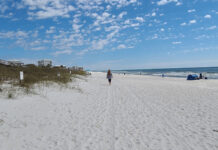
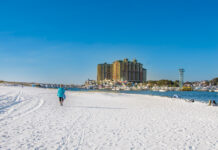
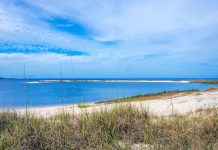
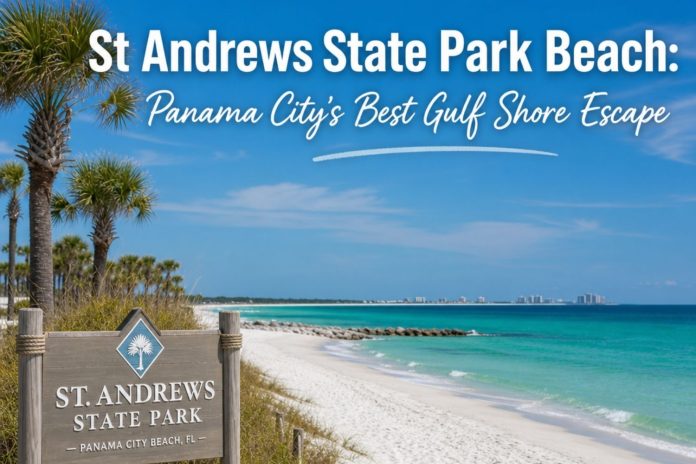
The main Gulf beach at St. Andrews is the version of this coastline that photographs best and delivers most immediately on what people drive here for. Over 1.5 miles of south-facing Gulf shoreline backed by tall, intact dunes and fronted by the same sugar-white quartz that runs the full Panhandle coast, but without a single condo tower or umbrella rental operation in the sightline. The beach is wide, with the sand staying powdery and consistent well above the wrack line because the dune system behind it has been left intact, and the water runs the full emerald-to-turquoise spectrum on clear days.
Boardwalks extend from the parking areas to the beach, with beach wheelchairs available for visitors who need them, obtained at the ranger station. Seasonal lifeguards are stationed on the main beach. The Jetty Store near the main beach entrance has snacks, drinks, beach chairs, and umbrellas for rent. The camp store has a broader inventory of snacks, grocery items, bait and tackle, and ice. These are the only food and supply options in the park, so plan your day’s provisions before arriving rather than assuming there’s more than what’s there.
I remember standing on this beach in February 2021 and thinking about how complete the setting was: the Gulf water reading emerald, the dunes rising behind the upper beach, and nothing built in any direction. That kind of sightline is genuinely rare in a park this close to a city of this size. The fact that it exists at the eastern end of Panama City Beach, five minutes from a Pier Park with 120 stores, is one of those Florida contradictions that only makes sense when you understand the military reservation history. You’ll feel the distance from the commercial strip the moment you step onto the beach.
The Grand Lagoon Side
Calm Bay Water · Best for Young Children · Boat Ramp Access
The Grand Lagoon side of the park faces north into the protected waters of Lower Grand Lagoon and St. Andrews Bay, and the character here is completely different from the Gulf side. Calm, shallow, and protected from Gulf surf, the lagoon water functions as a natural swimming pool that is ideal for young children, nervous swimmers, and anyone who wants a water day without worrying about wave action. On days when the Gulf flags are yellow or red, the Grand Lagoon side is the backup plan that doesn’t feel like a compromise.
The fishing pier at the Grand Lagoon is a separate facility from the Gulf beach boardwalks. It has a concession stand with fishing supplies, snacks, and souvenirs. Flounder is the signature target species here, but the brackish character of the lagoon draws a mix of species that changes with the season and the tidal conditions. The double-sided boat ramp at the lagoon is available for a launch fee ($12 for one person, $16 for two to eight people) and accommodates vessels up to the largest recreational boat sizes. The marina area and bay-side access also serve as the departure point for dolphin watching cruises and sunset boat tours that operate out of the park in season.
I’ve watched parents set up towels and chairs on the lagoon’s sandy shore and let their two-year-olds wade out to waist depth on a completely flat water surface while they sat back and watched without tension. That experience doesn’t exist on the Gulf side when any kind of swell is running. If you’re traveling with children under six and the Gulf conditions aren’t favorable when you arrive, the lagoon side is where your day should be. It’s not a lesser option; it’s a different kind of day entirely.
The Jetty and Snorkeling Area
Eastern Tip · Rock Jetties · Marine Habitat
The jetties at the eastern tip of St. Andrews State Park are the feature that draws the most knowing visitors, specifically snorkelers and divers who understand what rock structure in an otherwise sandy Gulf environment means for marine life density. The rock jetties were built to manage the St. Andrews Pass inlet, and over time they’ve created a concentrated marine habitat where tropical fish thrive in water that stays cleaner and clearer than almost anywhere on the Gulf Coast without a reef. On calm days with good sun, visibility at the jetties can exceed 20 feet, and the species you encounter, spadefish, sergeant majors, flounder, sheepshead, and various grouper and snapper depending on the season, aren’t what most people expect to find in Panhandle waters.
Snorkeling and scuba equipment is available for rent at both the Pier Store and the Jetty Store inside the park. The rental price is reasonable and the instruction from staff on conditions and timing is worth asking for before you get in the water. The critical safety note is one the park itself emphasizes: never swim near the jetty rocks when waves are rough or when the current through the inlet is running. The rocks are hard and currents near the inlet can be strong and unpredictable. Check conditions before entering and respect the posted advisories. On calm mornings with light wind, the jetty snorkeling is genuinely extraordinary. On rough days, the Gulf beach is the safer call.
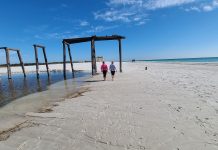
The jetty overlook is also accessible via elevated boardwalk for visitors who want the view without entering the water. The overlook gives you a view straight down the jetty structure and across the inlet toward Shell Island, and on calm mornings you’ll see the water running clear enough to see bottom structure from the boardwalk surface. I’ve stood on that overlook watching sting rays move through the clear green water below and felt like I was looking into a different ecosystem than the beach a hundred yards behind me. The transition from sandy beach to living marine habitat at the jetty base is one of the specific things about this park that earns its reputation.
Gator Lake and the Interior Habitats
Freshwater Interior · Wildlife Watching · Accessible Overlook
Gator Lake is the inland body of water in the park’s mainland section, and the name is accurate. The lake is man-made in origin but has aged into a functional freshwater habitat that hosts a resident alligator population visible from the accessible overlook on a reliable basis. The Florida State Parks website describes the overlook as one of the park’s interpretive highlights, and for good reason: watching a large alligator cruise the edge of a freshwater lake with pine flatwoods in the background, 200 yards from a Gulf beach, is a reminder of how compressed and varied this park’s ecology is.
The standard advice applies: maintain at least 30 feet of distance from any alligator, never feed wildlife, and keep pets and small children away from the water’s edge. The overlook is built to provide a safe viewing point that respects these distances, and alligator sightings are common enough that most visitors who stop here see one. Beyond the alligators, Gator Lake and the adjacent Buttonbush Marsh are significant bird watching zones: anhingas drying their wings on exposed branches, great blue herons stalking the shallows, marsh rabbits moving through the sedge edges, and numerous wading birds that shift between the lake and the nearby Gulf-area habitats.
The nature trails that wind through the park’s interior give you access to the range of habitats that make St. Andrews ecologically significant: coastal dunes, pine flatwoods, freshwater marshes, salt marshes, and the transition zones between them. Two half-mile nature trails are available from the main trail network, and the paved two-mile bike loop connects through the interior with bike rentals available at the camp store. The combination of the nature trail network, the overlook areas, and the lake gives the park a terrestrial wildlife experience that complements the beach and water activities in a way that most beach parks don’t provide.
Shell Island
Seven Miles of Undeveloped Barrier Island · Shuttle Access
Shell Island is the experience that most visitors list as the highlight of a St. Andrews trip, and it earns that consistently. The seven-mile undeveloped barrier island sits just offshore across the St. Andrews Pass inlet, accessible by the Shell Island Shuttle from the park or by private boat. No buildings, no roads, no concession stands, no restrooms. What’s there: miles of white quartz beach on the Gulf side, calm protected water on the bay side behind the jetty for swimming and snorkeling, excellent shelling along the waterline, wildlife including ghost crabs, white-tailed deer, and nesting sea turtles, and the kind of solitude that no commercial beachfront can provide.
The shuttle runs seasonally: in summer from Memorial Day through Labor Day, departures are every 30 minutes from 9 AM to 5 PM; in spring and fall departures are hourly from 10 AM. Round-trip fare is approximately $19.95 for adults and $12.95 for children ages 3-12. The ride takes about 15 minutes. The critical preparation note is one the park and the shuttle operator both repeat clearly: Shell Island has NO shade, NO restrooms, and NO drinking water. Bring everything you need for the day and pack every bit of it back out when you leave. People who arrive underprepared for the sun exposure on an undeveloped barrier island in August tend to cut the trip short. Sunscreen, hats, plenty of water, and food for the full duration of your visit are not optional.
The snorkeling in the calm water behind the Shell Island jetty is excellent for families because the water is protected from Gulf surf and stays shallow and clear. You can see shells and small marine life without a mask and add snorkeling gear to see considerably more. The shelling along the Gulf-side wrack line is the best accessible shelling in the entire PCB area and it’s available throughout the island’s length. Augers, scallops, jingle shells, and sand dollars appear in volume after a Gulf storm, and even on calm-weather days the shell line here is more productive than anything on the PCB main beach.
The Campground and Pine Flatwoods
176 Full-Hookup Sites · Pinewoods Setting · Year-Round
The campground at St. Andrews State Park is one of the most sought-after overnight camping destinations in the Florida State Park system, and the site quality explains why. Two campground loops nestle into the pinewoods near Lower Grand Lagoon, with 176 sites featuring full electric and water hookups, picnic tables, and grills. RVs up to 40 feet are accommodated. Dump stations, bathhouses with heated showers, and a laundry facility round out the utility side. Glamping options are also available for visitors who want the park experience without tents or RVs.
Waking up inside the park before the day-use gates open gives you an hour or more of exclusive access to the beaches, the nature trails, and the lagoon that no day visitor gets. The pinewoods at dawn are a birding experience of their own, with the campground serving as a stopover habitat for migratory species in spring and fall that pass through the pine-and-scrub canopy before moving on. Deer move through the campground edges at dusk and dawn. The alligators at Gator Lake are more active in the cooler morning hours. Spending multiple nights here, as the regulars who book a full week in peak season do, gives you the full range of the park’s character across different times of day and weather conditions.
Reserve well in advance. The campground fills for summer months and major holidays months ahead of the reservation opening window. Check availability through the Florida State Parks reservation system as far out as possible if you’re targeting a summer or spring break date. Winter camping is available and the park stays open year-round, which makes a November or January stay genuinely peaceful: the crowds are gone, the weather is cool, and the birds in the pinewoods are at their most varied during the winter migration stopover period.
St. Andrews State Park Rankings: Expert Scores Across 11 Categories
These scores reflect the full park experience, weighing the exceptional Gulf beach and snorkeling against the practical realities of the $8 fee, the seasonal capacity closures, and the limits on where dogs are permitted.
Sand Quality
9/10
Near-pure quartz sand backed by intact dunes, receiving less foot traffic per acre than the PCB public beach accesses just west of the gate. The upper beach stays more consistent and powdery than at the commercial pier beaches. Shell Island adds another 7 miles of equivalent quartz that sees even lighter traffic. This is the best sand condition in the Panama City Beach area.
Hiking & Beach Walking
8/10
Over 1.5 miles of Gulf beach, the Grand Lagoon shoreline, two half-mile nature trails, a two-mile paved bike loop, and nature trail access to the full range of park habitats. Add Shell Island’s seven miles of beach for those who take the shuttle. The only reason this doesn’t score higher is that the beach walking mileage within the park’s main section is limited compared to longer protected beaches like Topsail Hill or Cumberland Island.
Shelling
8/10
One of the better shelling experiences in the PCB area, particularly on Shell Island after a Gulf storm. The combination of the jetty current, which concentrates shell material, and Shell Island’s exposed eastern tip gives this park two distinct shelling zones that both produce well. On the main Gulf beach, finds are moderate and improve significantly after weather events. Augers, scallops, jingle shells, and sand dollars are reliable post-storm finds.
Water Conditions
9/10
Two distinct water environments: the Gulf side with clear emerald surf and gradual entry, and the Grand Lagoon with calm, shallow, protected water ideal for families. The jetties add a third environment with exceptional clarity and marine density. The park has the widest range of water conditions of any beach on the PCB coast, and the Grand Lagoon serves as a reliable calm-water backup when Gulf conditions aren’t favorable.
Scenery & Natural Beauty
9/10
Intact dunes, pine flatwoods, salt marsh, freshwater lake with alligators, the jetty structure at the peninsula’s tip, and an undeveloped barrier island offshore: the park’s visual range is exceptional for a coastal area this close to a major resort corridor. Standing on the Gulf beach here with no development in the sightline five minutes from Panama City Beach is one of the more striking juxtapositions on the Panhandle coast.
Birding & Wildlife
9/10
Multiple habitat types within 1,260 acres create exceptional species diversity. Resident alligators at Gator Lake, white-tailed deer moving through the campground at dawn, anhinga and great blue heron in the marsh areas, shorebirds on Shell Island, dolphins offshore on most calm mornings, sea turtles nesting on the Gulf beach May through October, and rich migratory stopover diversity in spring and fall. A genuinely excellent wildlife park wrapped around a beach park.
Family Friendliness
10/10
This is the category where St. Andrews earns its reputation cleanly. Two beach types for different swimming abilities, seasonal lifeguards on the main Gulf beach, equipment rentals on site, a camp store with food and snacks, boat tours and Shell Island access for older children, Gator Lake for wildlife watching, accessible boardwalks with beach wheelchair availability, and a campground for multi-night stays. Every age group has something built for them.
Dog Friendliness
5/10
Dogs are welcome in the campground and on the park’s nature trails with a leash, and service animals are welcome in all areas. Dogs are not allowed on the Gulf beach or the Grand Lagoon beach. This is a better outcome than most state park beaches in the Panhandle, where dogs are often excluded from the full trail network as well. For a camping trip with a dog, St. Andrews is workable. For a beach day with a dog, the Dog Beach at Russell-Fields Pier is your only Gulf option in the area.
Solitude & Peace
7/10
Significantly quieter than the commercial PCB strip adjacent to it, and the park’s size means you can find uncrowded spots even on moderately busy days by walking the beach away from the main access points. Summers bring real crowds, and the park reaches capacity and temporarily closes on the busiest summer weekends. The campground and early-morning hours give the best solitude. Winter is where you find the most peaceful experience of this park.
Entertainment & Nightlife
4/10
A natural park with no nightlife and limited commercial entertainment. What the park offers in this space: Shell Island shuttle, dolphin and sunset boat tours, bike rentals, snorkeling and equipment rentals, and the camp store food operation. Pier Park is 15 minutes west for anyone who wants the full entertainment menu. The park closes at sundown. Score reflects the category definition rather than a criticism: this is exactly as it should be.
Parking & Beach Access
7/10
$8 per vehicle is reasonable for the quality and scope of the park experience. Boardwalk access to the beach is available and accessible. The main parking area fills during peak season, and the park reaches capacity and may close temporarily on the busiest summer weekends and holidays. Arriving by 8 AM on summer days essentially eliminates the capacity issue. Annual Florida State Parks passes are excellent value for anyone visiting multiple state parks in a season.
St. Andrews State Park Sand & Water
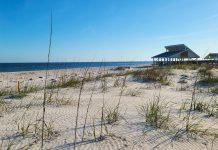
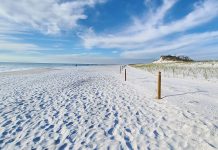
The sand here is soft, sugar-white, and about as undisturbed as it gets on this stretch of coast, wide open beach backed by some of the tallest, best-preserved dunes in the area. The upper beach is genuinely soft for sunbathing and sandcastle building, and it firms up nicely right at the water for easy walking and setting up chairs without sinking.
Because the park limits how many visitors it lets in on a given day, this beach never feels as worked over as the busier public stretches nearby, plenty of room to spread out even when the parking lot is full.
The water is where this park really sets itself apart, because you’re actually choosing between two different experiences. The Gulf side runs a clear, emerald green with a gradual entry and normal Gulf surf, good for typical beach swimming with the usual rip current caution during rough weather. The Grand Lagoon side, protected behind the jetty, stays calm and shallow enough that it’s the go-to spot for families with small children, and the water is some of the clearest you’ll find anywhere in the Panama City Beach area, genuinely good snorkeling right off the rocks.
-
Walkability. Wide, flat, and quieter than the beaches outside the park gate. The walk from the jetty to the fishing pier along the dune line is one of the best short walks on this whole coast.
-
Softness & Playability. Genuinely soft on the upper beach with room to spread out. Shell content is a bit higher here than the main PCB strip, a fun bonus if the kids like to hunt while they play.
-
Barefoot Comfort. Comfortable across most of the Gulf beach most of the year. The one exception is the jetty itself, which is rock, not sand, so plan on water shoes if you’re heading out to it.
-
Swimmability. Excellent on both sides. Choose the Gulf beach for normal surf and typical flag-based caution, or the calm, shallow Grand Lagoon side if you want the easiest water for young kids.
Want the full geology, grain composition, and the complete sand and water condition ratings? I broke it all down separately in Sand & Shore: St. Andrews State Park.
Dogs & Pet Accessibility
Are Dogs Allowed on the Sand? NO.
Pets are not permitted on the beach at either the Gulf side or the Grand Lagoon side, in the wetlands, on any boardwalk, in the playground, or in any building. This is a firm, actively enforced rule, not a suggestion.
Where Dogs Are Allowed
- ✓Heron Pond Trail and Gator Lake Trail, both leashed, both half a mile through shaded interior habitat.
- ✓The two-mile paved bike loop through the park’s interior, leashed.
- ✓Picnic areas throughout the park, leashed.
- ✓The campground itself, leashed, though not in swimming areas or buildings.
Where Dogs Are NOT Allowed
- ✗The Gulf-side beach, anywhere along its 1.5-plus miles.
- ✗The Grand Lagoon-side beach.
- ✗Any boardwalk, including the jetty overlook boardwalk and both beach-access boardwalks.
- ✗Wetlands, the playground, and all buildings.
Paws on the Ground Reality
If you’re traveling with a dog, plan your St. Andrews visit around the two half-mile interior trails and treat the beach itself as off the table. Walk Heron Pond Trail and the Gator Lake Trail back to back in the cooler morning hours, when bird activity and alligator sightings both run higher anyway, and you’ve got a genuinely good hour of dog-friendly park time before you head elsewhere for beach access.
For actual beach time with your dog, the closest real option is the Dog Beach at Russell-Fields Pier, a 400-foot leashed stretch of sand on the Gulf side near Pier Park, about 15 to 20 minutes west along Front Beach Road. For a longer hike with a dog rather than a beach day, Panama City Beach Conservation Park is worth the drive, roughly 2,900 protected acres with about 24 miles of natural-surface trail and over a mile of boardwalk through cypress domes, leashed dogs welcome, loops from a half mile up to around 11 miles.
Crowd Levels and the Overall Feel of St. Andrews State Park
St. Andrews draws a more diverse crowd than any other park in the PCB corridor precisely because it offers more distinct experiences within a single entry fee. On a busy summer Saturday you might find a serious birder working the Buttonbush Marsh overlook, a family with a two-year-old in the Grand Lagoon, a group of college students from FSU on the snorkeling trip, and a retired couple who’ve been camping in Loop A for five days. The park absorbs all of them without any one group defining the character of the whole.
The park reaches capacity and temporarily closes its entrance to new vehicles on the busiest summer weekends, major holidays, and some peak-season Saturdays. Arriving by 8 AM eliminates this risk on most days. Checking the park’s social media or calling the ranger station before driving in on a summer Saturday is basic preparation rather than excessive caution.
The crowd and atmosphere shift notably through the year:
- Spring (March through May): excellent conditions with warm-enough water, migrating birds and butterflies passing through the pine hammocks and coastal habitats, lighter crowds than summer, and Shell Island Shuttle running on reduced hours; the best all-around window for a first visit
- Summer (June through August): peak season with the warmest water and the most activity; Shell Island Shuttle running full schedule; jetty snorkeling at its best water temperature; capacity closures a real possibility on weekends; plan for early arrival and a full day
- Fall (September through October): warm water well into October, returning shorebirds and migratory species moving through, lighter crowds after Labor Day, and Shell Island Shuttle running reduced hours; the quality of the park experience matches summer with significantly fewer people
- Winter (November through February): the park’s quietest and most private season; the campground becomes a birding destination in its own right as winter migrants settle in; alligator activity at Gator Lake slows slightly but sightings continue; Shell Island Shuttle is not operating but the Gulf beach and all trail systems remain open
Who Is St. Andrews State Park Really For?
✓ Who Will Love St. Andrews State Park
-
Families with children of any age: the dual beach setup (Gulf surf and calm lagoon) covers every swimming ability level, and Gator Lake, Shell Island, and the boat tours give older children and teenagers their own highlights
-
Snorkelers and divers who want exceptional clarity without a boat trip: the jetty snorkeling is some of the best shore snorkeling on the Gulf Coast with equipment available for rent on site
-
Campers who want to wake up inside a natural park with early morning access before the day-use crowds arrive: the campground’s position in the pinewoods with bird activity and wildlife access at dawn is genuinely different from any campground experience adjacent to a commercial beach corridor
-
PCB visitors who want a full-day natural break from the commercial strip: this park is 15 minutes from Pier Park and feels like a different planet from it
-
Birders and wildlife watchers who want alligators, diverse shorebird species, migratory stopover habitat, and marine wildlife in one visit
-
Anglers who want multiple fishing environments without a boat: two fishing piers, the jetty, and surf fishing on the Gulf beach cover a range of target species and fishing styles
✗ Consider Another Beach If…
-
Your dog needs beach access: dogs are not allowed on the Gulf beach or the Grand Lagoon beach at St. Andrews; the trail system and campground are the dog-accessible areas
-
You want a long, uninterrupted beach walk with no facilities: the Gulf beach here is 1.5 miles; for longer natural beach walking, Topsail Hill Preserve State Park to the west has three miles
-
You’re planning a summer Saturday visit without a plan to arrive early: the capacity closure is a real possibility on peak summer weekend days; without an early arrival you risk turning around at the gate
-
You want nightlife after the beach day: the park closes at sundown; Pier Park is 15 minutes west for everything the evening requires
Things to Do at St. Andrews State Park, Florida
The activity range here is broader than almost any single beach park on the Panhandle. Budget more time than you think you need for a first visit.
-
Gulf Beach Swimming. The main Gulf beach has a gradual entry, seasonal lifeguards, and clear emerald water. The jetty end of the beach gets the best clarity. Always check the flag before swimming and be aware that the current near the inlet increases when the tide is moving strongly.
-
Grand Lagoon Swimming. The calm, shallow bay-side water is ideal for young children and anyone who wants flat water. No waves, protected from Gulf surf, and accessible from the lagoon-side facilities. On red or yellow flag days on the Gulf side, the lagoon is the right call for families.
-
Jetty Snorkeling and Scuba. The signature experience of the park. Rock jetties at the eastern tip create concentrated marine habitat with 20-plus feet of visibility on calm days. Snorkeling and scuba equipment is available for rent at the Pier Store and Jetty Store. Never enter the water near the rocks during rough conditions. Spadefish, sergeant majors, flounder, and grouper are among the regular species.
-
Shell Island Day Trip. The seasonal Shell Island Shuttle connects the park to the seven-mile undeveloped barrier island offshore. Excellent shelling, calm-water snorkeling behind the island’s jetty, and wildlife including ghost crabs, deer, and sea turtles. No facilities: bring all food, water, and sun protection for the full day. Adults approximately $19.95, children $12.95 round trip.
-
Kayaking and Paddleboarding. Rentals available seasonally from the park’s concessionaire. The Grand Lagoon is the primary paddling venue, with calm water and wildlife along the marsh edges. Pontoon boat rentals are available by the half or full day for bay exploration. Private boats can launch from the double-sided concrete ramp at the lagoon.
-
Fishing. Two dedicated fishing piers (Gulf side and Grand Lagoon), jetty fishing, and surf fishing on the Gulf beach. Flounder, Spanish mackerel, cobia, redfish, and seasonal species. A Florida fishing license is required for all fishing within the park. Bait and tackle is available at the camp store and the pier concession.
-
Gator Lake Wildlife Watching. The accessible overlook at Gator Lake offers reliable alligator sightings year-round, with the most activity in warmer months. Maintain 30 feet of distance from any alligator. The adjacent Buttonbush Marsh overlook is a productive bird watching point. Both are accessible by vehicle from the interior park road.
-
Biking. A two-mile paved road loops through the park’s interior with bike rentals available at the camp store. The paved surface makes this accessible for all skill levels and a good option for exploring the park’s habitat transitions without hiking the full trail system.
-
Dolphin and Sunset Cruises. Boat tour operators run dolphin watching and sunset cruises from the Grand Lagoon and bay side of the park in season. Atlantic bottlenose dolphins are year-round residents of St. Andrews Bay. Sunset from the water with the park’s pine-and-dune silhouette in the background is a specific version of the Gulf Coast evening that rewards the ticket price.
-
Camping. 176 full-hookup campsites in the pinewoods with electricity, water, picnic tables, grills, dump stations, heated shower bathhouses, and laundry. Glamping options also available. Reserve through the Florida State Parks system well in advance for summer and holiday dates. Winter camping is consistently excellent and the campground is usually available on short notice.
Local Knowledge and Practical Advice
A few things I’ve picked up walking this park and planning visits to it that make the difference between a rushed day and a complete one:
-
Arrive by 8 AM in summer to beat the capacity closure. The park opens at 8 AM and reaches vehicle capacity on busy summer and holiday weekends. Once the lot fills, the gate closes to new vehicles until space opens. Arriving within the first half hour guarantees entry and gives you beach time before the full crowd builds. This is not optional advice in July and August.
-
The entrance fee is $8 per vehicle. Annual Florida State Parks passes cover admission to every state park in Florida for the year and pay for themselves quickly if you’re visiting more than two or three parks in a season. Passes can be purchased at the gate during regular hours.
-
Plan the Shell Island trip as its own dedicated excursion. The shuttle runs specific departure times and the 15-minute ride plus island time means you’re committing the better part of a day. Shell Island has zero shade, zero facilities, and zero water supply. Sunscreen, hats, a full supply of water, and food for the duration aren’t optional. Families with children who sunburn easily should plan for shade in some form, since nothing on the island provides it naturally.
-
Never snorkel near the jetty rocks in rough conditions. The park’s safety advisories on the jetty are clear and should be taken seriously. The same current that makes the jetty area productive for marine life can push a swimmer into the rocks when conditions aren’t calm. Check conditions before entering the water and respect the posted advisories. Clear, calm mornings are the right window for jetty snorkeling.
-
Stay at least 30 feet from alligators at Gator Lake. Resident alligators are present in the lake year-round and visible from the overlook regularly. The park does not remove alligators that are behaving normally. Never feed wildlife anywhere in the park: it creates dangerous associations and is subject to Florida law enforcement.
-
Reserve the campground the day reservations open for peak-season dates. This campground fills for summer months and major holidays well before the dates arrive. Check the Florida State Parks reservation system for how far in advance sites become bookable and target the first available opening window for summer and spring break dates. Off-season camping is available with much shorter lead times.
-
Dogs are welcome in the campground and on trails but not on the beach. This applies to both the Gulf beach and the Grand Lagoon beach area. The park’s trail system gives dogs meaningful access to the interior habitats, including views of Gator Lake from the overlook zone. The beach restriction is firm and is enforced to protect nesting shorebird habitat near the inlet.
-
Sea turtle nesting runs from May through October on the Gulf beach. Marked nests are protected and may not be disturbed. Remove all personal equipment from the beach by sunset, use only red-filtered light if you’re on the beach after dark, and follow all posted instructions near marked nest sites. The park’s campground loop has a turtle-safe lighting system that allows overnight campers to comply with nesting season requirements without difficulty.
-
The snorkeling at the jetties is at its clearest in the morning before boat traffic builds. The inlet sees consistent watercraft movement as the day progresses, which adds turbidity near the jetty zone. Scheduling jetty snorkeling for the first two hours after park opening gives you the best visibility window of the day in summer. Fall mornings extend this window significantly as boat traffic decreases after Labor Day.
Where to Stay Near St. Andrews State Park, Florida
The park itself offers the best on-site lodging option if camping fits your plans. For everyone else, PCB and the surrounding area have a full range.
Camping Inside the Park
The campground at St. Andrews State Park is the top recommendation for anyone for whom camping is an option. 176 full-hookup sites in the pinewoods, with morning access to the park before day-use gates open, is a fundamentally different experience from any hotel or vacation rental base. Glamping is also available. Reserve through the Florida State Parks reservation system as far in advance as possible for summer and holiday dates.
East End and Thomas Drive Area Hotels and Condos
The Thomas Drive corridor leading from Front Beach Road to the park entrance has a range of vacation condos, family resorts, and smaller hotels within a 5-10 minute drive of the park gate. This is the closest lodging zone for non-campers and gives you early morning access to the park before the day-use traffic from the wider PCB area arrives. Rates here tend to be lower than the Gulf-front resorts in the central strip.
Panama City Beach Central Strip
Gulf-front resorts and large condo properties in the Pier Park area are about 15 minutes from the park by car. These properties give you Pier Park walkability in the evenings and the full PCB resort experience, with the park as a day trip from your base. Several of the larger central strip properties offer private beach chair and umbrella service on the sand directly adjacent to the resort building.
Vacation Rentals Near the Park
Single-family vacation homes and smaller condo units in the neighborhoods south of Thomas Drive and near Grand Lagoon offer a quieter base than the main PCB strip with proximity to the park. Bay-view properties on Grand Lagoon give water views without Gulf-front pricing and put you five minutes from the park entrance.
Panama City Mainland (Budget Option)
Panama City proper, about 10-15 minutes north via US 98, offers significantly lower nightly rates at chain hotels and budget properties. The drive to the park is straightforward. For visitors focused on the park experience rather than a resort base, mainland Panama City pricing makes multi-night stays considerably more affordable.
What Makes St. Andrews State Park Different from Nearby Beaches
Several things set this park apart from every other beach experience in the PCB and Panhandle corridor.
The jetty snorkeling is unlike anything else on the Gulf Coast at this latitude
Rock jetties in an otherwise sandy Gulf environment create a concentrated marine habitat that doesn’t exist at unarmored beaches. The clarity and species diversity at the St. Andrews jetties on a calm day, with 20-plus feet of visibility and tropical fish species from spadefish to flounder, is the kind of snorkeling most people associate with destinations much further south in Florida. No other beach accessible from PCB offers this without a boat trip.
The dual beach environment
The Grand Lagoon side and the Gulf side provide two categorically different water experiences within the same park, each with its own set of conditions and users. This flexibility is uncommon: most beaches offer one experience and manage it as well as they can. St. Andrews offers both, which means a rough Gulf day doesn’t cancel the park visit, it redirects it.
Shell Island as part of the park experience
A seven-mile undeveloped barrier island accessible by shuttle from inside the park is an asset that no other nearby beach offers. The island’s combination of excellent shelling, calm-water snorkeling, and complete absence of development makes it a genuinely distinct excursion available from within the same entry fee and gate.
Military reservation heritage means intact ecology adjacent to a resort city
The fact that this land was a military reservation through the mid-20th century is the only reason it exists as intact natural habitat today. No other beach in the PCB corridor has this protection history, and the ecological consequence is visible: the dune system is intact, the habitats are continuous rather than fragmented, and the wildlife density is measurably higher than at any unprotected coastline in the area.
St. Andrews State Park vs. Other Florida Panhandle Beaches
St. Andrews vs. Camp Helen State Park
Both are state parks with coastal dune lake features within the same coastal stretch. Camp Helen, about 15 miles west near the Walton County line, has a larger dune lake in Lake Powell, richer historical character with its Hicks family and Avondale Mills buildings, and a different trail system. St. Andrews has more beach footage, the jetty snorkeling, Shell Island access, and camping. Both are worth visiting on the same trip, and they don’t duplicate each other. For camping and a full-facility beach park, St. Andrews. For history and lake paddling, Camp Helen.
St. Andrews vs. Topsail Hill Preserve State Park
Topsail Hill Preserve, about 35 miles west near Destin, has three miles of Gulf beach, a tram service to the water, and camping. Its beach walking mileage exceeds St. Andrews, and its dune system is among the most impressive in the Panhandle. Topsail doesn’t have the jetty snorkeling, the dual beach environments, or Shell Island access. For pure beach walking distance and dune scenery, Topsail. For the full-experience park with snorkeling and Shell Island, St. Andrews.
St. Andrews vs. Panama City Beach (commercial strip)
The comparison between St. Andrews and the PCB strip three miles west is essentially the comparison between protected natural coastline and full commercial development. Same quartz sand, same Gulf water, completely different context. The strip offers 27 miles of developed beachfront with lifeguards at multiple points, Pier Park, water parks, and everything else PCB provides. St. Andrews offers a natural park experience with better marine wildlife and no commercial development visible from the beach. They’re not substitutes for each other: both have roles in a complete PCB trip.
St. Andrews vs. Grayton Beach State Park (30A)
Grayton Beach State Park, about 30 miles west on 30A, is the 30A dune lake park equivalent. Both are excellent Florida state parks with distinctive natural features. Grayton has Western Lake, strong camping, and the full 30A community character nearby. St. Andrews has the jetty snorkeling, Shell Island, dual beaches, and the PCB resort base available a few miles away. Choose based on whether you want the 30A community experience or the PCB full-service resort proximity.
Bottom line: St. Andrews State Park is the right choice when you want the complete natural Florida beach experience within reach of the full PCB resort corridor. The dual beaches, the jetty snorkeling, the Shell Island access, and the campground make it the most comprehensively equipped natural beach park in the PCB area, and it earns its national reputation specifically because it delivers all of those things consistently.
St. Andrews State Park Beaches, Florida: Frequently Asked Questions
How much does it cost to enter St. Andrews State Park?
The entrance fee is $8 per vehicle. Pedestrians and cyclists pay $2 per person. Annual Florida State Parks passes cover admission to all state parks in Florida for the year and are purchased at park entrances during regular hours. The park is open from 8 AM to sundown every day of the year.
Are there lifeguards at St. Andrews State Park?
Yes, seasonally on the main Gulf beach. Check the flag conditions before swimming even when lifeguards are present, and note that the jetty area has specific conditions that warrant extra caution regardless of the main beach flag. The Grand Lagoon side does not have lifeguards but the calm, shallow water makes it appropriate for supervised family swimming.
How do I get to Shell Island from St. Andrews State Park?
The Shell Island Shuttle operates seasonally from the park. In summer from Memorial Day through Labor Day, departures run every 30 minutes from 9 AM to 5 PM. In spring and fall, departures are hourly from 10 AM. Round-trip fares are approximately $19.95 for adults and $12.95 for children ages 3-12. The ride is about 15 minutes. Shell Island has no shade, restrooms, or drinking water: bring everything for the day. Private boats can also access the island via the park’s boat ramp.
Is the snorkeling good at St. Andrews State Park?
Yes, the jetty snorkeling is genuinely excellent on calm days. The rock jetties create a concentrated marine habitat with visibility that can exceed 20 feet, making this some of the best accessible shore snorkeling on the Gulf Coast. Snorkeling equipment is available for rent at the Pier Store and Jetty Store. The critical condition is water clarity: plan jetty snorkeling for calm mornings and never enter the water near the rocks during rough conditions.
Are dogs allowed at St. Andrews State Park?
Dogs are allowed on the nature trails and in the campground with a leash. They are not permitted on the Gulf beach or the Grand Lagoon beach. The trail system gives dogs access to the park’s interior habitats including the Gator Lake overlook zone. Service animals are welcome in all areas of the park.
Does St. Andrews State Park have camping?
Yes. The park has 176 full-hookup campsites in the pinewoods near the Grand Lagoon, with electricity, water, picnic tables, grills, dump stations, heated shower bathhouses, and laundry facilities. RVs up to 40 feet are accommodated. Glamping options are also available. Reservations are made through the Florida State Parks system and should be made as far in advance as possible for summer and holiday dates. Winter camping is typically available with shorter advance notice.
What wildlife can you see at St. Andrews State Park?
The park’s range of habitats supports exceptional wildlife diversity. Gator Lake has resident alligators visible from the accessible overlook. White-tailed deer move through the pinewoods, particularly at dawn and dusk in the campground area. Shorebirds including piping plover and least terns are present seasonally. Great blue herons, anhingas, ospreys, and bald eagles are regular sightings. Atlantic bottlenose dolphins appear offshore on most calm mornings. Sea turtles nest on the Gulf beach from May through October. The jetty area supports tropical fish species including spadefish, sergeant majors, and flounder.
Does St. Andrews State Park get crowded?
The park reaches capacity and temporarily closes its entrance to new vehicles on the busiest summer weekends, major holidays, and some peak-season Saturdays. Arriving by 8 AM, when the park opens, eliminates this risk on most days. Fall, winter, and weekdays provide significantly lighter crowds. Checking the park’s status before driving in on a summer Saturday is good practice.
Can you surf at St. Andrews State Park?
Surfing is possible on the Gulf beach at St. Andrews during weather events that produce rideable swell, which occurs several times per year when Gulf conditions align. This is not a reliable surf destination in the way that east-facing Florida Atlantic beaches are, but the park does see surfable conditions more frequently than the calmer stretches further west on the Panhandle.
Is the Grand Lagoon good for families with small children?
Yes, the Grand Lagoon is the best family swimming option in the park specifically for young children. The protected bay water stays calm regardless of Gulf conditions, the water is shallow well away from the shore, and there are no waves to manage. When the Gulf beach flags are yellow or red, the Grand Lagoon is the reliable backup that makes a park visit work for families with children who aren’t ready for surf.
Patti’s Perspective: My Honest Take on St. Andrews State Park
I first walked this park in 2021, and what stays with me is the moment I stood on the peninsula with the Gulf on one side, the calm bay on the other, and the jetties extending out into the pass at the tip. The peninsula setting gives the park a quality that flat, linear coastline can’t match: you’re inside the landscape in a way that changes how you read both the water and the sky. The emerald of the Gulf on the south side read completely differently from the blue-green of the Grand Lagoon on the north, and both of them together with the pine hammock interior made for one of the more complete natural settings I’ve experienced at any coastal park in Florida.
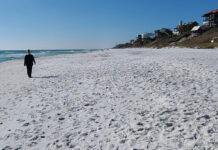
Then I walked from the jetty to the pier with the beautiful emerald waters on one side and the towering dunes on the other, and it is to this day, one of my favorite beach walks.
What I first wrote about this place is it is “by far one of the most spectacular coastal parks in Florida,” and I stand behind that. That isn’t something I say casually after walking every Florida beach, and I say it here because the combination of what this park offers is genuinely uncommon: the quality of the Gulf beach, the usefulness of the Grand Lagoon for families, the jetty snorkeling that competes with reef destinations much further south, Shell Island accessible by shuttle with seven miles of undeveloped barrier beach, a campground that puts you inside the park for dawn and dusk access, and the full range of habitat from alligator lake to pine flatwoods to salt marsh within a single afternoon’s exploration.
The sand is what I always notice first. The sugar-white quartz backed by those intact dunes, without a single condo tower in the sightline, is the beach version of what this whole coastline looked like before the development era. Standing there and knowing Pier Park is 15 minutes west is one of those Florida contradictions that you have to experience to fully absorb.
For the route, the trail connections, and what the full beach walking experience looks like from the Gulf beach through the lagoon trails, I have more detail in my beach hiking guide to St. Andrews State Park. But what I’ll say here is simpler: give this park a full day, not a half-day. It takes time to move through everything it has, and the park rewards the pace you give it.
My verdict: 9.5/10. St. Andrews State Park is the most complete beach park experience in the Panama City Beach area and one of the top coastal parks in Florida by any honest measure. The dual beaches, the jetty snorkeling, Shell Island, the campground, the wildlife, and the natural landscape that exists five minutes from a major resort city earn this park everything it has been given. It loses a point on solitude in peak season and on the beach dog restriction. Everything else is at or near the best of its category on the Panhandle coast.
Want to Live by the Water?The neighborhoods surrounding St. Andrews State Park on the eastern end of Panama City Beach are among the most sought-after in Bay County, and the park’s presence as a permanent protected natural buffer is a meaningful factor in the area’s appeal. Properties in the Thomas Drive and Grand Lagoon corridors offer bay views and proximity to the park at prices generally below the Gulf-front central strip, with shorter-term rental income potential from the park’s year-round visitor base.The park’s consistent national recognition and year-round operation support property values in the surrounding area by ensuring a steady visitor base regardless of season. For buyers interested in a waterfront or water-adjacent property within reach of both the full PCB resort corridor and a 1,260-acre state park, the eastern end of Panama City Beach represents one of the better-value positions on the Panhandle coast. Bay County’s overall affordability compared to the adjacent Walton County 30A market makes this end of PCB a practical entry point for Gulf Coast waterfront ownership.Explore Waterfront Living at LiveByTheWater.com
Real estate referral partner