


Dr. Julian G. Bruce St. George Island State Park Beaches, Florida
Nine miles. That is the number that changes everything about what you expect from a Florida state park beach. Not nine miles of beach interrupted by parking lots and bathhouse facilities every few hundred yards, but nine miles of undeveloped Gulf coastline where the only thing between the dune line and the water is sand, sea oats, and whatever birds and turtles are working the shore that day. Dr. Julian G. Bruce St. George Island State Park was ranked the number one beach in America in 2023, and walking it you understand why the ranking wasn’t assigned to the island’s town center beach. It was assigned to this.
Dr. Julian G. Bruce St. George Island State Park occupies the entire eastern end of St. George Island in Franklin County, protecting nearly 2,000 acres of barrier island habitat between the Gulf of Mexico on the south and Apalachicola Bay on the north. The park begins roughly 4.2 miles east of the island’s central lighthouse along East Gulf Beach Drive, and the transition from the island’s developed public stretch to the park is a physical shift you feel before you see the entrance gate: the road narrows, the dunes get taller, and the pine flatwoods close in on the bay side.
In this guide I cover every distinct section of the state park’s beach, from the two main day-use pavilion areas near the entrance through the nine-mile Gulf corridor, the bay-side shoreline along Apalachicola Bay, the Gap Point primitive camping territory at the trail’s end, and the remote eastern tip accessible only by foot, bike, or boat. The entrance fee is $6 per vehicle for two to eight people, $4 for a single-occupant vehicle, and $2 for pedestrians and bicyclists. The park is open 8am to sundown every day of the year. There are no lifeguards anywhere in the park. Dogs are welcome in the campground, on nature trails, and on paved surfaces but are not permitted on the park’s beach at any point.
The Vibe and Experience Inside the State Park
Where the Beach Belongs to the Beach
Crossing through the park entrance gate on East Gulf Beach Drive is one of the more satisfying transitions available on the entire Florida Panhandle. The rental cottages and road-facing houses that line the public stretch disappear, the dune profile rises noticeably on the Gulf side, and you enter a corridor where the Gulf is on your right and Apalachicola Bay is on your left with nothing between them except pine flatwoods and coastal scrub.
The park drive runs four miles of paved road from the entrance gate before transitioning to a five-mile stabilized road toward the eastern end. What strikes most people immediately is how narrow the island is at this end: in places the Gulf side and the bay side are separated by only a few hundred yards of land, and you can genuinely stand on the park road, look right toward the Gulf beach access, and look left toward the bay marsh without moving your feet. This is not a place that accommodates high-density visitors, and the park’s management reflects that. There is no commercial activity of any kind inside the park.
The culture inside the park is defined by what people came here to do: shell, walk, camp, fish, paddle the bay, watch birds, or lie on the beach without another human being in sight. The campground draws people who specifically want to wake up inside a protected wild coastal environment and walk the beach before anyone else is on it. The day-use visitors who pay the entrance fee and spend the day at one of the beach use areas tend to be families, couples, and birders who have already decided that the public stretch of the island is not enough of what they came for. Everyone inside the gate made a deliberate choice to be here, and that changes the energy compared to the more spontaneous crowd at the lighthouse park.
Seasons affect the park differently than they affect the public island. Summer sees the most visitors at the two main beach use areas, particularly on July 4 weekend when the campground is full and the beach use areas get their most activity. But even at peak summer, the miles of Gulf beach between the Sugar Hill area and the eastern end of the park road are never what most Florida beaches would call crowded. Fall is the prime birding window, when migrating species use the park’s dunes, scrub, and bay marshes as a layover. Winter brings the most isolated beach experience available on the island, and the campground offers some of the best dark-sky stargazing in the Florida Panhandle, since the nearest metropolitan area is more than 70 miles away and the bay provides 180 degrees of unobstructed sky to the south.
State Park Beach Sections: Six Distinct Environments on Nine Miles
The nine miles of Gulf beach inside the park and the additional bay-side shoreline break into six distinct experiences depending on how far east you go and which side of the island you are exploring.
Park Entrance and East Slough Beach Use Area
Park Entry Point · Pavilion · First Beach Access
The entrance station sits right at the start of the park boundary, and the East Slough Beach Use Area is the first major beach access you reach after paying your entrance fee and driving into the park. This is where the park’s management infrastructure concentrates: the ranger station is near here, restroom and rinse-off shower facilities, and one of the two large picnic pavilions that can be reserved in advance for $50 per day. Two Mobi-Mats providing accessibility access to the water are installed at the East Slough area, and beach wheelchairs are available at the ranger station on a first-come, first-served basis.
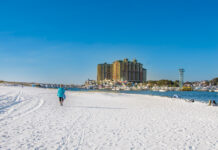
The beach at East Slough is wide and clean, with the same brilliant white quartz sand that runs the full nine miles. What makes this section feel different from the Sugar Hill area further east is proximity: you are still close enough to the park entrance that any day visitors who came in just for a few hours tend to cluster here. You will also notice the two natural boat ramps on the bay side near this area, restricted to shallow-draft vessels under 24 feet, where anglers and kayakers launch into Apalachicola Bay. The bay access here is one of the practical reasons some visitors prefer East Slough as a base over the campground area further east.
The views from the East Slough Gulf beach are identical in quality to the rest of the nine-mile corridor, with the same dune profile, sea oat coverage, and emerald water. On calm mornings you will regularly see dolphins working the surf line just offshore, which is as true here as anywhere else in the park. My honest take on East Slough as a day-use area: it is the right starting point for a first park visit because it offers the most facilities, but it concentrates the small number of day visitors who come through the gate in one spot. If you have time to drive further east in the park, do it.
Sugar Hill Beach Use Area and the Campground
Main Camping Hub · Second Major Pavilion · Beach Access Steps Away
Sugar Hill is where most of the park’s overnight visitors are based, and arriving here from the campground at first light to walk the Gulf beach before anyone else shows up is one of the more memorable things I have done on any Florida barrier island. The campground sits tucked behind historic sand dunes in the pine flatwoods a short walk from the Gulf beach, with 60 sites offering electric and water hookups. Six sites have concrete pads and accessible walkways. The campground also has two bathhouses with hot showers, a playground, and interpretive exhibits about the island’s natural history and its earlier use for turpentine production from the pine forest.
The second of the park’s two reservable picnic pavilions is at Sugar Hill, and this area functions as the social center of the state park during peak camping weekends. Families picnicking, anglers heading to the beach, birders scanning the tree line above the campground for red-cockaded woodpeckers and other pine-dependent species: Sugar Hill is the park at its most active, which still means a very manageable, very quiet energy compared to any developed beach on the Panhandle. The Gulf beach access from the campground area is a short walk through a dune boardwalk and opens onto the same wide, flat white sand that runs east and west with almost nothing visible on either horizon.
What makes Sugar Hill the best base for a multi-day park visit is the combination: the campground gets you closest to the beach at the park’s midpoint, the pavilion facilities make day cooking practical, and the eastern miles of undeveloped beach are within easy bike or walk range from here. Reserve as far in advance as possible through Florida State Parks reservations. The campground is being expanded with 30 additional sites and a new bathhouse, so capacity will improve, but existing site demand is high in summer. One practical note for campers: the site fill used in parts of the campground includes oyster shells, which can cut bare feet and paws. Keep footwear on in the campground area.
The Nine-Mile Gulf Shore
Undeveloped Corridor · Eight Access Points · Walking and Shelling
The nine miles of Gulf-side beach inside the park is the thing that earns the national ranking and the thing that sets this park apart from almost everything else on the Panhandle. Eight numbered vehicle access pulloffs are spaced along the park drive, with access point 1 and access point 8 offering Mobi-Mat accessibility extensions to the water. The pulloffs are simple and functional: parking area, a boardwalk or path through the dunes, and then the beach itself. No concession stands. No chair and umbrella rentals. No vendors. Nothing between you and nine miles of white quartz sand.
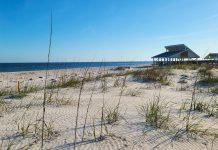
Walking the waterline here is different from walking any beach with development visible in the background. The dune profile on the inland side is healthy and largely intact, the sea oat cover is dense enough that you can see the natural stabilization the island is managing, and the width of the beach varies interestingly as you move east, narrowing in spots where recent storm erosion has worked on the upper beach and widening again where the dune system has had time to recover. The shell content on the waterline increases as you move further east in the park, which makes sense given the proximity to Apalachicola Bay’s input: lightning whelks, horse conchs, calico scallops, and olive shells are all realistic finds at any tide on the eastern miles, and after a storm or elevated surf the wrack line here produces the kind of haul that serious shellers specifically plan trips around.
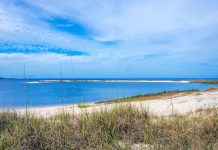
On a calm morning from the mid-park access points, the water in front of you is as close to that particular shade of emerald as you will find on the Florida Panhandle without driving to the Keys. The quartz seafloor bouncing light back up through clear water in a spot with no boat traffic and no sunscreen slick from crowded beaches produces a color that photographs slightly better than reality, which is saying something. If you only walk this nine-mile stretch once, walk it at low tide on the third or fourth calm day after any period of elevated wind or surf. The shells and the water quality will both be at their best.
The Apalachicola Bay Side
North Side of Park · Kayaking, Birding, Fishing · Marsh Ecology
Most people who visit the state park spend all their time on the Gulf side and never see the bay. This is understandable, because the Gulf beach is exceptional, but it means they miss the ecological half of what makes this park significant. The bay-side shoreline along Apalachicola Bay is a completely different environment: shallow, calm, warmer in summer, and lined with salt marsh and seagrass flats that support more wildlife by the square foot than the Gulf beach does.
Kayaking the bay side of the park is one of the better paddling experiences available on this part of the coast. The shallow draft required to navigate the oyster bars and seagrass beds is not a limitation here; it is a feature. You get into habitat that a motorboat can’t reach, and the bird activity in the marsh fringe is extraordinary. Great blue herons and snowy egrets work the shallows at dawn. Osprey nest on platforms visible from the park road and spend their mornings diving the shallows in full view. In winter, bald eagles patrol the bay-side tree line and can be seen from the park road without binoculars if you are paying attention. The bay-side launch points and boat ramps at East Slough are where to start for kayaks and small canoes; paddling east along the bay margin from there takes you through some of the most productive coastal habitat in northwestern Florida.
Fishing on the bay side is serious business in this park. The grass flats of Apalachicola Bay are legendary among Florida anglers for speckled trout and flounder, and the bay-side access points within the park give you direct entry to these flats without the competition you’d face from boat traffic outside the park boundary. Surf anglers on the Gulf side target pompano, redfish, whiting, and sea trout from the beach at dawn and dusk. A Florida fishing license is required and anglers should check with the park entrance station about current regulations before fishing.
Gap Point and the Primitive Camping Area
End of 2.5-Mile Trail · Two Primitive Sites · Foot, Bike, or Water Access
Gap Point sits at the end of the 2.5-mile Gap Point Trail that departs from the Sugar Hill campground area, running through pine flatwoods and coastal scrub to the eastern portion of the park where two primitive campsites sit in one of the more genuinely remote beach camping positions available in Florida. Each primitive site accommodates up to 12 people, making them practical for small groups or families who want a backcountry experience without the logistics of true wilderness camping. The sites are also accessible by canoe, kayak, or other shallow-draft watercraft from Apalachicola Bay.
What you give up by choosing Gap Point over the developed campground is almost everything except the beach itself. No cell service, which at the developed campground already sits at essentially zero, is even more theoretical here. No electricity. No showers. No facilities beyond what you carry in. What you gain is a position at the far quiet end of nine miles of undeveloped beach, with the darkness at night genuinely startling if you are used to camping anywhere near artificial light. The stargazing from Gap Point on a clear night, with the bay behind you and the Gulf in front and the nearest light pollution 70 miles away, is among the best available on any Florida coastline.
The trail to Gap Point passes through coastal scrub and pine flatwoods that hold species you won’t see from the car: five-lined skinks flashing vivid blue tails through the palmetto undergrowth, red-cockaded woodpeckers calling from the pine canopy above the trail, and the kind of snakes that are reminders to keep your eyes on the path. The Florida trail infrastructure through this section is maintained but natural, and the payoff at the end when you emerge onto the beach with nothing visible for miles in either direction is the kind of moment that rewards the 2.5 miles of effort.
East Pass and the Park’s Eastern Tip
Very Remote · No Vehicle Access · Bike, Foot, or Boat Only
The far eastern tip of the park, the East Pass area, is accessible only by bicycle, on foot, or by boat, since the stabilized road ends before the tip and vehicle access is not available at this end of the island. This section sits at the far end of the nine-mile beach corridor and sees a fraction of the already-light visitor traffic at the western sections of the park. The beach here is the least disturbed by human presence of any accessible stretch in the park, and the combination of Gulf shoreline on the south side and Apalachicola Bay entrance on the east and north gives this tip a distinctive water-on-three-sides character that is genuinely unusual.
The shelling at the eastern tip, when conditions are right, is among the most productive on the entire beach. The tip receives shell material from the bay entrance as well as the Gulf, and the combination produces a wrack line that is worth picking through carefully after any period of elevated surf or wind. Sea turtle nesting activity is concentrated at the eastern miles of the park, and if you are walking this far you are moving through active loggerhead nesting territory from May through October. Stay above the tide line, watch for nest markers, and give any marked area a wide path.
Getting here by bike from the Sugar Hill area takes roughly an hour at a comfortable pace on the stabilized road. Getting here by kayak from the bay-side launch at East Slough is a longer paddle but produces a completely different experience, arriving at the tip from the bay side with the whole Gulf spread out when you round the point. Either way, the East Pass end of this park is the kind of place that rewards the effort it takes to reach it, and the people who make it here are almost universally glad they did.
State Park Beach Rankings: Expert Scores Across 11 Categories
These scores reflect the state park beach specifically, which scores differently in some categories from the island’s public stretch because of the park’s complete lack of commercial development and the dog restriction on the beach.
Sand Quality
9/10
The same white quartz formation as the rest of the island, perhaps slightly more varied in shell content at the eastern end due to the Apalachicola Bay influence, but undisturbed by the constant foot traffic that compacts sand at the more popular public access points. The dune profile behind the beach is intact and healthy, which is increasingly rare on busy Florida beaches and contributes to the overall impression of a beach operating the way it was designed to.
Hiking and Beach Walking
10/10
Nine miles of continuous undeveloped Gulf beach plus the 2.5-mile Gap Point Trail through pine flatwoods and coastal scrub, plus the 3.5 miles of designated nature trails for biking. This is the best beach walking corridor on the Florida Panhandle, full stop. The firm wet-sand waterline runs without interruption for the entire nine miles, and you can cover real distance without ever leaving the waterline.
Shelling
10/10
Consistently ranked among the best shelling in all of Florida. The park’s protected eastern miles receive shells from both the Gulf and Apalachicola Bay, the undisturbed beach means shells are not being picked over constantly by the heavy traffic you see at more developed beaches, and the species variety is genuinely impressive. Lightning whelks, horse conchs, calico scallops, olives, sand dollars, and more all turn up with regularity after the right conditions.
Water Conditions
8/10
Emerald to turquoise on calm days, with the same clarity characteristics as the public beach. No lifeguards anywhere in the park. The flag system is used to communicate swim conditions and should be checked at the beach use area nearest to where you are swimming. The bay side offers completely calm, protected water for swimming and paddling when Gulf conditions are not ideal.
Scenery and Natural Beauty
10/10
Nine miles of Gulf beach with no development visible in any direction from the water. Healthy intact dune ridges with dense sea oat coverage. Pine flatwoods visible along the back side. Bay marshes on the north horizon. The absence of anything built or commercial in the visual field is the thing that earns this score, because the natural elements themselves are not unusually dramatic: the impact comes entirely from what is not there.
Birding and Wildlife
10/10
Nearly 300 documented species, including endangered and threatened species like the red-cockaded woodpecker and nesting loggerhead sea turtles. Shorebirds on the Gulf side include snowy plovers, least terns, black skimmers, willets, and ruddy turnstones. Bay-side species include osprey, bald eagle, great blue heron, snowy egret, and American oystercatcher. Dolphins are regularly visible from the Gulf beach. This is the best bird-watching destination on St. George Island by a significant margin.
Family Friendliness
7/10
Wide, flat beach with gradual entry and pavilion facilities makes for an excellent family beach day. The deduction is for the absence of lifeguards (true of the whole island) and the remoteness from food services once you are inside the park. Families who plan ahead with food and water and who supervise their swimmers carefully will have an outstanding experience. The campground playground and the nature trails add kid-friendly activity beyond the beach itself.
Dog Friendliness
2/10
Dogs are explicitly not allowed on the park’s beach or in any park facilities, which is the state park’s rule protecting nesting shorebirds and sea turtles. Dogs are welcome in the campground, on the nature trails, and on paved surfaces with a six-foot leash. If a beach day with your dog is the priority, stay on the public island stretch. The 2 rather than 1 reflects the legitimate dog access to other park areas, just not the beach itself.
Solitude and Peace
10/10
Nine miles of protected beach with a small parking capacity per access point and a visitor experience that naturally disperses people along the corridor. Once you are more than a mile east of the Sugar Hill area on the beach, you may have significant stretches to yourself even in peak summer. The Gap Point end of the park on a fall weekday approaches as close to genuine beach solitude as any accessible public land in Florida.
Entertainment and Nightlife
1/10
There is no entertainment infrastructure of any kind inside the park, no food vendors, no rentals, no services of any type beyond the facilities at the two beach use areas. The nearest restaurants are in the island’s town center, 4-plus miles back through the public stretch. The 1 rather than 0 reflects the stargazing, which is as good as any entertainment this part of Florida offers.
Parking and Beach Access
7/10
Eight numbered access pulloffs along the park drive, with accessibility mats at pulloffs 1 and 8, plus the two main beach use areas with larger parking capacity. The $6 per vehicle entrance fee covers all-day access to any part of the park. The deduction reflects the distance from the island entrance (4-plus miles) and the limited parking capacity per pulloff, which means popular summer weekends can see the main areas fill up by late morning.
St. George Island State Park Sand & Water
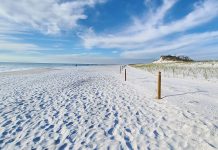
Nine miles of the same wide, flat, bright white sand run through this park without a single break for a building or a boardwalk snack bar. Up near the dunes, the sand is soft and deep enough that you’ll feel it in your calves on a long walk, but that same softness makes for easy lounging and genuinely good sandcastle material once you work in a little water from the waterline. Down where the waves reach, the sand packs firm enough for a barefoot jog, a game of catch, or a kid’s ambitious drip-castle project without the whole thing sliding apart. Because so few people walk this beach compared to the town stretch, the sand between pulloffs stays close to its natural, undisturbed state most of the year, which is part of what makes it feel so good underfoot.
The water here runs emerald to deep turquoise on a calm day, clear enough to watch your own feet in the shallows, and it can turn a more turbid green for a few days after wind or a front moves through. Entry is gradual at every beach use area and pulloff, no sudden drop-offs to catch you off guard, which makes it comfortable for wading in at your own pace. There are no lifeguards anywhere in the park, so the posted flag at East Slough or Sugar Hill is your real signal, check it before you swim rather than guessing. Because this stretch is so much less crowded than the public beach, it’s worth being extra mindful of currents and conditions since there are fewer people around if something goes wrong.
- 🚶 Walkability Nine uninterrupted miles of wide, firm waterline, one of the best long-distance walking beaches on the entire Panhandle.
- 🏖️ Softness & Playability The upper beach is soft and largely undisturbed, great for lounging and sandcastles with a little added water, while the packed waterline holds up well for games.
- 👣 Barefoot Comfort Comfortable most of the year, though the dry upper sand heats up fast by midday in summer, and shell content rises noticeably toward the eastern miles, worth a glance down before a long barefoot stretch.
- 🌊 Swimmability Gradual entry and generally calm water make swimming easy here, just check the flag at the nearest beach use area first since there are no lifeguards anywhere in the park.
Want the full geology, grain composition, and the complete sand and water condition ratings? I broke it all down separately in Sand & Shore: St. George Island.
Dogs & Pet Accessibility
Are Dogs Allowed on the Sand? RESTRICTED / NO.
To protect nesting shorebirds and sea turtles, dogs are not permitted on the beach anywhere inside the state park, at any access point, in any season.
Where Dogs Are Allowed
- ✓The Sugar Hill campground, on a six-foot leash.
- ✓The park’s designated nature trails, leashed.
- ✓Paved surfaces throughout the park, leashed.
Where Dogs Are NOT Allowed
- ✗The Gulf beach at East Slough, Sugar Hill, or any of the eight numbered pulloffs.
- ✗The bay-side shoreline within the park.
- ✗East Pass and the eastern tip.
Paws on the Ground Reality
If a beach day with your dog is the priority, this is not the park for it. Plan that part of your visit on the island’s public stretch instead, where leashed dogs are welcome on essentially all the sand: full detail in Hiking St. George Island. Bring your dog here for the campground and the Gap Point Trail, both genuinely enjoyable on a leash, just plan the beach portion of the trip elsewhere.
One practical note for campers: some of the fill used in the Sugar Hill campground includes oyster shell, sharp enough to cut paws. Keep footwear on your dog around the campsite even if the beach rule doesn’t apply there.
Crowd Levels and the Overall Feel of the State Park Beach
The crowd dynamic inside the state park is fundamentally different from the public island stretch because the entrance fee and the distance from the island’s amenities self-select the visitors. Day-trippers who crossed the bridge specifically for the lighthouse area and a quick beach walk do not typically drive another four miles to pay a separate entrance fee. The people inside the park gate made a deliberate choice, and the energy inside reflects that: quieter, more purposeful, more comfortable with extended time on the beach doing simple things.
The two main beach use areas, East Slough and Sugar Hill, see the highest concentration of day visitors on summer weekends, and even these areas are mild by Florida beach standards. Beyond the two pavilion areas, the numbered pulloffs along the nine-mile corridor see dramatically less traffic. On a busy July weekend, accessing pulloff 6 or 7 (mid-park) can mean walking the waterline in either direction for 20 minutes before seeing another person. On a fall weekday, you might have the eastern miles entirely to yourself.
Seasonal pattern:
- Spring: Excellent conditions, light crowds, ideal water temperature building through April and May. Peak shorebird activity begins in late April as nesting season approaches.
- Summer: Warmest water, most visitors, but the park’s capacity and dispersed access points mean even the busiest summer days feel manageable compared to most Florida beaches. Sea turtle nesting is active May through October.
- Fall: The best overall window. Warm water through October, dramatically reduced visitors after Labor Day, active fall migration, and storm-following shelling windows that can produce exceptional finds.
- Winter: The park’s most remote and solitary season. The campground stays open but fills slower. The beach sees perhaps its fewest visitors of the year. Bald eagles are regular winter visitors along the bay side.
Who Is the State Park Beach Really For?
✓ Who Will Love This Park
-
Shellers who want Florida’s best in terms of species variety and volume, with miles of undisturbed wrack line to work through after the right conditions
-
Campers who want to wake up inside a protected coastal environment and walk the Gulf beach at sunrise with no one around them
-
Birders who want nearly 300 documented species in one location, including endangered red-cockaded woodpeckers in the pine flatwoods and nesting shorebirds on the beach
-
Stargazers, since the park offers some of the darkest skies available on any Florida Gulf coast beach with an observation platform and the nearest metro 70-plus miles away
-
Kayakers and anglers who want bay-side access to Apalachicola Bay’s seagrass flats, teeming with speckled trout, flounder, wading birds, and dolphins
-
Anyone for whom the goal is nine miles of undeveloped Gulf beach, genuinely free of development, noise, and commercial activity for the full length
✗ Consider the Public Island Stretch If…
-
You are bringing a dog who needs beach access. Dogs are explicitly not allowed on any section of the park’s beach. The island’s public stretch is dog-friendly on leash.
-
You need cell service. Coverage in the park is already limited and drops to functionally zero at the campground and the eastern miles. Download offline maps before entering the gate.
-
You want food or drink access near the beach. The nearest restaurants are in the island’s town center, 4-plus miles west of the park entrance. The park has no food services of any kind inside the gate.
-
You need lifeguards. The park does not have them and never has. Confident swimmers who check conditions before entering the water will be fine, but the park is explicit about this: swimming is at your own risk.
-
You want resort-style convenience within walking distance of the water. The park offers the opposite of that, which is the point.
Things to Do at the State Park Beach
-
Beach Walking and Hiking. The nine-mile Gulf waterline is the signature experience: firm, flat sand from East Slough to the eastern tip with nothing interrupting the surface. The 2.5-mile Gap Point Trail through pine flatwoods to the primitive sites adds a completely different terrain. The 3.5 miles of designated bike and nature trails add even more. Plan at least two hours for a waterline walk from any access point to see what’s working the surf line.
-
Shelling. The best consistently productive shelling beach on the Florida Panhandle. Focus on the eastern miles from mid-park to Gap Point for the highest species variety. Walk the wrack line at low tide on the first calm morning after a period of elevated surf. Lightning whelks, horse conchs, calico scallops, olive shells, and sand dollars are all realistic finds. The squat position you hold examining shells in the wrack line adds up to more of a leg workout than most beach days offer.
-
Birding. Nearly 300 documented species, including threatened and endangered species on both the Gulf and bay sides. Bring binoculars and a field guide. The Gulf beach holds snowy plovers, least terns, black skimmers, willets, and ruddy turnstones during nesting and migration periods. The pine flatwoods above the campground are where to look and listen for red-cockaded woodpeckers, identified by the white patch on their black head. The bay side has osprey, bald eagles in winter, herons, and egrets year-round.
-
Kayaking the Bay Side. Launch from the boat ramp near East Slough and paddle east along the Apalachicola Bay margin through seagrass flats and salt marsh fringe. The bay-side paddling here is among the most wildlife-rich available on the Panhandle: wading birds, blue crabs, flounder visible in the shallows, dolphins working the deeper channels, and osprey overhead for the full route.
-
Fishing. Surf fishing from the Gulf beach for pompano, redfish, whiting, sea trout, and occasional Spanish mackerel. Bay-side fishing from the shore or by kayak for speckled trout and flounder on the grass flats. A Florida fishing license is required. Check with the entrance station about any current regulations before fishing.
-
Cycling. The park has 4 miles of paved road along the main park drive and 3.5 miles of designated nature trail for bikes. The stabilized road extending beyond the paved section adds more distance toward the eastern tip. Biking the park from the entrance gate to the beginning of the East Pass area is one of the better coastal cycling experiences in Florida: views of the Gulf on the right and the bay on the left for the full length.
-
Stargazing. The observation platform at the campground provides a designated viewing spot for night sky observation. With no cell tower lighting, no resort lights, and the Gulf providing 180 degrees of unobstructed dark sky to the south, this is among the best stargazing available on any accessible Florida Gulf beach. The Milky Way is visible on clear nights without optical aid. Bring a red flashlight for moving around the campground after dark during sea turtle nesting season.
-
Sea Turtle Watching. Loggerhead sea turtles nest along the park’s beach from May through October, with hatching activity concentrated in August and September. Nest markers are placed by park staff and volunteers. Do not approach or disturb marked nests or hatchlings. Occasional ranger-led nesting programs in summer provide structured viewing opportunities from a respectful distance.
-
Camping. Sixty sites with electric and water hookups at Sugar Hill, plus two primitive sites at Gap Point. Reservations through Florida State Parks up to 11 months in advance. The campground expansion adding 30 sites and a new bathhouse will improve capacity when complete. Reserve early for any summer weekend.
-
Picnicking. Two large reservable picnic pavilions with grills, tables, and restrooms at East Slough and Sugar Hill ($50/day plus tax for pavilion reservation, no reservation required for general picnic areas). Multiple other picnic facilities throughout the park. Plan to bring your own food and water for any full day inside the gate.
Local Knowledge and Practical Advice
A few things I’ve learned walking this park across different seasons and conditions:
-
The best shelling window is the first calm morning after any elevated surf or storm. Walk the wrack line east from mid-park within two hours of first light and carry a lightweight mesh bag. The eastern miles consistently produce more species variety than the western end near the entrance.
-
Download your offline maps before you enter the gate. Cell service drops significantly inside the park and hits essentially zero at the campground and eastern miles. The entrance station can give you a printed park map, which is the backup plan for navigation once you are inside.
-
Dogs are not allowed on the park beach, period. They are allowed in the campground, on nature trails, and on paved surfaces with a six-foot leash. If beach time with your dog is a priority, plan that portion of the day on the public island stretch before or after your park visit. Note also that the campground’s oyster-shell site fill can cut paws, so footwear on your dog in the campground area is a practical consideration.
-
Check the swim flag at the beach use area nearest to where you plan to enter the water. There are no lifeguards anywhere in the park. The flag posted at East Slough applies to the entrance-area beach. The flag at Sugar Hill applies to the Sugar Hill section. They are not always the same on days when wind conditions vary across the beach length.
-
Bring bug protection for the campground, not the beach. The pine flatwoods environment around the campground at Sugar Hill produces significant mosquito and no-see-um activity after sunset, particularly in summer and early fall. The beach itself is usually fine because the Gulf breeze keeps insects down. The moment you walk back toward the tree line, the bugs find you fast. A thermacell or DEET-based spray is not optional for evening campground time.
-
Reserve the campground well in advance, especially for summer weekends. Reservations open 11 months in advance through Florida State Parks. Summer holiday weekends fill within hours or days of the reservation window opening. The 30-site expansion under construction will add capacity, but until it opens, availability is limited. Even the primitive Gap Point sites can fill for popular weekends.
-
Remove everything from the beach by sunset from May through October. Sea turtle nesting is active across the park’s Gulf beach during this window. Chairs, tents, coolers, and any equipment left overnight can block nesting turtles or trap hatchlings. Use a red-filtered flashlight if you are on the beach after dark during nesting season.
-
The park entrance fee can be paid by card at the gate. $6 per vehicle for 2 to 8 people, $4 for a single-occupant vehicle, $2 for pedestrians and bicyclists. The Florida State Parks annual pass covers admission here as at any state park in the system, which is worth doing if you are planning multiple park visits in a year.
-
The park is accessible by bicycle from the island town center. The bike path network along East Gulf Beach Drive connects the lighthouse area to the park entrance with about 4 miles of riding. If you are staying in a rental cottage on the public stretch, biking to the park entrance and then into the park road is genuinely practical and the way most repeat visitors prefer to arrive.
-
Beach wheelchairs are available at the ranger station at no charge, first come first served. Three standard beach wheelchairs and one floating wheelchair are available to borrow. Ask at the entrance station when you arrive. The Mobi-Mat accessibility paths at access points 1 and 8, and at the Sugar Hill and East Slough beach use areas, provide hard-surface access to the water for guests with mobility limitations.
Where to Stay at and Near the State Park
The lodging options here range from camping inside the park itself to the full range of island rentals on the public stretch, which is the closest available alternative to being inside the park.
State Park Campground at Sugar Hill
The 60-site developed campground is the primary overnight option for visitors who want to be inside the park. Sites have electric and water hookups. The nightly rate is $24 base plus tax, a non-refundable $6.70 reservation fee, and a $7 nightly utility fee (utility fee does not apply to tent-only sites without hookups). The campground has two bathhouses with hot showers and the park is continuing a major expansion that will add 30 additional sites and a new bathhouse. Reserve through Florida State Parks reservations at 1-800-326-3521 or online at the state parks reservation portal, up to 11 months in advance.
Gap Point Primitive Sites
Two primitive campsites at the end of the 2.5-mile Gap Point Trail, each accommodating up to 12 people. Carry-in, carry-out. No facilities. Accessible also by kayak or canoe from the bay side. These sites offer the most remote overnight beach experience available in the park and fill on popular weekends. Reserve through the same Florida State Parks system as the developed campground.
Island Vacation Rentals on the Public Stretch
The entire public island stretch east of the lighthouse and west of the park gate is lined with vacation rental cottages and homes available for weekly and weekend rental. Staying in a rental on the eastern end of the public stretch, closest to the park gate, puts you within easy biking distance of the park entrance and sets you up for early-morning arrivals at the beach use areas before the day-use visitors arrive. Rates range from modest for small cottages to premium for Gulf-front homes with private pools.
Mainland: Eastpoint and Apalachicola
Eastpoint is directly across the Bryant Patton Bridge from the island with limited motel options at lower price points for visitors making day trips to the park rather than staying on the island. Apalachicola, about 20 minutes west, has boutique inns and bed-and-breakfasts in its historic National Register district, a pleasant base for visitors who want to pair park visits with the town’s seafood restaurants and historic character.
What Makes the State Park Beach Different from Other Protected Beach Destinations
Nine miles without a single commercial interruption
Most state park beaches in Florida offer protected beach in segments: a few miles of natural shoreline, then a break for a concession building, then more beach, then another facility. The nine-mile Gulf shore inside the state park runs without any commercial interruption from the East Slough area to the eastern tip. That unbroken length is what makes the walking experience here qualitatively different from most protected beach stretches in the state.
Shelling in a different category
The park’s protected status combined with its position near the Apalachicola Bay input creates a shell inventory that does not exist at this density and variety at any other Gulf beach park in the Florida Panhandle. The species that turn up here, particularly after the right tide and weather conditions, are the reason serious beachcombers identify this park by name when asked where to shell in Florida.
Stargazing that rivals any public beach in the state
The combination of the park’s remoteness, the 70-plus miles to the nearest metropolitan light pollution, and the Gulf’s open southern horizon creates a night sky experience that state parks much further from developed Florida cannot match. The observation platform at the campground formalizes what the beach delivers naturally: a dark-sky window over the Gulf that makes the Milky Way visible to the naked eye on clear nights.
Two distinct ecosystems on a park you can cross in minutes
The Gulf side and the Apalachicola Bay side of this park are separated in some spots by fewer than half a mile of land. Standing on the beach and then walking to the bay shore is a transition between two completely different ecological systems in a few minutes’ walk, and both are productive and worth extended time. Few coastal parks anywhere in Florida offer the dual-water character of this one.
The State Park Beach vs. Other Protected Florida Panhandle Destinations
St. George Island State Park vs. St. Joseph Peninsula State Park
These are the two best comparisons on the Florida Forgotten Coast and they are genuinely close in quality. St. Joseph Peninsula State Park at Cape San Blas covers a longer peninsula tip with dramatic Gulf views and a dune system that is more dramatic in height than St. George’s relatively flat barrier island profile. St. George Island State Park wins on shelling, bird species count, and access from a functioning island town. St. Joseph Peninsula wins on geological drama and the feeling of being at the end of a land spit with water on both sides for miles. Both deserve a full trip; the choice between them depends on whether you want more social infrastructure nearby (St. George) or more remote isolation (St. Joe Peninsula).
St. George Island State Park vs. Gulf Islands National Seashore (Fort Pickens)
The Fort Pickens section of Gulf Islands National Seashore at the west end of Pensacola Beach provides the closest equivalent on the western Panhandle: protected beach with a historic structure, camping, and miles of undeveloped shoreline. Fort Pickens wins on history, since walking through an 1800s brick fort is a different experience from anything at St. George Island. The St. George Island State Park wins on shelling, bird species diversity, bay-side ecology, and the quality and darkness of the night sky. The sand geology is similar at both, both drawing from the same Appalachian quartz formation.
St. George Island State Park vs. Perdido Key State Park
Perdido Key State Park in Escambia County near the Alabama border is a small but excellent protected stretch of the same quartz formation. The sand quality is comparable, but Perdido Key’s protected acreage is a fraction of St. George Island State Park’s nearly 2,000 acres. St. George Island is larger, more diverse in habitat, and significantly better for shelling. Perdido Key is closer to Pensacola’s services and easier to reach from the western Panhandle population centers.
St. George Island State Park vs. Caladesi Island State Park
Caladesi Island on Florida’s central west coast is often cited as the other state park beach that competes with St. George Island for national rankings. Caladesi is accessed only by ferry from Honeymoon Island, which naturally limits its visitors. St. George Island State Park is larger and more accessible while maintaining comparable solitude on its eastern miles. Caladesi’s sand is notably different: it is a finer, whiter quartz and shell composite and the water is calmer Gulf-side. Both deserve their reputations. They serve visitors from different parts of the state, and the comparison is more about geography of origin than quality.
Bottom line: Dr. Julian G. Bruce St. George Island State Park is the best available combination of nine undeveloped Gulf beach miles, elite shelling, near-300 bird species, genuine dark-sky access, and camping steps from the water, in one state park on the Florida Panhandle. Nothing else on this coast delivers all of that simultaneously.
St. George Island State Park Beach: Frequently Asked Questions
What is the entrance fee for St. George Island State Park?
The entrance fee is $6 per vehicle for 2 to 8 people, $4 for a single-occupant vehicle, and $2 for pedestrians and bicyclists. The Florida State Parks annual pass covers admission here. The park is open 8am to sundown every day of the year.
Are dogs allowed at St. George Island State Park beach?
Dogs are not allowed on the park’s beach. They are allowed in the campground, on designated nature trails, and on paved surfaces, all with a six-foot leash. If you want beach access with your dog on St. George Island, the public beach stretch between the lighthouse and the park entrance gate allows leashed dogs on the sand.
Are there lifeguards at St. George Island State Park?
No. There are no lifeguards anywhere in the park. A flag system is used to communicate swim conditions at the beach use areas. Check the flag before entering the water and treat it as your only formal safety indicator for that day.
How do I get to the state park from the St. George Island town center?
Drive east on East Gulf Beach Drive from the lighthouse for approximately 4.2 miles. The park entrance gate and ranger station will appear on the left. You can also bike to the park on the island’s paved bike path network, which connects the public stretch to the park entrance with about 4 miles of dedicated path.
Is St. George Island State Park good for shelling?
It is consistently cited as one of the best shelling beaches in Florida. The park’s protected status means the beach is not picked over by dense crowds, the position near Apalachicola Bay brings species variety not available at western Panhandle beaches, and the nine miles of walkable shoreline provides substantial surface area to cover after the right conditions. Walk the eastern miles in the early morning following elevated surf for the best hauls.
How many camping sites are at St. George Island State Park?
The developed campground at Sugar Hill has 60 sites with electric and water hookups. Two primitive sites are available at Gap Point, accessible by the 2.5-mile Gap Point Trail or by water. The campground is expanding with 30 additional sites and a new bathhouse. Reserve through Florida State Parks reservations up to 11 months in advance.
Is there cell service at the St. George Island State Park campground?
Essentially none. Coverage drops significantly inside the park and hits near-zero at the campground location and the eastern miles. Download offline maps before entering the gate. Two campground hosts are on duty for emergencies.
What wildlife can I see at St. George Island State Park?
Nearly 300 documented bird species including snowy plovers, least terns, black skimmers, willets, osprey, bald eagles (winter), and red-cockaded woodpeckers. Loggerhead sea turtles nest May through October on the Gulf beach. Dolphins are regularly visible offshore from the beach year-round. Blue crabs, flounder, speckled trout, and wading birds on the bay side.
What time does the state park close?
Sundown, every day of the year, including holidays. The park opens at 8am. Campers have overnight access, but day visitors need to be out by sundown.
Is sea turtle nesting active at the state park?
Yes, from May through October, with loggerhead sea turtles as the primary nesting species. The park staff and volunteers mark nests, and rangers occasionally offer educational programs during nesting and hatching season. Remove all equipment from the beach by sunset during nesting season. Use a red flashlight instead of white light if you are on the beach after dark.
Can I see the Milky Way from the state park?
Yes, on clear nights. The park is one of the few locations on the Florida Panhandle with the combination of distance from metropolitan light pollution (70-plus miles to the nearest city) and an open southern horizon over the Gulf that allows the full Milky Way to be visible to the naked eye. The campground observation platform is the designated viewing point. Plan around new-moon nights for the best results.
Patti’s Perspective: My Honest Take on the State Park Beach
I have walked this park in March light, when the sun is low enough in the afternoon to throw long shadows off the dune tops and the sand takes on a warmth that the photographs from July don’t show. I was here at the time of day when the beach is slipping from afternoon into evening, that particular window when the light changes faster than you think it will, and the Gulf in front of me was the kind of color you hold in your memory as a reference point for what Florida water can actually do when conditions line up. No one else in my visual field in either direction. That’s not an unusual experience at this end of the island.
The shelling here changed how I think about what a wrack line can hold. I’m not a small-details sheller, I want color and size and a sense that what I’m picking up has been through something. This beach delivers that. The lightning whelk I found near mid-park on a morning after an overnight front was the kind of find that makes you stop walking and sit down in the sand to look at it properly. The shells here earn their reputation.
My honest observation after walking this park at different times of year: the mid-park access points, maybe pulloffs 4 and 5, are the sweet spot for a full day. Far enough from the two pavilion areas that you have space without being so far east that logistics get complicated. The waterline from those pulloffs in either direction gives you a long morning walk with excellent shelling potential east and a comfortable return walk back along the Gulf with the sun moving behind you. I talk through the full corridor, what the terrain does mile by mile and where the shelling concentrations shift, in my hiking guide to the state park beach.
One thing that stays with me: standing at mid-park on a clear night when the campground is full behind the dunes and the Gulf in front of me is completely black except for the starfield above it, and the Milky Way is as clear as I’ve seen it on this coast, and the only sound is the surf and the occasional sound of a black skimmer calling in the dark. This park gives that to you for the price of a campsite reservation made months in advance. That’s a good deal.
My verdict: 8.5/10. An amazing nine-mile stretch of protected Gulf beach in the Florida Panhandle, earning every national ranking it has received. The shelling is elite. The wildlife is extraordinary. The night sky is the some of the best on this coastline. The only reason it doesn’t score higher is the lack of amenities and eateries, plus no-dogs-on-beach rule, which is the right policy for the wildlife but means I can’t bring my own four-legged beach companion. Everything else about this park earns the score.
Want to Live Near the Forgotten Coast?The real estate picture around St. George Island and Franklin County in general is one of the more interesting on the Florida Panhandle. The island itself has a mix of modest older cottages and newer, larger vacation homes that have been built to the county’s low-rise standards. Properties closest to the state park gate on the eastern end of the public stretch are increasingly sought after by buyers who want the park as their daily walking ground.The mainland towns of Eastpoint and Apalachicola offer substantially lower price points for buyers who want proximity to the island without the island premium. Apalachicola’s historic district has attracted a growing population of retirees, remote workers, and second-home buyers drawn by the architecture, the fresh oyster culture, and a pace of life that does not exist in the resort corridor beaches to the west. Franklin County overall remains one of the more affordable coastal counties in Florida with Gulf access, though the combination of a national top-ranked beach and limited inventory has been applying pressure to that affordability in recent years.Explore Waterfront Living at LiveByTheWater.com
Real estate referral partner