

Topsail Hill Preserve State Park Beach, Florida
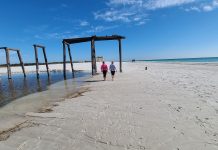
Topsail Hill earns its reputation the moment it asks you to work a little to reach it. No parking at the water’s edge, no condo row at your back, no chair rentals on the sand. You take the tram or walk the mile through pine flatwoods and coastal scrub, cross the elevated boardwalk over dunes that rise 25 feet above the Gulf, and step onto one of the most protected stretches of white quartz sand on the entire Panhandle. I’ve walked every beach in Florida, and this one still catches me when the boardwalk ends and the Gulf opens up.
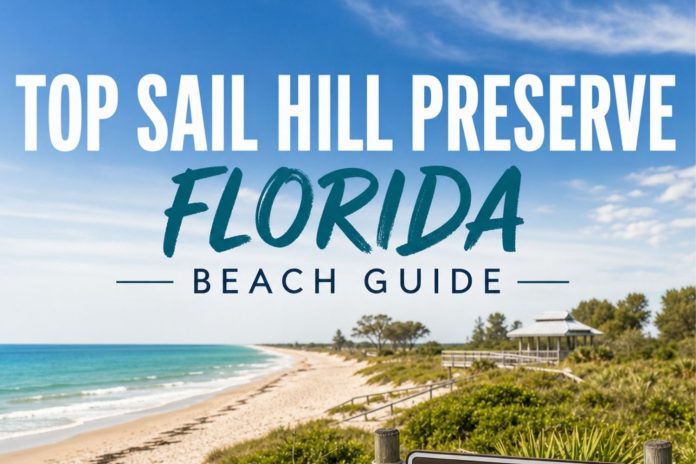
Topsail Hill Preserve State Park covers 1,640 acres in Santa Rosa Beach, about 10 miles east of Destin on the west end of Scenic Highway 30A in South Walton County. The park protects something increasingly hard to find on this stretch of coast: a natural shoreline with no development visible from the waterline, dune systems still working the way they worked before anyone built a hotel behind them, and three rare coastal dune lakes that exist nowhere else in the world in the same concentration.
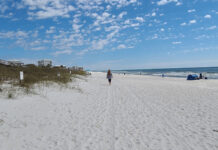
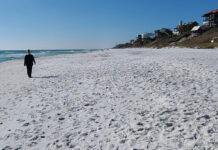
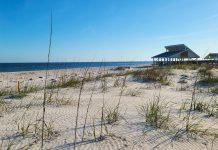
The park takes its name from the lead dune, which rises like a ship’s topsail against the Gulf sky. That dune is 25 feet above sea level, which may not sound dramatic until you’re standing at the base of it on white quartz sand with nothing but Gulf water stretching to the horizon. The beach itself runs 3.2 miles from one end of the park to the other, and for every one of those miles you won’t see a high-rise, a beach umbrella for rent, or a parking lot. What you’ll see is dune grass, shorebirds, and the deep emerald water that made this stretch of coast famous.
In this guide I’m walking you through every distinct section of Topsail Hill’s beach and landscape, going deep on the sand and water conditions, scoring it across all 11 categories, and giving you the honest read on who this park is built for and who might be more comfortable somewhere with more immediate access. I close with my own take on what makes this beach different from every other protected stretch of sand I’ve walked on this coast.
The Vibe and Culture at Topsail Hill Preserve
A State Park That Makes You Slow Down Before You Can Speed Up
There is no boardwalk at Topsail Hill. No beachfront bar. No chair rental waiting at the end of the tram. The vibe here is entirely defined by what the park is not, and that intentional absence is the point.
The crowd at Topsail Hill self-selects from the moment of arrival. You pull into the parking lot off US 98 and 30A, pay your entrance fee, and then you either wait for the tram, load your bike, or lace up your shoes. The beach is a mile away through a pine flatwood corridor. That mile filters out anyone who wasn’t serious about coming here in the first place. The people who make it to the sand are overwhelmingly nature-minded, unhurried, and genuinely happy to be somewhere this quiet.
The energy is calm in a way that most Panhandle beaches simply can’t replicate because they don’t have the land protection to enforce it. You’ll find birdwatchers with binoculars, families who camped overnight and are carrying their own chairs, couples who rented kayaks to paddle Campbell Lake before hitting the beach, and solo walkers who look like they’ve been coming here for years. Nobody’s playing speakers. Nobody’s rushing to claim prime real estate. The beach is long enough and the crowds thin enough that you naturally spread out without trying.
The park operates on its own schedule. Gates open at 8 AM and close at sunset, and the beach reflects that rhythm. Arrive before 9 AM in the summer and you’ll often have the whole shoreline to yourself or close to it, even in July. The tram runs hourly from the day-use parking area, which naturally distributes the crowd across the day rather than flooding the beach at noon. The campground guests, who have their own tram schedule, tend to arrive earlier and stay longer, and they’re the ones who know things like which section of beach has the best shelling after a northeast wind.
Seasonally, Topsail Hill runs a different pattern than the resort beaches nearby. Summer is the busiest stretch, but “busy” here looks like a lightly-used state park, not a resort beach. The campground fills quickly on summer weekends and the tram has a wait, but the beach itself absorbs the crowd without much friction. Fall is when the park shifts into a different register entirely. The air cools, the sea turtle nesting activity winds down, the summer families leave, and the birders and hikers move in. It’s genuinely one of the best fall destinations on the Panhandle. Winter is quiet and surprisingly beautiful, with the longleaf pines holding their color against the dune white and the shorebirds gathering along the wrack line.
Topsail Hill Beach Areas: Six Distinct Experiences on One Protected Shoreline
The beach at Topsail Hill is a single 3.2-mile stretch with no internal roads or parking cuts, which makes it feel more continuous and unbroken than almost any other Panhandle beach. But there are real, distinct sections with different characters, different terrain, and different reasons to seek them out. Here’s how the beach actually breaks down.
The Arrival: Trail, Tram, and Boardwalk
Day-Use Parking to Shoreline
The arrival experience at Topsail Hill is unlike anything else on the Florida Panhandle, and I say that having walked every beach between the Alabama border and the Keys. You don’t park and walk fifteen steps to the water. You board a tram that runs hourly, or you walk or bike the paved path, and spend the next mile traveling through a landscape that looks nothing like what’s happening on the resort corridor a few miles west.
The tram road passes through old-growth longleaf pines, sand pine scrub, coastal dune wetlands, and a transition zone where the vegetation shifts and the air starts to carry salt. First-time visitors are usually quiet on this ride. It’s unexpected, and the silence is part of it. You’ll look for deer along the scrub edge, you’ll notice carnivorous pitcher plants growing out of low wet spots, and by the time the tram stops you’re already somewhere else mentally. That’s the whole point of the mile-long buffer between road and beach.
The elevated boardwalk over the dunes is where the visit turns into something people talk about for years. The boardwalk crosses the dune system at height, which means you get a view of the dune landscape from above before you’re standing on the beach. White quartz sand rolling in every direction, dune grass in the gaps, the Gulf going from shallow turquoise at the shore to deep blue-green at the horizon. I’ve crossed this boardwalk in January with nobody else in sight and in July with a tram group ahead of me, and both times I stopped at the top and just stood there for a minute.
The Main Beach at the Boardwalk Drop
Day-Use Center
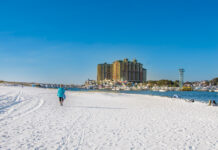
When you step off the boardwalk onto the sand, the first thing you notice is the scale. The beach is wide, the dunes behind you are tall, and there are no buildings anywhere in the sightline. The water ahead is that clear shallow turquoise that the quartz bottom creates, shifting to deeper green as the Gulf floor drops away from shore. On a calm morning you can see your feet in the water at knee depth.
This is the section of beach that sees the most foot traffic, which at Topsail Hill still means very little foot traffic compared to any public beach nearby. The sand here is occasionally firmer from tram visitors walking the same path to the water, but it recovers quickly in the off-season and off-hours. This is where the picnic pavilion and the restrooms are located, and where you’ll find ADA beach wheelchairs available at no charge from the ranger station. The infrastructure is minimal but well-placed.
I’d call this the “base camp” section of the beach. You set up here, orient yourself, and then decide which direction to walk. Neither direction disappoints, but most people stay near the boardwalk drop and never explore what the beach looks like a half-mile in either direction. If you do the same, you’ll have a great beach day. If you walk, you’ll have a great beach.
The Topsail Hill Dune Ridge and Western Beach
West of the Boardwalk
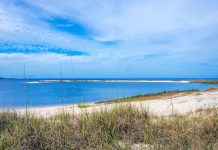
Walking west from the main boardwalk drop, the beach topography becomes more dramatic. This is the stretch where the namesake dune sits closest to the waterline, and the visual scale of the dune system becomes fully clear. The lead dune rises 25 feet above the beach, and when the light hits it from the east in the morning, the white quartz creates a glow against the Gulf blue that looks overexposed even to the naked eye.
The sand in this western section gets softer and less worked as you move away from the boardwalk center. You’ll notice the shell content in the wrack line picks up noticeably here, partly because fewer people are stopping to pick through it. I’ve found intact sand dollars in this stretch after a northeast wind, and on a calm morning with a low tide running out, the bird activity in this section is better than anywhere else on the beach. Snowy plovers and willets work the water’s edge, and pelicans run their patrol line just offshore.
This is also the section where the dune lake outfall occurs when Campbell Lake or Morris Lake overfills from rainfall and breaches through the dune line to the Gulf. The outfall zone is a specific geographic feature, a small fresh-saltwater junction marked by discolored water at the dune breach, and it draws birds and fish in a way that surprises first-time visitors who don’t know what they’re looking at. If you see a dark channel in the sand running from the dunes to the water with unusual bird activity around it, you’ve found the outfall. This is the version of Florida’s Gulf coast that most people never see because it doesn’t exist anywhere there’s a parking lot between the dunes and the road.
The Eastern Beach Walk
East of the Boardwalk
Heading east from the main boardwalk drop takes you away from the day-use center and into the quieter half of the beach. The dune line here is still substantial but runs slightly lower than the dramatic western ridge, and the sand has a slightly different character: still white quartz, still powdery where it hasn’t been compacted by foot traffic, but with a more gradual transition to the wet packed sand at the waterline.
This stretch is where I do most of my shelling at Topsail Hill. The eastern beach catches drift material from the prevailing Gulf currents differently than the western end, and after a storm or a sustained northeast wind you’ll find a wrack line with solid finds: calico scallops, Atlantic augers, fighting conchs, and if the timing is right after a storm, the occasional intact lightning whelk. The squat workout is legitimate here. I stopped more times per mile on this stretch than anywhere else on the 30A coast.
The eastern beach also marks where the park’s shoreline eventually transitions toward private property. You won’t hit a fence line or a sign at a dramatic moment; the transition is gradual, with the protected dune scrub giving way to more manicured dune grass as you approach the park boundary. Walk as far as you want and turn around when the Gulf calls you back. This eastern stretch is one of those rare spots where you genuinely feel like you’ve found an unworked section of Florida coast, and the footprint count in the sand will back that up.
The Campbell Lake Outfall and Dune Lake Zone
West Section near the Dune Lake Breach
Topsail Hill is one of only a handful of places in the world that has coastal dune lakes, and the spot where those lakes periodically overflow through the dunes to the Gulf is one of the most geologically interesting points on this entire stretch of Panhandle coast. Campbell Lake, Morris Lake, and No Name Lake are freshwater lakes sitting behind the dune ridge, filling up from rainfall and gradually draining through the sand until, when the water table rises high enough, they breach through the dune and connect to the Gulf for a period.
The outfall zone is visible from the beach as a discolored patch of water where the fresh drainage mixes with Gulf saltwater. When an active outfall is running, you’ll see the sand disturbed at the dune base, a shallow channel cutting down to the waterline, and a miniature delta of fine quartz grains fanning out at the water’s edge. It’s a small feature physically but an enormous one ecologically. The junction of fresh and salt water draws baitfish and the birds and larger predators that follow them. On an active outfall morning I’ve watched ospreys diving within 20 feet of the shore repeatedly while pelicans worked the outer edge of the plume.
This is also the area where the dune lake ecosystem most directly interacts with the Gulf, which means it’s one of the richest wildlife observation points in the park. When the outfall is inactive, the zone still shows as a damp low section in the dunes with different vegetation than the surrounding area. Even a quiet outfall zone has a feel to it that’s worth seeking out, and knowing what you’re looking at changes the experience from “interesting sand” to “active coastal geology.”
The Campground Beach Access
RV Resort and Cabin Guests
Campers and cabin guests at the Gregory E. Moore RV Resort have their own tram service connecting the campground to the beach, and the energy at this section of the waterfront is noticeably different from the day-use beach. You’ll find people who have been here three days and already know where the dolphin pod runs at 8 AM. You’ll find retirees with beach chairs who set up at sunrise and stay through the afternoon tide change. You’ll find families who have been doing this campground for ten years and could walk the tram path blindfolded.
The campground beach access point puts you toward the eastern section of the beach, and the crowd here has a “regular” quality that the day-use beach never quite gets. These aren’t people who drove in and have to be back at a vacation rental in Destin by 4 PM. They’re the people who know that the beach looks completely different at low tide versus high, who know that the shorebird count goes up on calm mornings after a front passes through, and who know to check the dune base near the outfall zone after a heavy rain event.
If you’re planning a multi-day visit to the 30A area, I’d strongly recommend at least one night in the campground specifically so you can experience this version of the beach. The tram runs at hours the day-use operation doesn’t, the pre-dawn walk to the water is genuinely something, and the long summer evenings when the day-use crowd has gone home and the light is still golden on the dune ridge are the best kept secret at Topsail Hill.
Topsail Hill Beach Rankings: Expert Scores Across 11 Categories
These scores account for the beach as a whole: the remarkable natural quality of the sand and scenery, the indirect access that filters the crowd, and the wildlife richness that comes with having 1,640 acres of undisturbed habitat behind the dunes.
Sand Quality
10/10
Near-pure white quartz, fine to powdery, with almost zero foot-traffic pressure compared to any public beach on this coast. The sand here looks the way Panhandle sand looks in photographs before people walk on it, because almost nobody does.
Hiking and Beach Walking
9/10
3.2 miles of uninterrupted protected shoreline plus 15 miles of interior trail system. The approach walk through the pine flatwoods and boardwalk crossing are themselves worth the visit. Loses one point only because the approach requires effort that some visitors won’t want to make.
Shelling at Topsail Hill
7/10
Better than most Panhandle beaches because the beach is so lightly worked. Calico scallops, augers, fighting conchs, and sand dollars after the right conditions. Timing matters: the best hauls come the morning after a storm or northeast wind, when the wrack line in the eastern and western stretches delivers fresh material that hasn’t been picked over.
Water Conditions
8/10
Emerald to turquoise on calm days, with the quartz seafloor bouncing light back in a way that makes the shallows glow. No lifeguards on duty, so swimmers need to read the water themselves. Generally calm surf, but rip currents are real during weather events.
Scenery and Natural Beauty
10/10
The most visually undisturbed shoreline on the 30A coast, and it’s not close. No condos, no chairs-for-rent, no development of any kind in the sightline from the waterline. The dune ridge running parallel to the beach is the most dramatic natural feature on this section of the Panhandle.
Birding and Wildlife
9/10
Part of the Great Florida Birding and Wildlife Trail, with 13 imperiled species documented in the park. Ospreys, bald eagles, snowy plovers, piping plovers, painted buntings, and over 100 bird species total. Sea turtle nesting May through October. Gopher tortoises, deer, and the rare Choctawhatchee beach mouse in the dune scrub.
Family Friendliness
7/10
A great family beach once you’re there, with calm shallow water, clean facilities, and a campground pool and playground. The tram logistics with small children and a lot of gear can be challenging, and there are no food vendors on the beach itself. Families who plan ahead thrive here. Families who want walk-up convenience will find it easier somewhere else.
Dog Friendliness
3/10
Leashed dogs are welcome on the 15-plus miles of hiking trails and at campground sites. Dogs are not permitted on the beach, the tram, the boardwalks, in buildings, in the dunes, or in or near the dune lakes. The trail system is genuinely good for dogs; the beach itself is completely off limits.
Solitude and Peace
9/10
The best-scoring beach on the 30A corridor for genuine quiet, even in peak summer. The tram-and-walk access distributes the crowd across the day and filters out casual visitors who just want to park and wade. Mornings before 9 AM on the beach feel like a private shoreline.
Entertainment and Nightlife
1/10
None, by design. The park closes at sunset. Kith and Ken Cafe at the campground does morning coffee and pastries. The camp store carries ice cream. That is the full entertainment offering, and if you’re staying here, it’s exactly enough.
Parking and Beach Access
7/10
The parking lot is well-designed and rarely overflows outside peak summer weekends. The beach itself requires a tram ride, a 1.2-mile walk, or a bike ride. That indirect access is a feature for anyone who came for quiet, and a genuine inconvenience for anyone who didn’t plan for it. Arrive early on summer weekends: the tram has a line by midmorning.
Topsail Hill Preserve State Park Sand & Water
The sand here is about as soft and white as Florida beaches get, and you’ll notice the flatness first, a wide, gently sloped stretch that runs 3.2 miles without a single steep drop-off to trip you up. Up near the dunes, the sand turns deep and powdery, fun for digging and burying feet but a little tiring to walk any real distance in. Down at the waterline, it packs hard and smooth, easy walking and easy running for kids who want to chase the waves. Sandcastle season is really a waterline activity here, that fine upper sand needs a good soak before it’ll hold a shape, so bring a bucket and set up camp closer to the wet sand if building is on the agenda.
The water itself shifts through clear turquoise near shore into a deeper emerald green farther out, and on a calm day you can usually see your own feet standing in a couple feet of water. Entry is gradual the whole way, no sudden drop-offs, which makes wading in easy and comfortable for most ages and comfort levels. There are no lifeguards and no flag warning system anywhere in the park, so it’s worth checking conditions yourself before swimming, especially after a storm has passed through, when rip currents become a real possibility even on a beach this generally calm.
- 🚶 Walkability: The packed waterline makes this one of the easiest beaches around for a long walk. Stick close to the wet sand and you can cover real distance without tiring your legs out.
- 🏖️ Softness & Playability: The upper beach is soft enough for serious digging and burrowing, and there’s plenty of width for games, blankets, and everything in between without feeling cramped.
- 🦶 Barefoot Comfort: Genuinely comfortable most of the day, especially near the water. The dry sand can get hot by midday in summer, so plan on sandals or a quick jog to the waterline if you’re visiting in July or August.
- 🌊 Swimmability: Calm, gradual, and welcoming most days, good for a wide range of comfort levels. Just remember there’s no lifeguard on duty, so keep an eye on conditions and on each other.
Want the full geology, grain composition, and the complete sand and water condition ratings? I broke it all down separately in Sand & Shore: Topsail Hill Preserve State Park.
Dogs & Pet Accessibility
Are Dogs Allowed on the Sand? RESTRICTED / STRONGLY NO.
To protect nesting shorebirds, sea turtles, and the dune mouse population, dogs are strictly prohibited on the beach itself anywhere in the park, along with the tram and the elevated boardwalks that cross the dunes.
Where Dogs Are Allowed
- ✓All 15-plus miles of the park’s interior hiking trails, leashed, including the Gopher Tortoise, Turpentine, Deer Track, Old Growth, and Morris Lake trails.
- ✓RV and tent campsites at the Gregory E. Moore RV Resort welcome leashed dogs. The cabins and bungalows do not.
- ✓The Timpoochee Trail, an 18-mile paved multi-use path running roughly parallel to Scenic 30A past several state parks and beach access points, a short drive from the park entrance.
- ✓Point Washington State Forest, a short drive away, permits leashed dogs on its loop trail system.
Where Dogs Are NOT Allowed
- ✗The Gulf beach anywhere in the park, all 3.2 miles of it.
- ✗The tram and the elevated boardwalks that connect the parking area to the beach.
- ✗The dune system itself, and in or near any of the three coastal dune lakes.
- ✗The park’s cabins and furnished bungalows, unlike the RV and tent sites.
Paws on the Ground Reality
This is genuinely good hiking for a leashed dog, just not a beach day. The interior trail system gives you real mileage, real shade in places, and a landscape most beach visitors never see. If your dog needs actual off-leash time, Alaqua Unleashed Dog Park in Santa Rosa Beach is a fenced option with separate large- and small-dog areas, a short drive from the entrance.
If beach time with your dog is the priority, plan around this park rather than through it. Santa Rosa Beach’s public county beach accesses allow dogs on the sand for local permit holders, but that program has historically required proof of local residency or property ownership, so it isn’t a practical walk-up option for most visiting families. Worth confirming current terms locally if it matters to your trip, since county programs like this do change.
Crowd Levels and the Overall Feel of Topsail Hill Preserve
The crowd at Topsail Hill is lighter than almost any beach of comparable quality on the Florida Panhandle, and that’s not an accident. The entrance fee, the tram access, and the absence of any commercial development on the beach itself create a natural filtration system. The people who show up are the people who wanted to be here specifically, and that shows in how the beach feels once you’re on it.
Day-use crowds gather near the boardwalk landing and thin out fast in both directions. Within a quarter-mile of the boardwalk drop, even on a peak July weekend, you can find stretches of beach with no one else on them. The campground guests have their own relationship with the beach that feels different from the day-use visitors: they’re unhurried, they know the tram schedule, and they’re often on the sand at hours the day-use crowd hasn’t reached yet.
The seasonal pattern at Topsail Hill runs roughly like this:
- Summer (June through August): Busiest stretch of the year, but “busy” is relative. The campground fills on weekends well in advance and the tram has a midmorning wait, but the beach itself never reaches resort-corridor crowd levels. The ranger programs run on full schedule.
- Spring and fall: The shoulder seasons are the real sweet spot. The Gulf is warm enough to swim through October, the summer crowd has left, and the migratory bird activity in fall makes the trail system worth a dedicated trip. Spring brings wildflower blooms in the scrub and the first sea turtle scouts before the main nesting season.
- Winter: Quiet and genuinely beautiful. The campground stays open and draws RV travelers looking for a warmer base than their home state. The beach is empty on weekdays, the water is too cold for most swimmers, but the light on the dunes and the shorebird concentrations in the wrack line make it one of the best times to walk here.
Who Is Topsail Hill Really For?
✓ Who Will Love Topsail Hill Preserve
-
Nature lovers, birders, and hikers who want a beach backed by 15 miles of trails and a coastal dune lake system found almost nowhere else in the world
-
Photographers and anyone who wants to see the Panhandle sand and dunes in their undisturbed natural state, without condos or umbrellas in the frame
-
Campers and RV travelers looking for a full-facility campground with direct beach access and some of the best-rated RV facilities in the country
-
Families who plan ahead and can manage the tram logistics: the beach is calm, the water is gentle, the campground has a pool and playground, and the ranger programs for kids are genuinely good
-
Beach walkers and shellers who want miles of lightly worked shoreline without fighting a crowd for every good shell in the wrack line
-
Anyone who wants the same white quartz sand as the resort corridor without a resort within sight
✗ Consider Another Beach If…
-
You want immediate beach access from your car. The tram or 1.2-mile walk is non-negotiable: there is no parking lot at the waterline at Topsail Hill
-
You’re traveling with a dog and want beach access. Dogs are welcome on the trails and at campsites, but not on the beach, the tram, or the boardwalks
-
You need lifeguards in the water. There are none at Topsail Hill and the beach is unsupervised
-
You’re looking for a nightlife or boardwalk scene after dark. The park closes at sunset, and the camp store and coffee shop are the full extent of the food and entertainment options
-
You’re visiting with very young toddlers and a lot of beach gear and no camping reservation. The tram helps but the logistics are real, and the beach has no shade structures, chair rentals, or vendors
Things to Do at Topsail Hill Preserve State Park
Topsail Hill gives you more to do within a protected natural setting than almost any other state park beach in Florida. The activities here are almost entirely outdoors and nature-focused, which is exactly what the park is designed for.
-
Beach Walking. 3.2 miles of continuous Gulf shoreline with no vehicle access and minimal foot traffic. Walk the full length from east to west for one of the best beach walks in Florida. The morning waterline with the dune ridge at your back and nobody ahead of you is the version of this beach people come back for.
-
Hiking the Trail System. 15-plus miles of marked trails through old-growth longleaf pine forests, coastal scrub, dune systems, and wetlands. The Morris Lake Trail (4.6 miles) crosses soft sand dunes and passes World War II-era missile testing remnants. The Turpentine Trail shows the remnants of the late 1800s turpentining industry. The Deer Track Trail winds past Campbell Lake and carnivorous pitcher plants.
-
Kayaking and Paddleboarding on Campbell Lake. Topsail Outfitters rents kayaks, canoes, and stand-up paddleboards for use on Campbell Lake seasonally. No outside vessels are allowed, and the lake rangers take the ecosystem protection seriously. Paddle at sunrise for the best wildlife viewing: ospreys diving for fish, herons stalking the shallows, and white-tailed deer at the water’s edge in the early morning.
-
Birding. Topsail Hill is part of the Great Florida Birding and Wildlife Trail and supports over 100 bird species across its diverse habitats. Look for Eastern Bluebirds, Painted Buntings, Bald Eagles, Ospreys, Snowy Plovers, Piping Plovers, and a rotating cast of migratory warblers in spring and fall. The beach wrack line and dune outfall zone are the best shorebird spots.
-
Shelling and Beachcombing. The eastern and western stretches of the beach hold better finds than the boardwalk center because they see less picking. Time your walk for the first morning after a storm or extended northeast wind for the best wrack line material. Ranger-led beachcombing programs are offered seasonally and teach you the difference between sea beans, egg casings, and live versus dead shells.
-
Swimming. Calm, gradual-entry Gulf water warm enough to swim from late April through October. No lifeguards are on duty, so read the water before you go in. The offshore Seahorse Reef, an artificial reef structured in the shape of a seahorse, offers snorkeling habitat when conditions are right.
-
Fishing. Saltwater fishing from the Gulf beach for redfish, pompano, Spanish mackerel, and king mackerel. Freshwater fishing at Campbell Lake and Morris Lake for bass, bream, panfish, and catfish. A valid Florida fishing license is required. No boats are permitted in the dune lakes: bank fishing only from the shoreline.
-
Sea Turtle Watching and Nesting Programs. Loggerhead and green sea turtles nest along Topsail Hill’s beach from May through October, with peak hatching in August. The park runs guided turtle programs including a Sea Turtle Baby Shower event in August. If you’re on the beach after dark during nesting season, use a red-filter flashlight only and remove all gear from the sand by sunset.
-
Biking. The Beach Tram Trail and the Campbell Lake Bike Trail are both paved and connect the parking area to the beach and lake. Bike rentals are available through Topsail Outfitters at the campground. The paved trails through the longleaf pines are an easy, beautiful ride at any fitness level.
-
Ranger Programs. Year-round interpretive programming includes freshwater and surf fishing clinics, beachcombing walks, wildlife programs on sea turtles, sharks, alligators, and the Choctawhatchee beach mouse, and breakfast with a ranger sessions at the campground amphitheater. Check the ranger station schedule on arrival.
Local Knowledge and Practical Advice
A few things I’ve picked up walking this beach and its trail system more than once:
-
Arrive before the first tram if you can manage it. The tram runs hourly from the day-use parking area, and the first run fills before 9 AM on summer weekends. Walking or biking the paved path is always an option and takes about 20 minutes. Early arrivers have the beach to themselves for at least an hour before the tram crowd arrives.
-
Note the construction update before your visit. As of January 2025, a new Nature Walk and Visitor Center is under construction at the park entrance. The tram stop and temporary restrooms have been relocated to the left of the construction fence. The construction does not affect the beach or trails, but allow a few extra minutes to orient at the entrance.
-
Pack everything you need for the day. There are no food vendors on the beach, no umbrella rentals at the waterline, and no concession stand at the boardwalk drop. The camp store near the campground carries ice, snacks, ice cream, and basic beach supplies, but it’s not at the beach access. Day visitors should arrive with everything: water, food, sunscreen, chairs, shade structures.
-
Book the campground months in advance for summer weekends. The Gregory E. Moore RV Resort is rated among the top campgrounds in the country and fills far ahead of peak season. Cabins and bungalows go especially fast. If you’re considering an overnight stay, check availability at Reserve America early. Fall and winter have more flexibility but still fill on weekends.
-
Dogs can use the trails but not the beach, tram, or boardwalks. Leashed dogs are welcome on all 15-plus miles of interior trails and at campsites, but are strictly prohibited on the beach, the tram, the elevated boardwalks, in the dunes, and near the dune lakes. Plan your day around the trails if you’re traveling with a dog and want beach time to stay at a nearby public beach.
-
There are no lifeguards at Topsail Hill beach. The beach is unsupervised. Check the National Data Buoy Center or a surf forecast app before you arrive to understand current Gulf conditions. Rip currents are possible during weather events and there is no flag warning system at the beach itself.
-
Learn the Choctawhatchee beach mouse and why it matters. This tiny mouse is an imperiled species found almost exclusively in the dune scrub systems of the Panhandle, and Topsail Hill is one of its strongholds. The mouse is nocturnal and rarely seen, but it’s responsible for spreading the seeds that keep the dune vegetation intact. The dunes you’re admiring exist partly because of this animal doing its work at 2 AM.
-
Entrance is $6 per vehicle for 2-8 people, cash or card accepted. Single-occupant vehicles pay $4. Walkers and cyclists pay $2 per person. Walton County Tourism has historically covered day-use admission from Memorial Day weekend through Labor Day as part of a seasonal promotion: check before your summer visit to confirm if the fee waiver is in effect.
-
Remove all beach gear by sunset during nesting season. Sea turtle nesting runs May through October. All chairs, tents, umbrellas, and personal items must be off the beach by sunset. Use a red-filtered flashlight if you’re on the sand after dark and never approach or shine white light on a nesting turtle or a nest.
-
Call ahead before a late arrival. The park gates close at sunset. If you’re arriving late and have a camping reservation, call 850-267-8330 before 5 PM on the day of your arrival for gate access instructions. Arriving after sunset without calling ahead may leave you locked out.
Where to Stay Near Topsail Hill Preserve State Park
Topsail Hill offers one of the widest ranges of on-site lodging of any Florida state park, and the campground’s reputation is strong enough that many visitors book it specifically.
On-Site: Gregory E. Moore RV Resort
The park’s full-facility campground is consistently rated among the top RV parks in the nation and offers 156 RV sites with water, sewer, 30- and 50-amp electric hookups, heated and cooled bathhouses, laundry, shuffleboard, a tennis court, and a fitness room. Big rigs up to 45 feet are welcome. The campground is connected to the beach by tram and paved bike path. Reserve well in advance, especially for summer and holiday weekends. Reservations can be made at the Florida State Parks reservation system or by calling 800-326-3521.
On-Site: Cabins and Bungalows
The park has 32 furnished cabins and bungalows available for nightly rental (1-night minimum on weekdays, 2-night minimum on weekends and holidays). Cabins accommodate up to 6 people; bungalows up to 4. All cabins are smoke-free and do not allow pets. Amenities include access to the campground pool, tennis courts, and tram service. This is the most comfortable way to stay inside the park, and the sunrise walk to the beach from the cabin area is genuinely something special.
On-Site: Tent Camping
22 tent sites with elevated tent pads, fire rings, and water and electric hookups. A restroom with showers is located within the tent camping area. Reserve early: tent sites fill on summer weekends, though they tend to have more availability than RV sites.
Santa Rosa Beach and Scenic 30A Vacation Rentals
The 30A corridor immediately east and west of the park is one of the most competitive vacation rental markets in Florida, with a range of options from small beach cottages near Dune Allen Beach to larger Gulf-front homes in the Grayton Beach and Santa Rosa Beach communities. Staying in a rental on 30A puts you within a short drive of Topsail Hill’s entrance while giving you access to the 30A dining and shopping scene that the park itself doesn’t offer. Rates are premium, particularly in summer, and booking a few months ahead is standard for peak-season dates.
Destin and Fort Walton Beach for Lower-Cost Mainland Options
Destin, about 10 miles west on US 98, has the broadest range of hotel and condo options in the area, with a full spectrum from budget motel to Gulf-front resort. Fort Walton Beach, a few miles further west, runs more affordable than Destin with easy highway access to the park. These options work well for day-trip visitors who want to use Topsail Hill as one stop among several on a broader Panhandle trip.
What Makes Topsail Hill Different from Nearby Beaches
Several Panhandle beaches claim natural character. Topsail Hill backs the claim with a specific set of features that don’t exist anywhere else in this immediate corridor.
The beach is genuinely inaccessible by car
Every other beach on 30A has a parking lot within 200 feet of the waterline. Topsail Hill puts 1,640 acres of preserved land between the road and the Gulf. That distance is the operating mechanism for everything the park does well: the quiet, the undisturbed dunes, the wildlife, the sand quality. It’s not a policy choice; it’s geography.
Three coastal dune lakes behind the dunes
Freshwater coastal dune lakes that periodically overflow through the dune line to the Gulf are found in only a handful of locations worldwide. Walton County has the highest concentration of them on the planet, and Campbell Lake, Morris Lake, and No Name Lake sit entirely within Topsail Hill’s protected acreage. The outfall zone where these lakes meet the Gulf is an active geological feature with no equivalent on the rest of the Panhandle.
The dune scale is different from everything nearby
The Topsail Hill dune rises 25 feet above the beach. Most Panhandle dunes are substantially smaller and more fragile. This dune system is intact and tall enough to function as a true visual and ecological barrier between the beach and the interior, which is why the beach looks the way it does from the waterline.
Wildlife richness from protected upland habitat
The 13 imperiled species documented in this park, including the Choctawhatchee beach mouse, require intact dune and scrub habitat to survive. Topsail Hill’s acreage provides it. That habitat richness feeds directly into the bird and wildlife activity on the beach in ways you can observe: more shorebirds, more dolphin sightings in the nearshore, more diversity in the wrack line biology.
Topsail Hill vs. Other Florida Panhandle Beaches
Topsail Hill vs. Grayton Beach State Park
Grayton Beach State Park, a few miles east along 30A, shares some of Topsail Hill’s protected character and is consistently ranked among the top beaches in the United States on its own merits. Grayton Beach has Western Lake, a coastal dune lake on its eastern edge, while Topsail Hill has three. Both parks protect undeveloped Gulf frontage with no commercial development visible from the beach. Grayton Beach is slightly easier to access, with a parking area closer to the water, but also slightly busier as a result. The two parks are the strongest arguments for 30A’s claim to protected natural beach quality. If I had to choose one for a full day, Topsail Hill wins on dune scale, wildlife richness, and trail mileage. Grayton Beach wins slightly on swimming beach character and the lake kayaking experience.
Topsail Hill vs. Destin Beaches
Destin sits 10 miles west on the same quartz formation and offers comparable sand quality in areas like Henderson Beach State Park, but the development corridor surrounding most of Destin beaches puts condos and resort infrastructure in the sightline. Topsail Hill is the answer for anyone who wants Destin-quality quartz without Destin-level development. The trade is convenience and nightlife for natural character.
Topsail Hill vs. Navarre Beach
Navarre Beach, about 20 miles west, runs on the same quartz sand system and offers noticeably lighter crowds than either Destin or Pensacola Beach. It’s a good public beach with a long pier and easy access. What it doesn’t have is the dune scale, the trail system, the dune lakes, or the protected acreage of Topsail Hill. Navarre is a better choice for dog owners who want beach access and families who want walk-up convenience. Topsail Hill is the better choice for a full natural immersion.
Topsail Hill vs. Deer Lake State Park
Deer Lake State Park, a smaller preserve a few miles east on 30A, is the closest direct comparison: another protected coastal dune lake shoreline with no development visible from the beach. Deer Lake is more intimate, with a shorter beach and no campground. Topsail Hill is the more complete experience with the full trail system, campground, and the three-lake complex. If you’re on 30A for more than a day or two, visit both.
Bottom line: Topsail Hill is the most ecologically complete protected beach experience on the Florida Panhandle. It wins on dune scale, wildlife richness, trail mileage, and sand quality, and the campground gives it overnight depth that day-use-only preserves can’t match. The trade is the indirect access, the absence of lifeguards, and the complete lack of nightlife. Come specifically for what it is.
Topsail Hill Preserve State Park Beach, Florida: Frequently Asked Questions
Is Topsail Hill Preserve State Park worth visiting?
Yes. It’s one of the most naturally intact beach environments in Florida, with 3.2 miles of protected white quartz shoreline, 15-plus miles of trails, and three rare coastal dune lakes that exist in this concentration almost nowhere else on Earth. If you came to the Panhandle for the sand and water and want to see it without a resort backdrop, this is the place.
How do you get to the beach at Topsail Hill?
You have three options: a tram that runs hourly from the day-use parking lot (approximately 1.2 miles to the shore), a paved path for biking, or the hiking trail on foot. There is no parking at the waterline. Budget 20-30 minutes from the parking lot to the sand, depending on which option you choose.
What is the entrance fee at Topsail Hill Preserve State Park?
$6 per vehicle for 2-8 people, $4 per single-occupant vehicle or motorcycle, and $2 per person for pedestrians and cyclists. The park is open daily from 8 AM until sunset. Walton County Tourism has historically offered free day-use entry from Memorial Day weekend through Labor Day, so check before your summer visit.
Are dogs allowed at Topsail Hill?
Leashed dogs are welcome on all 15-plus miles of interior hiking trails and at RV campsites. Dogs are not permitted on the beach, the tram, the elevated boardwalks, in buildings, in the dunes, or near the dune lakes. If beach access for your dog is a priority, the designated dog beaches at Navarre Beach or Pensacola Beach are better options.
Are there lifeguards at Topsail Hill beach?
No. The beach at Topsail Hill Preserve is unsupervised. There is no flag warning system at the beach. Check Gulf conditions before you arrive and use your own judgment about swimming conditions. Rip currents are possible during weather events.
What is the best time of year to visit Topsail Hill?
Fall, specifically September through November, offers the best balance of warm Gulf water, lighter crowds, and strong wildlife and birding activity as the migratory season moves through. Summer is the busiest period but the beach never reaches resort-corridor congestion. Winter is quiet, beautiful on the trails, and underrated for shelling and shorebird watching.
What are the coastal dune lakes at Topsail Hill?
Campbell Lake, Morris Lake, and No Name Lake are freshwater lakes sitting just behind the dune ridge. They’re part of a rare geological system found in only a handful of places worldwide: Walton County, Florida has the highest concentration of these lakes on the planet. When rainfall raises the water level high enough, the lakes breach through the dune and connect temporarily to the Gulf. The breach zone is visible from the beach as a discolored water patch where fresh and salt water mix.
Can you camp at Topsail Hill Preserve State Park?
Yes. The Gregory E. Moore RV Resort inside the park has 156 full-hookup RV sites and 22 tent sites, plus 32 furnished cabins and bungalows. The campground is among the most highly rated in the country and connects to the beach by tram and paved trail. Reserve well in advance for summer and holiday dates through the Florida State Parks reservation system or by calling 800-326-3521.
Is there food at Topsail Hill beach?
There are no food vendors on the beach itself. The camp store near the campground carries snacks, ice, ice cream, and basic supplies, and Kith and Ken Cafe at the campground serves coffee and pastries in the morning. Day visitors should bring all food and water they’ll need for the beach portion of their visit.
How does Topsail Hill compare to Grayton Beach State Park?
Both are protected state park beaches on 30A with no commercial development visible from the sand, and both are worth visiting. Topsail Hill wins on dune scale, trail mileage, and the three-lake dune system. Grayton Beach wins on beach character and Western Lake kayaking access. If you can only do one, Topsail Hill is the more complete experience for walkers, campers, and wildlife watchers.
Patti’s Perspective: My Honest Take on Topsail Hill Preserve
I had walked a lot of Panhandle beaches by the time I got to Topsail Hill, and I had started to develop a feel for when a place was going to deliver on its reputation and when it was going to be a well-photographed disappointment. Topsail Hill delivered in the first minute on the tram. The moment the pines closed in around the road and the noise of US 98 disappeared behind the tree line, I knew I was somewhere that had been genuinely protected and not just marketed that way.
The boardwalk crossing is the moment I always go back to. I’d seen the dunes from the road before I ever visited, but standing on the boardwalk above them with the Gulf opened up ahead and nothing man-made anywhere in the sightline is a different experience than seeing them from a car window. The dune grass moved in the breeze. The sand below was white in a way that made it look almost fake. I stood there longer than I had any practical reason to and then went down to the beach and walked for probably two hours in both directions without feeling the need to stop.
The coastal dune lake outfall zone was something I hadn’t expected to be as interesting as it was. I caught it on a morning when the lake had recently breached through the dune, and the discolored water patch at the dune base had drawn a group of ospreys working in tight rotation about 30 feet offshore. I watched for 20 minutes before moving on. That’s the kind of thing that only happens because the habitat on both sides of that dune is intact. The lake is alive because nobody built a parking lot behind it. The dune is intact because nobody drove a truck across it to set up chairs. The birds are there because the fish have somewhere to come from. It’s all connected, and Topsail Hill is one of the few places on this coast where you can still see that connection functioning the way it should.
My honest caveat: this is not the beach for a casual day-tripper who wants to park, walk 20 steps, and sit in a chair they didn’t have to carry. The tram is easy and the walk is beautiful, but you have to want to be here specifically to get the full return on the effort. If you do want to be here, it’s one of the best beaches in Florida.
My verdict: 9/10. The most naturally intact beach environment on the 30A corridor and one of my top five Florida beaches overall. The sand is exceptional, the dune scale is unmatched in this region, the wildlife richness is real, and the quiet is earned. It loses nothing for being a state park and gains everything from the protection that status brings. Come for a full day, walk the whole beach, and spend a few minutes on the boardwalk before you step onto the sand.
Want to Live by the Water?The Santa Rosa Beach and South Walton community along Scenic 30A is one of the most sought-after coastal real estate markets in Florida. Properties range from beach cottages and bungalows near Dune Allen Beach to Gulf-front vacation homes on the western 30A corridor, with values that reflect the area’s combination of natural beauty, protected open space, and high demand from second-home buyers and vacation rental investors.The 30A market draws a distinctive mix: remote workers who traded a city for a Gulf view, retirees looking for a smaller coastal community than Destin or Panama City Beach, and investors drawn to the area’s consistently strong vacation rental income. The land protection surrounding parks like Topsail Hill keeps the natural character of the corridor intact in a way that protects property values over the long term. If living near one of the most protected natural beach environments in Florida is something you’re considering, this stretch of coast is worth a serious look.Explore Waterfront Living at LiveByTheWater.com
Real estate referral partner