




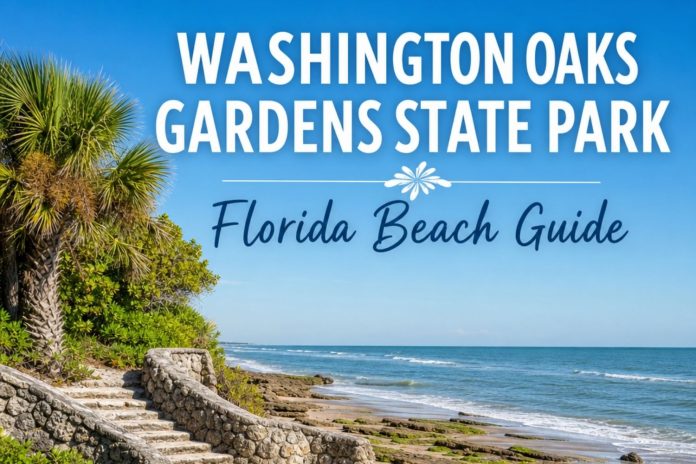
Washington Oaks Gardens State Park, Florida
Washington Oaks Gardens State Park is the one entry in this guide where I have to correct you before you even arrive. This is not a swimming beach, and the state park itself will tell you the same thing. What it is instead is one of the strangest, most photogenic pieces of coastline in Florida, a shoreline carved into swirls, arches, and tide pools by wave action working against rock rather than sand, sitting directly across the road from a formal garden that a General Electric chairman’s wife spent decades perfecting.
This 425-acre park straddles a narrow stretch of barrier island between the Atlantic Ocean and the Matanzas River, just south of Marineland and a short drive north of Palm Coast. Its name comes from two histories layered on top of each other, a 19th-century owner who really was a relative of President George Washington, and the oak trees that gave Louise and Owen Young’s winter retreat its name a century later. Both halves of that history are still visible here, in the gardens on one side of A1A and the rock beach on the other.
In this guide I’m covering the formal gardens and the historic Young estate, the coquina rock beach that makes this such an unusual stop, the Bella Vista and Mala Compra trail systems, and the river side where fishing, picnicking, and manatee sightings round out the visit. I’ll go deep on why this beach is built from rock instead of sand, and what that actually means for your visit, score it honestly across every category that matters, tell you exactly who this park fits and who should keep driving to a beach built for swimming instead, and cover exactly where you can bring your dog on the property. I close with my honest take on why I keep sending people to a beach I tell them not to swim at.
The Vibe & Culture at Washington Oaks Gardens State Park
A Winter Retreat That Became a Public Garden and a Geology Lesson
Most state parks on this coast protect a beach. This one protects a beach, a river, a maritime hammock, and a formal garden that a wealthy couple spent thirty years perfecting, and somehow none of those pieces feel like an afterthought.
This land has been valuable to somebody for a very long time. Native peoples used it for hunting and fishing long before European settlement, and one of its 19th-century owners, a surveyor named George L. Washington, was a genuine relative of the first president, close enough that locals started calling the property “The Washington Place” during his years here. In 1936, Louise Powis Clark and her husband Owen D. Young, chairman of General Electric and founder of RCA, bought the land as a winter retirement home and combined that historic Washington name with the property’s ancient live oaks to create the name Washington Oaks. Louise, a designer by trade, spent decades building the formal gardens by hand, blending native Florida plantings with roses, camellias, and touches of Asian garden design drawn from the couple’s travels. When Owen died in 1962, Louise donated most of the property to the State of Florida, with one condition attached to the gift: that the gardens be maintained exactly as she’d built them.
That condition still shapes the park today. The Youngs’ former home now serves as the visitor center, the rose garden still holds roughly 150 bushes, and a live oak estimated at 200 to 300 years old stands at the center of the grounds, having outlasted hurricanes, fires, and droughts long before anyone thought to protect it. In 2009, the whole complex of gardens and historic buildings was formally designated the Washington Oaks Historic District, which tells you how seriously this state now treats what began as one couple’s private hobby.
Cross A1A from the gardens, though, and the whole character of the park flips. The Atlantic side has none of the manicured calm of the garden side. It’s wild, rocky, and genuinely strange to look at, waves working slowly against exposed coquina rock instead of open sand, carving natural arches and tide pools that change shape over years rather than seasons. Very few Florida state parks ask you to hold two such different experiences, one formal and cultivated, one raw and geological, within a five-minute walk of each other.
Washington Oaks Areas: Gardens on One Side, Rock on the Other
This park splits cleanly into distinct experiences on either side of A1A, plus a river-facing side most visitors never make it to. Here’s how I break it down.
The Formal Gardens & Visitor Center
The Young Estate · Rose Garden, Reflection Ponds, and the Washington Oak
The gardens sit on the river side of the park, built around the Youngs’ original home, which now serves as the visitor center and small gift shop. Winding mondo grass paths lead you past reflection ponds, a rose garden holding around 150 bushes, azaleas and camellias timed to bloom through the cooler months, and two ravines carved by a spring-fed creek that Louise transformed into a rustic, jungle-like garden of their own. At the center of it all stands the Washington Oak itself, a live oak estimated at 200 to 300 years old, broad enough that you understand immediately why it gave the whole property its name.
The crowd here is quiet and unhurried, garden enthusiasts, photographers working the reflection ponds in early light, and regulars who show up for the park’s monthly First Friday Garden and History Walks or Second Saturday Plant Sales. It’s a genuinely different pace than anywhere else in this guide, closer to visiting a botanical garden than a beach.
My honest take, the gift shop and visitor center keep limited hours, generally Friday through Sunday in the late morning and early afternoon, staffed largely by volunteers, so call ahead if seeing inside the historic home matters to your visit. The gardens themselves are open with the rest of the park regardless.
The Coquina Rock Beach
Across A1A from the Gardens · Not a Swimming Beach
This is the beach that makes Washington Oaks genuinely unusual, and I want to be direct about it before you plan your visit around it. The Atlantic shoreline here holds the largest coquina rock outcropping on Florida’s Atlantic coast, formed from ancient coquina clam shells cemented together over thousands of years, the same geologic formation that gave the Spanish their building material for the forts further north. Waves have carved this rock into natural arches, narrow channels, and shallow tide pools that shelter snails and anemones, and the whole effect looks more like a rugged New England shoreline than a typical Florida beach.
The crowd here comes specifically for the rocks, photographers timing a visit for good light, beachcombers working the tide pools at low tide, and surf anglers casting between the rock formations for whiting and bluefish. It’s rarely crowded, and the barely-marked entrance road, which references only the surrounding scrub habitat rather than the beach itself, keeps plenty of visitors from ever finding it at all.
My honest take, and the park’s own guidance agrees, this isn’t a beach to swim at. The undertow here runs strong, and the submerged rock makes wading in genuinely risky. Come to look, to photograph, to explore the tide pools at low tide, and to walk the three-quarters of a mile of shoreline within the park boundary. Leave the actual swimming for a beach built for it.
Bella Vista Trail & the Matanzas River Side
Old A1A · Hiking, Biking, Fishing, and the Occasional Manatee
On the river side of the park, the Bella Vista trail system winds through roughly 1.7 to 1.9 miles of maritime hammock and coastal scrub, incorporating the Timucuan hiking trail, the Jungle Road hike-and-bike path, and a stretch of the original Old A1A roadway that the highway abandoned decades ago. A picnic pavilion with grills sits in a shaded hammock near a children’s playground, and a seawall along the Matanzas River gives anglers a shot at trout, redfish, drum, and flounder, alongside the whiting and bluefish working the surf on the ocean side. I’ve written more about hiking the Bella Vista Trail specifically, since the old road and hammock scenery deserve a closer look than I can give them here.
The crowd here mixes hikers and cyclists working the full loop, families using the picnic pavilion and playground, and a quieter group of anglers along the seawall who know this stretch of the Matanzas River well. Watch the water here patiently and you have a real chance at spotting manatees or dolphins working the Intracoastal, especially in the calmer, cooler months.
My honest take, don’t skip this side of the park just because the coquina beach gets all the attention. The old road running through the hammock has a genuinely different feel than anywhere else in this park, and it’s the most likely spot in the whole property to see real wildlife up close.
Mala Compra Loop & the Birding Trail
A Half-Mile Loop Between Hammock and Marsh
Rounding out the trail system, the Mala Compra loop runs about half a mile through the ecotone where maritime hammock meets the estuarine tidal marsh along the Matanzas River, a shorter, quieter alternative to the full Bella Vista system. This park sits on the Great Florida Birding and Wildlife Trail, and birding is genuinely popular here during migratory seasons, spanning the beach, the river, and the gardens themselves.
The crowd on this particular loop is thin, mostly birders working through a checklist picked up at the ranger station and anyone who wants a short, easy walk without committing to the longer Bella Vista route.
My honest take, this is the loop I’d recommend if you’re short on time but still want a real feel for the park’s natural side beyond the gardens and the rocks. Bring binoculars if you have them, especially in spring and fall.
Washington Oaks Gardens State Park Rankings: Expert Scores Across 11 Categories
These scores reflect what this park actually is, a garden and geology destination first, a swimming beach never, and I’m not going to inflate categories where that honesty matters most.
Sand Quality
6/10
There isn’t much actual sand here. This is a rock beach first, and the score reflects how genuinely distinctive that rock formation is rather than any softness underfoot.
Hiking & Beach Walking
8/10
A genuinely good trail system across Bella Vista and Mala Compra, plus three-quarters of a mile of rock shoreline that rewards a slow, careful walk.
Shelling & Tide Pooling
7/10
Genuinely rewarding at low tide, with pools among the rock formations sheltering snails and anemones alongside typical beach shell finds.
Water Conditions
3/10
Not a swimming beach, and the park says so directly. Strong undertow and submerged rock make wading in genuinely risky.
Scenery & Natural Beauty
10/10
One of the most visually distinctive parks in this entire guide. Between the carved coquina arches and the formal gardens under centuries-old oaks, this park earns a perfect score here.
Birding & Wildlife
9/10
A designated Great Florida Birding Trail stop, with manatees and dolphins regularly spotted from the Matanzas River side, especially in cooler months.
Family Friendliness
7/10
The picnic pavilion, playground, and short trails work well for families, though the lack of swimming means this isn’t a typical beach day destination for kids.
Dog Friendliness
5/10
Leashed dogs are welcome on the trails and in the picnic area, but not in the gardens or on the beach, which limits how much of the park you can actually see with a pet.
Solitude & Peace
8/10
Genuinely peaceful most days, especially on the river side trails and the hard-to-find beach entrance, which keeps plenty of visitors away entirely.
Entertainment & Nightlife
2/10
None in the usual sense, though the monthly First Friday walks and Second Saturday plant sales give the gardens their own small community calendar.
Parking & Beach Access
7/10
Multiple free lots serve the trailheads, gardens, and picnic grove, with a separate lot for the beach across A1A. An honor box handles the modest entrance fee.
Washington Oaks Sand & Water
I need to set expectations here before you picture a typical beach day. Washington Oaks is a rock beach more than a sand beach, with dark, weathered coquina outcroppings taking up most of the shoreline and only small pockets of actual sand collecting between them. What sand there is works fine for a quick sandcastle, but this isn’t a place to spread out a towel and stay put. It’s a beach built for walking slowly, picking your way across the rock, and looking closely at what the tide pools reveal, not for lounging.
Swimming isn’t recommended here, and the state park says so plainly. A strong undertow combines with submerged rock to make wading in genuinely risky, so treat this as a beach for exploring at the edge of the water rather than getting in it. On a calm day the water itself runs a typical deep Atlantic blue-green, but the interesting part is what’s visible at low tide, arches, channels, and shallow pools carved into the rock over time.
-
Walkability. Slow and deliberate rather than a stroll. You’re picking your way across rock more than covering ground quickly.
-
Softness & Playability. Mostly rock, with only small sand pockets for sandcastles. This is an exploring beach, not a spread-out-and-relax beach.
-
Barefoot Comfort. Genuinely poor. Wear real shoes, since the rock formations that make this beach so photogenic are hard on bare feet.
-
Swimmability. Not recommended anywhere on this beach. Head to Jungle Hut Road Park or Flagler Beach nearby if swimming is the goal.
Want the full geology, grain composition, and the complete sand and water condition ratings? I broke it all down separately in Sand & Shore: Washington Oaks Gardens State Park.
Dogs & Pet Accessibility at Washington Oaks Gardens State Park
Are Dogs Allowed on the Sand? RESTRICTED.
Your leashed dog can join you on the trails and in the picnic area, but not in the formal gardens or on the beach itself. That split means you’ll want to plan your visit around which half of the park you’re bringing your dog to.
Where Dogs Are Allowed
- ✓The Bella Vista and Mala Compra hiking and biking trails, on a leash.
- ✓The picnic pavilion and grounds near the river side.
Where Dogs Are NOT Allowed
- ✗The formal gardens, including the rose garden and the grounds around the Young family’s historic home.
- ✗The coquina rock beach across A1A, no exceptions.
Paws on the Ground Reality
Leave your dog at the trailhead or in the car for the gardens and the beach, since both are strictly off-limits regardless of how well-behaved your dog is. The trails themselves are shaded and comfortable for paws most of the year, and the picnic grounds give your dog somewhere to relax between walks. Bring your own water, since there’s nothing to refill from once you’re away from the visitor center.
If your dog needs a real beach walk while you’re in the area, Jungle Hut Road Park just south welcomes leashed dogs on its own beach, and it pairs naturally with a Washington Oaks visit.
Crowd Levels and the Overall Feel of Washington Oaks Gardens State Park
The gardens draw a steady, unhurried crowd of walkers and photographers, especially around the monthly First Friday and Second Saturday events. The beach across A1A stays genuinely quiet, thanks in part to an entrance that’s easy to drive right past without noticing. The river-side trails and picnic area see a mix of hikers, cyclists, and families, but nothing that ever feels crowded.
The overall feel shifts with the garden bloom calendar as much as the weather:
- Spring: the gardens are at their best, with azaleas and roses in bloom, and birding picks up with spring migration
- Summer: hot and humid like the rest of this coast, better suited to an early morning or late afternoon visit than a midday one
- Fall: comfortable temperatures return, and fall migration makes birding especially rewarding again
- Winter: camellias take over from the roses, and the cooler water makes this the best season for spotting manatees along the river
Who Is Washington Oaks Gardens State Park Really For?
✓ Who Will Love Washington Oaks Gardens State Park
-
Garden lovers and photographers who want a genuinely well-maintained formal garden under centuries-old oaks
-
Anyone curious about coastal geology, since this is the largest coquina rock outcropping on Florida’s Atlantic coast
-
Birders and wildlife watchers, given the Great Florida Birding Trail designation and regular manatee sightings on the river side
-
History buffs interested in the Young family’s legacy and the property’s deeper roots as “The Washington Place”
-
Anglers who want a quiet stretch of both surf and river fishing in one visit
-
Anyone who wants a genuinely different pace than a typical beach day, closer to visiting a garden with a beach attached than the reverse
✗ Consider Another Beach If…
-
You want to swim. This beach isn’t built for it, and the park says so directly
-
You’re bringing a dog and want it with you throughout the whole visit. Dogs aren’t permitted in the gardens or on the beach here
-
You want soft sand to lay a towel on. There’s very little actual sand here, mostly rock
-
You’re planning a spontaneous visit and need the visitor center open. Gift shop and visitor center hours are limited and volunteer-dependent
-
You want amenities like food service or rentals on-site. This is a quiet state park, not a developed beach destination
Things to Do at Washington Oaks Gardens State Park, Florida
Between the gardens, the rock beach, and the river side, this park offers more variety than its modest size suggests.
-
Strolling the Formal Gardens. Roughly 150 rose bushes, azaleas, camellias, reflection ponds, and the centuries-old Washington Oak, all within a compact, walkable footprint.
-
Exploring the Coquina Rock Formations. Natural arches, narrow channels, and tide pools best explored at low tide with sturdy shoes.
-
Hiking the Bella Vista & Mala Compra Trails. A combined trail system through maritime hammock, coastal scrub, and the historic route of Old A1A.
-
Biking. The Jungle Road and Old A1A hike-and-bike paths make for an easy, scenic ride through the hammock.
-
Fishing. Surf fishing on the ocean side for whiting and bluefish, and seawall fishing on the Matanzas River for trout, redfish, drum, and flounder.
-
Birding. A designated Great Florida Birding Trail stop, with a checklist available at the ranger station and strong activity during spring and fall migration.
-
Wildlife Watching on the River. Manatees and dolphins are regularly spotted from the Matanzas River side, especially in cooler months.
-
Picnicking. A covered pavilion with grills sits in a shaded hammock near a children’s playground, close to the river.
-
Monthly Garden Events. First Friday Garden and History Walks and Second Saturday Plant Sales, plus an annual Earth Day celebration and Holiday in the Gardens event.
Local Knowledge and Practical Advice
A few things I’ve picked up visiting this park more times than I can count:
-
Bring exact change for the honor box. The entrance fee is $5 per vehicle, and correct change is required since there’s no staffed gate.
-
Don’t plan on swimming here. If a swim beach is the goal, head to Jungle Hut Road Park just south or continue on to the beaches around Flagler Beach.
-
Call ahead if you specifically want to see inside the historic Young home. The gift shop and visitor center are typically staffed Friday through Sunday, late morning to early afternoon, and hours depend on volunteer availability.
-
Leave your dog in the car for the gardens and beach. Leashed dogs are welcome on the trails and in the picnic area, but not in the gardens or on the beach itself.
-
Wear real shoes for the rock beach. Sandals and bare feet don’t hold up well on the coquina formations.
-
Visit the beach at low tide. That’s when the tide pools and rock formations are most accessible and most photogenic.
-
The beach entrance is easy to miss. Signage references the surrounding scrub habitat more than the beach itself, so watch for the small parking area directly across from the gardens.
-
Ask at the visitor center about the ravine gardens. The spring-fed creek and its rustic, jungle-like plantings are easy to overlook if you only stick to the main garden paths.
-
Time a trip around First Friday or Second Saturday if gardens are your main draw. The guided walks and plant sales are genuinely worthwhile community events.
-
Pair this with Marineland or River to Sea Preserve just north. All three sit close enough together to make a full, unhurried day along this stretch of A1A.
Where to Stay Near Washington Oaks Gardens State Park, Florida
There’s no lodging or camping directly within the park, so here’s where to base yourself nearby.
Flagler by the Sea Campground
An oceanfront, family-run campground about a 10-minute drive south, with full hookups, beachfront RV sites, and boat slips on the Matanzas River.
Faver-Dykes State Park
About 19 miles north, this state park offers a quieter, inland camping alternative along Pellicer Creek.
RV Resorts Along A1A
A handful of RV resorts sit within a short drive of the park along the coastal highway, offering a range of amenities for longer stays.
Palm Coast & Flagler Beach, South
For hotels, vacation rentals, and full amenities, Palm Coast and Flagler Beach sit a short drive south, covered in their own dedicated guide.
What Makes Washington Oaks Gardens State Park Different from Nearby Beaches
Washington Oaks stands apart because it isn’t really competing to be a beach at all. Every other stop in this guide measures itself against swimming, sand, and sun. This one measures itself against a formal garden and a geological formation, and succeeds at both.
A few features make it distinct:
Florida’s largest Atlantic coquina rock outcropping
No other beach in this guide is defined this completely by exposed rock rather than sand, and the arches and tide pools carved into it are genuinely unlike anything else on this coast.
A formal garden built by one family over decades
The Youngs’ hand-built gardens, protected by the terms of their original donation to the state, give this park a level of curated beauty no other natural beach park in this guide can match.
Two histories layered on one property
The 19th-century Washington family connection and the 20th-century Young family legacy both live on in this park’s name and layout, a depth of story rare for a beach-adjacent state park.
A genuine river-side wildlife draw
Regular manatee and dolphin sightings from the Matanzas River side give this park a wildlife-watching dimension beyond what its modest size would suggest.
Washington Oaks Gardens State Park vs. Nearby Parks & Beaches
These are the spots visitors most often weigh against Washington Oaks, and the honest read on when you’d choose one over the other.
Washington Oaks vs. Marineland Area Beaches
Marineland, just north, shares this stretch’s coquina rock character but centers on a marine research attraction rather than formal gardens. The two pair naturally into one day.
Washington Oaks vs. Jungle Hut Road Park
Jungle Hut, just south and covered within my Marineland area guide, offers an actual swim beach and hammock trail without the rock hazards. Choose Jungle Hut if swimming is the goal for your day.
Washington Oaks vs. Anastasia State Park
Anastasia offers a long, swimmable, dune-lined beach with real surf and camping. Washington Oaks trades all of that for a rock beach and a genuinely unique formal garden experience.
Washington Oaks vs. Bulow Plantation Ruins & Other Flagler Historic Sites
Other historic sites further south lean purely into ruins and history without a beach attached at all. Washington Oaks is the rare spot that gives you both in one visit.
Bottom line: Washington Oaks Gardens State Park isn’t the beach to choose for a swim, and it never will be. It’s the choice for a genuinely unique combination of formal gardens, dramatic coastal geology, and quiet river-side wildlife watching, all within one modestly sized, easy-to-underestimate state park.
Washington Oaks Gardens State Park, Florida: Frequently Asked Questions
Can you swim at Washington Oaks Gardens State Park?
Swimming isn’t advisable here. A strong undertow combined with submerged coquina rock makes the water genuinely risky. Come for the scenery and tide pools instead.
How much does it cost to enter?
$5 per vehicle for two to eight people, paid through an honor box at the entrance. Correct change is required.
Are dogs allowed at Washington Oaks Gardens State Park?
Leashed dogs are welcome in the picnic area and on the hiking and biking trails, but not in the formal gardens or on the beach.
What are the coquina rock formations at Washington Oaks?
They’re the largest outcropping of coquina, a shell-based sedimentary rock, along Florida’s Atlantic coast, carved by waves into natural arches, channels, and tide pools over time.
What are the park hours?
The park is open 8am until sundown, 365 days a year.
Is there a visitor center or gift shop?
Yes, housed in the Youngs’ former home, though it’s typically staffed only Friday through Sunday in the late morning and early afternoon, depending on volunteer availability.
Can you camp at Washington Oaks Gardens State Park?
No, there’s no camping within the park itself. Flagler by the Sea Campground sits about 10 minutes south, and Faver-Dykes State Park offers camping about 19 miles north.
What is the Washington Oak tree?
A live oak estimated at 200 to 300 years old, standing at the center of the formal gardens and giving the property part of its name.
Is Washington Oaks Gardens State Park good for kids?
Yes, for picnicking, playground time, and short nature walks, though the lack of a swimming beach makes this a different kind of family day than a typical beach visit.
Why does the park have both gardens and a beach?
The property spans the full width of the barrier island between the Matanzas River and the Atlantic Ocean. The Young family built their gardens on the river side and gradually acquired the oceanfront property across the road, which is why the park straddles both today.
Patti’s Perspective: My Honest Take on Washington Oaks Gardens State Park
The gardens gave me a completely different kind of moment. Standing under the Washington Oak, knowing it was already a mature tree before anyone had ever heard the name Washington Oaks, put the whole property in a different kind of perspective. Louise Young built something here that was never really about tourism, it was about a life she and her husband wanted to spend surrounded by beauty they’d made themselves, and the state kept its promise to preserve exactly that.
My honest caveat, come here with the right expectations. This isn’t a beach day, it’s a slow, curious walk between two very different kinds of beauty, one grown by hand over decades, one carved by the ocean over centuries. Give it that kind of visit, and it becomes one of the more memorable stops in this entire guide.
Want to Live by the Water?The stretch of coast around Washington Oaks Gardens State Park offers a quiet, protected backdrop for nearby real estate in northern Palm Coast and southern Flagler County, with the park’s permanence as a neighbor helping preserve the area’s low-density, natural character.The market here draws buyers who value proximity to protected land, the Matanzas River, and a slower pace over dense beachfront development. Nearby Palm Coast offers considerably more traditional inventory for buyers who want easy access to this same stretch of coast with more amenities close by.If living near this kind of protected, historically rich coastline is something you’re considering, it’s worth exploring what’s available in this area.Explore Waterfront Living at LiveByTheWater.com
Real estate referral partner