

Fort Clinch State Park Beach, Florida
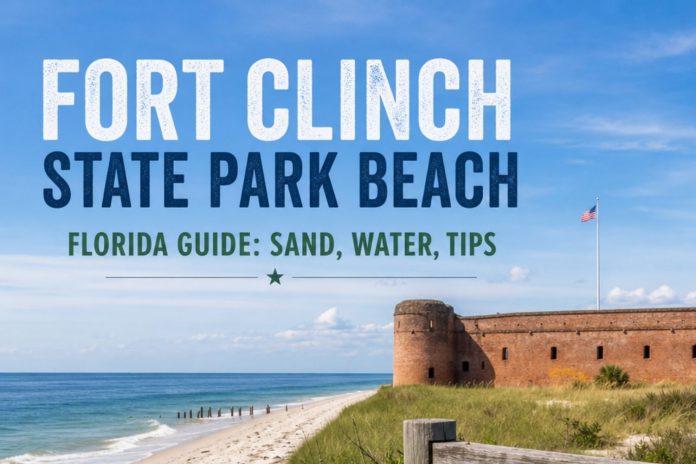
Fort Clinch State Park sits at the exact northeastern tip of Amelia Island, close enough to Georgia that you can watch Cumberland Island’s wild horses across the water on a clear day. This is one of three guides to my Amelia Island trilogy and it’s the one built around history, shark teeth, and camping rather than resort amenities or horseback riding. Nearly five million bricks went into a fort here that never saw a single shot fired in anger, and it remains one of the best-preserved Civil War-era fortifications left in the country.
This park sits at the opposite end of the island from Amelia Island State Park, which I’ve covered separately, and it centers on a genuinely different identity: a 19th-century fort you can walk through room by room, roughly three miles of beach considered among the best shark tooth hunting grounds in Florida, and two distinct campgrounds that consistently rank among the state’s best.
In this guide I’m covering the historic fort and its living history programs, the Atlantic beach and its shark tooth reputation, the park’s two campgrounds, and the trail system leading out toward Florida’s literal northernmost point. I’ll go deep on what the sand and water are actually like here, and why swimming is restricted to just one stretch of this beach, score it honestly across every category that matters, tell you exactly who this park fits and who might prefer Amelia Island’s other beaches instead, and cover exactly where your dog can and can’t go here. I close with my honest take on standing at the edge of Florida and looking at another state entirely.
The Vibe & Culture at Fort Clinch State Park
A Fort Built for a War That Never Came Here
Construction on Fort Clinch began in 1847, and by the time the Civil War actually reached this coast, the fort still wasn’t finished, and never would be. That unfinished quality is part of what makes it so genuinely interesting to walk through today.
Named for General Duncan Lamont Clinch, a veteran of the War of 1812 and both Seminole Wars, this Third System masonry fort was meant to anchor America’s coastal defense system after the Second Seminole War ended. Confederate troops occupied the incomplete structure in 1861 when Union forces briefly withdrew from Florida, using it as a safe haven for blockade runners. By 1862, with Union forces regaining control of southern Georgia, Robert E. Lee ordered the fort abandoned, and Union troops retook it without a single shot being fired. Construction limped on until 1869, and the fort was ultimately abandoned unfinished, its walls showing distinctly different brick colors and sizes depending on which era’s builders laid them.
The Army sold the fort in 1926, judging it to have no further military value, but preservation-minded locals saw something worth saving. Florida bought 256 acres including the fort in 1935, making this one of the state’s very first state parks, and the Civilian Conservation Corps spent the following years excavating sand that had buried parts of the structure, restoring its walls, and building the museum, roads, and campground still in use today. The fort found one more moment of relevance during World War II, serving as a surveillance and communications post, before settling permanently into its role as a public park in 1938.
That layered history is still very much alive here. On the first weekend of every month, costumed interpreters reenact Union garrison life circa 1864, complete with cannon firings, musket drills, and demonstrations in the fort’s laundry, infirmary, kitchen, and carpenter shop. A special Fort by Candlelight event each December adds an entirely different atmosphere to the same walls. Between reenactment weekends, the fort still holds daily interpretive tours, and the overall feeling here is less like visiting a museum and more like walking through a building that’s simply still doing its job, just with a different kind of visitor now.
Fort Clinch Areas: The Fort, the Beach, and Two Campgrounds
This park’s more than 1,100 acres break into a few genuinely distinct experiences. Here’s how I approach it.
The Historic Fort & Living History Programs
2601 Atlantic Ave · Separate Admission Required
Walking into Fort Clinch itself costs an additional fee beyond the park’s standard entrance, and it’s worth every bit of it. Inside, you can explore the prison, barracks, five bastions, guard rooms, and workrooms, with a small museum providing context for what you’re looking at. Climb to the ramparts and you get sweeping views across the Amelia River toward Georgia, a genuinely striking payoff for the walk up.
The crowd here is thickest on reenactment weekends, the first of every month, when costumed interpreters in Union blues bring the fort’s daily routines to life through cannon firings, drills, and hands-on demonstrations. Outside those weekends, the fort still offers daily tours with interpretive signage, and the crowd thins to a steady trickle of history-minded visitors and families working through the museum at their own pace.
My honest take, budget real time here, not just a quick walk-through. The unfinished, patchwork nature of the fort’s construction, different brick colors and sizes marking each era’s builders, tells its own story if you slow down enough to notice it.
The Atlantic Beach & Shark Tooth Hunting

Roughly Three Miles of Shoreline · Swimming Restricted to One Access Point
Fort Clinch’s beach has built a genuine reputation as one of the best shark tooth hunting grounds in Florida, and the science behind it is straightforward. Currents moving through the St. Marys River inlet carry fossilized shark teeth, some dating back to the last Ice Age and occasionally even fragments of megalodon teeth, out of ancient seabed deposits and onto this shoreline. The most productive hunting sits near the jetties by the fort and along the park’s northern shoreline, best after a storm or at low tide, when you’re scanning for small black triangles scattered among the broken shell line.
Swimming here is restricted specifically to the Atlantic Beach access point, reached by a boardwalk, since the areas near the jetties carry strong currents and steep drop-offs that make them genuinely unsafe. Shelling tends to be best in the zones north and south of the jetties themselves, separate from the swimming area.
The crowd here splits cleanly between dedicated shark tooth hunters working the tideline with real focus and casual beachgoers sticking to the designated swim area. My honest take, bring a small mesh bag and commit to moving slowly. This isn’t a beach where you stumble onto teeth by accident. It rewards patience more than almost anywhere else in this guide.
Two Campgrounds: Amelia River & Atlantic Beach
Oak Hammock or Oceanfront, Your Choice
Fort Clinch offers a genuinely rare choice for a single state park, two distinct campgrounds with two entirely different characters. The Amelia River Campground sits under a canopy of oak trees draped in Spanish moss, with sites offering an old Florida feel and hot-water shower facilities nearby. The Atlantic Beach Campground sits closer to the ocean itself, sandy and more exposed, with a ramped boardwalk connecting sites directly to the surf, close enough that you can genuinely hear the waves from your tent.
The crowd at both campgrounds tends to book up well in advance, especially oceanfront sites at the Atlantic Beach loop, and reservations open up to 11 months ahead through the Florida State Parks system. Leashed pets are welcome at both campgrounds, though they aren’t permitted on the beach itself.
My honest take, choose based on what kind of camping trip you want. The Amelia River sites are quieter and more shaded, genuinely pleasant even in summer heat. The Atlantic Beach sites trade that shade for direct proximity to the surf, and I’d choose them specifically if falling asleep to the sound of waves matters more to you than staying cool.
The Trails, Willow Pond & Florida’s Northernmost Point
Six Miles of Trails · Alligators, Deer & a View of Georgia
Beyond the fort and the beach, Fort Clinch holds roughly six miles of hiking and biking trails through maritime hammock and around freshwater ponds. The Willow Pond Trail loops specifically around a series of these ponds, a good spot to watch for alligators, white-tailed deer, and a wide range of birds without needing to set foot on the beach at all.
Walk the beach along Cumberland Sound at the park’s northern edge and you reach the literal northernmost point in the state of Florida, with Cumberland Island, Georgia visible directly across the water. On a clear day and with some patience, you can sometimes spot the wild horses that roam that island’s beaches, a genuinely strange and wonderful sight to catch from Florida soil.
The crowd on these trails is thin and quiet, birders and hikers who came specifically for the wildlife rather than the fort or the beach. My honest take, make the walk out to the northernmost point even if wildlife watching isn’t usually your thing. Standing at the literal edge of Florida, looking at another state entirely, is a small thrill that’s easy to underestimate until you’re actually there.
Fort Clinch State Park Rankings: Expert Scores Across 11 Categories
These scores reflect a park built around history, shark teeth, and camping, which is exactly where it earns its highest marks in this guide.
Sand Quality
7/10
White, hard-packed sand at low tide, firm enough for large-tire beach bikes, consistent with the rest of Amelia Island’s coastline.
Hiking & Beach Walking
8/10
Roughly six miles of trails, including the Willow Pond loop, plus a genuinely walkable beach out toward Florida’s northernmost point.
Shark Teeth & Shelling
9/10
Among the best shark tooth hunting grounds in Florida, with St. Marys River currents regularly depositing fossilized teeth, occasionally including megalodon fragments.
Water Conditions
5/10
Swimming is genuinely good, but restricted specifically to the boardwalk-access Atlantic Beach, since the jetty areas carry dangerous currents and steep drop-offs.
Scenery & Natural Beauty
9/10
Moss-draped oak hammock, dunes, and river views combine with a genuinely rare payoff, a clear sightline to Georgia’s Cumberland Island across the water.
Birding & Wildlife
9/10
A gateway site on the Great Florida Birding Trail, with over 100 recorded species, the rare purple sandpiper, gopher tortoises, alligators, and regular dolphin and manatee sightings offshore.
Family Friendliness
8/10
The living history reenactments, fort exploration, and shark tooth hunting all genuinely hold kids’ attention, though separate fort admission adds to the day’s cost.
Dog Friendliness
5/10
Leashed pets are welcome at both campgrounds, but dogs aren’t permitted on the beach itself.
Solitude & Peace
7/10
Genuinely peaceful outside reenactment weekends and busy camping seasons, especially along the trails and the northern beach stretch.
Entertainment & Nightlife
4/10
No town nightlife here, but the monthly living history reenactments and December’s Fort by Candlelight event genuinely count as some of the best on-site programming in this guide.
Parking & Beach Access
7/10
Straightforward entry for a modest vehicle fee, though lines can form at the gate on sunny weekends and separate payment is required to enter the fort itself.
Fort Clinch State Park Sand & Water
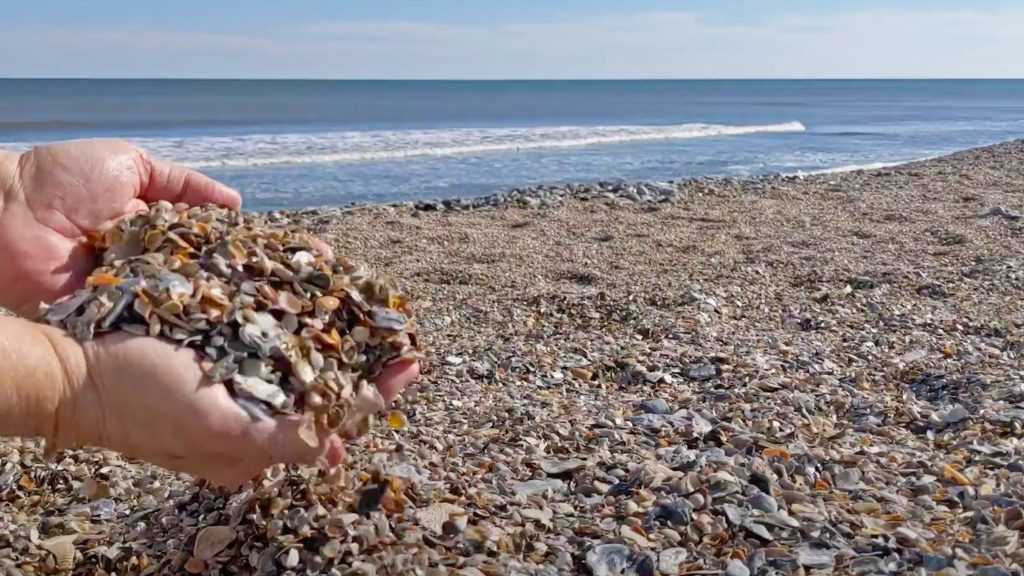
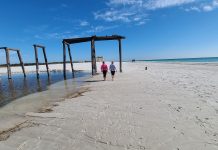
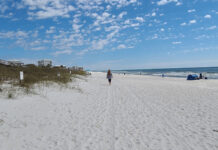
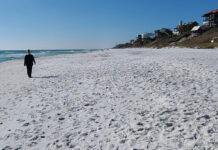
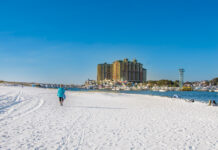
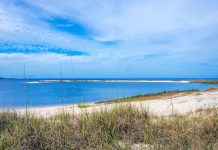
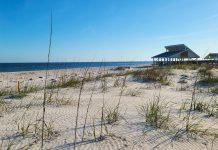
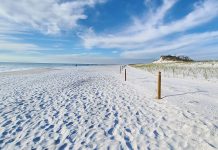
The sand here is bright white and firm once you get below the shells in some areas. It stays wide and flat for most of its length, plenty of room for a beach day, and it’s comfortable underfoot outside the shellier zones near the jetties. What makes this beach worth slowing down for is what’s mixed into the sand itself, a real concentration of fossilized shark teeth that reward anyone willing to scan the wrack line at low tide rather than rush past.
Swimming here is genuinely good, but only in one specific spot. The Atlantic Beach access point, reached by boardwalk, offers safe, manageable conditions on a calm day, with a gradual entry and a typical deep Atlantic blue-green color. The jetty areas and river side are a different story entirely, with strong currents and steep drop-offs that make swimming there unsafe and officially off-limits. Know which stretch you’re on before you wade in.
-
Walkability. Wide, flat, and firm at low tide, genuinely comfortable for a long walk or a bike ride down the beach.
-
Softness & Playability. Firm near the water, softer near the dunes, with plenty of room for sandcastles and a full day’s setup.
-
Barefoot Comfort. Comfortable through most of the beach, with normal caution around the shellier jetty zones.
-
Swimmability. Good specifically at the Atlantic Beach boardwalk access. Everywhere else along this shoreline, swimming is unsafe and prohibited.
Want the full geology, grain composition, and the complete sand and water condition ratings? I broke it all down separately in Sand & Shore: Fort Clinch State Park.
Dogs & Pet Accessibility at Fort Clinch State Park
Are Dogs Allowed on the Sand? RESTRICTED.
Your leashed dog is welcome at both campgrounds, but not on the beach itself. Plan around that split if a beach walk together is part of your trip.
Where Dogs Are Allowed
- ✓The Amelia River Campground and the Atlantic Beach Campground, on a leash.
- ✓Most of the park’s trails, including the Willow Pond Trail, on a leash.
Where Dogs Are NOT Allowed
- ✗The Atlantic beachfront, matching the same rule at Amelia Island State Park to the south.
- ✗Inside the historic fort itself.
Paws on the Ground Reality
The campgrounds give your dog plenty of shaded ground to settle into between activities, and the Willow Pond Trail’s shade makes for a comfortable walk most of the year, alligators aside, so keep a close eye and a firm leash near the water there. Bring your own water regardless, since campground spigots aren’t reliably dog-accessible. Enforcement on the beach restriction is consistent, since rangers patrol this stretch regularly given its popularity with campers and day visitors alike.
If a real beach walk with your dog matters to your trip, Amelia Island’s general beaches further south welcome leashed dogs on the sand.
Crowd Levels and the Overall Feel of Fort Clinch State Park
The crowd concentrates at the fort during reenactment weekends and at the designated swim beach on sunny days, while the trails and northern shoreline tend to stay quiet nearly year-round. Both campgrounds run at high occupancy for much of the year, especially oceanfront sites.
The overall feel shifts around the park’s own reenactment and seasonal calendar as much as the weather:
- Spring: comfortable temperatures, strong birding, and a good window for both camping and shark tooth hunting
- Summer: the busiest camping season, with real heat making early morning or late afternoon the better time for the fort and trails
- Fall: my favorite season here, thinner crowds and ideal conditions for a long beach walk or bike ride
- Winter: quiet, cool, and capped off by the Fort by Candlelight event in December, a genuinely different way to experience the fort after dark
Who Is Fort Clinch State Park Really For?
✓ Who Will Love Fort Clinch State Park
-
Shark tooth hunters chasing some of the best odds anywhere in Florida
-
History lovers who want a genuinely well-preserved, hands-on 19th-century fort with real living history programming
-
Campers who want a choice between shaded oak hammock sites and oceanfront camping within one park
-
Birders and wildlife watchers drawn to a Great Florida Birding Trail gateway site with genuinely diverse habitat
-
Anyone who wants the novelty of standing at Florida’s literal northernmost point, with Georgia in clear view
-
Cyclists who want genuinely rideable hard-packed beach sand at low tide
✗ Consider Another Beach If…
-
You want to swim anywhere along the beach freely. Swimming here is restricted specifically to the boardwalk-access Atlantic Beach
-
You’re bringing a dog and want it on the beach with you. Pets are welcome at the campgrounds but not on the sand
-
You want horseback riding on the beach. Head to Amelia Island State Park at the island’s southern tip instead
-
You’re not interested in Civil War history or living history programming. The fort is a central part of this park’s identity
-
You want resort amenities or a lively boardwalk scene. This is a nature and history-focused state park, not a beach town
Things to Do at Fort Clinch State Park, Florida
Between the fort, the beach, and the trails, this park offers a genuinely full day, or several.
-
Touring the Historic Fort. Explore the prison, barracks, bastions, and museum, with a separate admission fee beyond standard park entry.
-
Living History Reenactments. Costumed interpreters portray Union garrison life on the first weekend of every month, with a special Fort by Candlelight event each December.
-
Shark Tooth Hunting. Scan near the jetties and the northern shoreline at low tide, especially after storms, for one of Florida’s best shark tooth hunting experiences.
-
Camping. Choose between the shaded Amelia River Campground and the oceanfront Atlantic Beach Campground, both consistently well-reviewed.
-
Hiking & Biking. Roughly six miles of trails, including the Willow Pond loop around freshwater ponds, plus hard-packed beach riding at low tide.
-
Fishing. Surf fishing along the Atlantic shoreline and St. Marys Inlet for redfish, black drum, whiting, sheepshead, and flounder.
-
Birding. A gateway site on the Great Florida Birding Trail, with over 100 recorded species including the rare purple sandpiper.
-
Spotting Wild Horses Across the Sound. Walk out to Cumberland Sound for a chance at seeing Cumberland Island’s wild horses on the Georgia shoreline opposite the park.
Local Knowledge and Practical Advice
A few things worth knowing before you plan a visit here:
-
Budget for two separate fees. Standard park entry runs $6 per vehicle for two to eight people, and entering the fort itself costs an additional $2.50 per person.
-
Swim only at the Atlantic Beach boardwalk access. The jetty areas and river side carry strong currents and steep drop-offs, and swimming there is unsafe and prohibited.
-
Hunt for shark teeth near the jetties and the northern shoreline. Low tide after a storm offers the best odds, and small black triangles among the shell line are what you’re looking for.
-
Book oceanfront campsites up to 11 months ahead. The Atlantic Beach Campground’s most requested sites fill quickly.
-
Leashed pets are welcome at both campgrounds, but not on the beach. Plan accordingly if you’re traveling with a dog.
-
Time a visit for a reenactment weekend. The first weekend of every month brings the fort’s Civil War history to life with live demonstrations.
-
Bring your own Florida fishing license. The park does not sell them on-site.
-
Respect sea turtle nests, marked or not. This beach does see nesting activity, and disturbing a nest is both harmful and illegal.
-
Arrive early on sunny weekends. Lines can form at the entrance gate, and the visitor center itself keeps separate hours from the park’s general 8am to sunset schedule.
-
Walk out to Cumberland Sound at the park’s edge. Standing at Florida’s northernmost point is a small but genuine thrill worth the extra walk.
Where to Stay Near Fort Clinch State Park, Florida
Camping within the park itself is the main draw, with nearby options for anyone who wants a different kind of stay.
Amelia River Campground
Shaded sites under oak trees draped in Spanish moss, with hot-water shower facilities, water and electric hookups, and a genuinely old Florida atmosphere.
Atlantic Beach Campground
Sandy, more exposed sites close enough to the ocean to hear the waves at night, connected to the surf by a ramped boardwalk.
Historic Fernandina Beach, South
For hotels and bed and breakfasts, downtown Fernandina Beach sits just a few miles south, covered in my general Amelia Island beaches guide.
Amelia Island Resort Corridor
The Omni Amelia Island Resort and the Ritz-Carlton both sit further south on the island for visitors who want full-service amenities alongside a Fort Clinch day trip.
What Makes Fort Clinch Different from Nearby Beaches
Fort Clinch stands apart because it centers on layered history and geology in a way no other beach in this guide quite matches, a genuinely unfinished 19th-century fort paired with a beach that’s quietly been surrendering fossilized shark teeth for thousands of years.
A few features make it distinct:
An unfinished fort that tells its own story
The different brick colors and sizes marking each construction era give this fort a visible, physical timeline that few historic sites present this directly.
Some of the best shark tooth hunting in Florida
The specific tidal dynamics of the nearby St. Marys River inlet make this beach a genuinely exceptional shark tooth destination, occasionally turning up megalodon fragments.
Two campgrounds, two completely different experiences
Very few state parks in this guide offer this clean a choice between shaded oak hammock camping and true oceanfront sites within the same property.
Standing at the edge of Florida itself
Few places in this entire guide let you look across state lines the way the beach at Cumberland Sound does, with Georgia’s Cumberland Island and its wild horses visible just across the water.
Fort Clinch vs. Other Amelia Island Beaches
These are the beaches and parks visitors most often weigh against Fort Clinch, and the honest read on when you’d choose one over the other.
Fort Clinch vs. Amelia Island State Park
Amelia Island State Park, at the island’s southern tip, centers on horseback riding and fishing from the George Crady Bridge. Fort Clinch centers on history, camping, and superior shark tooth hunting.
Fort Clinch vs. the General Amelia Island Beaches
The general island beaches offer resort amenities, historic Fernandina Beach, and American Beach’s cultural significance. Fort Clinch trades all of that for a protected, history-first state park experience.
Fort Clinch vs. Little Talbot Island State Park
Little Talbot, further south near Jacksonville, is the better choice for birdwatching and general shelling. Fort Clinch remains the stronger pick specifically for shark teeth and Civil War history.
Fort Clinch vs. Big Talbot Island State Park
Big Talbot’s driftwood “boneyard” beach offers a completely different kind of natural spectacle, with no historic fort or camping to match Fort Clinch’s offerings.
Bottom line: Fort Clinch is the choice for history, shark teeth, and genuinely excellent camping at the northern tip of Amelia Island. Amelia Island State Park gives you horseback riding instead. The general island beaches give you resort amenities and deeper cultural history. Fort Clinch gives you a fort that’s still, in its own way, doing its job after more than 175 years.
Fort Clinch State Park Beach, Florida: Frequently Asked Questions
How much does it cost to enter Fort Clinch State Park?
$6 per vehicle for two to eight people, or $4 for a single-occupant vehicle. Entering the historic fort itself costs an additional $2.50 per person.
Can you swim at Fort Clinch State Park?
Yes, but only at the Atlantic Beach access point reached by boardwalk. Swimming near the jetties and the river side is unsafe and prohibited due to strong currents and steep drop-offs.
Is Fort Clinch good for shark teeth?
Yes, genuinely one of the best spots in Florida for it. Currents from the nearby St. Marys River inlet regularly deposit fossilized teeth near the jetties and along the northern shoreline.
Can you camp at Fort Clinch State Park?
Yes, at two distinct campgrounds, the shaded Amelia River Campground and the oceanfront Atlantic Beach Campground. Reservations open up to 11 months in advance.
Are dogs allowed at Fort Clinch State Park?
Leashed pets are welcome at both campgrounds, but dogs are not permitted on the beach.
What are the Civil War reenactments at Fort Clinch?
Costumed interpreters portray Union garrison life circa 1864 on the first weekend of every month, with cannon firings, musket drills, and daily activity demonstrations. A special Fort by Candlelight event is held each December.
Is Fort Clinch the northernmost point in Florida?
The beach along Cumberland Sound at the park’s edge marks the state’s literal northernmost point, with Georgia’s Cumberland Island visible directly across the water.
How old is Fort Clinch?
Construction began in 1847 and continued, off and on, until 1869, though the fort was never fully completed. It became a Florida state park in 1935.
Is Fort Clinch good for families?
Yes, with living history programming, a hands-on fort to explore, and genuinely exciting shark tooth hunting that holds kids’ attention well.
How far is Fort Clinch from Jacksonville?
About 30 miles, roughly a 45-minute drive via I-95 and A1A.
Patti’s Perspective: My Honest Take on Fort Clinch State Park
My honest caveat, budget your time and your money for both the park and the fort separately, and don’t rush the shark tooth hunting. Sometimes the teeth show up on the shore and sometimes you just won’t see any. This beach rewards patience in a way few others in this guide do.
Want to Live by the Water?The area near Fort Clinch State Park offers a genuinely protected, low-density alternative to the resort corridor further south on Amelia Island, with the park’s permanence as a neighbor helping preserve the northern tip’s historic, natural character.The market here draws history-minded buyers, retirees, and outdoor enthusiasts who want proximity to protected parkland, genuine camping access, and easy day trips into historic Fernandina Beach a few miles south. Because so much of this specific stretch of coastline is permanently protected as state park land, nearby property tends to hold long-term value well.If living near this kind of historically rich, protected coastline is something you’re considering, it’s worth exploring what’s available in this area.Explore Waterfront Living at LiveByTheWater.com
Real estate referral partner