



Ponte Vedra Beach, Florida
Ponte Vedra Beach is the quietest kind of famous. Everyone in Northeast Florida knows the name, the golf, the money, the reputation, but almost nobody outside the neighborhood has actually walked this sand. After years of coming back to this stretch of coast, I can tell you the reason it feels different from every other beach on Florida’s Atlantic side isn’t the golf courses behind the dunes. It’s how little of the shoreline is actually open to you, and how good the part that is open turns out to be.
This is a roughly ten mile run of Atlantic coastline in St. Johns County, tucked between Jacksonville Beach to the north and the Guana Tolomato Matanzas Reserve and St. Augustine to the south. Almost the entire shoreline fronts private, oceanfront residential property, so unlike a beach town built around a boardwalk, Ponte Vedra Beach is built around a handful of public entry points separated by long stretches you can only reach on foot along the wet sand. That sounds limiting, and it is, but it’s also exactly what keeps this beach as calm as it is.
In this guide I’m walking you through every way you can actually get your feet on this sand, going deep on what makes the coquina sand and the shark teeth here different from anywhere else on the coast, scoring it honestly across every category that matters, telling you exactly who this beach fits and who will be happier somewhere with more elbow room to park, and covering exactly where you can bring your dog. I’ll cover Mickler’s Landing, the Guana Tolomato Matanzas Reserve beaches at the north end, the quiet southern tip, and the private resort shoreline that gives this place its golf-town reputation. I close with my honest take on why the access problem here is also the whole point.
The Vibe & Culture at Ponte Vedra Beach
A Beach Town Without a Boardwalk
There’s no pier here, no strip of t-shirt shops, no music drifting out of a beachfront bar. Ponte Vedra Beach doesn’t perform for visitors, and that’s the entire personality of the place.
What you notice first, before you ever see the water, is how residential this stretch of A1A feels. Ponte Vedra Boulevard runs behind the dune line lined with oceanfront estates, hedges, and private walkovers, and the road itself narrows and quiets the further south you go. There’s no commercial strip crowding the shoreline the way there is at Jacksonville Beach fifteen minutes north. The community built itself around golf and privacy starting with the Ponte Vedra Inn & Club, which opened its first course in 1928, and that identity never really shifted. Today Ponte Vedra Beach is home to TPC Sawgrass and THE PLAYERS Championship, held every March on the Stadium Course, and golf is woven into the community’s sense of itself as thoroughly as the sand is.
That golf-first, privacy-first character shapes everything about how you experience the beach. This isn’t a place families drive to for a beach day the way they’d drive to St. Augustine Beach. It’s a place people live, and the beach is treated more like a backyard amenity than a public attraction. I’ve walked this shoreline in every season, and even during THE PLAYERS Championship week, when the whole area fills with golf fans and the resorts book solid, the sand itself barely notices. The crowd stays inland at the tournament and the clubhouses. The beach stays exactly as quiet as it always is.
Seasonally, this is a coast that runs mild rather than dramatic. Summer brings the warmest water and the only real crowd, mostly at Mickler’s Landing, but even peak season here feels restrained compared to Florida’s bigger beach towns. Fall is when I’d send anyone who asks, since the water holds its warmth into October and the parking lot pressure disappears almost overnight after Labor Day. Winter turns quiet and a little wild, with stronger northeast swells pushing in some of the best surf of the year, and sea turtle nesting season from May through October adds its own rhythm, with volunteer patrols walking this beach every morning before most residents are awake.
Ponte Vedra Beach Areas: The Five Ways You’ll Actually Reach the Sand
Ponte Vedra Beach isn’t a continuous public shoreline you can drive up and down looking for a spot. It’s a short list of specific access points separated by miles of private, walkover-only beachfront, and knowing which one you’re headed to matters more here than at almost any other beach I’ve covered. Here’s how it actually breaks down, north to south.
Mickler’s Landing Beachfront Park
The Public Anchor · Free Parking, Fills Fast
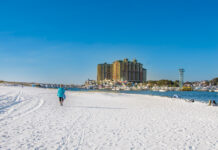
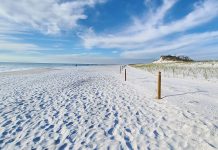
This is the beach most people mean when they say Ponte Vedra Beach, and it’s the first public beach park this community ever had. From the parking lot on Ponte Vedra Boulevard, a wooden walkway carries you up and over dunes that run close to 20 feet high before dropping you onto a wide, hard-packed stretch of sand. The color is the first thing that gets people. It runs a warm, rosy pink in the wet sand near the water, a shade that comes from crushed coquina clam shells mixed into the grain, and it’s genuinely different from the white quartz sand you’ll find at most other Atlantic beaches in this state.
The crowd at Mickler’s is the closest thing Ponte Vedra Beach has to a scene, and even that is relative. You’ll find dog walkers working the tide line early, shark tooth hunters bent over at the waterline scanning the wrack, a handful of surfers checking the shore break, and families who’ve figured out this is the easiest entry point in town. It’s still nothing like a Jacksonville Beach weekend. The lot itself is the constraint, not the sand.
I come here specifically for the shark teeth, and I’m not exaggerating when I say this is one of the most reliable stretches of coast in Florida for finding them. My honest advice, arrive before 8am on any summer weekend if you want a parking spot without circling. The lot fills fast and there’s no legal street parking anywhere near it once it’s full.
The Guana Tolomato Matanzas Reserve Beaches
North Beach, Middle Beach & South Beach Access · Fee Required
North of Mickler’s, the character of the coast changes completely. This stretch belongs to the Guana Tolomato Matanzas National Estuarine Research Reserve, and the beach here backs up to protected dune scrub instead of oceanfront homes. Small parking pull-offs sit along the west side of A1A, each with its own boardwalk crossing over the dunes, and the beach on the other side runs wide, undeveloped, and noticeably wilder than anything closer to town. At the North Beach access lot you’ll find a 15-foot statue of Ponce de Leon, marking the spot near where he’s believed to have made landfall in 1513, which gives this particular stretch a sense of history that the rest of Ponte Vedra Beach doesn’t carry.
The crowd here is a different crowd entirely. Birders show up for the fall raptor migration, when peregrine falcons follow the dune line by the hundreds during the first two weeks of October. Hikers use these lots to access the reserve’s ten-plus miles of interior trails. Paddlers launch into the Guana River on the sound side. On the beach itself, you’ll mostly find people who came specifically for the reserve, not for a beach day, and that keeps foot traffic here lighter than at Mickler’s even in summer.
I’m giving this one a shorter writeup here on purpose. The trail network, the birding, the kayaking, and the cultural history of this peninsula genuinely deserve their own full guide rather than a few paragraphs tucked inside a beach roundup, and I’ve written that guide separately. If you only have an afternoon, this is worth a stop for the statue and the dune walk alone. If you have a full day, it’s worth planning around, and I go into that in my hiking guide to the reserve trails.
South Ponte Vedra Beach Recreation Area
The Southern Tip · Picnic Tables, Limited Parking
About two and a quarter miles south of the Guana Reserve, South Ponte Vedra Beach Recreation Area marks the bottom edge of the Ponte Vedra Beach shoreline before it hands off toward Vilano Beach. The parking here sits across A1A from the South Ponte Vedra fire station, which tells you everything about how informal this access point is compared to Mickler’s. Once you cross over, the beach opens up wide and quiet, with picnic tables and grills set back near the dune line for anyone who wants to make a real afternoon of it.
This is the access point locals use when they specifically want to avoid the Mickler’s crowd, and it works. I’ve had long stretches of this beach to myself on weekday mornings, with nothing but a few dog walkers and the occasional angler working the surf. The sand carries the same pink coquina tone as the rest of Ponte Vedra Beach, and the shell content picks up noticeably here, since fewer feet disturb the wrack line day to day.
My honest take, this is the access point I’d send anyone who tells me Mickler’s felt too busy for what they wanted. It’s not glamorous. There’s no boardwalk, no facilities beyond the basics, but if quiet is the goal, this delivers it more reliably than anywhere else public in town.
The Residential Walkover Stretch
Old Ponte Vedra Boulevard · Deeded, Private Access
Between the public access points, most of Ponte Vedra Beach’s shoreline runs behind private, deeded walkovers that belong to the oceanfront homes along Ponte Vedra Boulevard. This is the stretch that gives the community its reputation, custom estates set behind sea oats and low dune lines, several with names and hedges instead of numbers, and almost no public foot traffic at all. Florida’s public trust doctrine still protects your right to walk the wet sand below the mean high water line here, but you won’t find parking, and you won’t find a legal way to cross the dunes to reach it unless you’re already staying at a property with access.
The people you’ll see on this stretch are almost exclusively residents and their guests, walking dogs at sunrise or heading out for a run before the day heats up. It has the feel of a private beach even though, technically, the sand itself below the tide line isn’t. I’ve walked sections of this stretch at the waterline from Mickler’s heading north and from South Ponte Vedra Beach heading south, and both times I had long, uninterrupted stretches of packed pink sand with nobody else on it except the occasional resident walking their dog.
My honest caveat here, don’t plan a beach day around this stretch unless you’re staying oceanfront yourself. The walking is genuinely good if you’re already at the waterline from a public access point and simply keep going, but there’s no legal way to park a car and cut through to this section on your own.
TPC Sawgrass & The Resort Beach Clubs
Private Beach Access for Guests & Members
The last piece of the Ponte Vedra Beach picture isn’t public at all, but it explains why this town looks the way it does. The Ponte Vedra Inn & Club, The Lodge & Club, and the Sawgrass Marriott all maintain their own private stretches of oceanfront, groomed and staffed for guests and members, with beach chair and cabana service built into the resort experience. This is the version of Ponte Vedra Beach that shows up in the glossy photos, and if you’re staying at one of these properties, it’s genuinely a different beach day than anything available to the general public here.
The crowd on these private stretches is exactly what you’d expect, resort guests, club members, and during THE PLAYERS Championship week every March, a noticeably golf-heavy mix of fans and players’ families staying on property. It’s calm, it’s maintained, and it’s the one part of Ponte Vedra Beach where amenities actually exist right on the sand.
I’ll be straightforward about this one. If you’re not booked at one of these resorts or a member of one of these clubs, you’re not getting onto this sand, and that’s worth knowing before you plan a trip around it. But it’s also worth understanding as part of the town’s identity, since the golf-and-beach-club culture here is as central to Ponte Vedra Beach as the coquina sand itself.
Ponte Vedra Beach Rankings: Expert Scores Across 11 Categories
These scores weigh the reality of this beach as a whole, meaning the genuine quiet and sand quality get balanced against a parking and access situation that’s some of the most restrictive I’ve covered anywhere in Florida.
Sand Quality
8/10
Pink coquina sand, hard-packed and easy underfoot, with a color and origin story you won’t find at a quartz beach. Coarser than powdery Panhandle sand, but that’s part of what makes it distinct.
Hiking & Beach Walking
8/10
Long, firm, flat waterline that’s genuinely excellent for walking or running, especially at low tide. The private walkover stretch means you’re walking the tide line rather than the dry sand, but the surface rewards it.
Shark Teeth & Shelling
8/10
One of the more productive shark tooth beaches on Florida’s Atlantic coast. Lightning whelks, coquina clams, and lettered olives turn up in the wrack line, especially after storms.
Water Conditions
6/10
Moderate to strong Atlantic surf that can catch swimmers off guard, especially around northeast wind events. Good for surfers on the right swell, less forgiving for casual swimmers than a Gulf beach.
Scenery & Natural Beauty
8/10
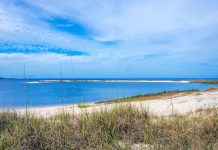
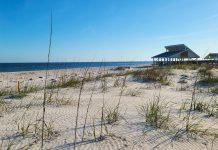
Tall dunes, sea oats, and oceanfront estates set well back from the sand. No commercial clutter in sight, which is rare for a beach this close to a major metro area.
Birding & Wildlife
8/10
Sea turtle nesting May through October, a fall peregrine falcon migration worth planning around at the GTM Reserve, and the endangered Anastasia Island beach mouse in the dune system.
Family Friendliness
6/10
Works for families who come prepared, but the surf can run stronger than expected and lifeguard coverage at Ponte Vedra’s own access points is limited. Shark tooth hunting genuinely holds kids’ attention.
Dog Friendliness
8/10
Leashed dogs are welcome at Mickler’s Landing and South Ponte Vedra Beach Recreation Area with no time-of-day restrictions, which is more generous than most Florida beach towns.
Solitude & Peace
9/10
This is the highest solitude score I’ve given a beach this close to a major Florida metro. The same limited access that frustrates parking also keeps the sand genuinely quiet.
Entertainment & Nightlife
4/10
There’s no boardwalk scene here. What you get instead is resort dining, spa culture, and a golf calendar built around THE PLAYERS Championship every March. Different kind of entertainment entirely.
Parking & Beach Access
4/10
This is the honest weak point. Mickler’s is the only real free lot, it fills by mid-morning most weekends, and there’s no street parking anywhere east of A1A to fall back on.
Ponte Vedra Beach Sand & Water
The sand at Ponte Vedra Beach is hard-packed and easy on your feet, especially right at the waterline, where it holds firm enough for a long walk or a run without ever turning into a slog. Up near the dunes it softens into a looser, slightly coarser texture, still fine for sandcastles once you add a little water, though it’s not the flour-soft powder you’d find on a Gulf beach. The beach itself runs wide and flat for most of its length, so you’ll have plenty of room to set up a chair without crowding anyone, and the rosy-pink tint in the wet sand makes for some of the prettiest early morning light on this whole stretch of coast.
The water changes more from day to day here than it does on a calmer beach further south, running a deep Atlantic blue-green that shifts with the wind and the swell. Entry is gradual most days, but this coast gets genuine surf, especially during a northeast wind event in fall or winter, and rip currents are a real, not theoretical, risk. Lifeguard coverage at Ponte Vedra’s own access points is limited and seasonal, so treat this as a beach where you watch the flags and use your own judgment rather than one where a tower is always watching for you.
-
Walkability. Wide, flat, and hard-packed at the tide line, genuinely one of the better long-walk beaches on this stretch of coast.
-
Softness & Playability. Coarser than a powdery quartz beach, but soft enough up near the dunes for sandcastles once the sand’s had a little water worked into it.
-
Barefoot Comfort. Comfortable at the waterline, though shell content picks up near the dunes, so bring water shoes if you’re planning to wade and hunt for shark teeth.
-
Swimmability. Manageable on calm days, genuinely rougher during northeast wind events, and lifeguard coverage here is seasonal at best, so check conditions before you go in past your knees.
Want the full geology, grain composition, and the complete sand and water condition ratings? I broke it all down separately in Sand & Shore: Ponte Vedra Beach.
Dogs & Pet Accessibility at Ponte Vedra Beach
Are Dogs Allowed on the Sand? RESTRICTED.
You can bring your leashed dog to two specific spots on Ponte Vedra Beach, Mickler’s Landing and South Ponte Vedra Beach Recreation Area, with no time-of-day restrictions at either one. Everywhere else along this stretch, the sand either fronts private property or belongs to a resort that keeps its beach for guests only.
Where Dogs Are Allowed
- ✓Mickler’s Landing Beachfront Park, the island’s main public access point, welcomes leashed dogs any time of day, year-round.
- ✓South Ponte Vedra Beach Recreation Area, the quieter southern access point, follows the same no-restriction leash policy.
Where Dogs Are NOT Allowed
- ✗The private beaches at the Ponte Vedra Inn & Club, The Lodge & Club, and Sawgrass Marriott, reserved for guests and members only, pets included.
- ✗The residential walkover stretch along Ponte Vedra Boulevard, where the sand fronts private homes with no public parking or crossover.
Paws on the Ground Reality
Both dog-friendly stops here feel more like a neighborhood dog park than a tourist beach, and you’ll mostly run into regulars who’ve been walking the same stretch of sand for years. Bring your own water, since neither lot has a pet fountain, and keep the leash on the whole time you’re out there. St. Johns County’s ordinance doesn’t carve out an exception once your dog is in the surf, whatever you might read elsewhere.
If your dog needs more room to roam than two beach lots give you, head north to the Guana Tolomato Matanzas Reserve, where leashed dogs are welcome on ten miles of shaded trail through maritime hammock, well beyond what either beach access point offers.
Crowd Levels and the Overall Feel of Ponte Vedra Beach
Because so much of this shoreline is private, the crowd here concentrates almost entirely at the handful of public access points, and it thins out fast the moment you start walking away from them. Mickler’s Landing carries the closest thing to a real crowd, mostly locals, dog walkers, and shark tooth hunters rather than day-trippers. The Guana Reserve beaches at the north end draw a nature-focused crowd, birders and hikers more than sunbathers. South Ponte Vedra Beach Recreation Area stays quiet nearly year-round, known mostly to people who live nearby.
The feel of this beach shifts by season more around golf and weather than around school calendars, which sets it apart from most Florida beach towns:
- March: THE PLAYERS Championship fills the resorts and gated communities with golf fans, though the beach itself stays largely unaffected
- Summer: the busiest window at Mickler’s, with the warmest water and the fullest parking lot, though still restrained compared to a developed beach town
- Fall: my favorite stretch here, warm water lingering into October with a fraction of the summer crowd and easy parking
- Winter: quiet, sometimes windswept, with the best surf of the year and sea turtle patrol volunteers giving way to birders following the fall migration into early winter
Who Is Ponte Vedra Beach Really For?
✓ Who Will Love Ponte Vedra Beach
-
Shark tooth hunters and shell collectors who want one of the more reliable stretches of coast in Florida for the hobby
-
Anyone chasing genuine solitude on a developed stretch of Northeast Florida coastline, since the limited access keeps crowds naturally thin
-
Golfers and resort travelers who want championship golf and a beach day within the same trip
-
Dog owners, since Mickler’s Landing and South Ponte Vedra Beach Recreation Area both welcome leashed dogs with no time restrictions
-
Birders and nature lovers who want to pair a beach stop with the trail system and fall raptor migration at the Guana Tolomato Matanzas Reserve
-
Buyers and lifestyle seekers exploring Northeast Florida’s luxury oceanfront and golf-course real estate market
✗ Consider Another Beach If…
-
You want a boardwalk scene with dining, music, and nightlife within walking distance. Head to Jacksonville Beach instead
-
You need guaranteed, abundant free parking. Mickler’s is the only real option and it fills fast in season
-
You want calm, gentle water for small children to wade in. This Atlantic surf runs stronger than a protected sound-side beach
-
You’re traveling on a tight budget. Resort pricing and limited public infrastructure make this a pricier beach town than most
-
You want a big group beach day with amenities like pavilions, food, and restrooms right on the sand. The public access points here are basic
Things to Do at Ponte Vedra Beach, Florida
Ponte Vedra Beach rewards people who came for something specific rather than a generic beach day. Here’s what actually fills a visit here.
-
Beach Walking. Long, hard-packed stretches at the tide line, best at low tide and quietest in the early morning before the sun gets high.
-
Shark Tooth Hunting. The signature activity here. Scan the wrack line at low tide, especially the morning after a storm, and bring a mesh bag if you’re getting serious about it. I’ve cataloged my best finds in a separate beach finds guide to Ponte Vedra Beach.
-
Shelling. Lightning whelks, coquina clams, and lettered olives show up consistently. This is also where I get my squat workout in. Every good shell means another squat, and by the end of a real shelling walk you’ve done more legwork than a gym session.
-
Surfing. A genuine, if secluded, surf spot around Mickler’s, best on a south or east-southeast swell around low tide. Watch out for rips and check conditions before paddling out.
-
Golf. TPC Sawgrass and the Ponte Vedra Inn & Club’s courses anchor this community’s identity. THE PLAYERS Championship arrives every March on the Stadium Course.
-
Birding & Nature Trails. The Guana Tolomato Matanzas Reserve’s trail network and fall falcon migration make this a full nature day on their own, separate from the beach itself.
-
Kayaking & Paddleboarding. Better suited to the calm estuary water inside the GTM Reserve than the open Atlantic surf at Ponte Vedra Beach itself.
-
Fishing. Surf fishing off the beach at Mickler’s and South Ponte Vedra Beach Recreation Area for whiting, pompano, and the occasional redfish.
-
Wildlife Watching. Sea turtle nesting runs May through October, with volunteer patrols walking the beach most mornings. The endangered Anastasia Island beach mouse lives in the dune system here too, though you’re unlikely to spot one.
-
Sunrise Watching. This is the Atlantic side, so the show happens at sunrise, not sunset, and the dunes at Mickler’s catch the first light in a way that’s worth setting an early alarm for.
Local Knowledge and Practical Advice
A few things I’ve picked up walking this beach more times than I can count:
-
Arrive at Mickler’s before 8am on summer weekends. The lot is the only real free parking in Ponte Vedra Beach and it fills by mid-morning. There’s no legal street parking to fall back on once it’s full.
-
Wear water shoes if you’re shelling or hunting shark teeth seriously. The heavier shell content here is harder on bare feet than a soft quartz beach, and you’ll want to stay in the water longer than you expect.
-
Walk the wet sand, not the dry sand, if you’re covering distance. The tide line stays hard-packed and fast to walk, while the upper beach near the dunes softens up and slows you down fast.
-
Dogs must stay leashed at all times, including in the water. St. Johns County’s Animal Code doesn’t carve out an exception once your dog is in the surf, whatever you may have read elsewhere.
-
Ponte Vedra’s own access points are largely unguarded. St. Johns County Marine Rescue staffs towers seasonally from Memorial Day through Labor Day, but not consistently at Mickler’s or South Ponte Vedra. Self-monitor and respect the surf.
-
No vehicles are permitted on the sand anywhere in Ponte Vedra Beach. That’s different from parts of St. Johns County further south, where beach driving is allowed with a seasonal pass.
-
Skip flashlights and white light on the beach after dark during nesting season. From May through October, artificial light can disorient nesting sea turtles and their hatchlings. Use a red light if you need one at all.
-
Book well ahead if your trip lands in March. THE PLAYERS Championship at TPC Sawgrass fills every resort and rental in the area and pushes rates up significantly that week.
-
Free beach wheelchairs are available through St. Johns County. Call ahead to reserve one, and know that Mickler’s has a handicapped-accessible boardwalk down to the sand.
-
Respect the private walkovers along Ponte Vedra Boulevard. The wet sand below the tide line is public, but the dunes and walkovers belong to the homes behind them. Stay below the wrack line if you’re walking through.
Where to Stay Near Ponte Vedra Beach, Florida
Ponte Vedra Beach skews toward resorts and gated golf communities rather than budget lodging, and the options break down clearly by what kind of trip you’re planning.
Oceanfront Resorts & Private Clubs
The Ponte Vedra Inn & Club, its sister property The Lodge & Club, and the Sawgrass Marriott Golf Resort & Spa all sit directly on private stretches of Ponte Vedra Beach oceanfront, with beach chair and cabana service included for guests. This is the only way to actually access the resort-maintained beach clubs I mentioned earlier, and it’s worth booking specifically if that’s the experience you want.
Golf Course & Gated Community Rentals
Sawgrass Players Club and The Plantation at Ponte Vedra both offer short-term rentals within gated golf communities, ranging from condos to full estate homes. Demand and rates spike hard during THE PLAYERS Championship week every March, so book early if your trip falls anywhere near that window.
Vacation Homes Near Mickler’s & Palm Valley
For a more accessible price point, look at rentals in the Palm Valley area west of A1A, within a short drive or bike ride of the Mickler’s Landing parking lot. You won’t get oceanfront, but you’ll get easy access to the one beach in town with real parking.
Camping
Ponte Vedra Beach itself has no camping. The nearest options are Anastasia State Park, about 45 minutes south near St. Augustine, or Kathryn Abbey Hanna Park in Jacksonville, about 30 minutes north, both with beachfront tent and RV sites.
Jacksonville Beach & St. Augustine, Nearby
For lower rates and more lodging variety, Jacksonville Beach sits about 15 minutes north and St. Augustine about 25 minutes south, both with a much wider range of budget to mid-range hotel options for visitors who’d rather day-trip to Ponte Vedra Beach than stay directly on it.
What Makes Ponte Vedra Beach Different from Nearby Beaches
Ponte Vedra Beach stands apart for reasons that would be a drawback anywhere else. Most beaches compete on how much they offer. This one gets its identity from how little of it you can actually reach.
A few features make it distinct:
Pink sand and serious shark teeth
The coquina-tinted sand and the shark tooth hunting here are genuinely different from the quartz beaches that dominate the rest of Florida’s coastline, and few Atlantic beaches in this state produce teeth as consistently as this stretch does.
A golf town built around a beach, not the other way around
TPC Sawgrass and THE PLAYERS Championship give Ponte Vedra Beach an identity that has almost nothing to do with the sand itself. Very few Florida beach towns have their calendar built around a golf tournament rather than spring break or a summer festival.
Restricted access as the actual amenity
The limited public entry points that make parking difficult are the same reason this beach stays as quiet as it does. It’s a genuine tradeoff, and it’s one that shapes the entire experience here more than any other single factor.
A reserve at the front door
Very few developed beach communities have a National Estuarine Research Reserve sitting directly at one end of town. The Guana Tolomato Matanzas Reserve gives Ponte Vedra Beach a nature dimension most golf-and-beach towns simply don’t have.
Ponte Vedra Beach vs. Other Northeast Florida Beaches
These are the beaches visitors most often weigh against Ponte Vedra Beach, and the honest read on when you’d choose one over the other.
Ponte Vedra Beach vs. Vilano Beach
Vilano Beach sits just south, on the other side of the Guana Reserve, and offers noticeably easier public access with a more casual, walkable crowd. If parking and access frustrate you at Ponte Vedra, Vilano solves that problem while keeping a similar Northeast Florida feel.
Ponte Vedra Beach vs. Jacksonville Beach
Jacksonville Beach, about 15 minutes north, is the livelier, more developed choice, with a real boardwalk-adjacent scene, restaurants, and nightlife within walking distance of the sand. Choose Jacksonville Beach for energy and convenience. Choose Ponte Vedra Beach for quiet and shark teeth.
Ponte Vedra Beach vs. Anastasia State Park
Anastasia State Park protects four miles of genuinely wild, undeveloped shoreline near St. Augustine, with none of the private residential frontage that defines Ponte Vedra Beach. It’s the better choice if you want protected dunes and full public access without navigating anyone’s private walkover.
Ponte Vedra Beach vs. Amelia Island
Amelia Island, about 45 minutes north, shares a similar upscale, resort-driven identity, but with considerably more public beach access and a more developed resort corridor. Ponte Vedra Beach is the quieter, more exclusive version of that same Northeast Florida luxury coastline.
Bottom line: Ponte Vedra Beach is the most exclusive, most restricted, and quietest beach town of its size on Florida’s Atlantic coast. Vilano and Anastasia give you the same region with far easier access. Jacksonville Beach gives you the energy Ponte Vedra deliberately doesn’t have. Where you land depends on whether the parking hassle is worth the solitude on the other side of it.
Ponte Vedra Beach, Florida: Frequently Asked Questions
Is Ponte Vedra Beach public?
The sand below the mean high water line is public under Florida’s public trust doctrine, but most of the shoreline fronts private residential property with deeded, private walkovers. Public access is limited to a handful of specific entry points, primarily Mickler’s Landing and South Ponte Vedra Beach Recreation Area.
Where do you park at Ponte Vedra Beach?
Mickler’s Landing Beachfront Park, at 1109 Ponte Vedra Boulevard, has the only substantial free public lot. South Ponte Vedra Beach Recreation Area and the Guana Tolomato Matanzas Reserve access points offer smaller lots further south and north.
Are dogs allowed on Ponte Vedra Beach?
Yes, leashed dogs are welcome at Mickler’s Landing and South Ponte Vedra Beach Recreation Area with no time-of-day restrictions. St. Johns County requires dogs to stay leashed at all times, including while in the water.
Is Ponte Vedra Beach good for shark teeth?
Yes, it’s one of the more reliable spots on Florida’s northeast Atlantic coast for it. Scan the wrack line at low tide, especially the morning after a storm, for the small dark triangular teeth that wash up consistently here.
Is the water safe for swimming at Ponte Vedra Beach?
It can run stronger than a typical Gulf beach, with real rip current risk and limited, seasonal lifeguard coverage at Ponte Vedra’s own access points. Self-monitor, check conditions before swimming, and be cautious around northeast wind events.
Can you drive on Ponte Vedra Beach?
No. Vehicles are not permitted on the sand anywhere in Ponte Vedra Beach, unlike some driving beaches further south in St. Johns County.
Is Ponte Vedra Beach crowded?
Rarely, by Florida standards. Mickler’s Landing sees the most traffic, especially summer weekends, but the beach thins out fast once you walk away from the public access points, since so much of the shoreline is private.
What is the Guana Tolomato Matanzas Reserve, and can I visit the beach there?
It’s a National Estuarine Research Reserve stretching from Ponte Vedra Beach south toward Palm Coast, protecting 76,000 acres of estuary, dune, and marsh habitat. Its northern beaches sit just north of Mickler’s, with their own parking access points and a $3 per vehicle entrance fee.
When is sea turtle nesting season at Ponte Vedra Beach?
May 1 through October 31. Volunteers with the Ponte Vedra Sea Turtle Patrol walk the beach most mornings during that window to mark and monitor nests.
Is Ponte Vedra Beach good for families?
It works for families who come prepared for real Atlantic surf and limited amenities. The shark tooth hunting holds kids’ attention well, but the lack of consistent lifeguard coverage means adults need to stay attentive.
How does Ponte Vedra Beach compare to Vilano Beach?
Vilano offers considerably easier public access and a more casual crowd, while Ponte Vedra trades that convenience for more solitude and better shark tooth hunting. Both share the same Northeast Florida coastal character.
Patti’s Perspective: My Honest Take on Ponte Vedra Beach
I’ve also come to respect the tradeoff this community made, whether they’d frame it that way or not. Every other developed beach town I’ve covered in Florida chose accessibility over quiet. Ponte Vedra Beach chose quiet, and it accepted the parking headaches and the private walkovers as the cost of keeping it that way. I don’t love circling for a spot at Mickler’s on a July Saturday, but I understand exactly why the sand stays as calm as it does the rest of the year.
My honest caveat, don’t come here expecting a typical Florida beach day. Come here expecting a walk, a hunt for something small and specific in the sand, and a stretch of coast that isn’t performing for anyone. That’s what this beach actually is, and once you stop expecting the boardwalk version of a beach town, it’s genuinely one of the more rewarding walks on this coast.
Want to Live by the Water?Ponte Vedra Beach and the surrounding St. Johns County area offer some of the most sought-after golf course and oceanfront real estate in Northeast Florida, from gated communities surrounding TPC Sawgrass to direct oceanfront estates along Ponte Vedra Boulevard.The market here draws golf enthusiasts, retirees, remote professionals, and families drawn to the A-rated St. Johns County school district. Gated golf communities offer entry points from the high $600s, while oceanfront estates run well into the eight figures for direct beach access, and the market has held its value more consistently than most comparable luxury coastal markets in the Southeast.If living by the water, or behind a fairway, is something you’re considering, whether full time, part time, or as an investment, it’s worth exploring what’s available in this area.Explore Waterfront Living at LiveByTheWater.com
Real estate referral partner