
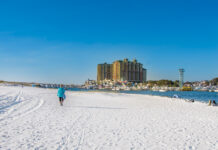

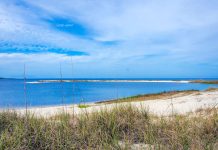
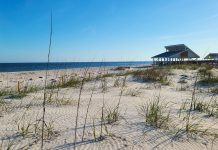
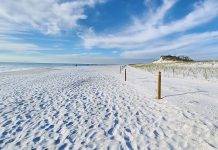
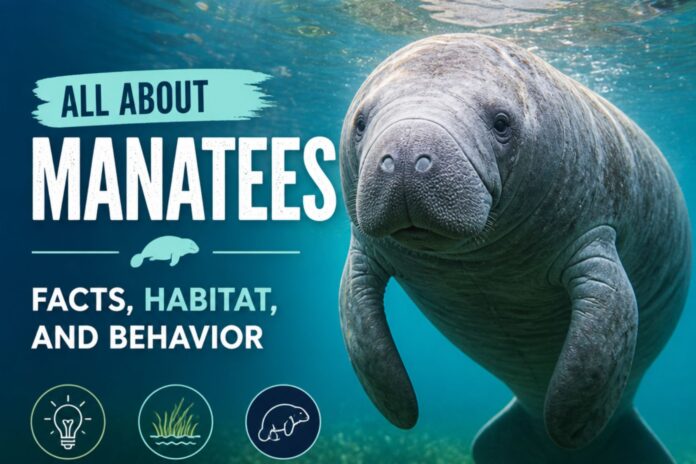
Manatees don’t live on the beach the way a shorebird or a ghost crab does, but almost every stretch of Florida sand I’ve ever walked has a manatee waterway hiding just behind it, a pass, an inlet, a spring run, a bay you can see from the parking lot.
I’ve swum with manatees more than once in the springs of central west Florida, and I still haven’t found the words that do it justice, so I’m going to try again anyway. The water there runs a constant 72 degrees, clear enough to see thirty feet in any direction, and somewhere in that blue a shape the size of a small car will materialize out of nowhere, moving so slowly it barely seems to be moving at all. Florida is, without question, the easiest place on Earth to have that exact experience. No other state, no other country, hands you a legal, ethical, in water encounter with a wild sea cow the way Florida does.
Meet Florida’s Manatee
The animal gathering by the hundreds in Florida’s springs every winter is Trichechus manatus latirostris, the Florida manatee, a subspecies of the West Indian manatee found almost nowhere else on Earth in these numbers. The most recent statewide count, based on aerial surveys, put the population at roughly 9,790 manatees, with a credible range of 8,350 to 11,730, split fairly evenly between the west coast and east coast populations. That’s a real recovery story. When aerial surveys began back in 1991, the minimum count was only 1,267 animals statewide.
The Florida manatee is currently listed as a threatened species under the Endangered Species Act, downlisted from endangered in 2017 after decades of protection and recovery work. As of this writing, the U.S. Fish and Wildlife Service has proposed formally separating the West Indian manatee into two distinct listings, the Florida manatee staying threatened and its Caribbean cousin, the Antillean manatee, being reclassified as endangered. That proposal followed years of advocacy from groups pushing for Florida manatees to get the same upgrade, especially after a brutal unusual mortality event tied to seagrass collapse in the Indian River Lagoon killed over 1,255 manatees between December 2020 and April 2022. Federal wildlife officials determined the population has since stabilized enough to keep the current threatened status, though as I’ll get into further down, that stabilization is fragile and depends entirely on what happens to the water manatees actually live in.
Why They All Come Here Every Winter
Manatees carry almost no insulating body fat, which for a nine to thirteen foot, thousand pound animal seems almost unfair, but there it is. Once the surrounding water drops below roughly 68 degrees Fahrenheit, a manatee is at real risk of cold stress syndrome, a slow, cumulative condition that weakens the immune system, causes skin lesions, and can turn fatal if exposure drags on. So every fall, as Florida’s rivers and coastal waters start to cool, manatees statewide start moving toward the same handful of places: natural artesian springs that hold a rock steady 72 degrees year round no matter the season, and the warm water discharge canals of a dozen or so power plants around the state.
That second category exists almost by accident. Coastal power plants historically drew in seawater to cool their systems and discharged it several degrees warmer, and to a manatee, a steady plume of 80 degree discharge water is functionally indistinguishable from a spring that never runs dry. Manatees adopted these industrial warm water sites decades ago, taught the route from mother to calf the same way they learned natural springs, and today the Florida Fish and Wildlife Conservation Commission estimates close to two thirds of the state’s entire manatee population depends on artificial warm water sources to survive winter. It’s an uneasy, entirely human made safety net, and as Florida’s power grid shifts away from the plants that created it, figuring out what replaces that warmth for hundreds of thousands of collective manatee winters is one of the real unresolved questions in manatee conservation right now.
Why the Sand Matters Here Too
If you’ve read anything else I’ve written about sand, you know I could talk about grain size and color for an unreasonable length of time, so here’s the short version as it applies to manatees. Seagrass, the plant a manatee spends six to eight hours a day eating, is a true flowering plant with real roots, and those roots need to anchor into something. That something is almost always fine sand or soft silt, spread across a shallow seafloor shallow enough for sunlight to actually reach the blades. Change the sand, and you change whether seagrass can grow there at all. That’s the quiet, unglamorous reason nearly every manatee hotspot on this list sits above the exact same recipe: soft bottom, shallow water, clear light, and a steady source of warmth in winter. The sand under the water turns out to matter every bit as much as the sand under your feet.
The Big Bend & Nature Coast Springs
Manatees are the headline act on this stretch of coast, and the sand under the water is a big part of why.
Crystal River & Kings Bay
Citrus County’s Kings Bay, the waterway behind Crystal River, is spring fed and holds at a steady 72 to 74 degrees, with a soft, pale, sandy bottom that lets sunlight reach the seagrass meadows manatees graze on all winter.
Established in 1983 specifically to protect the Florida manatee, the Crystal River National Wildlife Refuge is the only refuge in the entire national wildlife refuge system created for this one species, and it’s also the only place in the United States where the U.S. Fish and Wildlife Service permits supervised, in water swimming with wild manatees.
Three Sisters Springs, the crown jewel inside the refuge, is where most of that happens. From November through March, hundreds of manatees pack into the spring’s clear, shallow basin, and licensed local tour operators run guided snorkel trips that put you in the water alongside them under strict federal guidelines. The rule everywhere in Kings Bay is passive observation: you float, you watch, you let a manatee choose to approach you, and you never chase, corner, straddle, or grab one, even a curious one that comes within arm’s reach. Paddle craft can enter Three Sisters Springs on their own from April through mid November, but in water access can be closed by the refuge at any time conditions call for it, so always check current status before you go. I’ll be honest, the crowding here has grown enough in recent years that longtime local operators have raised real concerns about enforcement keeping pace with tourism, so book with an operator who visibly prioritizes the manatees’ comfort over cramming in more swimmers, and treat every rule like it exists for a good reason, because it does.
Homosassa & Springs in the Big Bend
A few miles south, the Homosassa River carries the same clear, spring fed water and the same sandy floor down to the Gulf, and the Chassahowitzka and Weeki Wachee Rivers just north and south of it offer quieter, less crowded versions of the same experience for anyone paddling in winter.
A short drive from Crystal River, Ellie Schiller Homosassa Springs Wildlife State Park gives you a different kind of access entirely: a floating underwater observatory that lets you look directly into the spring basin without getting wet at all. The park also runs an active manatee rehabilitation program, meaning some of the animals you’ll see are permanent residents recovering from injury, alongside wild manatees that use the spring’s headwaters as a winter refuge on their own schedule. It’s a wonderful option for families, non swimmers, or anyone who wants a guaranteed, nose to glass manatee encounter without a wetsuit.
Further up toward the Big Bend, the Suwannee River’s Manatee Springs and the grass beds around Wakulla Springs and Apalachicola Bay round out one of the most consistently productive manatee coastlines anywhere in the state, sand, spring, and seagrass working together exactly the way they’re supposed to.
Tampa Bay
Manatees spread out across Tampa Bay’s shallow, seagrass rich flats for most of the year, then concentrate hard around the bay’s warm water discharge sites once winter arrives. Apollo Beach, on the bay’s eastern shore, sits beside the discharge canal that draws hundreds of manatees to the TECO Manatee Viewing Center on the coldest days of the season, and the sandy, gently sloping flats just offshore hold seagrass beds thick enough to support them the rest of the year. Across the bay, the barrier beaches of St. Petersburg and Clearwater sit above bayside waterways, like Boca Ciega Bay, that see manatees moving through on their way to warmer refuges each winter, even though the Gulf beach itself is a less likely spot for a sighting than the calmer water behind it.
Southwest Florida
Charlotte Harbor, Sarasota Bay, and the barrier islands strung along them holds manatees year round rather than just in winter, since the bays here stay mild and are genuinely thick with seagrass growing in soft, sandy bottom sediment. Behind Lido Key, the mangrove edged shallows of Sarasota Bay are a dependable spot for a paddling sighting, and just south, Siesta Key‘s bayside waters around the Jim Neville Marine Preserve turn up manatees regularly among the same sandy grass flats famous for the key’s quartz sand beach on the Gulf side. Sarasota’s Phillippi Creek, feeding into the bay from the mainland, is a quiet, narrow, low boat traffic spot worth checking from shore.
Further south, Charlotte Harbor and the barrier islands around Boca Grande, Sanibel, and Captiva sit above one of the richest seagrass systems on the Gulf coast, and manatees follow the fresher water up the Myakka and Peace Rivers into the harbor during summer’s higher rainfall. Near Fort Myers, Lovers Key State Park and the Orange River behind Manatee Park round out one of the most reliable manatee regions in the entire state, sandy passes and grass beds stitched together mile after mile.
Blue Spring State Park
Up on the St. Johns River in Orange City, Blue Spring State Park is the polar opposite kind of manatee experience, but every bit as powerful. This first magnitude spring pumps a constant 72 degree flow into the river, and from mid November through mid March, the entire spring run is closed to all water activity, swimming, snorkeling, paddling, all of it, to give wintering manatees complete, undisturbed refuge. You watch from a network of boardwalks and overlooks instead, which sounds like a consolation prize until you’re standing above water clear enough to count individual manatees resting nose to tail below you. Blue Spring set a park record of 932 manatees counted in a single January morning during a hard cold snap, and mornings in the several hundreds are common through peak season. Outside manatee season, roughly April through October, the spring run reopens for swimming, tubing, and snorkeling, and any manatee still around at that point gets the same hands off respect as always.
The Space & Treasure Coast
The Indian River Lagoon, running along Florida’s Atlantic side from Titusville down through Vero Beach and Fort Pierce, is the single most important manatee corridor on the east coast, and also the most fragile, since it was the epicenter of the seagrass collapse behind the 2020 to 2022 mortality event. At Merritt Island National Wildlife Refuge, an observation platform overlooking Haulover Canal near Titusville regularly delivers reliable sightings connecting the Indian River to Mosquito Lagoon. Just south, the Cape Canaveral area power plant discharge canal has recorded as many as a thousand manatees in a single cold snap, among the largest gatherings of the species anywhere in the state. Further down the coast, Fort Pierce’s Manatee Observation and Education Center and Vero Beach’s Round Island Beach Park both offer easy, low key public viewing along the same lagoon system.
Southeast Florida
Manatees follow the Intracoastal Waterway and its connected lagoons all the way down this coast, moving between beach towns most visitors never associate with sea cows. Riviera Beach, behind the barrier island beaches of Palm Beach County, sits beside the Lake Worth Lagoon and its warm water power plant discharge, drawing manatee crowds every winter to the free Manatee Lagoon observation deck. Further south, the canals and waterways behind Fort Lauderdale’s beaches see manatees moving through the same Intracoastal system, particularly in the cooler months, and Jupiter’s inlet and the Loxahatchee River both hold resident populations feeding on grass beds in the sandy shallows just inland from the sand people actually sunbathe on.
Miami & the Keys
Even Florida’s biggest, busiest coastline hasn’t pushed manatees out. Biscayne Bay, just behind the beaches of Key Biscayne and Virginia Key, holds a resident population that shows up reliably for anyone paddling its shallow, sandy grass flats, and Oleta River State Park, tucked along the mangrove creeks north of Miami Beach, is one of the most dependable urban sighting spots in the entire state. During cold snaps, manatees push further into the city’s canal system, gathering at spots like the Little River Dam and the Deering Estate’s boat basin. Heading south into the Keys, the grass flats around Islamorada and the backcountry of Florida Bay hold manatees year round, grazing the same soft sand bottom seagrass meadows that make the Keys’ famously clear water clear in the first place.
The Power Plant Trio
Three warm water discharge sites have become genuine manatee institutions, all of them free, all of them land based, no boat or wetsuit required. The TECO Manatee Viewing Center in Apollo Beach sits beside Tampa Electric’s Big Bend Power Station and can draw a hundred fifty to three hundred manatees on a cold day, viewable from elevated platforms and a tidal boardwalk. Manatee Lagoon, an FPL eco discovery center in Riviera Beach, sits beside the utility’s Next Generation Clean Energy Center and offers an observation deck over the Lake Worth Lagoon along with hands on exhibits, completely free to visit. And Manatee Park in Fort Myers, run by Lee County, overlooks the Orange River near an FPL discharge canal and adds a kayak launch if you’d rather get out on the water yourself once the manatees have thinned out for the season. All three run their heaviest crowds from roughly November through March, and all three are places where you should expect to look but never touch.
The Panhandle
Manatees are seasonal visitors here rather than year round residents, mostly showing up in the warmer months and following the coast west from the peninsula. Along Perdido Key, small groups have been turning up more often in recent summers in the calm, grassy water of Big Lagoon and the Intracoastal Waterway on the bay side of the island, drifting along docks and shoreline seagrass beds that most beachgoers never even glance at from the Gulf side. Further east, Panama City’s St. Andrews Bay and the grass flats around Choctawhatchee Bay see similar warm season sightings. This isn’t reliable, guaranteed manatee territory the way central Florida is, so treat any sighting here as the genuine, lucky bonus that it is.
The Rules I Don’t Bend On
Manatees are protected in Florida by three separate layers of law, the federal Marine Mammal Protection Act, the Endangered Species Act, and the state’s own Florida Manatee Sanctuary Act, and the rules that come out of all three boil down to the same handful of things every single time. Never touch, chase, corner, ride, or feed a manatee, even one that swims right up to you, since teaching a wild manatee to seek out human contact makes it more likely to end up scarred by a boat propeller later. Give a resting or nursing animal real distance. If you’re boating anywhere near a manatee zone, especially shallow seagrass flats or a spring run, slow down before the signage tells you to, not after, since boat strikes remain one of the single leading causes of manatee death in this state every year. And if you come across a manatee that looks sick, injured, entangled, or dead, don’t attempt to handle it yourself. Call the FWC Wildlife Alert Hotline at 888-404-3922, available around the clock, and let trained responders take it from there.
Who’s Protecting Florida’s Manatees
Save the Manatee Club, headquartered in Longwood and founded in 1981 by Jimmy Buffett and former Florida governor Bob Graham, funds rescue, rehabilitation, research, and public education statewide, and its Adopt-A-Manatee program lets anyone symbolically adopt a real, named, tracked manatee for as little as twenty five dollars a year. The U.S. Fish and Wildlife Service manages the Crystal River National Wildlife Refuge and enforces federal manatee protection rules across the state, while the Florida Fish and Wildlife Conservation Commission runs the state’s rescue network, aerial population surveys, and mortality investigations. The Clearwater Marine Aquarium operates one of the state’s critical care and rehabilitation facilities for injured and orphaned manatees, and the St. Johns River Water Management District works to protect the spring flow at sites like Blue Spring that manatees depend on every winter. Add to that the volunteer network at Friends of Blue Spring State Park, quietly counting manatees at dawn every cold morning of the season, and you’ve got a genuinely deep bench working on behalf of one animal.
Where Things Stand Right Now
The honest picture is better than it was five years ago, but nowhere near settled. The Indian River Lagoon’s seagrass driven mortality event that killed over 1,255 manatees between late 2020 and early 2022 was formally closed in March 2025 after mortality numbers returned to expected background levels, and the last confirmed starvation death linked to that specific event was documented back in March 2023. Statewide manatee deaths have hovered in the mid five hundreds for the past few years, 555 in 2023, 565 in 2024, with a modest uptick through most of 2025, numbers conservationists describe as concerning but not the runaway crisis of a few years ago. Water quality, and specifically the health of Florida’s seagrass meadows, remains the entire ballgame. Manatees don’t die because they’re inherently fragile. They die when the sandy, sunlit meadows that grow their food get smothered by algae fed by fertilizer runoff, leaking septic systems, and stormwater, which is really a story about us managing our own water better, not about the manatees changing anything at all.
Questions I Get All the Time
Is Crystal River really the only place you can legally swim with manatees?
Yes, in the entire United States. It’s specifically permitted there under federal guidelines because of the refuge’s unique history and management. Everywhere else in Florida, including Blue Spring and the power plant viewing centers, is look but don’t touch, no exceptions.
What do I do if a manatee approaches me while I’m in the water?
Stay still and let it come to you if it wants to. Don’t reach out, don’t chase it if it moves away, and don’t try to guide it anywhere. The whole idea of passive observation is that the manatee is making every choice, not you.
When’s the best time to see the most manatees at once?
Cold snaps, plain and simple. The coldest mornings of the winter, usually January and February, push the highest numbers into the warm water refuges, which is exactly when Blue Spring and Crystal River set their record counts.
Do manatees bite or pose any real danger to swimmers?
No. Manatees are herbivores with no interest in you whatsoever beyond mild curiosity, and there’s no documented case of one seriously hurting a person. The only real safety concern in the water is accidentally startling one or getting between a mother and her calf.
Why do so many manatees have scars on their backs?
Boat propellers, almost always. Researchers actually use each manatee’s unique pattern of propeller scars the way you’d use a fingerprint, to identify and track individual animals over years or even decades.
Thoughts & Reflections
There’s a particular kind of quiet that only exists underwater next to something enormous and completely at peace. I’ve chased plenty of things in my life, deadlines, reinventions, a version of myself I thought I was supposed to become faster than I actually could. A manatee has never once chased anything in its life except maybe a mate, unhurried, it didn’t need me to notice it to keep existing exactly as it was. It just kept drifting, entirely unbothered, entirely itself, while I floated there rearranging my whole idea of what a good pace for living actually looks like.
