









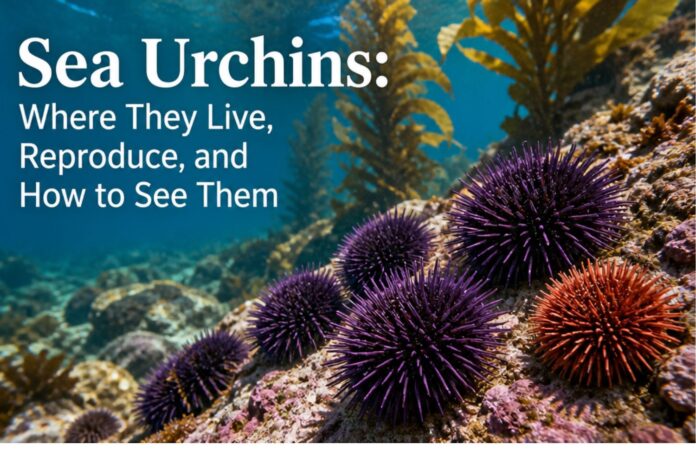
If you love warm sand between your toes, the sparkle of shallow water, and the tiny dramas unfolding along the shoreline, sea urchins are one of the beach’s most fascinating characters. These spiky little echinoderms may look like simple round balls with thorns, but they are wonderfully complex animals with a long evolutionary story, a global range, and a surprising role in coastal ecosystems.
They’re not just beach curiosities. They’re living reminders that the sea is full of clever designs.
A sea urchin looks like a pincushion that lost an argument with the ocean, and I mean that with love. Under all those spines is one of the most important grazers on any reef or rocky shore. When urchins are in balance, reefs and kelp forests thrive. When they are not, whole underwater landscapes change. I never step toward the water without checking where my feet are going, and urchins are one big reason.
What Is a Sea Urchin?
A sea urchin is a round, spiny echinoderm, a cousin of sea stars, sand dollars, and sea cucumbers. The word “echinoderm” comes from Greek roots meaning “spiny skin,” which is fitting for these armored little grazers. Its body is a hard shell called a test, and the spines grow out of it on small ball and socket joints, so each one can swivel. Between the spines are hundreds of tube feet that reach out past the tips, and tiny pincer shaped organs called pedicellariae that keep the shell clean and, in a few species, carry venom.
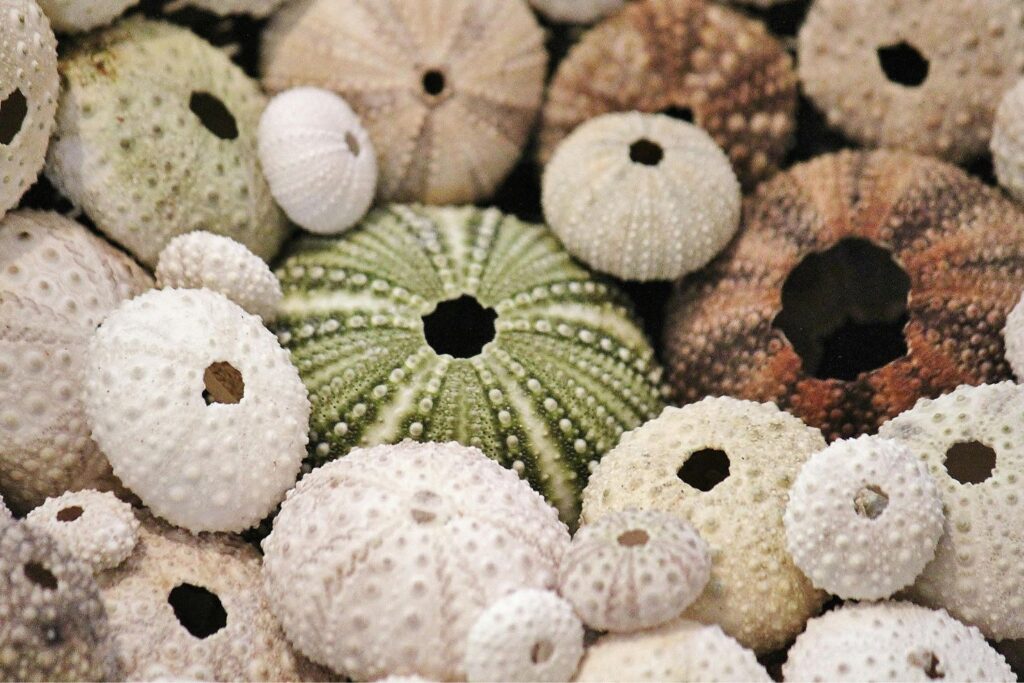
Like all echinoderms, urchins show five part symmetry, which you can see on the shell of a dead one as five neat bands. They have no brain, only a ring of nerves, and they can sense light and touch all over their bodies.
How Many Species of Sea Urchins Are There?
Scientists count more than 900 species, living in every ocean from tide pools to deep trenches. Here are the ones you are most likely to meet on the beaches and reefs I write about:
- Longspine urchin, Diadema antillarum: black, with spines that can reach over a foot. It is a vital reef grazer in Florida and the Caribbean.
- Variegated urchin, Lytechinus variegatus: a smaller, greenish to purple urchin of Florida seagrass beds and sandy flats, famous for covering itself in shell bits and grass.
- West Indian sea egg, Tripneustes ventricosus: a dark, short spined urchin of Caribbean seagrass, eaten as a delicacy on some islands.
- Rock-boring urchin, Echinometra lucunter: a reddish brown urchin that carves its own little pocket in limestone along the Florida and Caribbean shore.
- Slate pencil urchin, Eucidaris tribuloides: thick, blunt spines that look like pencils, found on Florida and Caribbean reefs.
- Purple sea urchin, Strongylocentrotus purpuratus: the tide pool urchin of the Pacific coast.
- Red sea urchin, Mesocentrotus franciscanus: the big Pacific urchin that can live for many decades.
- Green sea urchin, Strongylocentrotus droebachiensis: a northern species of both the Atlantic and the Pacific.
- Atlantic heart urchin, Moira atropos: the burrower of Florida’s sandy bottoms, covered in soft, hair like spines.
How Do Sea Urchins Move?
On tube feet, with the spines helping. Hundreds of tiny tube feet, each with a sucker on the end, stretch out and grab the bottom while the spines push and pivot, which lets an urchin walk in any direction without turning around. Some cover themselves with shells and bits of seagrass for camouflage and shade. Rock-boring urchins hardly move at all. They wear a snug hole into the limestone with their spines and teeth and spend life there, coming out only to graze. The longspine urchin moves more than you would expect for something shaped like a ball of needles, and it swings its spines toward a shadow or a hand that comes close, which is a good reason not to reach.
What Do Sea Urchins Eat?
Mostly algae, and the sea urchin’s mouth is one of nature’s best tools for getting it. Five hard teeth in a structure called Aristotle’s lantern scrape algae off rock and coral. Many urchins also eat seagrass, kelp, and the occasional dead animal. On a healthy reef this grazing keeps the coral from being smothered by fast growing algae. On the Pacific coast, urchins eat kelp. Their numbers are normally held in check by predators like sea otters and sunflower sea stars, and when those predators disappear, urchins can multiply and chew kelp forests down to bare rock, creating what scientists call an urchin barren. Along parts of California’s coast this has happened to the bull kelp forests.
How Do Sea Urchins Reproduce?
By spawning. Male and female urchins release sperm and eggs into the water, often at the same time, and fertilized eggs become tiny free swimming larvae that drift in the plankton for weeks. Eventually they settle on the bottom and change into small urchins. Because urchins spawn in the open water, they need to live close together to succeed, and this is one reason Diadema struggles to come back after die-offs. The animals simply end up too far apart. The edible part of an urchin, called uni in sushi restaurants, is the animal’s gonads, which is why urchin fisheries focus on healthy, ripe animals.
Sea Urchins and Sand: The Sand Makers
Here is my favorite sand fact in the whole echinoderm series. Urchins make sand. Rock-boring urchins and longspine urchins scrape and grind limestone and coral as they graze, and the fine bits they release become part of the sediment on the bottom. Add parrotfish and waves, and you have the recipe for the soft white sand of a tropical beach. Urchins are not the only sand makers, but they are one of the quiet ones. Then there are the sand dwellers. Variegated urchins and sea eggs live on sandy seagrass flats, and they decorate themselves with shell pieces and blades of grass, as if they were wearing a little disguise. Heart urchins go all the way and burrow, spending their days just below the surface in clean sand and leaving a small dimple behind. A dead heart urchin test on the beach looks like a pale, fragile egg with a pattern on top, and the sand it came from is the sand I keep telling you to pay attention to.
Where to See Sea Urchins Around the World (and the Rules for Each)
Sea urchins have a nearly worldwide distribution. They live in most marine regions, from warm tropical waters to cool temperate seas. Common global regions include:
- The Pacific Ocean, including the coasts of North and South America, Japan, Australia, and island chains across the tropics
- The Atlantic Ocean, especially rocky coastlines and reefs
- The Indian Ocean, where tropical reef species are common
- The Mediterranean Sea, where sea urchins are often seen on rocky shores
- Polar and subpolar waters, where certain species survive in colder environments
Different species have different preferences. Some thrive in shallow sunlit reefs, while others prefer deeper or darker habitats. A few are famous for their role in controlling kelp forests, where too many urchins can overgraze and create what marine ecologists call an urchin barren.
Popular places around the world where sea urchins are commonly seen include:
Florida and the Florida Keys
Look for variegated urchins on seagrass flats and sandy shallows, rock-boring urchins on limestone ledges and jetties, and longspine urchins under ledges on the reefs, especially at night. The longspine urchin, Diadema antillarum, is a species of special concern here. Harvest of longspine urchins is prohibited in Florida, and the rules for other urchins fall under the state’s marine life regulations, so check the FWC’s sea shell page before bagging anything. Sand dollars and sea biscuits are treated separately from urchins in those rules. The Florida Keys National Marine Sanctuary protects living animals within its boundaries.
The Caribbean
Diadema once blanketed Caribbean reefs. In 1983 and 1984 a mysterious disease killed the vast majority of them across the region, and the reefs that lost their grazers were overgrown with algae. Populations are slowly returning in some places, and in 2022 another die-off hit across the Caribbean, which is a hard reminder of how fragile the recovery is. Snorkeling over a reef where Diadema has returned is a sight worth seeking, and the island you visit may have local rules or guides who know where to go.
Panama
Urchins are part of the reef community around Panama’s Caribbean islands, and the best way to see them is the way you see everything else there: from the water, from a boat or a snorkel. Bocas del Toro’s reefs and seagrass beds are home to several species. Ask your boat captain about the best spots, and keep your hands off the bottom.
The Pacific Coast: Washington, Oregon, and California
Purple urchins fill tide pools from Washington to Baja, and red urchins live in deeper water and in kelp forests. Urchins are the center of a big conservation story here. As sunflower sea stars declined from wasting disease and sea otters were absent from much of the range, purple urchins multiplied and helped strip bull kelp forests along parts of Northern California. Rules vary by state. Washington and Oregon protect tide pool animals and regulate urchin harvest, and California requires a fishing license for recreational take and bans all collecting in marine protected areas. The agencies below have the current regulations.
The North Atlantic and Beyond
Green sea urchins are common in cold, rocky waters in the northern Atlantic and parts of the Pacific, and urchin fisheries operate in Maine, Japan, Chile, and elsewhere. Sea urchin is a serious delicacy in many countries. If you travel for it, remember that your plate is a wild population, and ask where it came from.
If you want to spot sea urchins in the wild, the best places are often:
- Tide pools at low tide
- Rocky shorelines
- Clear reef flats
- Kelp forests on snorkel or dive trips
- Protected marine reserves
- Calm lagoons and bays with healthy underwater life
Some of the best viewing comes from snorkeling in tropical reef areas or from peering carefully into tide pools during low tide. Early morning or late afternoon can be especially good, when the light is beautiful and the water is calmer.
Touching or Collecting: The Rules to Know
Sea urchins are beautiful, but they are not souvenirs, and they should be treated with care.
Do not touch unless you know it is safe
Some species have sharp spines or tiny pedicellariae, which are little jaw-like structures that can pinch or irritate skin. Even harmless-looking urchins can cause painful punctures.
Never pry them from rocks or reefs
Removing a sea urchin can injure the animal and damage the habitat. If it is attached to a rock or wedged into a reef, leave it alone.
Do not collect live animals
In many places, it is illegal to collect marine life without a permit. Even where it is allowed, local rules may protect certain species or limit removal from marine parks and protected areas.
Respect local regulations
Before taking shells, tests, or dried urchins from beaches, check the rules. Some areas allow collecting empty shells only. Others ban removal entirely to protect ecosystems.
Best practice: observe, photograph, and move on
The most beach-loving approach is the simplest one: admire sea urchins where they belong. A photo makes a great memory, and the urchin gets to keep doing its important ocean work.
What Happens If Touch or You Step on One
Do not touch them, and watch your feet. Urchin spines are brittle and can break off in skin, causing painful puncture wounds. Longspine urchin spines are especially nasty, and a few tropical species carry venom in their pedicellariae or spines. If you are stuck, remove any visible spines carefully with tweezers, wash the area well, and see a doctor if it is swollen, deep, or in a joint. Soaking in hot water, as hot as you can stand without burning, is the standard first aid advice for many marine spine injuries. For the urchin, being handled can mean losing spines and being pulled from the rock or reef it needs. Wear water shoes in rocky shallows, shuffle your feet, and keep your hands to yourself.
Why Protect Sea Urchins
Sea urchins are more than spiky beach oddities. They are key players in coastal ecosystems. By grazing on algae, they can help prevent overgrowth and support balance in reefs and kelp forests. At the same time, too many urchins in one place can strip away vegetation, showing how delicate marine systems can be.
They are also a reminder that the shoreline is alive with hidden stories. Under the glittering waterline, the sand and rocks are home to creatures that have been perfecting their survival for millions of years.
Who’s Protecting Sea Urchins
The longspine urchin is a focus of reef restoration. Researchers at the University of Florida’s IFAS and partners in the Keys have worked on raising and returning Diadema to reefs, a slow but promising effort. The Florida Fish and Wildlife Conservation Commission prohibits Diadema harvest, and the Florida Keys National Marine Sanctuary protects the reef habitat they depend on. On the Pacific coast, The Nature Conservancy and many partners are working on kelp restoration and urchin management, and the IUCN Red List tracks species at risk.
Sea Urchin Curiosity Corner
Are sea urchins dangerous?
They are not aggressive, but stepping on one can cause painful puncture wounds, and a few tropical species have venom. Wear water shoes and look before you step.
What do sea urchins eat?
Mostly algae, along with seagrass, kelp, and dead animals. They scrape food off rocks with five teeth in a structure called Aristotle’s lantern.
How do sea urchins move?
They walk on hundreds of tube feet and use their spines to push and pivot, which lets them travel in any direction without turning.
How do sea urchins reproduce?
By spawning. Males and females release sperm and eggs into the water, and the fertilized eggs become swimming larvae that later settle on the bottom as tiny urchins.
How many species of sea urchins are there?
More than 900 species are known worldwide.
Can you touch a sea urchin?
Better not to. The spines can break off in your skin, and handling or pulling an urchin from its rock can hurt it. Look and photograph instead.
What should I do if I step on a sea urchin?
Remove visible spines carefully with tweezers, wash the area, and soak in hot water you can tolerate. See a doctor if it is swollen, deep, near a joint, or showing signs of infection.
Is it legal to take a sea urchin in Florida?
Harvesting the longspine urchin is prohibited. Other urchins fall under Florida’s marine life rules and park or sanctuary regulations, so check before you collect anything living.
Why are sea urchins important?
They graze algae, which helps coral reefs stay healthy, and they can also overgraze kelp forests when their predators are gone. They are a barometer for the health of an ecosystem.
Do sea urchins make sand?
In a small way, yes. Urchins that scrape and bore into limestone and coral release fine particles that become part of the sediment on the sea floor.
