




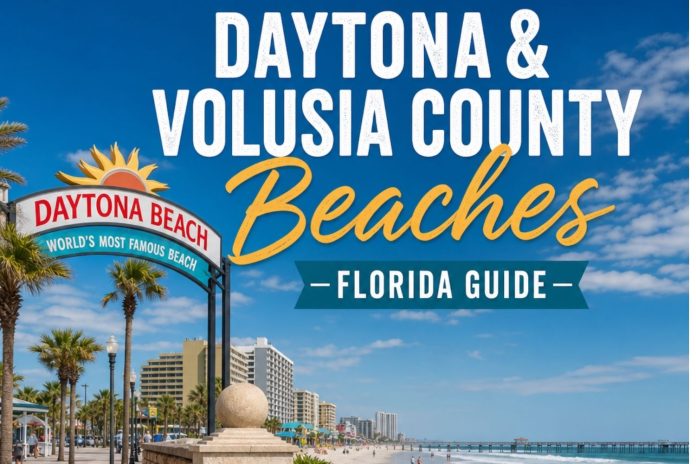
Daytona Beach, Florida
Daytona Beach gets called the World’s Most Famous Beach, and after walking every mile of it more times than I can count, I can tell you the sand under your feet actually earns part of that reputation, even if the town around it doesn’t always live up to the postcard. This is the beach where you can still drive a car onto the sand and park facing the water, and that alone makes it unlike almost anywhere else I’ve walked in Florida.
Daytona Beach runs about 23 miles along Florida’s Atlantic coast, part of a barrier island shared with Ormond Beach to the north and Daytona Beach Shores and Wilbur-by-the-Sea to the south. What separates it from nearly every other beach in this state is what’s under your feet. The sand here compacts hard enough to drive on, and Daytona has been letting cars onto that sand since before Daytona International Speedway existed, since the beach itself was the racetrack.
In this guide I’m walking you through the different stretches of this beach, from the boardwalk center out to the quieter residential edges, going deep on what makes this sand behave the way it does, scoring it honestly across every category that matters, and telling you exactly who this beach actually suits. I’ll cover the pier, the driving zones, the family splash park, exactly where you can and can’t bring your dog, and the stretches south of the crowd where I’ve stayed myself. For more on what lives in this sand and what you might find washed up, I’ve also written a birding guide and a beach finds guide for this stretch. I close with what this beach means to me personally, since this is one of the few beaches on my list I knew long before I started walking Florida’s coastline for a living.
The Vibe & Culture at Daytona Beach
A Racing Town That Happens to Sit on a Beach
Daytona Beach doesn’t feel like most Florida beach towns, and the reason traces straight back to the sand itself.
Long before Daytona International Speedway was built, drivers raced automobiles directly on the hard-packed sand here, going back to 1902 when the beach itself was the track. That history never left. You’ll still see the culture in the driving lanes marked out on the sand today, in the motorcycle roar that takes over the whole town every Bike Week in late February and early March, and in a beachfront population that treats speed and engines as part of the local identity rather than something separate from it.
That said, the beach itself has quieter registers than the racing reputation suggests. The center of the island, around the Main Street Pier and the boardwalk, carries the energy you’d expect: arcades, thrill rides, live music at the historic Bandshell, and a crowd that skews loud, young, and constantly moving. Head north toward the Ormond Beach line or south past Daytona Beach Shores into Wilbur-by-the-Sea, and the volume drops fast. Condo towers give way to smaller motels and private homes, the crowd thins to locals and repeat snowbirds, and the beach starts to feel like a place people actually live rather than a place built purely for a weekend.
Seasonally, this beach runs on a calendar dictated by events more than weather. Bike Week in late February through early March brings roughly half a million riders into a town of about 60,000 people, and Spring Break has followed close behind it for decades. Summer is peak beach season for families, with free Bandshell concerts running from late May through September. Fall and winter bring Biketoberfest in mid October and a noticeably calmer, cooler stretch of beach walking once the events crowd clears out, which is honestly my favorite time to be here.
Daytona Beach Areas: Six Distinct Stretches Along the Sand
Daytona Beach is not one uniform strip, it changes character block by block as you move along Atlantic Avenue and A1A. Here’s how it actually breaks down, north to south, and what you’ll find at each stop.
The Boardwalk, Main Street Pier & Bandshell
Island Center · Paid Off-Beach Parking
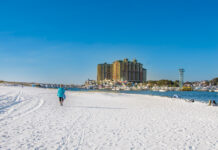
The first thing you notice arriving at the center of Daytona Beach is how wide the sand gets right where the crowd is thickest. The beach in front of the Main Street Pier stretches out generously, hard-packed and flat enough that families set up entire camps of chairs, coolers, and umbrellas without crowding their neighbors. The pier itself runs roughly 1,000 feet into the Atlantic, and walking it puts the whole scene in perspective, arcade lights and the Bandshell’s coquina shell curves on one side, open ocean on the other.
This is where you’ll find the classic Daytona crowd: families up from Orlando for the day, spring breakers when the calendar allows it, anglers working the pier rail for pompano, whiting, and the occasional small shark, and street performers working tips along the boardwalk. It’s a genuinely active stretch, not a quiet one, and the sand takes heavier foot and vehicle traffic here than anywhere else on the beach.
I’ll be honest with you, the boardwalk itself has seen better days. Parts of it feel worn, a few storefronts sit empty, and the crowd can turn rowdy after dark, especially during Bike Week or Spring Break. I still come here for the Bandshell concerts in summer and to watch the anglers work the pier at sunset, but if you want the version of this beach you’ll actually want to remember, don’t stop here.
Sun Splash Park & Breakers Oceanfront Park
Just North of the Pier · Free Splash Park
A short walk north of Main Street Pier, the beach opens into a stretch built specifically around families with young kids. Breakers Oceanfront Park runs a 2.5 acre beachfront space with a children’s splash fountain, volleyball courts, and a playground, while Sun Splash Park nearby adds another free water feature for kids who need a break from the surf.
The crowd here shifts noticeably younger than at the pier. Parents keep an eye on toddlers running through the fountain jets while older kids play volleyball on the sand, and the whole stretch has an easier, less chaotic feel than the boardwalk a few blocks south. It’s still busy in summer, but it’s busy in a manageable, family-oriented way rather than a bar-crowd way.
This is genuinely the stretch I point families toward when they ask where to base a beach day with young kids. You get the convenience of being minutes from the boardwalk without actually sitting inside its loudest hour, and the splash park buys you an extra hour of patience from a toddler who’s had enough of the waves.
The Beach Driving Zone
Multiple Access Ramps · Fee Applies
This is the feature that makes Daytona Beach different from almost every other beach in Florida, and it deserves its own stop on this list rather than a footnote. Along most of the beach, tide and season permitting, you can drive your own car directly onto the sand and park facing the ocean. The City of Daytona Beach’s official beach rules keep the speed limit at 10 miles per hour, require headlights on and at least one window down, and restrict driving hours to protect nesting sea turtles during the May through October season.
Non-residents pay a fee to drive and park on the beach, currently 30 dollars per vehicle per day or 150 dollars for an annual pass, while Volusia County residents can register for free access through the ParkVolusia program. You’ll find designated ramps up and down the island, and the driving lanes are clearly marked with posts, with parking allowed east of the conservation zone facing either the ocean or the dunes.
I still get a small thrill every time I drive onto this sand, even after walking this beach for years. There’s something about parking your own car ten feet from the surf that no boardwalk or pier can replicate, and it’s worth doing at least once even if you’d rather walk the rest of your visit. Just don’t try it in a front-elevated truck, those aren’t permitted, and pay attention to posted tide conditions before you commit to a spot.
North Beach Street & the Ormond Border
Quieter Residential Stretch · Toward Granada Boulevard
Walk or drive north from the pier area and the energy drops within a few blocks. Condo towers give way to older motels and low-rise beachfront homes, the crowd thins out fast, and by the time you’re approaching the Ormond Beach line the sand feels almost like a different beach entirely. The width and quality of the sand doesn’t change much here, it’s still the same hard-packed quartz, but the foot traffic drops enough that early morning walks along this stretch can go a long stretch without seeing another set of footprints.
You’ll find mostly locals here, and since December 2025 you’ll find dog owners too. A 1.7 mile stretch of this sand, running between Williams Avenue and Seabreeze Boulevard just north of the pier, opened as Daytona Beach’s first official dog beach, with six vehicle ramps, nearly 300 off-beach parking spaces, and two pedestrian walkovers. It joins Ormond Beach, Lighthouse Point Park, and Smyrna Dunes Park as the fourth leashed dog beach on this coast. Add in retirees on morning walks and a handful of repeat visitors who’ve figured out that staying a few blocks north of Main Street gets you the same beach with a fraction of the noise, and this stretch feels honest rather than glamorous, exactly the direction I’d point anyone who wants a quiet morning walk, dog in tow or not, without leaving the city of Daytona Beach entirely.
I’ve had some of my best early sunrise walks on this stretch, coffee in hand, watching the shorebirds work the wrack line before the rest of the island wakes up. If solitude matters more to you than convenience, this is the direction to walk.
Daytona Beach Shores
South of the Pier · Its Own Municipality
Cross south past Silver Beach Avenue and you’re technically in a different city, Daytona Beach Shores, even though the sand doesn’t announce the change. This stretch is dominated by direct oceanfront condo towers, many of them built in the 1970s through the 1990s, and the crowd here tends to be older, more residential, and less transient than the boardwalk area a mile or two north.
The beach itself stays wide and walkable, and because so much of the shoreline here is lined with residential condos rather than commercial storefronts, the overall feel is calmer even during peak season. You’ll still find beach driving access here, and Frank Rendon Park and other off-beach lots give visitors without a condo reservation somewhere to park.
This is the stretch I’d recommend to anyone who wants oceanfront convenience without boardwalk chaos. It’s not quiet in the way the far north end is quiet, but it’s calm in a settled, lived-in way that a lot of visitors don’t expect from the Daytona Beach name.
Wilbur-by-the-Sea
Far South End · Toward Ponce Inlet
Keep going south past Daytona Beach Shores and the development thins out again as you approach Wilbur-by-the-Sea, a small unincorporated beach community that sits right before the beach transitions toward Ponce Inlet. The buildings here are smaller and older, mostly single-family homes and low-rise duplexes rather than towers, and the beach itself feels noticeably less trafficked.
The crowd shrinks to almost entirely locals and longtime part-time residents. You won’t find arcades or splash parks here, just sand, surf, and a handful of quiet beach access points serving the neighborhood. It’s the kind of stretch you’d drive past without noticing unless you already knew it was there.
This is where the whole 23 mile stretch starts to feel less like an event and more like an actual coastline again, and I always end a Daytona Beach trip with a walk through here if I have the time.
Daytona Beach Rankings: Expert Scores Across 11 Categories
These scores weigh the full stretch of Daytona Beach as a whole, which means the energy and convenience of the boardwalk gets balanced against the genuine quiet you’ll find toward Wilbur-by-the-Sea and the north end near Ormond.
Sand Quality
7/10
Hard-packed quartz, tan to gold rather than sugar white, with patches of orange from iron-stained coquina shell. Not the softest sand in Florida, but genuinely excellent for walking and driving.
Hiking & Beach Walking
8/10
23 miles of flat, firm shoreline with almost no elevation change. Loses a point to quieter Atlantic beaches further south for uninterrupted solitude, since development runs the length of the island.
Shelling at Daytona Beach
4/10
Light and inconsistent. The Atlantic surf here doesn’t deposit shells the way calmer Gulf beaches do. Worth a look after a storm, not a reason to plan a trip.
Water Conditions
6/10
Greenish brown to blue depending on wind and swell, with real surf and real rip current risk. Always swim in front of a lifeguard tower, and know that Volusia County sees more shark bites than any other county in the country, mostly minor.
Scenery & Natural Beauty
6/10
Wide open Atlantic horizon and genuinely good sunrises, but a dense wall of condo towers lines much of the shoreline. The far north and south ends improve this score considerably.
Birding & Wildlife
6/10
Shorebirds along the wrack line, dolphins offshore on calm mornings, and sea turtle nests from May through October. Development along the developed center limits habitat compared to protected stretches further along this coast.
Family Friendliness
8/10
Sun Splash Park, Breakers Oceanfront Park, lifeguards on duty, and hard-packed sand that’s easy for little legs to walk on. The boardwalk’s late-night crowd is the one thing to plan around.
Dog Friendliness
7/10
A genuine change since December 2025. A 1.7 mile leashed dog beach now runs between Williams Avenue and Seabreeze Boulevard, joining Ormond Beach, Lighthouse Point Park, and Smyrna Dunes Park as the fourth true dog beach on this coast.
Solitude & Peace
3/10
This is one of the busiest, most event-driven beaches in Florida, and it shows most of the year. The north end and Wilbur-by-the-Sea offer real escape, but the center of the island rarely feels empty.
Entertainment & Nightlife
9/10
The boardwalk, the pier, the Bandshell’s free summer concerts, arcades, thrill rides, and an entire motorsports culture built around Bike Week, Biketoberfest, and the Daytona 500. Few Florida beaches compete with this on sheer activity.
Parking & Beach Access
8/10
26 beach access points, on-beach driving and parking at most ramps, and abundant off-beach lots. The daily driving fee and event-weekend crowds are the main drawbacks.
Daytona Beach Sand & Water
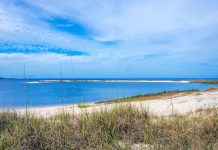
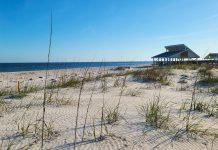
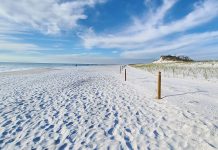
Daytona Beach’s sand is wide, flat, and famous for one reason: it’s hard-packed enough to drive a car on. You’ll notice that firmness the moment you step onto it, especially right at the waterline, where the sand stays solid and easy to walk on for miles without your feet sinking in. Up near the dunes and the driving lanes, the dry sand softens up a bit, soft enough for a proper sandcastle once you add water, but this isn’t a beach known for deep, powdery sand to sink your toes into. It’s a beach built for walking, biking, and driving in a straight line for as long as you want to go.
The water shifts with the wind more than with the calendar. On a calm day you’ll get a green-blue color and a manageable knee to waist-high surf, gradual to wade into, and comfortable enough for a real swim. Push in a storm system or a stiff onshore wind and it turns choppier and more brown-green within a few hours. Rip currents are a real and constant consideration here, not just an occasional warning, so always swim near a lifeguard tower and check the flags before you go in past your knees.
-
Walkability. Flat, hard-packed sand runs for miles. One of the easiest beaches in Florida for a long walk, a run, or a bike ride along the water.
-
Softness & Playability. Firm at the waterline, softer up near the dunes and driving lanes. Good for sandcastles once you add a little water, though this isn’t a deep-powder beach.
-
Barefoot Comfort. Comfortable most of the year right at the water’s edge. The dry sand near the boardwalk and driving lanes heats up enough by midday in summer to send you back toward the water.
-
Swimmability. Good in front of a lifeguard tower, with gradual entry and manageable surf on calm days. Rip currents are a real, ongoing risk elsewhere, so stick to guarded stretches when you can.
Want the full geology, grain composition, and the complete sand and water condition ratings? I broke it all down separately in Sand & Shore: Daytona Beach.
Dogs & Pet Accessibility at Daytona Beach
Are Dogs Allowed on the Sand? RESTRICTED.
Dogs are only allowed on one specific stretch of Daytona Beach’s sand. Everywhere else on the beach, pets are off limits outside of service animals.
Where Dogs Are Allowed
- ✓The 1.7 mile leashed dog beach running between Williams Avenue and Seabreeze Boulevard, just north of Main Street Pier, open since December 2025.
- ✓Six vehicle ramps and two pedestrian walkovers give you direct access to this stretch, with nearly 300 off-beach parking spaces nearby.
Where Dogs Are NOT Allowed
- ✗Every other stretch of Daytona Beach’s sand, including the boardwalk, Main Street Pier, and the beach driving zones further south toward Daytona Beach Shores and Wilbur-by-the-Sea.
- ✗Sun Splash Park and Breakers Oceanfront Park, both family beach areas without pet access.
Paws on the Ground Reality
Bring your own water for your dog, since there’s nothing set up specifically for pets along this stretch yet. The hard-packed sand that makes this beach so easy to drive on is just as easy on paws, firm enough that it stays comfortable near the waterline even though the dry sand further up can get hot by midday in summer. Volusia County has been serious about the leash and cleanup rules since this stretch opened, and rangers do check, so keep your dog leashed and pick up right away.
If you want a longer walk than the 1.7 miles here allows, the residential streets running north toward the Ormond Beach line make for an easy, shaded extension once your dog is ready to come off the sand.
Crowd Levels and the Overall Feel of Daytona Beach
Compared with quieter Atlantic beaches further south, like New Smyrna Beach, Daytona Beach runs distinctly busier, and it’s busier by design. This is an events town built around motorsports and Spring Break traditions going back generations, and the crowd tracks the calendar closely.
You’ll find a different beach depending on where you stand. Near the pier and boardwalk it’s day-trippers, families, and whoever’s in town for whatever event is running that week. Head toward Daytona Beach Shores and the crowd shifts to condo residents and repeat snowbirds. Out toward Wilbur-by-the-Sea or north near the Ormond line, it thins out to mostly locals on their morning walk.
The feel of this beach shifts more by event than by season, more than almost anywhere else I’ve walked in Florida:
- Bike Week (late February into early March): roughly half a million motorcycle riders descend on the town, Main Street becomes an open-air rally, and the beach itself gets noticeably busier with spillover crowds
- Spring Break (March): the traditional crowd this beach is famous for, energetic and loud, concentrated most heavily around the boardwalk
- Summer: peak family season, with Bandshell concerts every weekend and the warmest, most swimmable water of the year
- Biketoberfest (mid October): a smaller echo of Bike Week, followed by the calmest, most pleasant stretch of the year for walking the beach itself
Who Is Daytona Beach Really For?
✓ Who Will Love Daytona Beach
-
Anyone who wants to actually drive their car onto the sand and park facing the ocean, since very few Florida beaches still allow this
-
Families who want a boardwalk, arcades, a splash park, and a beach day all within walking distance of each other
-
Motorsports fans building a trip around Bike Week, Biketoberfest, or a Daytona International Speedway race weekend
-
Long-distance beach walkers who want miles of flat, hard-packed sand without worrying about soft patches
-
Surfers looking for genuine Atlantic wave action rather than calm Gulf water
-
Anyone chasing budget-friendly oceanfront lodging, since this stretch runs noticeably cheaper than beaches further south on this coast
-
Dog owners, now that a 1.7 mile leashed dog beach runs between Williams Avenue and Seabreeze Boulevard, a genuine change as of December 2025
✗ Consider Another Beach If…
-
You want genuine solitude on an Atlantic beach. Head to New Smyrna Beach or further south, since the center of Daytona rarely empties out
-
You’re bringing a dog and want off-leash freedom or beach access outside the designated stretch. The dog beach is leashed-only and limited to the Williams Avenue to Seabreeze Boulevard corridor
-
You’re a dedicated sheller chasing a high hit rate. This Atlantic stretch is light on shells compared to Gulf coast beaches
-
You want sugar-white, powder-soft sand. This is firm, functional quartz built for walking and driving, not the softest sand in the state
-
You’re nervous about sharks. Volusia County records more shark bites than any other county in the country, though the large majority are minor
-
You want to avoid crowds entirely during Bike Week or Spring Break, both of which push this town well past its everyday population
Things to Do at Daytona Beach, Florida
Daytona Beach gives you more built-in activity per mile of sand than almost any other Florida beach. Here’s what actually fills a day here beyond laying out a towel.
-
Beach Driving. Drive your own vehicle onto the sand at designated ramps and park facing the ocean, tide and season permitting. A 10 mile per hour speed limit applies, along with a daily fee for non-residents.
-
Beach Walking. Miles of firm, flat sand running the full 23 mile stretch of the island. Quietest and coolest in the early morning before the boardwalk crowd and beach traffic pick up.
-
Pier Fishing. The Main Street Pier draws anglers after pompano, whiting, bluefish, and the occasional small shark. No license required when fishing directly from the pier.
-
Surfing. Designated surf zones operate in season, generally 9:30 a.m. to 5:30 p.m. from late May through Labor Day, kept separate from swimming areas near the pier.
-
Swimming. Lifeguard towers staff the main tourist stretches during daylight hours. Always swim directly in front of a guarded tower given the real rip current risk here.
-
Wildlife Watching. Sea turtle nesting runs May through October, with loggerhead, green, leatherback, Kemp’s ridley, and hawksbill turtles all documented on Volusia County beaches. Dolphins are a regular sighting offshore on calm mornings.
-
Bandshell Concerts. Free live music at the historic coquina Bandshell runs Friday and Saturday nights from late May through September, with fireworks over the ocean following Saturday shows.
-
Motorsports. Daytona International Speedway sits a short drive inland, home to the Daytona 500, and the town builds entire events around Bike Week in late February and Biketoberfest in October.
-
Dog Beach Walking. A 1.7 mile leashed dog beach opened between Williams Avenue and Seabreeze Boulevard in December 2025, with six vehicle ramps and nearly 300 off-beach parking spaces.
-
Boardwalk & Arcades. Classic beachfront arcades, thrill rides at Screamer’s Park, and Daytona Lagoon water park sit steps from the sand near Main Street Pier.
Local Knowledge and Practical Advice
A few things I’ve picked up walking this beach more times than I can count:
-
Walk north toward the Ormond line or south past the Shores for the quiet version of this beach. The crowds thin out fast in both directions, and the sand quality doesn’t change at all.
-
Check tide conditions before driving onto the sand. Beach driving is closed during high tide and after heavy rain in some areas, and the Volusia Beaches app shows real-time ramp status.
-
Bring the dog north of the pier now, leashed and within the marked zone. The Williams Avenue to Seabreeze Boulevard dog beach opened in December 2025, ending a decades-long ban on this stretch of sand. Waste bags and a six-foot leash limit are strictly enforced.
-
Always check the lifeguard flag before swimming past your knees. Rip currents here are a genuine daily consideration, not an occasional warning, and the surf changes quickly with wind direction.
-
Book Bike Week or Spring Break dates a season ahead. Bike Week runs late February into early March and pulls roughly half a million riders into a town this size. Rooms and campgrounds fill fast.
-
Turn off beachfront lights and put your phone away after dark during nesting season. Bright light disorients nesting females and hatchlings trying to find the water, May through October.
-
Alcohol and glass containers are prohibited on the sand. Bonfires need a permitted fire ring outside of turtle season, or your own contained fire pit once nesting season ends.
-
Time a visit for a Saturday night in summer if you want the Bandshell fireworks. Free concerts run Friday and Saturday nights from late May through September, with fireworks after Saturday shows only.
-
Front-elevated trucks aren’t allowed on the beach driving lanes. If your vehicle has more than four inches of front fender lift compared to the rear, plan to park off-beach instead.
-
Know that Volusia County sees more shark bites than any other county in the country. The overwhelming majority are minor nips in shallow water, not the reason to avoid the ocean, but it’s worth knowing before you wade out at dusk.
Where to Stay Near Daytona Beach, Florida
Daytona Beach has more than 12,000 hotel rooms across the area, and lodging here runs noticeably more affordable than beaches further south on this coast. Here’s how the options break down.
Boardwalk & Main Street Corridor
Oceanfront resorts and hotel chains line Atlantic Avenue near the pier and boardwalk, putting you in walking distance of the arcades, Bandshell, and beach driving ramps. Several larger resorts along this stretch offer beachfront pools and direct beach access, which is worth checking if convenience matters more to you than quiet.
Daytona Beach Shores Condos
The condo corridor south of the pier offers direct oceanfront units, many available as short-term vacation rentals, with a noticeably calmer feel than the boardwalk area. This is a good middle ground if you want beach convenience without the loudest hours of the year.
Wilbur-by-the-Sea & North of the Pier
Smaller motels and beachfront homes toward the far north and south ends of the island put you a short drive from the action with a much quieter beachfront right outside your door. This is where I’d stay if a quiet morning walk matters more to your trip than nightlife.
Camping
Tomoka State Park, just north along the Tomoka River, offers shaded campsites with electric hookups a short drive from the beach. Nova Family Campground and several private RV resorts closer to the Speedway also serve visitors timing a trip around Bike Week or race weekends, though those fill up months in advance.
Inland Daytona & DeLand
For lower rates, the inland corridor along International Speedway Boulevard and the town of DeLand offer a wider range of budget hotel options for visitors willing to day-trip to the beach rather than stay directly on it.
What Makes Daytona Beach Different from Nearby Beaches
Daytona Beach stands apart for one reason above all others: you can still drive your car onto the sand. Almost no other developed beach in Florida allows this anymore, and the entire culture of the town, from motorsports history to the boardwalk itself, grew up around that one fact.
A few other features make it distinct:
A beach built for cars as much as feet
The driving lanes, the ramps, and the 10 mile per hour speed limit turn a walk on this beach into something closer to a shared road with the surf as one shoulder. No other major Florida beach mixes vehicle culture into the sand this directly.
A motorsports identity that never left the beach
Daytona International Speedway sits inland now, but the beach racing history that built it is still visible in the driving lanes today. Bike Week and Biketoberfest turn the whole town into an extension of that culture twice a year.
Budget-friendly oceanfront access
Compared to beaches further south on Florida’s Atlantic coast, oceanfront lodging here runs noticeably cheaper, which keeps this beach accessible to a broader range of visitors than its more upscale neighbors.
Daytona Beach vs. Other Florida Atlantic Beaches
These are the beaches visitors most often weigh against Daytona Beach, and the honest read on when you’d choose one over the other.
Daytona Beach vs. Ormond Beach
Ormond Beach sits immediately north and shares the same hard-packed sand and beach driving access, but with a noticeably quieter, more residential feel and its own designated dog beach. Choose Daytona if you want the boardwalk and events. Choose Ormond if you want the same sand with less noise.
Daytona Beach vs. New Smyrna Beach
New Smyrna Beach sits about 15 miles south and offers a similar Atlantic coastline with a smaller, more laid-back beach town feel and a stronger surfing reputation. It’s the quieter cousin on this stretch of coast, popular with locals who want the same ocean without the event-driven crowds.
Daytona Beach vs. Flagler Beach
Flagler Beach sits about 20 miles north and trades the wide, drivable sand of Daytona for a narrower beach backed by a genuinely charming small town and a state park. If solitude and small-town character matter more than amenities, Flagler is the better call.
Daytona Beach vs. Cocoa Beach
Cocoa Beach sits about an hour south on the Space Coast and offers comparable Atlantic surf with a stronger surfing culture and rocket launch views, but without the beach driving that defines Daytona. Both run family-friendly and budget-accessible compared to South Florida’s beach towns.
Bottom line: Daytona Beach is the full-throttle, full-service version of this stretch of Florida’s Atlantic coast, built around a driving and racing culture no other developed beach in the state still offers. Ormond Beach and New Smyrna Beach give you the same coastline with more quiet. Flagler Beach gives you more small-town character. Where you land depends on whether you came here for the activity or to get away from it.
Daytona Beach, Florida: Frequently Asked Questions
Is Daytona Beach worth visiting?
Yes, especially if you want a beach that does more than most. The hard-packed sand, the ability to still drive onto the beach, and the boardwalk energy near Main Street Pier make it one of the more distinctive beach experiences in Florida, even if it isn’t the prettiest stretch of sand in the state.
Can you still drive on Daytona Beach?
Yes, at designated ramps along most of the island, tide and season permitting. Non-residents pay a daily fee, currently 30 dollars per vehicle or 150 dollars for an annual pass, while Volusia County residents can register for free access.
Is Daytona Beach crowded?
The center of the island around the pier and boardwalk stays busy most of the year, and events like Bike Week and Spring Break push it to capacity. The north end toward Ormond and the south end past Daytona Beach Shores stay noticeably quieter even in season.
Are dogs allowed on Daytona Beach?
Yes, as of December 2025, on a designated 1.7 mile leashed stretch between Williams Avenue and Seabreeze Boulevard just north of Main Street Pier. It’s the fourth dog beach in Volusia County, joining Ormond Beach, Lighthouse Point Park, and Smyrna Dunes Park. Outside that stretch, pets still aren’t permitted on the sand except service animals.
Is Daytona Beach safe from sharks?
Volusia County records more shark bites than any other county in the country, and Daytona Beach Shores has had incidents in recent years. The large majority of bites are minor nips in shallow water rather than serious attacks, and swimming in a group away from dawn and dusk hours reduces the risk further.
When is Bike Week at Daytona Beach?
Bike Week runs roughly 10 days in late February into early March each year, drawing around half a million motorcycle riders. Spring Break traditionally follows immediately after, so the back half of Bike Week and the week following it are the busiest stretch of the year.
What is the best time of year to visit Daytona Beach?
Late fall through early spring, outside of Bike Week and Spring Break dates, offers the best mix of comfortable weather and lighter crowds. Summer brings the warmest water and the most going on, including free Bandshell concerts, but also the biggest crowds and heat.
Is Daytona Beach good for families?
Yes, particularly around Sun Splash Park and Breakers Oceanfront Park just north of the pier, where a children’s splash fountain, playground, and easy parking make for a manageable family beach day. The boardwalk’s later evening crowd is the main thing to plan around.
Where is the best parking at Daytona Beach?
Beach driving ramps let you park directly on the sand at most points along the island for a daily fee, while off-beach lots at parks like Breakers and Sun Splash offer an alternative if you’d rather not drive on the beach itself. Fort Pickens style entrance fees don’t apply here, this fee covers beach access broadly.
Is the water clear at Daytona Beach?
Not especially. The Atlantic surf here stays more active than calmer Gulf beaches, which keeps the water a greenish blue rather than clear on most days, and it turns cloudier after wind or storms. Clarity improves in late summer and fall when conditions settle.
Patti’s Perspective: My Honest Take on Daytona Beach
Daytona Beach isn’t just another stop on my walking mission. This beach has history with me that goes back long before I started walking the Florida coastline for a living. I’ve spent time here as a kid, as an adult, and as a parent, and my family counted down more than one New Year’s Eve on this sand watching the fireworks go up over the water. When people ask me to name a beach that means something personal, this is one of the first ones I think of.
I’ll say the honest thing most guides won’t. I’m not a fan of this beach during its busiest stretches. Bike Week and Spring Break turn the boardwalk into something I’d rather avoid, and the town around the sand can feel worn down in a way that doesn’t match the reputation. But the beach itself, the actual sand under your feet, is a different story. It’s some of the easiest walking sand I’ve covered anywhere in this state, firm enough to drive on and forgiving enough to walk for miles without your legs tiring the way they do on looser sand further south.
What keeps bringing me back is that driving lane. There’s something about parking a car ten feet from the surf, windows down, that connects this place to a hundred years of history most visitors never think about while they’re setting up their umbrella. Walk the quiet stretches north toward Ormond or south past the Shores, and you’ll find the version of this beach that made me love it long before I ever wrote a word about it.
My verdict: 7/10. Not the prettiest sand in Florida, and not the place to go if solitude is your goal during peak events, but it earns its fame honestly on the strength of that hard-packed sand and a driving culture no other developed beach in this state still offers. Come during the quieter months, walk further than the boardwalk, and this beach will show you why it’s carried its reputation for over a century.
Want to Live by the Water?Daytona Beach and the surrounding Volusia County area offer some of the more affordable oceanfront real estate on Florida’s Atlantic coast, from direct oceanfront condo towers near the boardwalk to quieter residential stretches in Daytona Beach Shores and Wilbur-by-the-Sea.The market here draws retirees, motorsports fans who visit for events year after year, remote workers, and vacation home buyers who rent their properties when they’re not using them. Condo pricing on the island has softened from its pandemic-era highs into more of a buyer’s market, and oceanfront units here still run well below comparable properties further south on this coast.If living by the water is something you’re considering, whether full time, part time, or as an investment, it’s worth exploring what’s available in this area.Explore Waterfront Living at LiveByTheWater.com
Real estate referral partner