




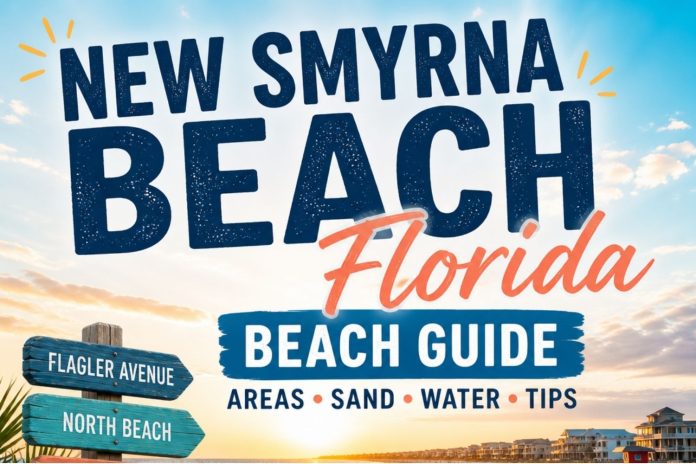
New Smyrna Beach, Florida
New Smyrna Beach has become one of my genuine favorites on this whole coast, and it took me a while to admit that, since I came in expecting just another Volusia County beach town. What I found instead was 17 miles of some of the easiest walking sand in Florida, real surf culture, real history, and enough wildlife between the beach and the Indian River Lagoon to keep me looking down at my feet and up at the sky in the same walk.
New Smyrna Beach sits on a barrier island south of Ponce Inlet, with the Atlantic Ocean on one side and the Indian River Lagoon, one of the most biodiverse estuaries in North America, on the other. Seventeen miles of beach run the length of this stretch, split cleanly between a drive-on section to the north and a car-free section to the south that runs all the way to Canaveral National Seashore.
In this guide I’ll walk you through the distinct stretches of this beach, going deep on what makes this sand and this surf different from anywhere else I’ve covered on this coast, covering exactly where you can bring your dog, scoring it honestly, and telling you exactly who this beach actually suits. I’ll cover Flagler Avenue, the north jetty surf scene, the quiet no-drive stretch toward Bethune Beach, and the historic downtown most day-trippers never bother crossing the bridge to see. For more on the wildlife here and what turns up along the wrack line, I’ve also written a birding guide and a beach finds guide for this stretch. I close with why this beach earned a permanent spot on my personal list, since that doesn’t happen often after this many miles of Florida coastline.
The Vibe & Culture at New Smyrna Beach
A Surf Town That Also Happens to Be One of Florida’s Oldest Settlements
New Smyrna Beach carries its history and its surf culture with the same easy confidence, and neither one feels like it’s performing for visitors.
This town has been called one of the world’s best surf towns by more than one national outlet, and the reputation holds up once you’ve watched the break near the north jetty on a good morning. Surfers here range from kids on their first lesson to a handful of names who went on to compete professionally, and the culture around it, board shops, casual dress, an unhurried pace, shapes the whole beachside strip along Flagler Avenue.
What surprised me was how much history sits quietly underneath that surf town identity. New Smyrna carries a real claim as Florida’s second-oldest European settlement, founded in 1768 by Dr. Andrew Turnbull and roughly 1,500 Mediterranean colonists, predating most of the state’s development by over a century. Some historians even argue the coquina Turnbull Ruins downtown may predate St. Augustine’s own Spanish fort, though nobody can prove it definitively at this point. You’ll feel that layered history most on Canal Street, the mainland side of town, distinct from the beachside strip on Flagler Avenue and connected by a short bridge over the Intracoastal.
Seasonally, this beach runs warmer and more consistent than the crowd-driven calendars further north. Spring and fall bring the best surf and the lightest crowds. Summer is peak family season along the drive-on beach near Flagler Avenue. The southern no-drive stretch toward Bethune Beach barely changes character by season at all, staying quiet nearly year-round.
New Smyrna Beach Areas: Five Distinct Stretches Along 17 Miles
New Smyrna Beach splits cleanly by whether you can drive on it, and each stretch within those two halves has its own personality. Here’s how it breaks down, north to south.
Flagler Avenue Beachfront
Downtown Beachside · Drive-On Access
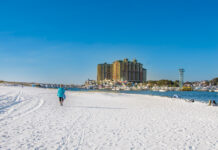
The first thing you notice pulling up to the Flagler Avenue beach ramp is the arch marking the entrance, and then the fact that you can drive straight through it onto hard-packed white sand. This is the social center of New Smyrna’s beachside, a five block stretch running straight down to the water lined with surf shops, galleries, ice cream counters, and restaurants housed in old Florida beach cottages and restored Victorian homes.
The crowd here mixes everyone: day-trippers up from Orlando, surfers walking boards down to the water, families setting up beach chairs a few feet from their parked car, and a steady stream of locals who treat Flagler Avenue as their actual downtown rather than a tourist strip. It gets genuinely busy on weekends and during festivals like Wine Walk, but it never feels as saturated as Daytona’s boardwalk a few miles north.
I always start a New Smyrna visit here, not because it’s the prettiest stretch of sand in this guide, but because it’s the best introduction to how this town actually works. Grab a coffee, walk the five blocks to the water, and you’ll understand the whole beachside identity before you’ve even gotten your feet wet.
North Beach & the Approach to Smyrna Dunes
Toward Sapphire Park · Drive-On, Residential
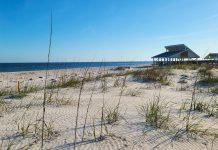
North of Flagler Avenue, the beach passes through a noticeably more residential stretch as you head toward the inlet. Sapphire Park, also known as North Beach Community Park, anchors this section, and the condo towers that line Flagler Avenue give way to lower buildings and dune-backed sand with sea oats swaying along the upper beach.
The crowd thins here compared to Flagler, mostly locals and repeat visitors who’ve figured out that this stretch gets the same drivable sand with noticeably less congestion. It’s still an active beach, cars parked facing the water, families set up for the day, but it has a quieter, more settled feel than the main strip a mile or two south.
This is the stretch I point people toward when they want the convenience of driving onto the sand without the Flagler Avenue crowd. It’s not a secret exactly, but it gets a fraction of the foot traffic for reasons I’ve never fully understood.
Smyrna Dunes Park & the North Jetty Surf Break
Northern Tip of the Peninsula · Ponce de Leon Inlet
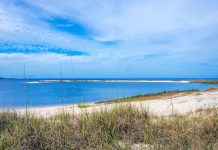
At the very northern tip of New Smyrna’s barrier island, Smyrna Dunes Park runs 184 acres along the south shore of Ponce de Leon Inlet, with more than two miles of elevated, handicapped-accessible boardwalk winding through the dune system. This is also where the beach’s most famous feature lives, the surf break near the jetty that gave this town its international reputation among surfers.
The crowd here splits cleanly between two groups: surfers working the break, recognizable from a distance by how long they’re willing to wait for the right wave, and everyone else, walking the boardwalk for the dune scenery, the inlet views, and the leashed dog beach tucked along the shoreline. It’s genuinely one of the better wildlife-watching spots in this guide, with dolphins working the inlet on calm mornings and a real chance at seeing a manatee in the calmer water.
I’ll be honest about the one thing this stretch is also known for. The water near this jetty sees more shark activity than almost anywhere else in the country, part of why this whole town carries the Shark Bite Capital nickname. The overwhelming majority of incidents are minor, ankle or foot nips in shallow water where a fish was mistaken for a foot, but I still give the immediate jetty area a wider berth than I do the open beach further south.
27th Avenue & the No-Drive Line
Transition Point · Beach Driving Ends Here
27th Avenue marks the exact line where New Smyrna’s drive-on beach ends and its car-free southern stretch begins. The park here has its own ramp for anyone driving up from the north, and it’s the last chance to park directly on the sand before the beach shifts to pedestrian only for the rest of the way to Canaveral National Seashore.
Families gravitate here specifically because of that line. Parents who want beach convenience without worrying about vehicle traffic near young kids consistently point to 27th Avenue as their pick, since you get easy parking and a beach that’s genuinely calmer than the more trafficked stretch closer to Flagler. It stays busy in season but never feels chaotic.
This is the spot I’d recommend first if someone tells me they’re bringing small children to New Smyrna Beach. It gives you the last bit of drive-on convenience paired with the calmer feel of the no-drive zone just steps away.
Silver Sands & Bethune Beach
South of 27th Avenue · No-Drive, Toward the National Seashore
South of 27th Avenue, New Smyrna’s beach shifts entirely to pedestrian access, and the character shifts with it. Silver Sands and Bethune Beach are quiet residential stretches with a noticeably lower profile than anything north of them, no condo towers, no beach driving, just wide sand backed by dunes and modest homes.
The crowd here is almost entirely locals and the handful of visitors who’ve made the drive specifically for the quiet. Mary McLeod Bethune Beachfront Park anchors the southern end of this stretch, and beyond it the development simply stops, giving way to Canaveral National Seashore’s undeveloped coastline.
I end most of my New Smyrna visits walking this far south if I have the daylight left. It’s the clearest reminder on this entire beach that you’re standing on a barrier island, not a boardwalk, and it’s where I’ve had some of my best quiet mornings anywhere in Volusia County.
New Smyrna Beach Rankings: Expert Scores Across 11 Categories
These scores weigh the full 17 mile stretch, which means the energy of Flagler Avenue gets balanced against the genuine quiet you’ll find toward Silver Sands and Bethune Beach.
Sand Quality
7/10
Hard-packed white to tan quartz, the same family of sand found up and down this coast. Genuinely excellent for walking, driving, and long barefoot stretches at the waterline.
Hiking & Beach Walking
9/10
One of the best walking beaches on this whole coast. Seventeen miles of firm, flat sand, with the no-drive stretch south of 27th Avenue among the most peaceful long walks I’ve done anywhere in Florida.
Shelling
5/10
Better than Daytona or Ormond, especially near Smyrna Dunes Park after a storm. Still not a dedicated shelling destination, but worth a look along the inlet shoreline.
Water Conditions
6/10
Genuinely excellent surf near the jetty, but real current and shark activity concentrate in that same area. The open beach further south swims calmer and more predictably.
Scenery & Natural Beauty
7/10
Dune systems at Smyrna Dunes Park and the undeveloped stretch toward Bethune Beach both beat the condo-lined sections further north on this coast.
Birding & Wildlife
9/10
Dolphins and manatees in the inlet, a genuine gateway to the Indian River Lagoon’s more than 4,000 documented species, and sea turtle nesting May through October. One of the richest wildlife stretches in this guide series.
Family Friendliness
7/10
27th Avenue and the no-drive zone south of it suit families well. The shark activity concentrated near the north jetty is worth knowing about and easy to simply avoid.
Dog Friendliness
7/10
Smyrna Dunes Park has a genuine leashed dog beach, though dogs aren’t permitted on its boardwalk after 10 a.m. Elsewhere on the main beach, pets follow the same restrictions as the rest of Volusia County.
Solitude & Peace
6/10
Flagler Avenue and the drive-on stretch stay lively most of the year. Silver Sands and Bethune Beach, just a few miles south, offer real quiet in the same trip.
Entertainment & Nightlife
6/10
Flagler Avenue and Canal Street deliver genuinely good dining, galleries, and a laid-back bar scene, but nothing resembling a boardwalk or arcade. This town entertains you differently than Daytona does.
Parking & Beach Access
7/10
Multiple drive-on ramps and off-beach lots serve the northern half well, though fees apply everywhere. The no-drive southern stretch has fewer access points and less parking overall.
New Smyrna Beach Sand & Water
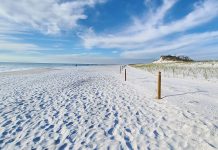
New Smyrna Beach’s sand is some of the most consistently walkable in Florida, flat and firm for all 17 miles, easy on your feet whether you’re strolling near Flagler Avenue or the quiet stretch toward Bethune Beach. The dry sand up near the dunes softens some, good for a sandcastle once you add water, but the real story here is how comfortable the packed sand stays at the waterline mile after mile, which is exactly why this is one of the best long-walk beaches on this whole coast.
The water changes personality depending on how close you are to the inlet. Near the north jetty at Smyrna Dunes, you’ll find the genuine surf break that made this town famous, along with real current strength worth respecting. Further south, the water calms into typical Atlantic conditions, gradual to wade into and good for a casual swim. Rip currents and shark activity both concentrate near the jetty, so stick to guarded stretches near Flagler Avenue or 27th Avenue if swimming is the goal.
-
Walkability. Firm, flat sand for all 17 miles, especially comfortable south of 27th Avenue where there’s no vehicle traffic to disturb it.
-
Softness & Playability. Firm at the water’s edge, softer up near the dunes. Good for sandcastles once you add water.
-
Barefoot Comfort. Comfortable most of the year at the waterline, though the dry sand near Flagler Avenue heats up by midday in summer.
-
Swimmability. Good near Flagler Avenue and 27th Avenue, where lifeguards watch the water. Avoid swimming directly at the jetty, where currents and shark activity both run highest.
Want the full geology, grain composition, and the complete sand and water condition ratings? I broke it all down separately in Sand & Shore: New Smyrna Beach.
Dogs & Pet Accessibility at New Smyrna Beach
Are Dogs Allowed on the Sand? RESTRICTED.
Smyrna Dunes Park has a genuine leashed dog beach along the inlet shoreline. Everywhere else on New Smyrna’s 17 miles of beach, pets follow Volusia County’s general restrictions.
Where Dogs Are Allowed
- ✓Smyrna Dunes Park’s designated dog beach along the inlet shoreline, leashed, throughout the day.
- ✓Smyrna Dunes Park’s elevated boardwalk, leashed, before 10 a.m. only.
Where Dogs Are NOT Allowed
- ✗Smyrna Dunes Park’s elevated boardwalk after 10 a.m.
- ✗Flagler Avenue, 27th Avenue, and the rest of the drive-on beach corridor.
- ✗The no-drive stretch south through Silver Sands and Bethune Beach.
Paws on the Ground Reality
Bring your own water for the walk, since there’s no dog-specific water station at Smyrna Dunes Park, though the park’s shaded boardwalk sections offer some relief from the sun before that 10 a.m. curfew kicks in. The sand here runs a bit coarser near the jetty from all that inlet-driven shell content, worth knowing if your dog has sensitive paws, though it softens up away from the inlet mouth. Rangers do check the boardwalk curfew, so plan an early visit if you want your dog with you on the elevated walkway as well as the sand.
If your dog needs a longer walk than this one park allows, the residential streets around the mainland side of town offer easy, shaded alternatives once you’re off the beach.
Crowd Levels and the Overall Feel of New Smyrna Beach
Compared with Daytona a few miles north, New Smyrna runs at a noticeably more relaxed pace, even in its busiest sections. Flagler Avenue gets genuinely crowded on weekends and during festivals, but the town never feels like it’s straining under its own popularity the way Daytona’s boardwalk does.
You’ll find a different crowd depending on where you stand. Near Flagler Avenue it’s a mix of day-trippers, surfers, and locals treating it as an actual downtown. Toward Smyrna Dunes it’s almost entirely surfers and wildlife watchers. South of 27th Avenue it’s residents and anyone specifically seeking out the quiet.
The feel here shifts gently by season, more tied to surf conditions than to events:
- Spring: some of the best surf conditions of the year, with lighter crowds than summer
- Summer: peak family season along the drive-on beach, the warmest water, and the busiest Flagler Avenue gets all year
- Fall: my favorite window here, good surf, warm water, and a noticeable drop in crowd size
- Winter: quiet and cool, with the southern no-drive stretch nearly empty on weekday mornings
Who Is New Smyrna Beach Really For?
✓ Who Will Love New Smyrna Beach
-
Surfers of any level chasing a genuinely world-class, internationally recognized break near the north jetty
-
Long-distance beach walkers who want 17 miles of consistently firm, comfortable sand without fighting a crowd for the whole stretch
-
Wildlife watchers drawn to the Indian River Lagoon, one of the most biodiverse estuaries in North America, right on the town’s doorstep
-
History lovers curious about Florida’s second-oldest European settlement and the Turnbull Colony story downtown
-
Anyone who wants both a drive-on beach and a genuine car-free stretch within the same short trip
-
Art and food lovers who’ll appreciate Canal Street’s galleries and Flagler Avenue’s restaurant scene as much as the beach itself
✗ Consider Another Beach If…
-
You want boardwalk energy, arcades, or nightlife on the scale of Daytona. This town entertains you differently, through dining and galleries rather than rides
-
You’re nervous about sharks and can’t get past the nickname. The risk is genuinely low outside the immediate jetty area, but the reputation is real and it will be in the back of your mind
-
You want the softest, most powder-fine sand in Florida. This is firm, functional quartz, excellent for walking and driving, not the finest sand in the state
-
You’re a dedicated sheller chasing a high hit rate. Shelling here is decent by this coast’s standards but still light compared to Gulf beaches
-
You want abundant, budget beachfront hotel inventory. Vacation rentals and condos dominate here more than traditional hotels
-
You need a beach with zero learning curve for vehicle access. Beach driving here follows tide and season rules that are worth reading before you show up
Things to Do at New Smyrna Beach, Florida
Between the surf, the sand, and the two historic downtowns, New Smyrna Beach fills a day differently than anywhere else in this guide series. Here’s what actually fills the time here.
-
Surfing. The break near the Smyrna Dunes north jetty has an international reputation. Surf shops up and down Flagler Avenue offer lessons and rentals for every skill level.
-
Beach Driving. Drive onto the sand at Flagler Avenue, North Beach, or Third Avenue, tide and season permitting. Beach driving ends at 27th Avenue, where the car-free stretch begins.
-
Beach Walking. The no-drive stretch from 27th Avenue south through Silver Sands and Bethune Beach offers some of the most peaceful long walking on this whole coast.
-
Wildlife Watching. Dolphins and manatees are regular sightings in the inlet and along the Indian River Lagoon. Sea turtle nesting runs May through October.
-
Arts & Galleries. Canal Street’s historic downtown is home to The Hub on Canal and the Atlantic Center for the Arts, a nationally recognized artist residency program.
-
Historic Sightseeing. The Turnbull Ruins at Old Fort Park and the New Smyrna Museum of History trace this town’s claim as Florida’s second-oldest European settlement.
-
Paddleboarding & Kayaking. The calm waters of the Indian River Lagoon offer a completely different, quieter way to experience the wildlife here than the ocean side.
-
Dog Beach Walking. Smyrna Dunes Park has a designated leashed dog beach along the inlet shoreline, though dogs aren’t allowed on the boardwalk itself after 10 a.m.
Local Knowledge and Practical Advice
A few things I’ve picked up walking this beach more times than I can count:
-
Give the immediate jetty water extra distance if you’re not surfing. Shark activity concentrates there more than anywhere else on this beach. The risk drops noticeably once you’re a stretch of sand away.
-
Beach driving ends at 27th Avenue. Don’t plan on driving further south toward Bethune Beach, that entire stretch is pedestrian only.
-
Budget for the beach access fee no matter where you park. Driving on the sand runs around 30 dollars a day, and off-beach lots run around 20 dollars a day for non-residents.
-
Surf the north jetty break early, before the wind picks up. Morning conditions are consistently the cleanest, and it’s also the best window for spotting dolphins in the inlet.
-
Cross the bridge to Canal Street at least once. Most visitors never leave the beachside, and they miss the historic downtown that explains why this town claims to be Florida’s second-oldest settlement.
-
Know the dog beach hours at Smyrna Dunes Park. Leashed dogs are welcome on the sand, but they’re not allowed on the elevated boardwalk after 10 a.m.
-
Nesting season runs May through October. Keep beachfront lighting dim after dark and give any marked nest a wide berth.
-
Book a sunset table at JB’s Fish Camp near the national seashore entrance. It’s a short drive south of Bethune Beach and worth the trip on its own.
-
Don’t let the Shark Bite Capital nickname scare you off entirely. The overwhelming majority of incidents are minor nips in shallow water near the inlet, not the reason to avoid the ocean along the rest of this beach.
Where to Stay Near New Smyrna Beach, Florida
Lodging here leans heavily toward vacation rentals and condos rather than traditional hotels. Here’s how the options break down.
Flagler Avenue & Beachside
Vacation rentals, beach cottages, and a handful of small hotels cluster within walking distance of Flagler Avenue’s shops and restaurants, putting you steps from both the drive-on beach and downtown dining.
Oceanfront Condos
Direct oceanfront condo buildings run the length of the drive-on beach, with a wide range of pricing depending on age and location. Many are available as short-term rentals, especially further from the immediate downtown strip.
Silver Sands & Bethune Beach
Quieter rental homes in the no-drive southern stretch suit anyone prioritizing calm over convenience. This is where I’d stay for a genuinely slow trip, close to Canaveral National Seashore without the crowd further north.
Camping
Sugar Mill Ruins Travel Park and New Smyrna Beach RV Park and Campground both offer full-hookup sites a short drive from the sand, popular with snowbirds and RV travelers timing a visit around the area’s mild winter weather.
Inland Volusia County
For lower rates, the mainland side of town along US-1 and points further inland toward DeLand offer a wider range of budget options for visitors willing to drive to the beach rather than stay directly on it.
What Makes New Smyrna Beach Different from Nearby Beaches
New Smyrna Beach stands apart because it does two things at once that most Florida beach towns only manage one of: a genuine, internationally recognized surf culture, and a real historical identity that predates most of the state’s development.
A few other features make it distinct:
Both a drive-on and a car-free beach in one trip
Few beaches in Florida let you experience both driving onto the sand and a genuinely car-free, undeveloped stretch within the same short drive. The line at 27th Avenue makes that choice explicit.
A surf break with a real international reputation
National Geographic and other outlets have named this one of the world’s best surf towns, and the break near the north jetty is consistently good enough to have produced professional competitors.
Two historic downtowns connected by a bridge
Flagler Avenue on the beachside and Canal Street on the mainland give this town a layered identity that most single-strip beach towns on this coast don’t have.
New Smyrna Beach vs. Other Florida Atlantic Beaches
These are the beaches visitors most often weigh against New Smyrna, and the honest read on when you’d choose one over the other.
New Smyrna Beach vs. Daytona Beach
Daytona Beach sits a short drive north and offers a bigger boardwalk scene and more nightlife, but New Smyrna wins clearly on surf quality, walkability, and overall solitude once you’re south of Flagler Avenue.
New Smyrna Beach vs. Ponce Inlet
Ponce Inlet sits just across the inlet from New Smyrna’s north jetty and offers a smaller, quieter, more exclusive version of the same wildlife-rich inlet setting, without the surf culture or the historic downtown.
New Smyrna Beach vs. Cocoa Beach
Cocoa Beach, about an hour south on the Space Coast, offers a comparable surf reputation and a similarly laid-back beach town feel, along with rocket launch views that New Smyrna can’t quite match.
New Smyrna Beach vs. Flagler Beach
Flagler Beach sits north past Ormond and trades New Smyrna’s surf culture and historic downtown for an even smaller-scale, quieter small-town feel with a narrower beach.
Bottom line: New Smyrna Beach is the rare Florida beach town that backs up both its surf reputation and its history claims once you actually spend time there. Daytona gives you more energy. Ponce Inlet gives you more exclusivity. Cocoa Beach gives you rockets. New Smyrna gives you the most complete package of surf, sand, wildlife, and genuine small-town character in this entire guide series so far.
New Smyrna Beach, Florida: Frequently Asked Questions
Is New Smyrna Beach worth visiting?
Yes, and it’s become one of my genuine favorites on this coast. The combination of walkable sand, a world-class surf break, rich wildlife, and real history gives it more depth than most single-purpose beach towns nearby.
Why is New Smyrna Beach called the Shark Bite Capital of the World?
The waters near the north jetty at Ponce de Leon Inlet see more shark bite incidents than almost anywhere else in the country, largely because sharks, surfers, and baitfish all concentrate in the same inlet currents. The overwhelming majority of incidents are minor.
Can you drive on New Smyrna Beach?
Yes, from 27th Avenue north to the jetty at Smyrna Dunes Park, tide and season permitting. South of 27th Avenue through Silver Sands, Bethune Beach, and Canaveral National Seashore, the beach is pedestrian only.
Are dogs allowed on the beach in New Smyrna Beach?
Leashed dogs are welcome on the sand at Smyrna Dunes Park’s designated dog beach, though they aren’t permitted on the park’s elevated boardwalk after 10 a.m. Dog access on the main beach follows Volusia County’s general rules.
Is New Smyrna Beach good for surfing?
Yes, genuinely so. The break near the north jetty has an international reputation and has produced professional competitors. It’s considered one of the more consistent, well-shaped breaks on Florida’s Atlantic coast.
Is New Smyrna Beach good for families?
Yes, particularly around 27th Avenue and the no-drive stretch just south of it, which offers easier parking and calmer water than the busier sections near Flagler Avenue and the north jetty.
What is the best time of year to visit New Smyrna Beach?
Fall offers the best mix of good surf, warm water, and thinner crowds. Spring is a close second for surf conditions. Summer is peak family season, and winter is the quietest, coolest stretch of the year.
Is New Smyrna Beach the same as Daytona Beach?
No. New Smyrna Beach is its own city south of Daytona Beach Shores, with a distinct surf culture, a different historic identity as one of Florida’s oldest settlements, and its own separate beach driving rules.
Where is the best parking at New Smyrna Beach?
Flagler Avenue and 27th Avenue both have dedicated beach ramps for vehicle access, while off-beach lots serve the no-drive stretch further south. Fees apply nearly everywhere, so budget for it regardless of where you park.
Is New Smyrna Beach really Florida’s second-oldest city?
It carries that claim, founded in 1768 as a British colonial settlement led by Dr. Andrew Turnbull, predating most of the state’s development. Some historians even argue its ruins may predate St. Augustine’s fort, though it’s disputed and unlikely to ever be proven either way.
Patti’s Perspective: My Honest Take on New Smyrna Beach
This is one of my new favorite places on this whole coast, and I don’t say that lightly after the number of Florida beaches I’ve walked for this work. It’s the walking that got me first, that long, forgiving stretch of sand south of 27th Avenue where I could go a mile without seeing another set of footprints, and then it was the wildlife, dolphins working the inlet, birds along the wrack line, that kept me coming back.
What earned this beach a permanent spot on my list, though, wasn’t the sand or even the wildlife. It was standing on Canal Street for the first time, completely by accident, after years of only ever crossing the bridge to the beachside. Learning that this quiet stretch of Florida coast carries a real claim as one of the oldest European settlements in the state, older in some tellings than St. Augustine itself, changed how I saw every mile I’d already walked here. That’s the kind of thing that happens rarely enough in this work that I actually stopped and sat with it for a minute.
I won’t pretend the shark reputation doesn’t cross my mind near the jetty, because it does, every time. But I’ve learned to hold that alongside everything else this beach offers rather than let it define the whole visit, and once you walk far enough south of that inlet, the water calms down and the whole experience opens back up into something genuinely restorative.
My verdict: 8/10. The most complete beach town in this guide series so far, with real surf, real history, real wildlife, and a walkability that few Florida beaches can match. Respect the water near the jetty, cross the bridge to Canal Street at least once, and give yourself the full day this beach deserves.
Want to Live by the Water?New Smyrna Beach offers a genuinely diverse range of waterfront real estate on Florida’s Atlantic coast, from oceanfront condos along the drive-on beach to quieter homes near Silver Sands and Bethune Beach, plus Intracoastal properties on the mainland side with protected water access.The market here draws surfers, artists, retirees, and second-home buyers who are increasingly relocating from higher-cost coastal markets. The barrier island’s limited developable land keeps inventory naturally constrained, and the town’s authentic character, rather than heavy commercialization, continues to draw buyers who want more than just a beach house.If living by the water is something you’re considering, whether full time, part time, or as an investment, it’s worth exploring what’s available in this area.Explore Waterfront Living at LiveByTheWater.com
Real estate referral partner