





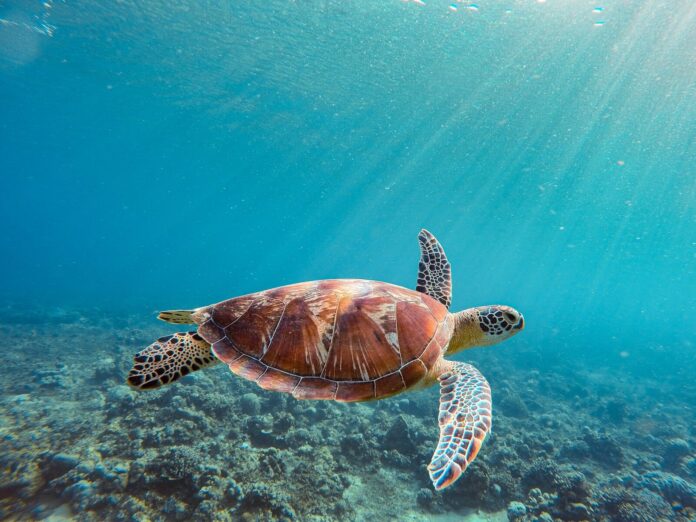
I always loved turtles, but I never expected to be so infatuated with sea turtles. The first time I found a fresh nesting crawl on an empty beach at sunrise, that unmistakable tractor-tread path leading up from the water and back again, I stood there like I had discovered a message left just for me. In a way, I had. A 250 pound reptile had hauled herself out of the ocean in the dark, dug a hole with her back flippers without being able to see what she was doing, laid around a hundred eggs, and quietly disappeared back into the waves before anyone was awake to see it. That is not a small thing. That is a small miracle wearing a shell.
Meet the Seven
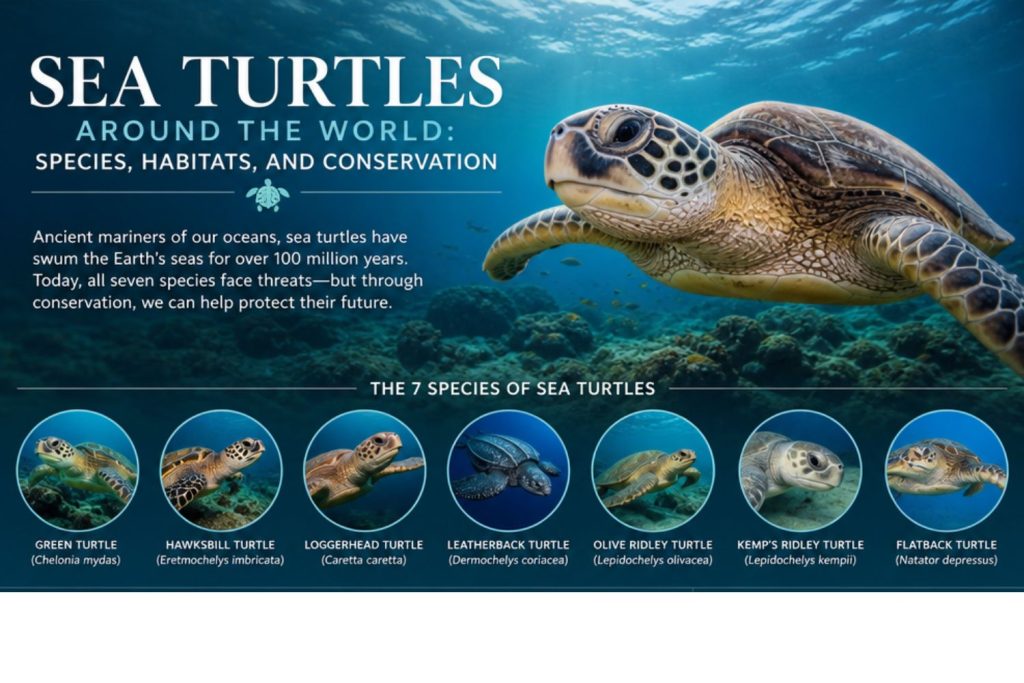
There are seven species of sea turtle left on this planet, and every single one of them is doing something remarkable. Six belong to the same general hard-shelled family. The seventh, the leatherback, is in a category of its own, no bony shell at all, just a ridged, rubbery back over cartilage, and it is the largest turtle on Earth, sometimes topping 1,400 pounds. Leatherbacks dive nearly 4,000 feet down chasing jellyfish and migrate over 10,000 miles a year, which makes them, by a wide margin, the most giddy-paced travelers of the bunch.
The loggerhead has the head and jaw of a turtle that means business, built to crush whelks and conch, and it nests on more of the world’s beaches than any species except the leatherback, including, as I am extremely proud to report, more of them right here in Florida than anywhere else on the planet.
The green sea turtle is the biggest of the hard-shelled species and the only one that grows up to be mostly vegetarian, grazing seagrass and algae, which is also why its fat turns green and gave the species its name. It nests on a two-year cycle, big years followed by quieter ones, so if you hear that green turtle numbers were down last summer, don’t panic, that’s just how they roll.
The hawksbill is the one with the narrow, curved beak and the strikingly patterned shell that used to be carved into “tortoiseshell” jewelry, which is a big part of why it’s now Critically Endangered. It eats sponges almost exclusively, which makes it one of the more important species for keeping coral reefs healthy.
The Kemp’s ridley is the smallest sea turtle in the world and also the most endangered, and it does something none of the others quite manage, nesting in a synchronized mass event called an arribada, Spanish for “arrival,” where thousands of females come ashore together over just a few days. Its cousin, the olive ridley, does the same thing on an even bigger scale and is, by sheer population, the most abundant sea turtle on Earth.
And then there’s the flatback, the overachiever of niche specialists, the only sea turtle species that nests in exactly one country. If you want to see a flatback, you are going to Australia, full stop, no substitutions.
Want the deep dive on the biology of any one of these? NOAA Fisheries keeps solid species profiles on the loggerhead, green, leatherback, and hawksbill turtles if you want to go down the rabbit hole the way I did.
The Whole Wild Process, From Egg to Ocean
Here is the part that turned me from someone who thought turtles were nice into someone who now plans beach walks around nesting season. A female sea turtle comes ashore, usually at night, and if she likes what she finds, no bright lights, no obstacles, enough privacy, she digs a nest chamber roughly ten to twenty four inches deep using nothing but her rear flippers, working entirely by feel. She lays somewhere between 80 and 120 soft, ping-pong-ball-sized eggs, covers the nest, disguises it with sand thrown every which way to confuse predators, and crawls back to the sea. She might do this two to eight times in a single season, then not nest again for two or three years.
Sometimes she comes ashore and changes her mind entirely, a false crawl, turning back to the water without laying a single egg. It happens all the time and it is not a tragedy, it just means tonight wasn’t the night.
About 60 days later, depending on how warm the sand has been, the eggs hatch. And here is the detail that still stops me cold every time I explain it to someone new: the temperature of the sand determines whether the hatchlings are male or female. Warmer sand means more females, cooler sand means more males. There is no genetic coin flip involved at all. The beach itself is making that decision, nest by nest, degree by degree.
The hatchlings dig upward together over several days and then erupt from the sand as a group, almost always at night, in what’s called a boil, dozens of tiny turtles scrambling for the brightest open horizon, which under natural conditions is the moonlight reflecting off open water. It is, by every account I have read and every bit of secondhand joy I have absorbed from friends who have witnessed it, one of the most purely delightful things you can watch nature do. It is also brutal. Roughly one hatchling in a thousand survives to adulthood. Every single nest matters. Every dark, quiet, obstacle-free stretch of beach matters. That’s not guilt talk, that’s just math, and it’s exactly why so many people around the world have organized their entire volunteer lives around protecting a few hundred yards of sand each summer.
When to Go Looking
Nesting season timing depends entirely on hemisphere and species. Across most of Florida, the Caribbean, and the wider Northern Hemisphere, nesting season runs roughly spring through fall, with loggerheads and greens peaking in June and July and hatching following about two months later. Flip to the Southern Hemisphere and the whole calendar flips with it, Australia’s Mon Repos runs its season November through March, which means their turtle summer is happening while I’m wearing a sweatshirt.
Where to Actually Go See Them
If you want to build a trip around sea turtles, and I would encourage you to, here is where the real magic happens.
Tortuguero, Costa Rica is the largest green turtle nesting site in the entire Western Hemisphere, tens of thousands of females a season on a 21 mile stretch of black sand, and the Sea Turtle Conservancy has been studying it continuously for more than 50 years. If you only ever take one turtle-focused trip in your life, people who know a lot more about this than I do will point you here first.
Ras Al Jinz, Oman might be my favorite discovery from researching this whole thing. It’s one of the most important green turtle nesting concentrations in the entire Indian Ocean, and the Ras Al Jinz Turtle Reserve runs ranger-led night tours where you can actually watch the nesting process happen a few feet away. Desert on one side, turtles on the other. Quisquous in the best possible way.
Mon Repos, near Bundaberg, Australia is the most significant loggerhead nesting site in the entire South Pacific, and it’s genuinely one of the most accessible turtle experiences on Earth. During the 2025-2026 season alone, rangers documented 422 loggerhead turtles, 19 flatbacks, and one green turtle nesting there, laying around 212,100 eggs between them. The Mon Repos Conservation Park runs nightly ranger-guided Turtle Encounter tours from November through March, and it’s the only place on this list where you have a real shot at seeing a flatback, since Australia is the only country on Earth where they nest at all.
Trinidad’s Grande Riviere and Matura Bay host one of the largest leatherback nesting aggregations in the world, community-run tours, peak season March through August. Mexico’s Yucatán Peninsula holds the largest hawksbill rookery in the Western Hemisphere. Rancho Nuevo, Mexico is where nearly the entire Kemp’s ridley population nests, in a genuinely dramatic mass arribada event, though public access there is tightly restricted since it’s an active research site rather than a tourist destination.
And then there’s home. Florida holds close to 90 percent of all sea turtle nesting in the continental United States, and if you want the full rundown of where to see them right here, from the Panhandle down through the Keys and back up to Amelia Island, that’s a whole separate deep dive I’ve put together just for this coastline. Sea Turtles on the Sands of Florida
Rules Wherever You Go
Every single nesting beach in the world runs on some version of the same short list of rules, because every single one of these species is protected, either by international treaty, national law, or both. Keep your distance, ten feet minimum, more if a guide tells you more. No flash photography, ever. No flashlights or phone lights pointed anywhere near a turtle or a hatchling, since artificial light disorients them and can send them crawling the wrong way, sometimes fatally. Don’t touch. Don’t dig. If you find a hole you made earlier in the day, fill it back in before you leave, since an uncovered hole can trap a nesting female or a scrambling hatchling just as easily as a car bumper can. And if you’re at a beach with a guided walk program, book it, follow the guide, and understand going in that a sighting is never guaranteed. These are wild animals doing something ancient and private, not a scheduled performance.
Curiosity Corner
How long do sea turtles live?
Somewhere between 50 and 100 years is the best estimate researchers have, since no one has ever tracked a single turtle from hatchling to natural death. They’re basically living a longer, slower version of my own reinvention story, and I find that deeply comforting.
Do sea turtles really cry?
They do produce tears, but it’s not emotion, it’s how they get rid of the excess salt they take in from seawater and food. Still gets me every time I see the photo.
Do sea turtles come back to the beach where they were born?
Yes, it’s called natal homing, and most females nest within roughly five to twenty miles of their own hatching beach using a mix of magnetic-field sensing and cues scientists are still working to fully understand. There is something in that fact that I find myself thinking about far more than I expected to.
Why are so many sea turtle species endangered?
Habitat loss, historic egg and shell harvesting, bycatch in fishing gear, plastic pollution, boat strikes, and a changing climate that’s shifting sand temperature and, with it, hatchling sex ratios. The encouraging part is that every single threat on that list has an organization, a law, or a volunteer patrol actively working against it.
What’s the difference between a sea turtle and the turtle in my backyard pond?
Sea turtles have paddle-shaped flippers instead of legs and feet, and unlike land or freshwater turtles, they can’t pull their heads into their shells. They’ve traded that defense for a life almost entirely spent in open water.
Thoughts & Reflections
I keep coming back to that first crawl I found, the one that stopped me cold on an empty beach. I think about how that turtle did the hardest, most vulnerable thing she’ll do all year completely alone, in the dark, with zero guarantee that any of it would work out, and then she just went back to the ocean and kept living her life. No audience. No credit. She didn’t wait to feel ready and she didn’t need anyone’s permission to trust the process. If that’s not a walking mission metaphor handed to me directly by the universe, I don’t know what is.
