

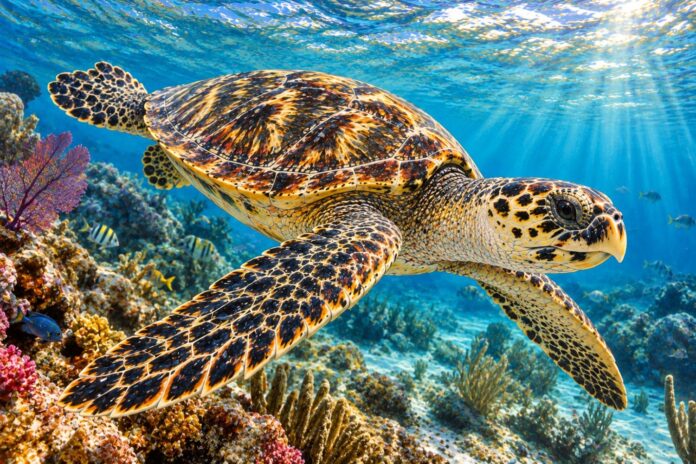
Meet the Hawksbill
The hawksbill is the small, graceful reef turtle of the group, and she is named for her narrow, pointed beak, which looks a lot like a hawk’s. That slim beak slips into crevices in the coral to reach sponges, which most animals avoid because many are toxic, and by keeping them in check she helps keep reefs healthy. She is also the turtle whose shell was once so prized as “tortoiseshell” that it nearly drove her to extinction, and international trade in it has been banned for decades. She is a quiet turtle, usually weighing somewhere between 100 and 200 pounds, and she nests alone on small beaches in dozens of countries instead of coming ashore in crowds.
Start with the beak. It is thin and pointed, nothing like the thick, blunt beak of a loggerhead or the rounded face of a green. Her shell glows in amber, gold, brown and black, often with a streaked or mottled pattern, and in younger turtles the plates overlap like roof shingles while the back edge of the shell looks serrated, almost like a saw blade. She has two claws on each front flipper, four pairs of plates down each side, and two pairs of scales between her eyes. NOAA’s hawksbill page has the full picture. She is small and light enough to slip into places no loggerhead could, and that is where the story of her sand begins.
The Sand for the Hawkbill
Every sea turtle so far on this list wants some version of the same thing, a stretch of open sand wide and clear enough to work with. The hawksbill wants the opposite. She’s the smallest of the species I’ve covered, with a narrow, hawk-like beak and a shell so strikingly patterned it nearly got her carved into extinction for jewelry. And when she comes ashore to nest, she doesn’t want the open beach at all. She wants to disappear into it, climbing over rocks and reef rubble if she has to, tucking herself into the vegetation at the very back of the sand where almost nobody would think to look.
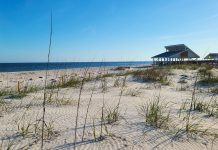
Where a loggerhead wants firm, packed sand and a leatherback wants a steep, obstacle-free approach, a hawksbill wants privacy above almost everything else. Researchers who study her nesting patterns describe a clear preference for narrow, steep beach zones with low human presence, often small “pocket beaches” tucked between rocks, and a strong pull toward nesting under or behind woody vegetation rather than out in the open. One long-running study in Mexico found nest density dropped sharply the closer a beach sat to town and artificial light, pushing females toward the least convenient, most erosion-prone stretches of sand simply because that’s where people weren’t. She’s not choosing difficult sand because she loves a challenge. She’s choosing it because it’s the only sand left where she can work undisturbed.
Florida’s Reef-Adjacent Sand
Hawksbill nesting in Florida is genuinely rare, a handful of nests most years, mostly in the Keys and along the southeastern Atlantic coast, which makes sense once you know how tightly she’s tied to coral reef. The Dry Tortugas, out at the very end of the Keys, is the most productive hawksbill nesting site in the state, and it’s not a coincidence that it also sits inside some of the healthiest reef habitat left in the country. She spends her whole life within a short swim of reef, and when it’s time to nest, she doesn’t stray far from it.
Mexico’s Steep, Narrow Yucatan Sand
Campeche, on Mexico’s Yucatán Peninsula, holds the largest hawksbill rookery in the entire Western Hemisphere, spread thin across a string of specific beaches with names most people will never hear otherwise, Punta Xen, Isla Aguada, Sabancuy, Celestún. A long-term study at Celestún found exactly the pattern you’d expect from everything else about this species, hawksbills there showed a strong preference for the steepest, narrowest sections of beach, the parts under the most active erosion, simply because those were the sections furthest from town and artificial light. Local youth-run turtle protection programs walk these beaches all night during nesting season, and the population here has been recovering steadily for two decades, tens of thousands of hatchlings released some years.
The Virgin Islands’ White Coral Sand
Buck Island, off St. Croix in the U.S. Virgin Islands, holds the largest hawksbill nesting concentration anywhere in the territory, on a stretch of powder-white coral sand appropriately named Turtle Beach, backed by recovering tropical dry forest on an island with no permanent residents at all. Buck Island Reef National Monument has run one of the longest continuous sea turtle research programs in the world here, and the island’s total isolation, boat access only, no development, is exactly the kind of undisturbed sand a hawksbill goes looking for.
The Solomon Islands’ Redemption Story
The Arnavon Islands, four small sand islands ringed by white beach and blue water in the Solomon Islands, hold the largest hawksbill rookery in the entire South Pacific, roughly 2,000 nests a year. I want to tell this one slowly because the backstory matters. This population was hunted hard for its shell for more than a century, driven low enough by the 1970s that the government stepped in, then nearly lost again when that top-down approach failed and harvesting resumed. What actually turned it around, starting in 1995, was the three local communities of Kia, Katupika, and Wagina taking over management themselves. Since then, nesting numbers and the rate at which turtles return to nest again have both roughly doubled. It’s one of the only hawksbill rookeries on Earth with a genuinely encouraging trend line, and it got that way because the people closest to the sand decided to protect it themselves.
Her Track and Her Nest
A hawksbill’s crawl is smaller and shallower than what you’d find from a loggerhead or green, somewhere around 70 to 85 centimeters wide, with an asymmetrical, alternating flipper pattern that looks distinctly different in the sand once you know what you’re looking at. Building the nest itself can take up to an hour and a half, longer than it sounds for a turtle her size, in part because she’s often climbing over roots and rock instead of simply digging into open ground. And her role doesn’t end when she leaves. She’s one of the main reasons reef sponges don’t take over and smother coral colonies, which makes her, quite literally, part of what keeps the reef itself alive.
Country by Country: Everywhere She Nests and Feeds
The hawksbill is the quiet one of this series. She doesn’t come ashore in crowds. She nests alone, in low numbers, on small beaches tucked behind reef, in dozens of countries, which is exactly why her map is so long. I’ve sorted it by region, with the places she nests and the places she mostly feeds. The numbers come from several different assessments and some are older than others, so treat them as a rough scale rather than a scoreboard. The main sources are NOAA’s hawksbill species page, Anne Meylan’s Caribbean survey, and the Indian Ocean and Southeast Asia assessment.
The Caribbean and the Atlantic
Meylan’s survey found hawksbill nesting in 32 of the 35 Caribbean countries and territories it covered. Aruba, Bermuda and the Cayman Islands were the three with none. The biggest numbers:
- Cuba: an estimated 1,700 to 3,400 nests a year.
- Mexico: an average of about 2,800 nests a year, with Punta Xen and the Yucatan Peninsula the stand-out sites.
- Antigua and Barbuda: about 400 to 500 nests a year.
- Puerto Rico: around 650 nests a year, with Mona Island by far the heaviest, along with Culebra and Vieques.
- U.S. Virgin Islands: about 400 nests a year, led by Buck Island Reef National Monument off St. Croix.
- Guatemala: roughly 380 to 760 nests a year on its Caribbean side.
- Barbados: 50 to 60 females a year, with the west coast logging more than 1,000 crawls in the atlas.
- Martinique, the Dominican Republic, Jamaica, and the Turks and Caicos Islands: a few hundred nests or nesting females a year each.
- Venezuela: an estimated 50 to 500 females.
Smaller or unquantified nesting is recorded in Anguilla, the Bahamas, Belize, the British Virgin Islands, Colombia, Costa Rica, Dominica, Grenada, Guadeloupe, Haiti, Honduras, Montserrat, Nicaragua, Panama, St. Kitts and Nevis, St. Lucia, St. Vincent and the Grenadines, and Trinidad and Tobago. On the U.S. mainland the number is just one or two nests, mainly on Florida’s southeast coast and in the Keys. Farther south, Brazil’s hawksbills nest in smaller numbers on Bahia’s beaches, including Praia do Forte. Foraging sites named include Nicaragua’s Miskito Cays, where a turtle tagged on Buck Island turned up, and Mona and Monito Islands, which are the main feeding habitat in the U.S. Caribbean.
The Eastern Pacific
- Mexico to Peru: NOAA estimates about 700 nesting females a year across the eastern Pacific.
- El Salvador: Bahia de Jiquilisco, the single most important hawksbill nesting area in the eastern Pacific, with about 170 nests a year, plus Los Cobanos with about 60.
- Nicaragua: Estero Padre Ramos, which averages more than 200 nests a year in its mangroves, and Aserradores with about 100 more.
- Costa Rica and Panama: smaller nesting and feeding, with Panama’s Coiba National Park described as the densest hawksbill feeding concentration in the eastern Pacific.
The hawksbills in this part of the world have an unusual habit. Many nest and feed in mangrove estuaries, not on open ocean beach.
The Western Indian Ocean and Africa
- Seychelles: about 1,000 nests a year, concentrated in the Inner Islands and the Amirantes, and among the world’s largest hawksbill nesting groups.
- Mozambique: Quirimbas National Park in the north.
- The British and French overseas territories in the region are part of the Southwest Indian population, which the Seychelles anchors.
The Red Sea, the Arabian Gulf and South Asia
- Egypt, Sudan, Eritrea and Djibouti: the Red Sea population, with no recent survey data.
- Iran, Saudi Arabia, Kuwait, Qatar, the United Arab Emirates, Oman and Yemen: the Arabian and Persian Gulf and Arabian Sea population.
- India, Sri Lanka and the Maldives: all appear in the regional assessment. Sri Lanka lists hawksbills among its nesting turtles, and Bangladesh has rare hawksbill nesting.
Southeast Asia
The Southeast Asia review and the Indian Ocean assessment together give this list.
- Indonesia: about 2,000 nests a year, with Segama and Momperang Islands in the Java Sea logging more than 1,000 a year in 2016 to 2018.
- Malaysia: Sabah’s Turtle Islands, where Pulau Gulisaan alone holds about 90 percent of the clutches, plus Melaka (about 1,000 clutches in 2022) and Pulau Redang.
- Thailand: the Gulf of Thailand, including Koh Khram.
- The Philippines: the southern rookeries in the Sulu Sea, which remain largely unsampled.
- Singapore: hawksbills nest on the southern islands, including Sisters’ Islands Marine Park. They are critically endangered there, and nesting has risen in recent decades.
- Cambodia, Brunei, Myanmar and Timor-Leste: small amounts of nesting reported.
- Vietnam: hawksbills haven’t nested for more than a decade. Japan and China are also listed in the regional assessment.
Australia and the Pacific
- Australia: about 2,000 nests a year on the northwest coast and around 6,000 to 8,000 in the Great Barrier Reef region, with Milman Island the northern reef index beach, plus Rosemary Island in Western Australia and North East Island at Groote Eylandt in Arnhem Land.
- Solomon Islands: the Arnavon Islands, the largest hawksbill rookery in the South Pacific, with about 2,000 nests.
- Papua New Guinea: a major feeding area for turtles that nest in the Solomons, particularly the Gulf of Papua and the Bismarck-Solomon Sea.
- Hawaii (United States): the south coast of Hawaii Island and the east coast of Molokai, with 10 to 25 females a year. These turtles generally stay within the island chain.
- American Samoa: Ofu, Olosega and Tutuila.
Turtles that nest in the Solomons have been tracked feeding in Australian and Papua New Guinean waters, which is a good reminder that a nest in one country can mean a reef in another. In Australia, the feeding areas named include the Gulf of Carpentaria and the Torres Strait.
The takeaway for me is that hawksbill beaches are almost never dramatic. They’re a small, steep strip of sand at the edge of a reef somewhere, and she’s one of maybe a dozen turtles using it all season. That’s what makes the map so long, and so fragile.
Where You Can Go Stand on That Sand
The Dry Tortugas offer the best shot at hawksbill sand in the continental U.S., though sightings there are genuinely rare rather than programmed. Buck Island Reef National Monument is accessible by authorized boat tour from St. Croix, with the island’s isolation itself part of the draw. In Mexico, several Campeche beach camps welcome visitors and volunteers during nesting season through local conservation groups. The Arnavon Islands are the real expedition, remote even by Solomon Islands standards, but a visit there supports the exact community-led model that brought this population back from the edge.
Thoughts & Reflections
There’s something about a turtle that actively avoids the open stage that I didn’t expect to relate to as much as I do. I’ve spent a lot of my life assuming the meaningful work had to happen where people could see it, the launch, the big pivot, the visible reinvention. Watching a hawksbill climb over rock and root just to find a hidden patch of sand where nobody’s watching has me reconsidering that. Some of my most important work, the stuff that actually changed the trajectory of my life, happened in the quietest, least photographed corners of it. Nobody was clapping. It mattered anyway.
And then there’s Arnavon, which I can’t stop thinking about for a completely different reason. That population was nearly lost, not once but twice, first to exploitation and then to a well-intentioned government fix that didn’t actually work. What saved it wasn’t a bigger authority stepping in from outside. It was the people who lived closest to that sand deciding to take responsibility for it themselves, and sticking with it long enough for the numbers to actually turn around. I think about that every time I’m tempted to believe a broken thing, in my own life or anyone else’s, is too far gone to rebuild. Sometimes it just needs the right people to finally take it on as theirs.
